

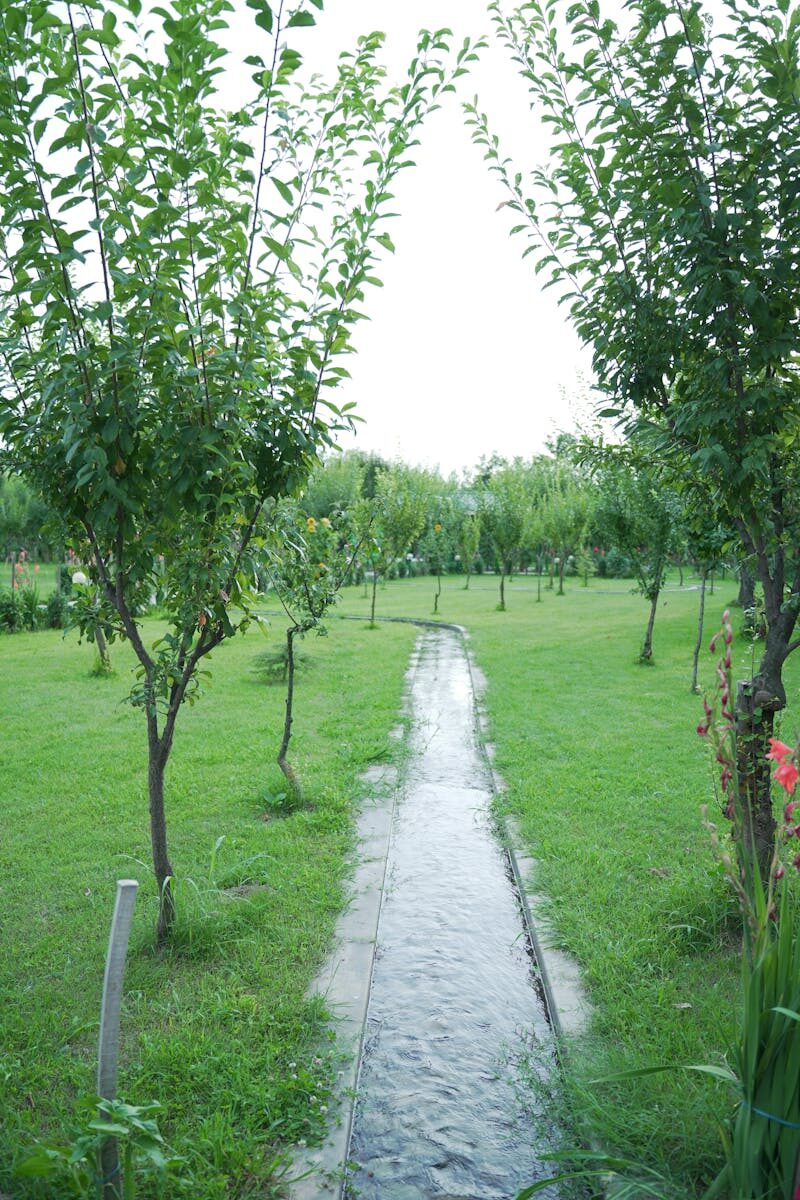
If your yard floods every time it rains, or you’re watching perfectly good rainwater run straight off your driveway and into the gutter, a garden swale might be exactly what your landscape is missing. And in 2026, swales aren’t just utilitarian drainage ditches — they’ve evolved into genuinely beautiful landscape features that solve serious water management problems while adding real value to your property.
I’ve spent years helping homeowners across the country turn soggy, erosion-prone yards into thriving, water-smart landscapes. Whether you’re in the rain-heavy Pacific Northwest, the storm-prone Gulf Coast, or the drought-and-deluge-cycle Southwest, there’s a swale design that fits your yard, your soil, and your budget. This guide covers everything you need to get started in 2026.
What Is a Garden Swale, and Why Do You Need One?
A swale is a shallow, gently sloped channel designed to slow, spread, and sink rainwater into the ground rather than letting it rush away. Think of it as a guided path for stormwater — one that gives water time to infiltrate the soil, recharge groundwater, and nourish your plants along the way.
The difference between a basic drainage ditch and a well-designed garden swale comes down to intention. A ditch moves water away. A swale uses water — directing it to planted areas, slowing its velocity to prevent erosion, and filtering pollutants before they reach local waterways.
In 2026, with many parts of the USA still navigating increasingly intense rainfall events due to shifting climate patterns, homeowners and municipalities alike are turning to swales as a first-line tool in sustainable landscape management. In fact, the U.S. Environmental Protection Agency has actively promoted bioswales and vegetated swales as part of its Green Infrastructure program, recognizing them as cost-effective alternatives to conventional stormwater infrastructure.
Beyond the environmental benefits, a well-planted swale can add genuine beauty to your yard. Done right, it looks like a natural garden feature — not a drainage problem waiting to happen.
Understanding Swale Basics Before You Dig
Before you grab a shovel, it helps to understand a few foundational concepts. Swales work by following the contour of the land — meaning they run across a slope rather than down it. This is the key principle that makes a swale different from a trench. By running on contour, a swale catches water moving downhill, holds it temporarily in the channel, and allows it to slowly soak in.
The three critical factors that determine swale performance are:
Slope: A swale should sit on nearly level ground (ideally 0–2% grade along its length) so water pools gently rather than racing through. If your yard has steeper grades, you may need a series of smaller swales connected by overflow points, or a check-dam system.
Soil permeability: Sandy or loamy soils absorb water quickly. Dense clay soils drain slowly, which means water will sit longer in your swale — not necessarily a problem, but something to design around (more on this later).
Overflow routing: Every swale needs a plan for excess water. During a major storm, your swale will fill up. Where does that water go? Routing overflow to a secondary swale, a dry creek bed, or a rain garden prevents flooding elsewhere on your property.
7 Garden Swale Design Ideas Worth Considering in 2026
1. The Classic Contour Swale with Native Plantings
This is the gold standard for backyard water management, and for good reason — it’s effective, low-maintenance, and beautiful when planted well.
To build one, you’ll mark the contour line across your slope using a level or an A-frame level tool, then dig a shallow channel about 12–18 inches deep and 2–3 feet wide. The excavated soil gets piled on the downhill side to form a berm, which catches overflow and creates a slightly raised planting bed.
The real magic happens when you plant it. Native plants are the ideal choice here because their deep, established root systems enhance infiltration and hold the berm together. In the Southeast, try native sedges, swamp milkweed, and Joe-Pye weed. In the Midwest, blue flag iris, wild bergamot, and prairie dropseed thrive in swale conditions. Along the West Coast, rush species, creeping red fescue, and California fuchsia are excellent options.
Native plantings also support local pollinators — something increasingly valued in residential landscaping in 2026 as awareness of pollinator habitat loss grows.
2. The Bioswale: Urban and Suburban Drainage Done Right
Bioswales are engineered versions of natural swales, typically used in more formal or urban settings where aesthetics and precise water management both matter. They’re commonly seen in commercial parking lots, along roadsides, and in front yard landscaping in newer residential neighborhoods.
The key difference between a bioswale and a standard swale is the engineered soil mix. Bioswales use a layered media — often a mix of sand, compost, and topsoil — that’s designed to maximize infiltration while filtering pollutants like motor oil, heavy metals, and fertilizer runoff. If your swale is near a driveway or parking area, a bioswale is the better choice.
For front yard applications, bioswales can be designed to look like formal planted borders or meadow-style gardens. Ornamental grasses like blue oat grass and feather reed grass give structure, while flowering perennials like black-eyed Susan, coneflower, and salvia add color.
Many cities now offer rebates or cost-share programs for front yard bioswale installation as part of their stormwater compliance programs — worth checking with your local municipality before you budget.
3. The Dry Creek Bed Swale
If the word “ditch” makes you uneasy, this is the design for you. A dry creek bed swale functions identically to a standard swale, but it’s surfaced with rounded river rock and designed to look like a natural stream channel — one that carries water during rain events and looks like a beautiful garden feature the rest of the time.
This design is especially popular in:
- Arizona, New Mexico, and Southern California, where dry wash aesthetics feel at home in the landscape
- Sloped suburban yards where a traditional planted swale might erode before vegetation establishes
- High-visibility areas like the side yard between two houses, where curb appeal matters
To build a dry creek bed swale, line the channel with a permeable landscape fabric (never impermeable plastic) and fill it with smooth river rock in varied sizes — smaller gravel on the edges, larger cobble in the center. Add boulders strategically to create natural-looking flow breaks. Drought-tolerant ornamental plantings on both edges complete the look.
4. The Rain Garden–Swale Combination
A rain garden and a swale are natural partners. The swale catches and conveys water across the landscape; the rain garden sits at the end of the swale and acts as the final collection and infiltration basin.
In practice, this looks like a shallow swale running from your downspout or driveway edge across the lawn, leading to a planted depression (the rain garden) at a lower point in the yard. The rain garden is typically 6–12 inches deep and planted with moisture-tolerant species that can handle both wet and dry conditions.
This combination is particularly effective for homeowners who want a complete system — from collection to dispersal — rather than just moving water from one spot to another. It’s also one of the most widely recommended designs by extension services in states with active stormwater regulations, including Maryland, Minnesota, and Washington.
5. The Orchard or Food Forest Swale
Popularized by the permaculture design movement, the orchard swale takes the contour swale concept and applies it specifically to food-producing landscapes. The berm created from swale excavation becomes the planting bed for fruit trees, berry bushes, or other edibles — positioned to receive the slow-release irrigation that the swale provides after every rainfall.
This design makes extraordinary sense in areas that receive irregular rainfall — plentiful in spring, dry in late summer — because the swale essentially banks rainwater in the soil near the root zone of fruit trees. Over time, the organic matter added to the berm and the consistent moisture create some of the most productive planting zones in the whole garden.
For home orchards in the Southeast, Midwest, and Southwest, this is one of the most rewarding swale designs to implement. It does require more initial planning and earthmoving, but the payoff in reduced irrigation needs and improved tree health is substantial.
6. The Swale-to-Pond System
If your property has enough space and a natural low point, routing a swale to an ornamental pond or small retention basin creates a complete water harvesting system that’s both functional and visually stunning.
The swale captures runoff, slows it, partially infiltrates it, and delivers the remainder to the pond. The pond stores water for irrigation, supports aquatic plants and wildlife, and acts as a visual focal point in the landscape. In dry climates like the high desert of Colorado, New Mexico, and Utah, a pond fed by a swale system can remain full most of the season with nothing more than natural rainfall.
This design requires the most planning of any on this list — especially around pond liner selection, overflow routing, and mosquito management — but when done well, it becomes the centerpiece of the entire property.
7. The Infiltration Trench Swale Hybrid
In areas with poor surface drainage but reasonably permeable subsoil (common in parts of the Mid-Atlantic and Midwest), an infiltration trench beneath the swale can dramatically improve performance. The trench — typically 2–3 feet deep, filled with gravel, and fitted with a perforated pipe — acts as an underground reservoir that extends the swale’s capacity.
This hybrid design is particularly useful in tight suburban lots where a wide, gently sloped swale isn’t practical. The infiltration trench does the heavy lifting underground, while the swale above it can be narrower and still planted attractively.
How to Build a Garden Swale: Step-by-Step
Building a swale is a manageable DIY project for most homeowners, though larger or more complex designs may warrant professional grading help. Here’s a practical overview of the process.
Step 1: Survey Your Yard’s Drainage Pattern
Walk your yard during or immediately after a heavy rain. Watch where water collects, which direction it flows, and where it exits the property. Take notes or photos. This real-world observation is more valuable than any diagram because it shows you what’s actually happening — not just what the topography suggests.
Identify your high points (where water originates), low points (where it pools), and the flow paths connecting them.
Step 2: Mark Your Contour Line
Use a line level, a water level, or a digital level app to find the true contour line across your slope — the line where every point is at the same elevation. This is where your swale will sit.
You can use stakes and string to mark the line, then adjust as needed to avoid trees, utility lines (always call 811 before you dig), or other obstacles. A slight S-curve is perfectly acceptable and often looks more natural.
Step 3: Calculate Your Swale Dimensions
The size of your swale should be proportional to the area draining into it. A rough rule of thumb: for every 1,000 square feet of contributing watershed, you need approximately 50–75 cubic feet of swale capacity (length × width × depth). If your slope is steep or your soil drains slowly, add capacity.
A typical residential swale runs 20–50 feet long, 2–4 feet wide, and 12–18 inches deep. The cross-section should be gently curved (a parabolic or U-shape) rather than sharply V-shaped, which concentrates erosive energy at the bottom.
Step 4: Dig the Channel and Build the Berm
Excavate the channel along your marked contour line, placing all excavated soil immediately downhill to form the berm. The berm should be compacted gently and crowned (slightly raised in the center) to resist settling.
Check that the bottom of your swale channel is level from end to end — this is critical. If the swale tilts, water will flow toward the lower end instead of pooling evenly and infiltrating.
Step 5: Create an Overflow Structure
Before you plant anything, design and build your overflow. This is the point where excess water exits the swale safely during large storm events. Options include:
- A level sill spillway — a shallow notch at one end, lined with rock, that allows water to flow gently onto a stable surface
- A gravel-lined channel leading to a secondary swale or rain garden
- A piped outlet through the berm into a dry creek bed or pond
Never leave a swale without a tested overflow path. A flooded berm that overtops unexpectedly can cause more erosion damage than having no swale at all.
Step 6: Stabilize and Plant
Immediately after construction, stabilize the bare soil on the berm and channel edges. Use jute netting or erosion control fabric on the berm face. Seed with a fast-germinating cover crop (annual rye works well) if you’re not planting permanent vegetation right away.
For permanent planting, space plugs or container plants 12–18 inches apart. Water them in well and keep them consistently moist for the first growing season. Once established — typically after the first full year — native plants in a swale require minimal supplemental irrigation.
Step 7: Test with a Hose, Then a Real Rain
Before you consider the project complete, test the system with a garden hose. Run water into the swale at a rate that simulates a moderate rain event. Watch how it fills, where it flows, and how it overflows. Fix any problem spots now, while the soil is still easy to reshape.
Common Mistakes to Avoid
Digging off-contour. Even a slight tilt in the wrong direction and your swale becomes a channel, not a catcher. Check with a level multiple times during excavation.
Skipping the overflow plan. This is the single most common reason swales fail or cause damage. Every swale must have a designed overflow path.
Planting too aggressively too soon. Large, thirsty plants on a fresh berm can destabilize it before the soil has settled and consolidated. Start with ground covers and grasses, then add larger shrubs and trees in year two.
Using non-native turf grass. Lawn grass does almost nothing to enhance infiltration and requires regular mowing in a location that’s often wet. Native plants, ornamental grasses, and perennials will always outperform turf in a swale.
Neglecting utility checks. Always call 811 — the national “Call Before You Dig” number — at least three days before digging anywhere in your yard. Buried utility lines are more common than most homeowners realize.
Swale Design Tips for Specific USA Regions
Pacific Northwest (Oregon, Washington): You have plenty of rainfall but heavy, compacted clay soils in many areas. Focus on wide, shallow swales with engineered soil amendments to improve infiltration. Red twig dogwood, rushes, and native sedges are excellent plant choices.
Southeast (Florida, Georgia, Carolinas): Intense summer thunderstorms mean your swales need generous capacity. Swale-to-pond combinations work beautifully here. Native plants like muhly grass, blue flag iris, and Walter’s viburnum thrive in wet-dry cycles.
Midwest (Minnesota, Iowa, Illinois): Cold winters mean you need swale plantings that can handle freeze-thaw cycles. Prairie natives — little bluestem, wild bergamot, rattlesnake master — are perfectly adapted. Check with your local extension service for county-specific plant lists.
Southwest (Arizona, New Mexico, Nevada): Monsoon season delivers intense, short rainfall events on sun-baked soil. Swales here need to handle high-velocity input and rapid dispersion. Dry creek bed designs with desert-adapted plants (desert willow, fairy duster, penstemon) are the most effective and visually appropriate.
Northeast (New York, Pennsylvania, New England): Regulations in many Northeastern states are increasingly requiring on-site stormwater management for any property over a certain disturbed area. Bioswales and rain garden–swale combinations align well with these requirements. Check with your state DEP or local planning department.
Swale Maintenance: What to Expect Year by Year
Year one is the most hands-on. Weed regularly to give your plantings a chance to establish. Re-stake or re-seed any areas where erosion occurs. Check the overflow structure after every significant rain.
Year two and beyond, a well-planted swale becomes nearly self-maintaining. The root systems of established plants stabilize the berm and enhance infiltration dramatically. Annual tasks include removing invasive species if they appear, dividing overcrowded perennials, and clearing any debris that accumulates at the overflow point.
Swales don’t need fertilizing — in fact, fertilizer applied in or near a swale can end up in local waterways, which defeats the whole purpose. Let the organic matter from decomposing plant material feed the system naturally.
What Does a Swale Cost to Build in 2026?
For a basic DIY contour swale in a residential backyard, you’re looking at materials costs of $200–$600 depending on the length, plant choices, and whether you need erosion control materials. This assumes you’re doing the digging yourself with a rented excavator or by hand.
If you hire a landscaping contractor with grading experience, expect to pay $1,500–$6,000 for a complete swale system depending on complexity, size, and region. Bioswales with engineered soil media cost more — often $4,000–$12,000 for a residential-scale installation.
Many states and municipalities offer stormwater rebate programs that can offset 25–50% of these costs. Learn more about sustainable landscaping grant programs available in your area — they’re more widely available in 2026 than ever before.
Final Thoughts: Your Yard Can Handle Its Own Water
A well-designed garden swale is one of the highest-impact improvements you can make to a residential property. It solves real problems — flooding, erosion, soggy lawn — while creating beauty, supporting wildlife, and reducing your dependence on municipal stormwater infrastructure.
The 2026 landscape is one where homeowners are increasingly expected (and in some places, required) to manage rainwater on-site. Getting ahead of that curve with a thoughtfully designed swale puts you in a strong position — financially, ecologically, and aesthetically.
Start small if you’re not sure. A single 20-foot swale at the base of a downspout can make an immediate, visible difference in how your yard handles rain. From there, the system can grow as your confidence and your budget allow.
The best time to build a swale was ten years ago. The second best time is this spring.