

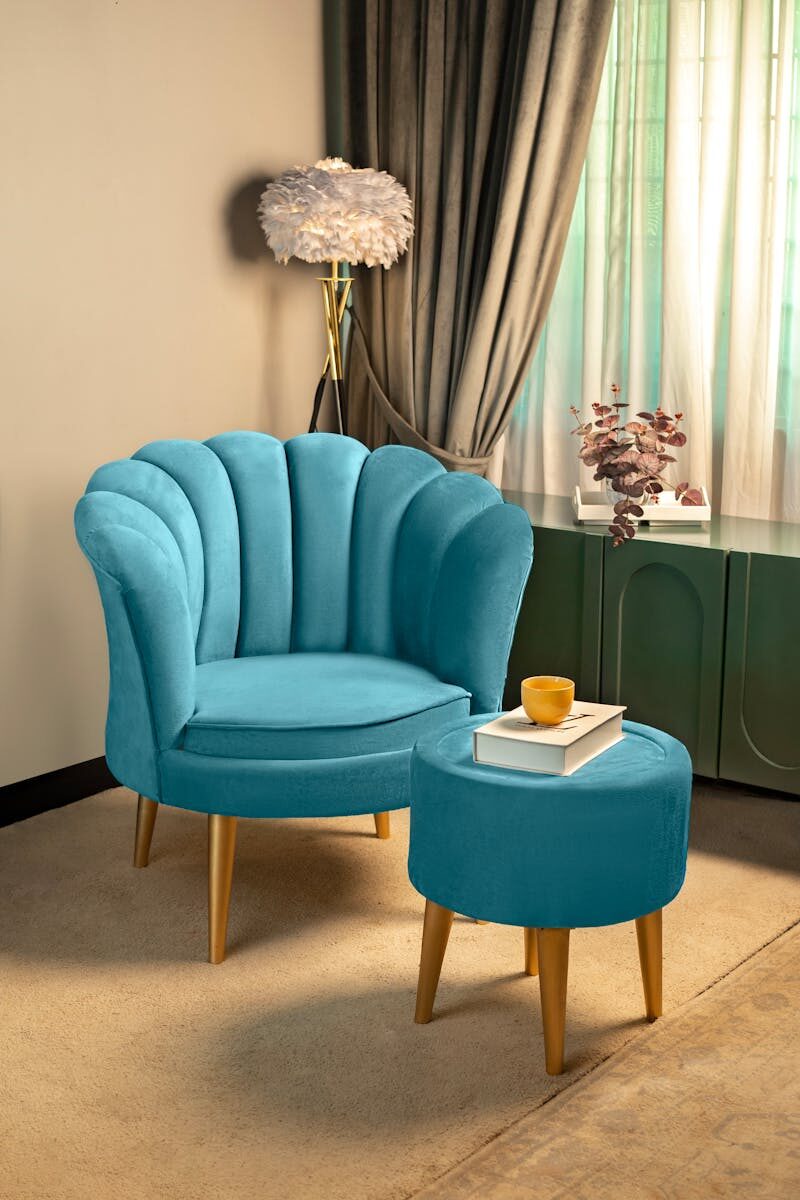
You know the feeling when you finally sit in a chair that actually fits you?
Not just a chair that holds your weight — but one that wraps around your back, supports your neck, and makes you want to stay put for the next two hours. That’s what a well-chosen wing chair with ottoman does. Every single day.
The wingback chair has survived three centuries of furniture trends for one simple reason: nothing else does what it does. It gives you a defined, private, deeply comfortable place to sit — and when you add a matching ottoman, you complete the picture entirely. Feet up, back supported, the world at a comfortable distance.
Whether you’re furnishing a reading corner, anchoring a living room, or finally replacing that sad accent chair that never quite worked — this guide covers everything. Styles, fabrics, price ranges, what to look for before you buy, where to shop in the US, and how to style a wing chair and ottoman set so it looks intentional rather than incidental.
A Brief History of the Wingback Chair
The wingback chair dates to 17th-century England, born in the Queen Anne and Georgian furniture traditions — design movements that were among the first to treat comfort and proportion as equally important as beauty.
The original design was purely practical. The high back and closed side panels — the wings — were there to protect the sitter from cold drafts during long evenings near an open fire. The wings trapped warm air around the body. The high back supported the full length of the spine. The deep seat allowed a natural, relaxed posture.
What those early English furniture makers didn’t know is that they were building one of the most ergonomically sensible seating designs in the history of domestic furniture. The shape has barely changed in three hundred years because it didn’t need to.
What has changed is the language around it. Today’s wingback chairs come in traditional, mid-century modern, contemporary, and oversized silhouettes — upholstered in everything from hand-tufted leather to performance boucle. The form is the same. The possibilities are wider than ever.
Why a Wing Chair with Ottoman Is Worth Every Dollar
Let’s talk about what this combination actually does for your body — because the comfort case goes deeper than “it looks cozy.”
The high back of the wingback chair supports the entire length of the spine. That matters especially for people who spend long hours at a desk and arrive at the end of the day with tension in the lower back and shoulders. The wings reduce peripheral distraction and create a mild sense of enclosure — which is why reading in a wingback chair feels qualitatively different from reading on a sofa.
Add the ottoman and the ergonomic picture completes. When your legs are elevated to roughly seat height, pressure on the lumbar spine drops significantly. Your hip flexors fully release. Your whole body decompresses rather than just the part that’s seated.
This isn’t furniture marketing language. It’s basic human posture mechanics — and the wingback chair with ottoman figured it out before the word ergonomics existed.
Beyond the physical benefits, there’s the psychological one. A wing chair creates a designated place that’s yours in the home. A spot with a purpose. That kind of defined personal space — especially in open-plan American homes where rooms can feel undefined — has real quality-of-life value.
Wingback Chair Styles: The Full Breakdown
The most common mistake buyers make is assuming wingback chairs only belong in traditional or formal spaces. That’s a dated idea.
Here are the major style categories you’ll find when shopping in 2026.
Traditional Wingback Chair
The classic form. Tall back, pronounced curved wings, rolled arms, cabriole or tapered legs in walnut or mahogany. Upholstered in velvet, leather, or rich woven fabric. Often finished with button tufting, nailhead trim, or both.
This is the chair that looks at home in a formal living room, a paneled home library, or a study with floor-to-ceiling bookshelves. It makes a statement without trying to. When it’s done well — solid hardwood frame, hand-tufted cushioning, brass nailhead detail — it’s one of the most satisfying pieces of furniture you can own.
Best for: traditional living rooms, home offices, formal sitting rooms, and anyone who appreciates classic American and English furniture design.
Mid-Century Modern Wingback
Same high-back silhouette, radically different execution. Mid-century wingback chairs strip away the ornamentation and replace it with clean geometry. Flat or slightly angled wings rather than curved. Tapered wooden legs in light oak or walnut. Solid-color upholstery in tweed, boucle, or performance fabric.
These chairs sit naturally alongside a mid-century credenza, a Hans Wegner-style side table, or a minimalist sofa. They bring warmth and structure without the formality of a traditional wingback.
Best for: mid-century interiors, Scandinavian-influenced rooms, eclectic spaces that mix eras, and buyers who want the wingback comfort without the traditional visual weight.
Contemporary and Transitional Wingback
The transitional wingback takes the recognizable silhouette and modernizes every detail. Proportions are softer. Legs shift from carved wood to brushed metal. Upholstery moves toward performance fabrics, linen blends, and textural weaves. The tufting, if present, is more subtle.
These chairs fit in modern open-plan homes without disrupting the visual flow of the space. They’re the choice for buyers who love the ergonomics and the look of a wingback but live in a contemporary home where a full traditional chair would feel like a costume.
Best for: contemporary homes, transitional interiors, open-plan living rooms, and buyers who want the wingback form with lower-maintenance materials.
Swivel and Reclining Wingback
A newer evolution — and a genuinely useful one. Swivel wingback chairs rotate 360 degrees, which makes them practical in family rooms and home offices where you want to move without lifting the chair. Reclining versions add an adjustable back and sometimes a built-in footrest, making the separate ottoman optional.
These tend to be slightly less elegant than static wingbacks, but what they lose in visual formality they more than make up for in daily usability.
Best for: home media rooms, primary bedrooms, home offices, and buyers who prioritize maximum physical comfort.
Oversized and Cuddle Wingback
The extra-wide wingback is having a genuine moment in 2026 interior design. An oversized seat with high curved wings feels less like a chair and more like being held. These work especially well as bedroom reading chairs, in nurseries, and in any space where the primary goal is maximum softness and comfort rather than visual formality.
Many in this category come upholstered in boucle, teddy fleece, or textured cotton — tactile fabrics that reinforce the cozy intent of the design.
Best for: bedrooms, reading nooks, nurseries, and anyone who wants a chair that feels like a hug.
Fabric and Upholstery: What to Choose for Your Life
The fabric on a wing chair is not just an aesthetic decision. It determines how the chair looks in five years and whether daily life with it is easy or annoying.
Here’s an honest breakdown.
Velvet
Rich, visually deep, and currently one of the most popular choices for statement wingback chairs. Velvet comes in the jewel tones that dominate 2026 interior design — forest green, navy, dusty rose, cognac, charcoal.
The trade-off is maintenance. Velvet shows compression marks from regular use and picks up pet hair aggressively. It’s not impossible to clean, but it requires more care than most other options.
Choose velvet if: The chair is going in a low-traffic spot — a bedroom, a study, a formal sitting room. Avoid it in family rooms with young children or pets.
Genuine Leather
Top-grain and full-grain leather are the long-game choices. They’re more expensive upfront — genuine leather wingback sets typically start around $900 and scale well past $3,000 for heirloom-quality pieces. But leather improves with age, developing a patina and softness that cheaper materials can’t replicate.
It’s also the most practical upholstery for heavy daily use. Spills wipe off. Surface dirt doesn’t embed. A good leather chair with proper conditioning can look better at fifteen years than it did at one.
Choose genuine leather if: You want a chair you’ll own for decades, you use it daily, or the room has a traditional or mid-century aesthetic that suits leather naturally.
Faux Leather and PU Leather
Modern faux leather has closed the quality gap significantly. Today’s better PU leather options are soft to the touch, easy to clean, and durable enough for daily family use. They’re the right call for buyers who want the leather look without the leather price.
The key is to buy from a reputable retailer at a mid-range price point — cheap PU leather peels within a year or two of regular use. Spend at least $400 to $600 on a set and you’ll find materials that perform well.
Choose faux leather if: Budget is a constraint but the leather aesthetic is important to you, or the room gets heavy use and you don’t want to think too carefully about cleaning.
Performance Fabric
Performance fabrics — Crypton, Sunbrella, and similar engineered textiles — are the practical choice for American family homes. They look and feel like conventional upholstery, but clean up with soap and water and resist stains, moisture, and odor at the fiber level.
These are not a compromise. Some of the most beautiful wing chairs available today come in performance fabric. They just also happen to handle a spilled glass of wine without drama.
Choose performance fabric if: You have kids or pets, the chair is going in a high-use living room, or you simply want to stop thinking about what happens when someone sits down with a snack.
Boucle and Textured Weaves
Boucle — the loopy, tactile knit fabric associated with mid-century and organic modern design — gives a wingback chair an artisanal quality that few other materials match. Paired with natural wood legs, it creates a chair that reads as carefully chosen rather than ordered online and forgotten.
Boucle is not as practical as performance fabric and not as formal as velvet or leather. It lives in the sweet spot between the two — better looking than utility fabrics, more forgiving than velvet.
Choose boucle if: The room has a mid-century, Scandinavian, or organic modern aesthetic and the chair won’t see daily heavy use.
Price Guide: What to Budget in 2026
Wing chair and ottoman sets cover an enormous price range in the US market. Here’s an honest look at what different budgets actually get you.
Under $350 — Entry Level Engineered wood frames, lower-density foam, polyester fabric or basic PU leather. These sets work for guest rooms, occasional use, and starter apartments. At this price point, don’t expect the chair to maintain its shape after five years of daily use. Some sets in the $150 to $200 range offer genuine value for light use — solid customer reviews exist at this tier — but manage expectations accordingly.
$350 to $800 — Mid-Range This is where most everyday buyers find the best balance of quality and value. Wayfair, AllModern, and similar retailers offer sets in this range with solid construction, better foam density, and real fabric or faux leather options. These chairs are built for daily use and should hold up comfortably for five to eight years with basic care.
$800 to $2,000 — Upper-Mid Genuine leather, performance fabrics, and hardwood frames become standard at this tier. Brands like Ethan Allen, Crate & Barrel, and Pottery Barn operate here. Construction quality is meaningfully better — kiln-dried hardwood frames, sinuous spring suspension, higher-density cushioning. Chairs at this level, well-maintained, can last fifteen to twenty years.
$2,000 and above — Heirloom Quality Hand-crafted construction, artisan tufting, top-grain or full-grain leather, solid hardwood frames with corner-blocked joinery. These are pieces you buy once and keep for decades. Brands like Stickley and Restoration Hardware, along with custom upholsterers, occupy this space. At this level, the ottoman is usually an equally serious piece — not an afterthought.
Vintage and Antique Georgian tufted wingback sets, Børge Mogensen leather chairs with ottomans, and mid-century designer pieces are available through platforms like 1stDibs, Chairish, and eBay. Prices range from a few hundred dollars for unlabeled pieces needing reupholstery to $9,500 or more for verified designer sets in excellent condition.
Where to Buy a Wing Chair with Ottoman in the USA
Wayfair is the most comprehensive online source across all price points. The filtering options — upholstery type, dimensions, color, price — make it easy to narrow a large inventory quickly. Free shipping is standard and returns are manageable.
AllModern is Wayfair’s mid-century and contemporary arm. Better curation, slightly higher floor on quality. Worth checking if your interior leans modern.
Ethan Allen is the right choice for traditional American wingback styles. In-store design consultants can help match chairs to existing rooms — a genuinely useful service when you’re spending $1,500 or more on a piece.
Pottery Barn and Crate & Barrel offer reliable transitional styles in the $900 to $1,800 range. Quality control is consistent and the return policies are customer-friendly.
Perigold is Wayfair’s luxury tier — curated high-end furniture that doesn’t appear on the main Wayfair site. Worth exploring if you’re shopping at the $1,500-and-above level.
Home Depot carries a surprisingly wide wingback selection in the budget to mid-range category — and has the advantage of in-store availability in many locations, so you can actually sit in the chair before buying.
1stDibs and Chairish are the best platforms for vintage and antique sets. Condition and provenance are better verified here than on general marketplaces.
Local furniture stores and estate sales remain underrated options. Sitting in a wingback chair before purchasing tells you more than any product description — seat depth, cushion firmness, back angle, and overall scale in a room are things that don’t translate well to photographs.
6 Things to Check Before You Buy
1. Seat Depth
The single most important and most overlooked measurement. A seat that’s too deep forces you to sit on the edge to keep your feet on the floor. Too shallow and your thighs hang uncomfortably. For most adults, 21 to 24 inches is the comfortable range. Measure your existing chairs before ordering anything online.
2. Frame Construction
Kiln-dried hardwood frames — oak, ash, maple, or cherry — are the gold standard for longevity. Engineered wood is acceptable at lower price points but won’t survive fifteen years of daily use. Look for corner-blocked and doweled joints rather than staple-and-glue construction.
3. Cushion Density
High-density foam at 1.8 lbs per cubic foot or higher holds its shape over years of use. Lower-density foam compresses and develops permanent dents within months. The best mid-range and above chairs layer high-density foam with Dacron or down wrapping for a softer feel that doesn’t sacrifice long-term support.
4. Wing Shape and Back Height
Curved wings feel more enveloping and traditional. Flatter, angled wings read more contemporary. Back height affects both comfort and visual scale — a chair with a back over 45 inches makes a stronger design statement and provides better head and neck support.
5. Ottoman Proportions
The ottoman should sit at roughly the same height as the chair seat — typically 17 to 19 inches off the floor. Too low and it doesn’t properly support your legs. Too high and it tilts your hips forward uncomfortably. When buying a set, this is taken care of. When buying pieces separately, measure carefully.
6. Fabric vs. Your Actual Life
Be honest about your household. Velvet in a home with a golden retriever and two kids is a maintenance decision you’ll regret. Performance fabric in a quiet formal sitting room that sees two visitors a month is unnecessary. Match the upholstery to the realistic daily conditions of the room, not the aspirational version of your home.
How to Style a Wing Chair and Ottoman Set
A wing chair placed well looks like it belongs. Placed badly, it looks like a leftover from a different room. Here’s how to get it right.
The reading corner: Angle the chair 15 to 20 degrees toward natural light. Add a side table at armrest height for a drink and a lamp positioned just over your shoulder. A small footstool or the matching ottoman in front completes it. This is the most satisfying corner in any home — a dedicated spot that has a purpose and communicates it clearly.
Flanking a fireplace: Two matching wingback chairs with ottomans on either side of a fireplace is the most traditional configuration — symmetrical, formal, and genuinely inviting. It makes a living room feel furnished and complete in a way that two sofas alone rarely achieves.
As a bedroom anchor: A wing chair and ottoman at the foot of the bed or tucked into a corner creates a secondary zone in the room. A place to sit in the morning, read at night, or simply be without being in bed. This transforms a bedroom from a sleeping room into a full living space.
Mixed with modern furniture: Don’t over-coordinate. A traditional leather wingback alongside a contemporary sofa creates more visual interest than a fully matched suite. The mix of old and new, formal and relaxed, adds depth and a collected quality that staged showroom furniture can never replicate.
As a color anchor: A bold wingback — deep green velvet, cognac leather, rich navy boucle — can function as the accent piece that defines a neutral room’s entire color direction. The ottoman in a complementary texture reinforces the palette without competing with it.
For more ideas on creating a cohesive living room around a statement accent chair, check out our complete living room accent chair styling guide for room-by-room inspiration organized by interior style.
Caring for Your Wing Chair with Ottoman
A well-made wingback should last fifteen to twenty-five years with basic maintenance. Here’s what that looks like in practice.
Fabric chairs: Vacuum regularly with an upholstery attachment. Blot spills immediately — don’t rub, which pushes liquid deeper into the fibers. Most performance fabrics clean with mild soap and warm water. Velvet and delicate upholstery benefit from professional cleaning every two to three years.
Leather chairs: Wipe down monthly with a soft damp cloth. Apply a quality leather conditioner every six to twelve months. Keep leather away from direct sunlight and heat vents — both accelerate drying and cracking more than anything else.
Frame and joints: Check for loose screws or wobbly joints periodically, especially in the first year when wood naturally settles. Tighten hardware as needed. Loose joints left unaddressed become structural problems.
Ottoman: The ottoman takes more physical abuse than the chair — feet, children, and impromptu extra seating all accumulate wear faster than a properly-used chair. Inspect the legs and base regularly.
Cushions: Rotate and fluff regularly to maintain even compression across the seat. For removable covers, follow manufacturer washing instructions carefully — most structured chair cushions cannot be machine washed without distortion.
Quick Reference: Best Wing Chair with Ottoman by Buyer Type
The serious reader: Traditional or mid-century silhouette, tall back, seat depth 22 to 24 inches, high-density foam cushioning. Leather or performance fabric. Prioritize back support and cushion quality over visual drama.
The style-focused buyer: Velvet or boucle in a bold color, contemporary or transitional wingback form, metal legs. Accept that the upholstery requires more care. Worth it for the visual impact.
The family living room: Performance fabric or genuine leather, hardwood frame, mid-range price tier. Skip velvet and light linen. Choose a color that works with the room — not just the chair in isolation.
The home office: Leather or faux leather swivel wingback. Prioritize back support and mobility. An ottoman at correct seat height makes extended sitting far more comfortable.
The bedroom reader: Oversized or standard wingback in a soft tactile fabric — boucle, teddy, or quality cotton blend. Softer cushioning, quieter color palette.
The budget-conscious buyer: Wayfair and AllModern mid-range sets in the $350 to $700 range offer genuine daily comfort and reasonable longevity. Don’t buy below $200 for a chair you’ll sit in every day — the cushion and frame quality simply aren’t there.
Final Thoughts
A wing chair with ottoman is one of the few furniture purchases that people rarely regret once they’ve made the right choice.
It improves your daily life in a quiet, consistent way. It gives your home a place with a clear purpose. And when it’s chosen well — right style, right fabric, right proportions for the room — it becomes one of those pieces you stop noticing because it simply belongs.
Buy it once. Buy it right. You’ll still be sitting in the same chair in twenty years.
And it’ll probably be even better by then.