

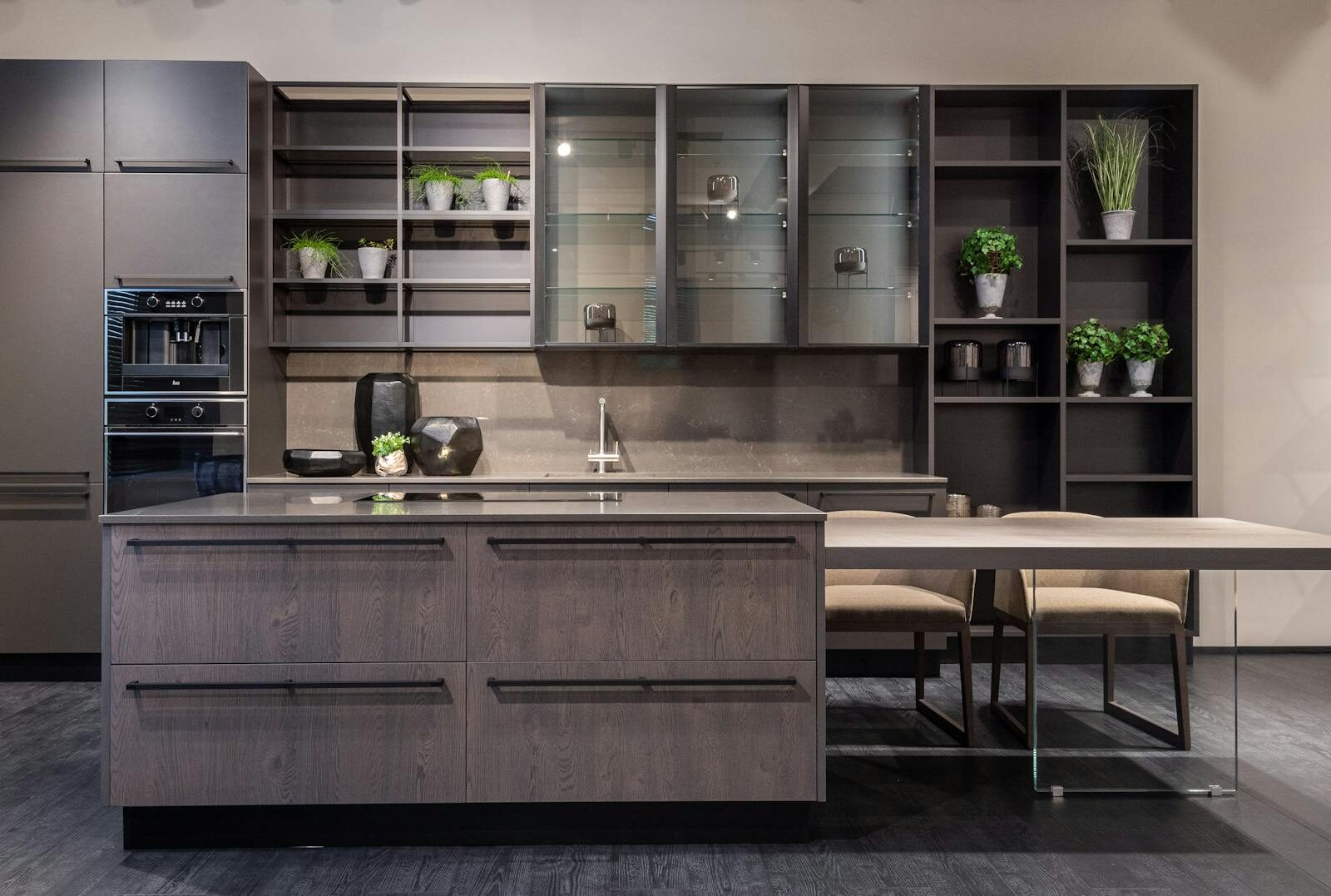
There’s a moment in almost every kitchen renovation when a homeowner looks at a rendering and says, “Something’s missing — it feels flat.” More often than not, what’s missing is contrast. Not necessarily color contrast, but material contrast — the interplay between solid surfaces and something that catches the light differently. Smoked glass cabinet doors are one of the most effective ways to introduce that quality into a modern kitchen, and in 2026, they’ve moved well beyond a niche design detail into mainstream premium kitchen design across the United States.
This isn’t a trend driven purely by aesthetics, though the look is undeniably compelling. Smoked glass cabinet doors solve a genuine design problem: they add visual depth and a sense of layering without the visual chaos of fully open shelving, and they offer a level of sophistication that standard wood or painted cabinet doors simply can’t replicate. Whether you’re renovating a kitchen in a Pacific Heights townhouse in San Francisco, a mid-century modern home in Scottsdale, or a new construction in the suburbs of Atlanta, this design element can transform how your kitchen reads — both in photographs and in daily life.
Here’s everything you need to know before making the decision.
What Are Smoked Glass Cabinet Doors, Exactly?
Before getting into design applications and costs, it’s worth being precise about what “smoked glass” actually means, because the term gets used loosely — sometimes interchangeably with frosted glass, tinted glass, or reeded glass — and they’re not the same thing.
Smoked glass refers to glass that has been tinted during the manufacturing process, giving it a dark, translucent appearance. The most common tints are gray-smoke, bronze-smoke, and charcoal. The glass is semi-transparent — you can see through it, but what’s behind it is softened, shadowed, and partially obscured. The degree of transparency varies by tint density, which is typically expressed as a percentage of light transmission.
This is different from:
- Frosted glass, which is opaque and diffuses light without revealing anything behind it
- Clear glass, which is fully transparent — no concealment at all
- Reeded or fluted glass, which has a textured surface that distorts and diffuses the view
- Seeded or antique glass, which has decorative bubbles or imperfections for a vintage aesthetic
Smoked glass occupies a specific middle ground: it reveals just enough to suggest what’s behind it while maintaining a level of visual discretion. This is what makes it so well-suited to kitchen cabinetry — your dishes and glassware become a soft, hazy backdrop rather than a fully exposed display.
Why Smoked Glass Cabinet Doors Work So Well in Modern Kitchens
The design logic behind smoked glass cabinet doors is rooted in something designers talk about a lot but homeowners rarely hear articulated: the idea of controlled visual weight.
A kitchen full of solid cabinet doors reads as a single, unbroken mass. That’s not inherently bad — it can feel very clean and cohesive — but it can also feel heavy or monotonous, especially in larger kitchens or open-concept spaces where the cabinetry is visible from multiple angles and distances.
Open shelving solves the visual weight problem but introduces a different one: it requires constant curation, exposes everything to grease and dust, and creates visual noise if the shelving isn’t immaculately organized — which, for most American households, is most of the time.
Smoked glass is the elegant middle path. It breaks up the solid plane of a cabinet run, introduces a material that responds differently to light at different times of day, and allows a hint of the contents within — enough to feel personal and layered, not so much that disorder becomes visible.
There’s also a practical argument: smoked glass cabinet doors function as a visual cue for guests navigating an unfamiliar kitchen. Without fully exposing contents, they suggest where glasses, dishes, or pantry items live, reducing the awkward “where do you keep the mugs?” moment that comes with fully opaque cabinetry.
Types of Smoked Glass Used in Cabinet Doors
Not all smoked glass is created equal, and the type you choose will significantly affect both the look and the cost of your project.
Gray-Smoked Float Glass
This is the most common and most versatile option. Gray-smoked glass has a cool, neutral tone that pairs naturally with white, greige, charcoal, and navy cabinet finishes. It’s widely available, relatively affordable, and looks equally at home in a contemporary flat-panel kitchen and a transitional shaker-style design.
Bronze-Smoked Glass
Bronze tinting adds warmth that gray-smoke can’t achieve. In kitchens with warm wood tones, brass hardware, or cream-colored paint finishes, bronze-smoked glass feels much more intentional and cohesive than gray. It’s a detail that reads as deliberate rather than default.
Charcoal or Dark-Smoked Glass
At its darkest, smoked glass becomes nearly opaque — the contents behind it are barely discernible, creating a dramatic, lacquer-like surface quality that catches light beautifully. This is the choice for kitchens where the goal is maximum impact. It pairs particularly well with high-gloss white cabinetry or natural wood, where the dark glass creates a strong material contrast.
Smoked Low-Iron Glass
Standard float glass has a slight green tinge that becomes visible at the edges. Low-iron glass eliminates this green cast, producing a cleaner, more neutral appearance. For premium projects where the edge quality of the glass is visible — in thicker doors or frameless applications — low-iron smoked glass is worth the additional cost.
Smoked Tempered Glass
In any application where safety is a consideration — lower cabinet doors, doors that might be impacted by children or activity — tempered smoked glass is the appropriate choice. When broken, tempered glass shatters into small, blunt fragments rather than sharp shards. Many building codes in the US require tempered glass in certain locations within kitchens; verify local code requirements with your contractor.
Frame Options: How the Door Is Built Around the Glass
The glass itself is only part of the story. The door frame — the structure that holds the glass — has as much design impact as the glass material.
Full-Frame (Inset Glass Panel)
The traditional approach: a wood or MDF frame with a routed channel that holds the glass panel. This is the dominant construction method for shaker-style doors with glass inserts. The frame can be painted to match the cabinet body, stained to show natural wood grain, or finished in a contrasting tone for a two-tone effect.
Frameless (All-Glass Door)
In this configuration, the glass panel is the door — no wood frame, just glass with polished or beveled edges and a simple pivot or hinge mechanism. This approach delivers maximum impact and a very contemporary feel, but it’s more expensive to fabricate and requires precise hardware. It’s particularly effective for upper cabinets in kitchens with a strong European or minimalist aesthetic.
Metal-Frame Doors
Steel, brass, or matte black aluminum frames combined with smoked glass have become one of the signature details of 2025 and 2026 kitchen design. The metal frame adds an industrial or architectural quality that pure wood frames can’t replicate, and the contrast between a warm or dark metal finish and smoked glass is visually striking in a way that photographs exceptionally well. This combination is especially popular in kitchens across Brooklyn, Austin, Denver, and other cities where industrial-influenced design has a strong presence.
Mullion Doors
Mullions are the interior dividers within a glass door — the thin bars that divide the glass panel into a grid of smaller panes. Traditional mullion configurations (six-pane, eight-pane) create a more classical or transitional look. Modern mullion designs use a single horizontal or vertical bar, creating a minimal grid that’s contemporary without being stark. Smoked glass with a simple single-bar mullion is one of the most versatile design combinations available.
Design Applications: Where and How to Use Smoked Glass Cabinets Effectively
Knowing that smoked glass looks good is one thing. Knowing where to deploy it in a kitchen design to get the maximum effect is another.
Upper Cabinets Only
The most common and most conservative application: smoked glass on upper cabinet doors, solid panels on all lower cabinets. This creates a natural visual hierarchy — the upper zone feels lighter and more open, the lower zone feels grounded and solid. It’s an approach that works in virtually any kitchen style and at almost any budget level.
Island Cabinetry
Using smoked glass on the island — particularly on the side panels or on floating upper shelving above an island — creates a beautiful focal point. Because islands are often viewed from multiple angles, the light-catching quality of smoked glass works especially well here.
Display Cabinets and Bar Areas
Dedicated display cabinets — for barware, china, or collectibles — are natural applications for smoked glass. The partial concealment adds a layer of sophistication that clear glass can’t match, and the contents are protected from grease and dust while remaining visible enough to enjoy.
Pantry Cabinet Doors
A smoked glass insert on a full-height pantry cabinet is one of the most underrated applications. It gives the pantry cabinet a furniture-like quality that breaks up what would otherwise be a large, blank panel. Done well, a smoked glass pantry door reads like a piece of architectural millwork rather than a storage unit.
Butler’s Pantry or Transitional Zones
For homes with a butler’s pantry or a pass-through between kitchen and dining, smoked glass on the cabinetry in those transitional zones creates a beautiful sense of layering — especially when lit from within.
Smoked Glass Cabinet Doors and Interior Lighting: The Combination That Changes Everything
This is the detail that most homeowners miss until they see it in person: interior cabinet lighting behind smoked glass creates an effect that’s nothing short of spectacular. During the day, the glass catches ambient light and softly reveals the contents behind it. In the evening, with a small LED strip inside the cabinet, the smoked glass glows — the contents become a diffused silhouette, the glass takes on depth and warmth, and the kitchen becomes dramatically more atmospheric.
This isn’t a complicated or expensive addition. LED strip lighting inside glass-front cabinets costs a few hundred dollars to install and uses minimal energy. The visual return is disproportionate to the investment, particularly in kitchens that are used as entertaining spaces.
If you’re planning smoked glass cabinet doors, build interior lighting into the design from the start — retrofit installations are possible but more disruptive than planning for it upfront.
Cost Breakdown: What to Budget for Smoked Glass Cabinet Doors in the US
Costs vary significantly depending on the type of glass, the door construction, the number of doors, and regional labor rates. Here’s a realistic framework for US homeowners planning in 2026.
Glass cost alone (fabricated to size, per panel):
- Standard gray-smoked float glass: $40–$90 per panel
- Bronze or charcoal smoked glass: $55–$110 per panel
- Low-iron smoked glass: $80–$150 per panel
- Tempered smoked glass (any tint): add 25–40% to base cost
Door fabrication (frame + glass, per door):
- Painted wood-frame shaker door with smoked glass insert: $180–$380 per door
- Metal-frame door with smoked glass: $300–$650 per door
- Frameless all-glass door: $400–$900 per door
Retrofit vs. new installation: Replacing existing solid cabinet doors with new smoked glass doors on an existing cabinet box is one of the most cost-effective kitchen upgrades available. A full upper-cabinet door replacement on a mid-size kitchen — say, 10 to 14 door fronts — can often be completed for $2,500–$7,000 in materials and labor, depending on the door style and glass type selected.
Regional labor variation: Installation labor in high-cost markets (San Francisco Bay Area, New York Metro, Seattle) runs 30–50% higher than in markets like the Midwest or Southeast. Factor this into your total project budget accordingly.
What to Store Behind Smoked Glass: A Practical Guide
Part of making smoked glass cabinet doors work in real life — not just in design renderings — is being intentional about what you store behind them.
The soft obscuring quality of smoked glass is forgiving, but it’s not invisible. Here’s what works well and what doesn’t.
Works beautifully:
- Matching sets of glassware or stemware
- White or neutral dish sets
- Barware collections
- Cookbooks with attractive spines
- Ceramics with consistent colors or styles
Avoid or reorganize:
- Mismatched containers, lids, and random items
- Brightly colored or visually chaotic items
- Plastic items that read as cluttered even through obscured glass
- Half-used pantry items without consistent packaging
The transition to smoked glass cabinet doors is often a prompt for homeowners to invest in matching storage containers, decant dry goods into glass jars, or simply edit what lives in the most visible cabinets. That’s not a flaw — it’s one of the underrated benefits of this design choice.
Maintenance and Cleaning: What You Actually Need to Know
One of the most common questions about glass cabinet doors is how difficult they are to maintain. The honest answer is: less difficult than you’d expect, but they do require a different approach than painted wood doors.
Daily use: Smoked glass shows fingerprints less than clear glass because the tint absorbs some of the optical contrast that makes fingerprints visible. This is a genuine practical advantage, particularly in households with children.
Cleaning: A microfiber cloth with a small amount of glass cleaner is all you need. Avoid abrasive cleaners that can scratch the glass surface, and avoid ammonia-based cleaners on any glass near painted wood frames, as ammonia can damage paint finishes over time.
Frame maintenance: Painted wood frames around smoked glass panels should be wiped down with a damp cloth — avoid soaking the wood, particularly around the glass channel, where water can cause the wood to swell or the finish to peel.
Sealing: Smoked glass itself doesn’t require sealing or special treatment. The tint is integral to the glass, not a surface coating.
2026 Design Trends: How Smoked Glass Fits the Current Aesthetic Moment
In 2026, the dominant direction in American kitchen design has shifted meaningfully toward what designers are calling “quiet luxury” — a preference for materials and finishes that signal quality without shouting for attention. Smoked glass is a textbook example of this aesthetic sensibility.
The all-white kitchen that defined a decade of American home design has been replaced by kitchens that use warm neutrals, natural materials, and deliberate material mixing. In this context, smoked glass reads as sophisticated without being trendy — it has a timelessness that many of the more fashionable surface treatments don’t.
Specific combinations that are defining the 2026 moment across US kitchen design:
- Smoked glass with warm white or cream painted frames and unlacquered brass hardware — warm, layered, organic
- Charcoal smoked glass with matte black metal frames in a high-gloss white kitchen — dramatic, architectural, high contrast
- Bronze smoked glass with rift-cut white oak framing and integrated handles — the natural materials approach that’s been building since 2023
- Gray smoked glass with sage green or deep navy cabinetry — the color-forward direction that’s particularly strong in coastal US markets
For a broader look at how these material and finish trends fit into the overall landscape of premium kitchen design this year, the National Kitchen & Bath Association (NKBA) publishes detailed design trend research that’s an excellent resource for homeowners and design professionals alike.
And if you’re weighing smoked glass alongside other premium cabinet door options for your renovation, our guide on premium modern kitchen cabinets and design solutions covers the full range of materials and styles worth considering.
Common Mistakes to Avoid When Specifying Smoked Glass Cabinet Doors
Even a genuinely great design choice can go wrong if the details aren’t handled carefully. These are the most frequent mistakes homeowners and even some contractors make when specifying smoked glass.
Choosing the wrong tint density for the space. Very dark smoked glass in a kitchen with limited natural light reads as heavy and oppressive. In darker kitchens, opt for a lighter smoke tint and supplement with interior cabinet lighting.
Ignoring the edge quality. The polished or beveled edge of the glass is visible in frameless applications and at close range in framed doors. Standard sawn edges look unfinished; polished edges look intentional. Specify polished edges on all visible glass surfaces.
Mismatching frame and cabinet finish. If your cabinet frames are painted, the door frames should match precisely — not approximately. Glass draws the eye, and any mismatch in sheen level or color will be immediately visible.
Skipping tempered glass where required. This is both a safety and a code issue. Know your local building code requirements and err on the side of tempering in any door below counter height or in any high-traffic area.
Not planning for what goes behind the glass. Ordering smoked glass cabinet doors without thinking through the contents is a setup for disappointment. Do the edit before the installation, not after.
Actionable Steps to Add Smoked Glass Cabinet Doors to Your Kitchen
If you’re ready to move forward, here’s a practical sequence to keep the project on track.
- Identify which cabinets will get glass doors. Start by marking them on your floor plan. Upper cabinets only? Island? Pantry? The answer shapes everything else about the specification.
- Select your glass type and tint. Order glass samples if possible — seeing the actual material in your kitchen’s light conditions is far more reliable than judging from a catalog photo.
- Decide on the frame construction. Wood frame, metal frame, or frameless. This decision should align with your overall kitchen aesthetic and hardware choices.
- Plan for interior lighting. If you want it — and you likely will after seeing it — plan the electrical rough-in before any millwork is finalized.
- Get at least three quotes. For both the glass fabrication and the door installation. Quality and pricing vary significantly between suppliers.
- Confirm lead times. Custom glass and specialty door fabrication can take 4–10 weeks. Build this into your renovation schedule.
- Edit your cabinet contents before installation day. Use the transition as an opportunity to organize, pare down, and invest in a few matching storage pieces that will look intentional behind the glass.
Final Thoughts
Smoked glass cabinet doors are one of those design decisions that tend to be polarizing in the planning stage and universally loved once they’re installed. They require more thought upfront — the right glass type, the right frame, the right contents, the right lighting — but when those decisions are made well, the result is a kitchen that has a quality and depth that’s genuinely difficult to achieve with any other single material choice.
In 2026, as American kitchen design continues to move toward warmth, materiality, and quiet sophistication, smoked glass sits at the intersection of those values perfectly. It’s not a trend chasing the moment — it’s a material that has been used in high-end residential design for decades and has finally become accessible at the premium residential level.
If your kitchen feels like it’s missing something — presence, personality, depth — smoked glass cabinet doors might be exactly what it needs.