

Searching for houses for rent in Greensboro? You’ve probably seen a page advertising “436 homes” or some similar number. Here’s the first thing to know: that count is a snapshot, not a fixed inventory. Rental sites refresh daily. The real number of available houses in Greensboro usually falls somewhere between 300 and 550, depending on the season. Spring and early summer bring the most listings, since leases turn over then. Late fall and winter bring fewer.
The exact count matters less than understanding your real choices. You need to know what things cost by neighborhood and where renters commonly run into trouble. That’s what this guide covers.
What Renting a House in Greensboro Actually Costs
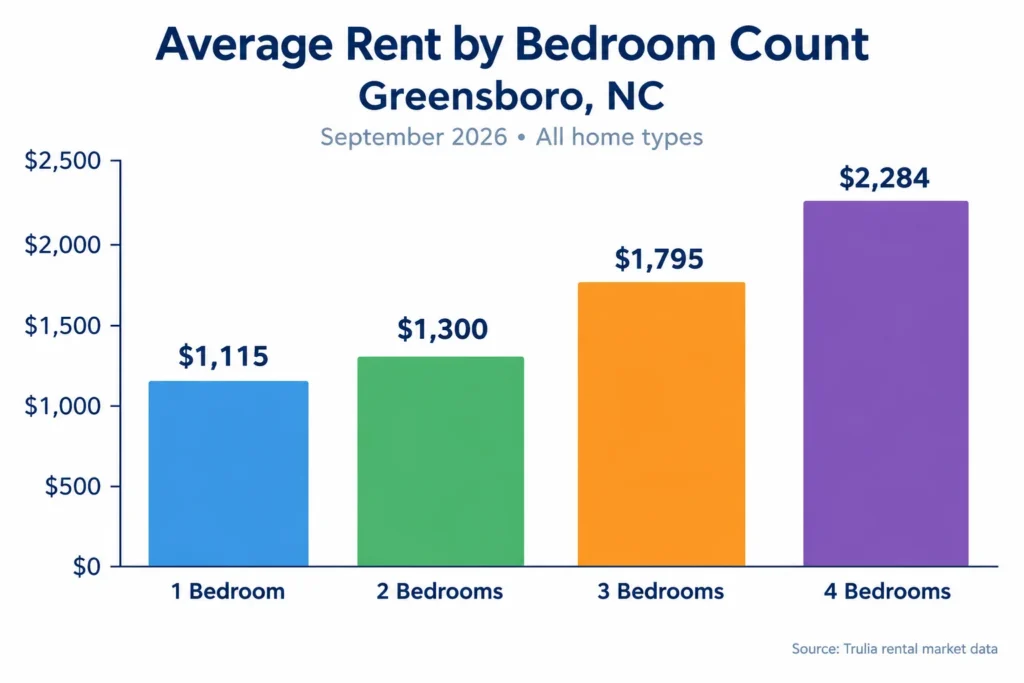
Rent data for Greensboro varies more than you’d expect. Different sites pull from different slices of the market. Some track only large apartment communities. Others aggregate single-family listings from property managers and individual landlords. Based on several current market trackers, here’s a realistic picture for mid-to-late 2026:
- Studio/1-bedroom apartments: roughly $900–$1,200/month
- 2-bedroom apartments: roughly $1,250–$1,450/month
- 3-bedroom houses: roughly $1,600–$1,950/month
- 4-bedroom houses: roughly $2,000–$2,500/month
Single-family houses consistently cost more than apartments with the same bedroom count. Part of that comes from the yard, garage, and extra square footage. Part of it comes from tighter house inventory compared to apartments. If you spot a 3-bedroom house listed well below $1,500 in a desirable zip code, take a second look before you get excited. It might be an older property with deferred maintenance. Or the low price might hide utility costs billed separately elsewhere in the lease.
Here’s something most listing pages skip: Greensboro’s median gross rent from Census data runs noticeably lower than what you’ll see on active listing sites. That gap exists for a simple reason. Census figures cover every renter-occupied unit in the city, including long-term tenants who’ve stayed below market rate for years. Listing sites only show what’s on the market right now. In practice, the “average rent” you see quoted online reflects what a new renter should expect to pay. It doesn’t reflect what every renter in Greensboro currently pays.
Greensboro’s Rental Neighborhoods, Compared
Greensboro doesn’t have one “good side of town.” It has distinct pockets with different price points, housing stock, and commute patterns. Here’s how the main rental areas break down.
| Neighborhood | Typical Feel | Rent Range (relative) | Best For |
|---|---|---|---|
| Sunset Hills / Irving Park | Historic, tree-lined, larger older homes | Highest in the city | Buyers of character homes, walkability to Friendly Center |
| Westerwood / Fisher Park | Historic bungalows, close to downtown | Mid-to-high | Young professionals, downtown commuters |
| Lindley Park / Friendship | Established, mixed housing ages | Mid | Families wanting UNCG-adjacent living |
| New Irving Park | Newer construction, suburban | Mid-to-high | Families wanting newer builds with yards |
| Sedgefield / Adams Farm (southwest) | Newer subdivisions, planned communities | Mid | Families near good schools, more space for the money |
| Pomona / Hewitt Area | Working-class, older housing stock | Lower-to-mid | Budget-conscious renters, easy I-40 access |
| Downtown Greensboro | Mixed lofts, condos, some houses | Mid-to-high | Renters wanting nightlife, restaurants, no yard needed |
Here’s a practical detail most listing aggregators miss. Greensboro’s southwest side — Adams Farm, Sedgefield, and the area feeding into Northern Guilford and Southwest Guilford schools — often gives families the best ratio of house size to rent. Builders put up a lot of this housing stock in the 1990s and 2000s. That means updated electrical, updated HVAC, and better layouts, without the price premium you’d pay in a historic district.
Do you commute to Piedmont Triad International Airport, FedEx’s regional hub, or the logistics corridor near I-40/I-73? Living on the northwest side near Bryan Boulevard cuts your drive time significantly compared to downtown or the southeast.
Things Greensboro Rental Listings Commonly Don’t Tell You
HOA and community fees on newer rentals. More of Greensboro’s newer single-family rental stock now sits inside HOA communities, especially south and west of the city. Some property managers fold HOA dues into rent. Others bill separately or pass along special assessments. Ask directly — listings don’t always disclose this.
Guilford County property tax reassessments affect rent indirectly. Guilford County periodically reassesses property values. When assessed values rise, some landlords raise rent at renewal to offset the higher tax bill. Planning to stay multiple years? Ask your prospective landlord how often they’ve raised rent in the past. It’s a fair question, and you should ask it before you sign.
Older homes may have knob-and-tube wiring or oil heat remnants. Greensboro has plenty of housing stock from the 1920s through the 1950s, especially in Fisher Park, Westerwood, and Glenwood. These homes have charm, but ask specifically whether someone updated the electrical system and what heats the house. Some older homes still run oil furnaces or use only a partial conversion to gas or heat pump systems. That affects your utility bills more than you might expect.
Flood zones near local creeks. Parts of Greensboro near Buffalo Creek, North Buffalo Creek, and South Buffalo Creek sit inside FEMA-designated flood zones. This usually won’t trigger an insurance requirement the way it would for a homeowner’s mortgage. But heavy rain has caused localized flooding in low-lying spots before. If a rental sits near a creek or in a low area,
Common Mistakes Renters Make in Greensboro
Assuming every “Greensboro” listing sits inside city limits. Guilford County includes several municipalities and unincorporated areas that listing sites lump under “Greensboro” — think Sedgefield, Colfax, and parts near Oak Ridge. This matters for school zoning, city services, and sometimes utility providers. Care about school assignment? Verify the exact address with the Guilford County Schools locator instead of trusting the listing’s neighborhood name.
Not budgeting for Duke Energy and Piedmont Natural Gas separately. Most Greensboro houses run on Duke Energy for electricity, Piedmont Natural Gas (or an all-electric heat pump) for heat, and Greensboro Water Resources for water and sewer. Renters coming from areas with bundled utilities often get surprised by three or four separate accounts.
Skipping the walkthrough on older houses. Greensboro’s rental mix includes plenty of pre-1970s housing, so a pre-move-in walkthrough matters more here than in a market dominated by new apartment complexes. Document existing damage. Test every outlet. Check water pressure. Older plumbing shows up often enough that it’s worth ten extra minutes.
Underestimating summer humidity’s effect on older HVAC systems. Greensboro sits in a humid subtropical climate zone. Summer humidity can make an undersized or aging AC unit feel wildly inadequate, even when the temperature itself seems manageable. If a listing doesn’t mention the HVAC’s age, ask. A unit installed before 2015 may struggle on the worst July and August days.
Renting a House vs. an Apartment in Greensboro: Which Makes More Sense
Houses make more sense if you need more than two bedrooms, want outdoor space for kids or pets, or plan to stay two or more years. The cost gap per square foot narrows a lot once you’re above 1,500 square feet. Apartments win on maintenance simplicity, proximity to downtown amenities, and shorter lease terms — many complexes offer 6- to 12-month leases, while single-family owners usually want a 12-month minimum.
One trade-off is easy to miss: individual landlords or small local property management companies own most house rentals in Greensboro, not large corporate operators. That cuts both ways. You might get more flexibility on move-in dates or minor repair requests. You might also deal with slower response times than a big apartment REIT offers. Ask upfront who handles maintenance requests and how quickly they typically respond.
A Practical Decision Framework
Choosing between multiple Greensboro house listings? Weigh them in this order:
- School zone, if you have kids — verify it directly instead of trusting the listing.
- Commute route and time, accounting for I-40, Wendover Avenue, and Battleground Avenue traffic during rush hour.
- Age and condition of major systems — HVAC, roof, water heater — since these affect your comfort and your odds of a mid-lease repair headache.
- Total monthly cost including utilities and any HOA fees, not just the advertised rent.
- Landlord responsiveness. Gauge this partly by how fast they answer your first inquiry and whether they’ll discuss maintenance history openly.
Renters who jump straight to price and square footage often hit surprises in month two or three — an unexpected HOA fee, a landlord who’s hard to reach, or a school zone that doesn’t match what they assumed.
Weighing renting against buying in the Greensboro area? Check current listing inventory and price trends before you commit to a longer lease. See our guide on Jackson County, MO Homes
Frequently Asked Questions
How much does it cost to rent a 3-bedroom house in Greensboro, NC?
Expect somewhere between $1,600 and $1,950 a month for a standard 3-bedroom house. Prices run higher in Irving Park and Sunset Hills and lower in older neighborhoods on the city’s south and east sides.
Is Greensboro, NC a cheap place to rent compared to the rest of the state?
Yes, generally. Greensboro’s rents sit below both the national average and rents in Charlotte and Raleigh, though the gap has narrowed as demand has grown.
What’s the best neighborhood in Greensboro for renting near good schools?
Families often look toward Adams Farm, Sedgefield, and other southwest Greensboro neighborhoods zoned for Northern Guilford or Southwest Guilford schools. Always confirm school assignment directly with Guilford County Schools rather than trusting a listing.
Do I need renter’s insurance in Greensboro?
Most landlords require it. Even when it’s not required, it’s a cheap way to cover your belongings — your landlord’s insurance only covers the structure, not your stuff.
How far in advance should I start looking for a rental house in Greensboro?
Start 30 to 45 days before your move-in date. That said, desirable single-family homes in popular neighborhoods can rent within a week of listing, especially in spring and summer.
Are utilities usually included in Greensboro house rentals?
Rarely for single-family homes. Most house rentals require you to set up your own Duke Energy, Piedmont Natural Gas, and Greensboro Water Resources accounts. Some apartment complexes bundle water or trash service into rent instead.
What should I check before renting an older home in Greensboro?
Ask about the HVAC system’s age, whether someone updated the electrical wiring, and whether the home has any history of water intrusion or flooding — especially if it sits near Buffalo Creek or one of its tributaries.
Sources & References
- U.S. Census Bureau, American Community Survey — median gross rent benchmarks
- Guilford County Schools — school zone verification
[…] If you’re weighing amenities against neighborhood and budget for your next move read our guide on Houses for Rent in Greensboro, NC. […]