

There’s something almost theatrical about the way a peony wakes up in spring. One week the garden bed is bare. The next, these deep red or burgundy shoots are pushing right up through the soil like they have somewhere important to be. If you’ve never grown peonies before — or you’ve inherited a garden bed and aren’t sure what’s coming up — this guide will walk you through exactly what to expect, from the first red nub in March all the way to those lush, overflowing blooms in late May and June.
I’ve been growing herbaceous peonies in my Zone 6 garden for over a decade, and every spring those first emerging shoots still feel like a small miracle. Let’s break down what you’ll actually see, week by week, so you know your plants are healthy and thriving.
The First Signs: Early Spring Emergence (March–April)
The very first thing you’ll notice when peonies emerge in spring is color — and it’s not what most people expect. Instead of green, young peony shoots come up in shades of deep red, burgundy, or almost purplish-pink. This reddish pigmentation is caused by anthocyanins, the same compounds responsible for the color of red cabbage and autumn leaves. It’s completely normal, and it actually signals a healthy plant.
These early shoots look like tight, pointed fists punching through the mulch. They’re firm and almost waxy to the touch. Depending on your location in the US, you might see this as early as late February in the South (USDA Zones 7–8) or not until April in the Upper Midwest and New England (Zones 4–5).
What to look for at this stage:
- Tight, pointed shoots ranging from deep red to burgundy-purple
- Multiple shoots emerging in a cluster from a single crown
- Shoots typically 1–3 inches tall in early emergence
- No visible leaves yet — just the colored, scale-like tips
If your shoots look soft, mushy, or black rather than firm and reddish, that can indicate a late frost injury or botrytis blight. Healthy emerging shoots should have some resistance when gently pressed.
Mid-Spring: The Stem and Leaf Stage (April–Early May)
Once the shoots clear a few inches above ground, things move quickly. The red color begins to fade as the stems elongate and the first true leaves unfurl. By mid-April in most of the continental US, a healthy peony plant will look like a compact, leafy shrub reaching 6 to 18 inches tall, depending on the variety.
What the stems look like:
Peony stems in spring are smooth, strong, and slightly glossy. They’re not hollow like some other perennials — they’re solid and sturdy, which is part of why they can eventually support those heavy blooms without snapping. The stems are typically green with faint reddish striping near the base where they’re still maturing.
What the leaves look like:
Peony leaves in spring are one of the prettiest things in the garden that nobody talks about enough. They emerge with a slight reddish or bronzy tinge that slowly transitions to a rich, deep green as they mature. The leaves are compound — meaning each “leaf” is actually made up of several leaflets — and they have a smooth, slightly waxy surface with pointed tips. In some varieties, especially the Itoh (intersectional) hybrids, the foliage is more deeply divided and almost fern-like in texture.
By early May, a well-established peony plant looks full, lush, and almost architectural — a dense mound of deep green leaves that would be worth growing even if it never flowered.
Late Spring: Bud Development (May)
This is the stage that gets gardeners excited. Sometime in May — usually mid-month across much of the US — you’ll notice small, round, tight buds forming at the tips of the stems. At first they’re no bigger than a marble, and they’re wrapped in papery outer sepals that are often tinged with pink, red, or green.
Peony buds have a characteristic look:
- Round to slightly oval in shape
- Firm and dense — they feel solid when gently squeezed
- Covered in tightly layered sepals, sometimes with a sticky, resinous coating
- Often attracting ants (more on this below)
The buds will swell over one to three weeks before they’re ready to open. As they get closer to blooming, you’ll notice the sepals beginning to separate slightly, and you might catch your first glimpse of the color waiting inside.
A Note on Ants and Peony Buds
If you see ants crawling all over your peony buds, don’t panic and don’t reach for the pesticide. This is one of the most common questions US gardeners have every spring. The ants are attracted to a sweet nectar the buds secrete as a natural part of their development. The ants aren’t harming the plant — in fact, the relationship is essentially neutral to mildly beneficial, as the ants may deter other insects. According to the University of Minnesota Extension, you do not need to remove ants from peony buds, and the old myth that ants are required for peonies to bloom is false.
Peak Bloom: What Peony Flowers Look Like (Late May–June)
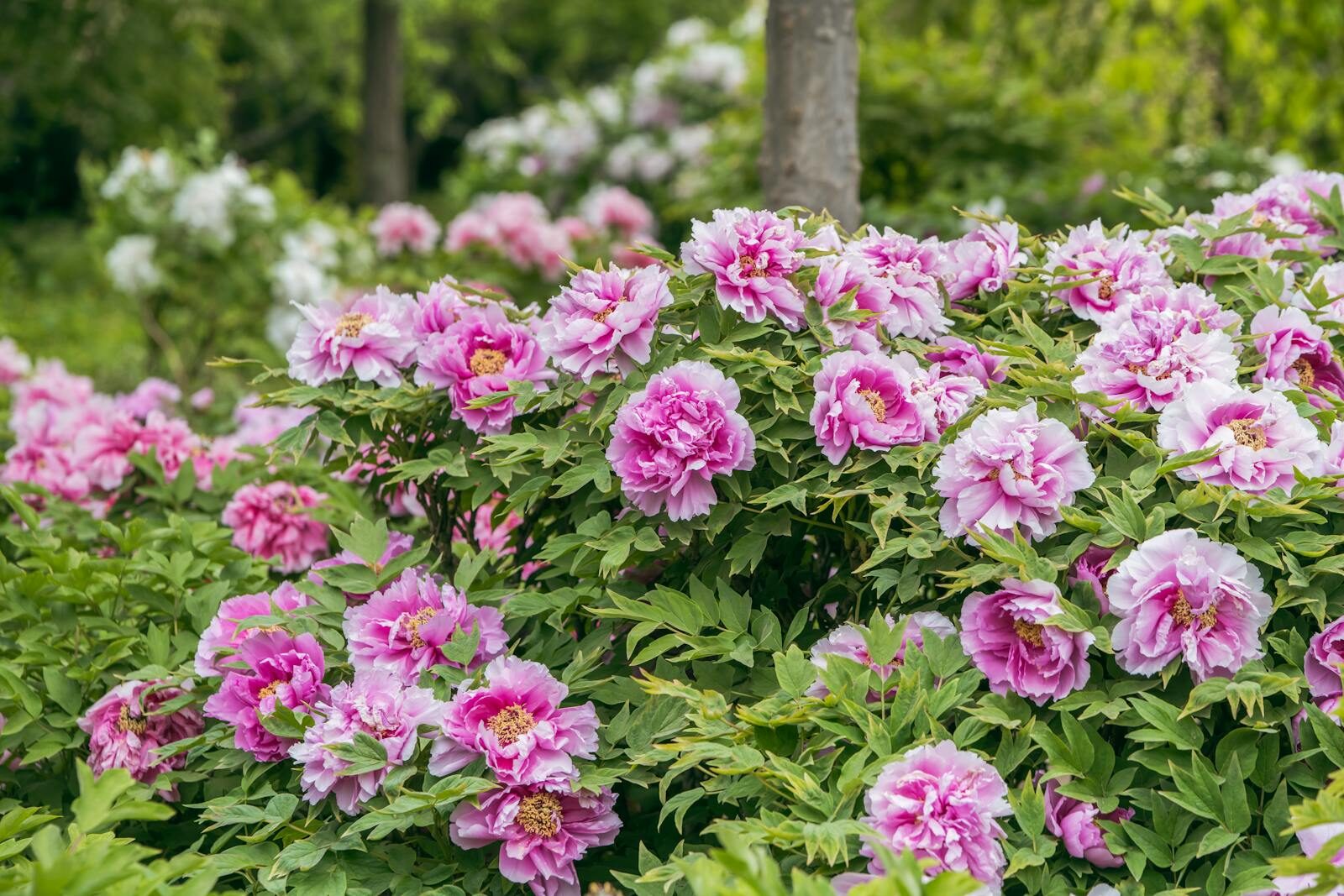
When a peony finally opens, it’s genuinely one of the most dramatic things that happens in a spring garden. The transformation from tight bud to full bloom can happen in just two or three warm days, and the result is extraordinary.
Bloom forms vary widely by variety, and here are the main types you’ll encounter:
Single Peonies
These have one or two rows of large petals surrounding a center of prominent yellow stamens. They look open, airy, and slightly wild — almost like a poppy crossed with a rose. ‘Krinkled White’ and ‘Scarlett O’Hara’ are popular single varieties in the US.
Semi-Double Peonies
A few extra rows of petals around a visible center. They’re fuller than singles but still show some of the stamens. ‘Prairie Moon’ is a well-loved semi-double with soft yellow petals.
Double Peonies
The classic, ruffled, overflowing bloom most people picture when they think of peonies. The center is packed with so many petals that the stamens are completely hidden. Varieties like ‘Sarah Bernhardt’ (soft pink), ‘Festiva Maxima’ (white with red flecks), and ‘Karl Rosenfield’ (deep magenta-red) are doubles that have been American garden staples for over a century.
Bomb-Type Peonies
A subtype of doubles where the center petals are much smaller and more densely packed than the outer guard petals, creating a “bomb” or cushion shape in the center. ‘Kansas’ and ‘Raspberry Sundae’ are popular bomb-type varieties.
Japanese and Anemone-Form Peonies
These have outer guard petals plus a center filled with narrow, petal-like structures called staminodes. They’re incredibly refined-looking and hold up better in rain than fully double varieties.
Peony Colors in Spring: What Shades Can You Expect?
Peonies come in a surprisingly wide range of colors, though they don’t include blue or true orange (at least not yet — breeders are working on it). In a typical American garden, you’ll find:
- White and cream — crisp, pure whites to soft ivory and warm champagne tones
- Pale pink to deep rose — the most common color range; everything from blush to hot pink
- Red — true red varieties like ‘Red Charm’ and ‘Buckeye Belle’ are stunning
- Coral and salmon — often found in Itoh hybrids; these are newer and highly sought after
- Lavender and lilac — subtle, soft purple-pink tones in varieties like ‘Lavender’
- Yellow — almost exclusively found in Itoh hybrids; ‘Bartzella’ is the gold standard
Many peonies also have a strong, sweet fragrance that becomes more intense on warm, sunny days — another characteristic that sets them apart from most other spring-blooming perennials.
What Different Peony Types Look Like in Spring
Not all peonies emerge and bloom on the same timeline, and understanding the types can help you identify what’s in your garden.
Herbaceous Peonies die back to the ground every winter and re-emerge each spring from the crown. These are the most common type in American home gardens and what most of this article describes.
Tree Peonies are woody shrubs that don’t die back. In spring, you’ll see new leafy growth budding out from the existing woody branches, and they often bloom earlier than herbaceous varieties — sometimes in April in warmer zones.
Itoh (Intersectional) Peonies are a cross between the two. The stems die back like herbaceous peonies, but the plant has the vigor of a tree peony. The foliage is distinctly different — more deeply cut and lacy-looking — and the blooms tend to be wider and flatter, often in those sought-after coral and yellow shades.
Regional Timing Guide for US Gardeners
Bloom timing varies significantly depending on where you live. Here’s a general guide:
- USDA Zones 3–4 (Minnesota, Wisconsin, Maine, Dakotas): Buds emerge in April; blooms in early to mid-June
- USDA Zones 5–6 (Ohio, Pennsylvania, Missouri, Pacific Northwest): Shoots emerge in March; blooms in mid-May to early June
- USDA Zones 7–8 (Virginia, Tennessee, Pacific Coast, parts of Texas): Emergence in February–March; blooms in late April to mid-May
- USDA Zones 9+ (Southern California, Gulf Coast): Peonies struggle here due to insufficient winter chill hours; look for low-chill varieties
For help identifying your USDA zone and choosing the right peony variety, see our guide → “Best Peony Varieties for Every US Climate Zone“
What Healthy vs. Unhealthy Spring Peonies Look Like
Healthy signs:
- Firm, deeply colored emerging shoots
- Sturdy upright stems that don’t flop before they’re full height
- Deep green, glossy leaves with no spotting or yellowing
- Multiple fat buds forming per stem
- Gradual color progression from red/burgundy to green as the plant matures
Warning signs:
- Gray, fuzzy coating on stems or buds (botrytis blight — a fungal issue common in wet springs)
- Black or mushy shoots (frost damage or crown rot)
- Yellow, stippled leaves (possible spider mite or virticillium wilt)
- Buds that form but never open (could be late frost damage, lack of chill hours, or planting too deep)
If your peony buds form every year but never open, the most likely culprit in the US is that the plant was set too deep. Peony eyes (the growth buds on the crown) should be no more than 1 to 2 inches below the soil surface. Any deeper and the plant will produce beautiful foliage but few or no flowers.
Actionable Spring Peony Care Tips
Now that you know what to look for, here’s how to make sure your peonies look their absolute best:
- Pull back mulch early. As soon as you see shoots emerging, loosen and pull back any heavy winter mulch so the shoots aren’t blocked or rotting underneath it. You can leave a light layer around (not over) the crown.
- Don’t fertilize with high-nitrogen fertilizer in spring. A balanced slow-release fertilizer or a light topdressing of compost around (not on) the crown in early spring is ideal. Too much nitrogen pushes leafy growth at the expense of flowers.
- Install support rings early. Double and bomb-type peonies get heavy when they bloom and will flop without support. Set peony rings or tomato cages around the emerging plants in early spring — before they grow through them.
- Water deeply but don’t overwater. Spring rains typically handle most of the watering needs, but if April is dry, give established plants a deep soak once a week rather than shallow daily watering.
- Watch for botrytis in wet years. If spring is unusually wet, improve air circulation by thinning out some of the interior stems and keeping fallen leaves and debris cleared from the base of the plant.
- Deadhead spent blooms but leave the foliage. After blooming is finished, remove the faded flowers but leave all the leaves in place until they die back naturally in fall. The foliage is photosynthesizing energy that the plant stores in its roots for next year’s bloom.
Final Thoughts
Watching peonies come back to life every spring is one of those reliable garden rituals that reminds you why perennials are worth investing in. From those first dramatic red shoots pushing through cold soil in March, to the massive, fragrant blooms of late May and June, peonies put on a show that very few other plants can match.
If you’re new to growing them, the most important thing to remember is that patience pays off. Young plants — especially those planted from bare-root divisions — may take two or three years to bloom fully. But once they’re established, a well-placed peony can live and bloom in the same spot for fifty years or more. In fact, there are peonies blooming today on old homesteads across the Midwest that were planted in the early 1900s.
That kind of staying power is exactly what makes them worth understanding, worth planting, and worth every spring you get to watch them bloom.