

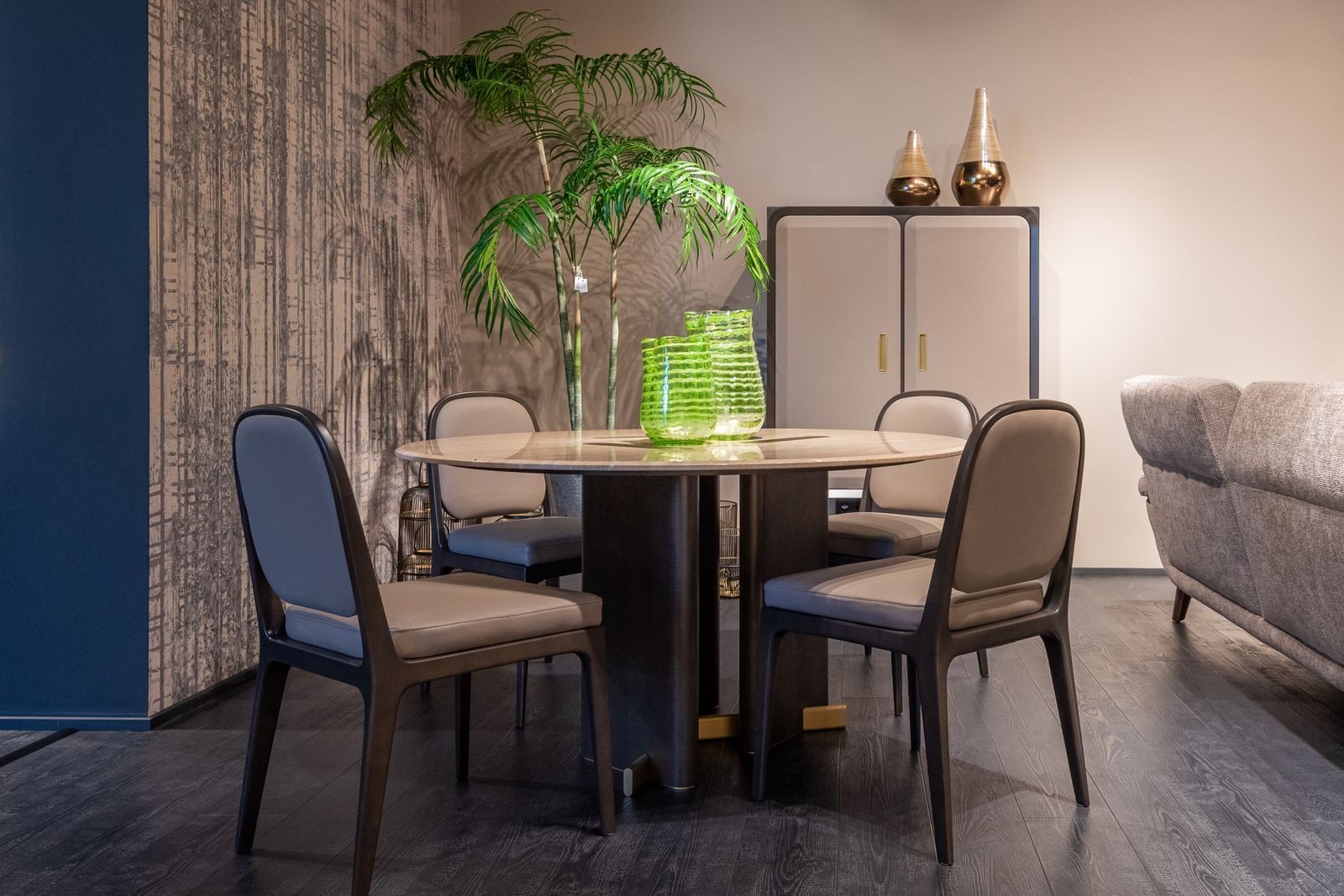
If you’ve shopped for a dining set lately, you’ve probably noticed something. The corners are disappearing. After years of long rectangular tables ruling open-concept homes, round tables are back in 2026. In fact, they’re not just a small-space compromise anymore. Instead, designers are putting them front and center, from Brooklyn apartments to Texas farmhouses.
I spent the past few weeks helping two friends measure their dining rooms. Together, we compared sets ahead of the summer furniture sales. Along the way, the same questions kept coming up. For instance: What size actually fits my room? Also, do the chairs need to match? And is a pedestal base worth the extra cost? Below, this guide answers all three questions. It’s based on 2026 design trends, as well as the space-planning math professional designers use every day.
Why Round Tables Are Trending in 2026
The shift toward round tables isn’t just a passing style choice. Rather, it reflects a bigger change in how people want their homes to feel: warmer, more social, and less formal. So, designers point to a few specific reasons for the shift this year.
- No head of the table. A circle removes hierarchy from seating. Because of this, it fits how many households actually gather now: casual, rotating, and open to guests of all ages.
- Better traffic flow. Since there are no corners jutting into walkways, round tables are easier to navigate in open kitchens and small dining nooks.
- A softer look overall. Curved furniture, arched doorways, and rounded light fixtures are all trending together this year. As a result, a round table anchors that look nicely.
- Richer materials. White oak, walnut, natural stone, and terrazzo are the standout finishes in 2026. Often, they’re paired with sculptural pedestal bases that double as a design statement.
That said, rectangular tables aren’t going anywhere. They’re still the better fit for long, narrow rooms. However, if your space is square-ish, open-plan, or on the smaller side, this is a good year to consider a round table.
Step One: Get the Size Right
Before you fall for a finish or a chair style, first grab a tape measure. After all, sizing mistakes are the top regret people have with dining sets. Additionally, round tables have their own sizing rules, since seating capacity depends on circumference, not length and width.
Here’s a quick size reference:
| Table Diameter | Comfortably Seats | Minimum Room Size Needed |
|---|---|---|
| 36–42 inches | 2–4 people | 8 x 8 feet |
| 44–48 inches | 4 people | 9 x 9 feet |
| 54 inches | 5–6 people | 10 x 10 feet |
| 60 inches | 6–8 people | 11 x 11 feet |
| 72 inches | 8 people | 12 x 12 feet |
Two simple rules make this easy to apply at home.
First, leave 36 inches of clearance on every side of the table. This way, chairs have room to pull out. Plus, it lets people walk behind seated guests without a hip-shuffle. Specifically, the National Kitchen & Bath Association, the industry authority on dining and kitchen space planning, recommends at least 36 inches of clearance behind any seat, and 44 inches where regular foot traffic passes behind diners.
Second, budget about 24 inches of table edge per person. In short, that’s the minimum space someone needs to eat without bumping elbows with the next chair.
Here’s a practical trick before you buy: mark the table’s footprint on your floor with painter’s tape. Also, include the clearance zone. If it feels tight while you’re just standing there, then it will feel even tighter once you add chairs, a rug, and a light fixture.
Does your dining area double as a home office or homework station? If so, an extendable round table is worth the extra cost. Indeed, it’s one of the most requested features in 2026. For example, a 44-inch everyday table can expand into an oval that seats six for the holidays. And because of the leaf design, it won’t eat up your floor space the rest of the year.
Choosing Chairs: Matched Sets vs. Mix-and-Match
For years, the rule was simple: buy a table and chairs that match exactly. Recently, though, that rule has relaxed. In fact, mix-and-match seating is one of the clearest trends of 2026. Still, it works best with a little intention behind it.
A matched set makes sense when:
- Your room is small, so visual consistency helps it feel calm instead of busy
- You’re furnishing a rental or first home, where a coordinated set is simpler to shop for and move
- Your dining room leans traditional or formal
Mixing chairs works well when:
- You pair upholstered captain’s chairs at the ends with simpler wood side chairs
- You add a bench on one side of the table for kids or flexible extra seating
- You keep one thing consistent, such as wood tone or seat height, so the mix still looks intentional
Meanwhile, a few practical notes apply to chairs no matter the style you pick. For comfortable legroom, leave 10 to 12 inches between the seat and the underside of the tabletop. Generally, standard dining chairs run 18 to 20 inches wide, while armchairs are usually 22 to 25 inches wide. So, if you’re seating six at a 48-inch round table, armchairs at every seat will crowd it fast. Instead, save them for just the head positions, if you use them at all.
Additionally, pedestal-base tables give you more flexibility than four-leg tables. Because there’s no center leg to dodge, chairs can sit evenly spaced around the whole circle.
Materials That Are Actually Worth the Money in 2026
Not every trending finish ages well. So, here’s how this year’s popular materials hold up over time. This matters, after all, since you’ll likely own this table for a decade or more.
- Solid wood (white oak, walnut, ash): The most durable choice overall. Over time, it develops a patina that many people end up preferring over a factory-fresh look. It costs more upfront; however, scratches can usually be sanded and refinished.
- Natural or sintered stone tops: Highly resistant to heat and scratches. Increasingly, these are popular on pedestal tables. They’re heavier and pricier, but in exchange, they’re nearly maintenance-free day to day.
- Reclaimed and FSC-certified wood: A continuing sustainability trend. Although grain and color can vary a bit from piece to piece, the eco-conscious sourcing appeals to many buyers.
- Glass tops: Visually light overall. Because they don’t visually “block” the room, they work well in smaller spaces. On the downside, they do show fingerprints and need more frequent cleaning.
- Laminate and veneer: The budget-friendly option. While it’s fine for a starter home or rental, it’s more vulnerable to moisture and heat damage over the years.
Here’s a regional note for U.S. shoppers. If you live somewhere humid, such as the Gulf Coast, Florida, or the coastal Southeast, solid wood tables need a little extra attention. So, look for a sealed finish, and keep the table out of direct sun and away from vents that cause sudden humidity swings. Otherwise, those swings can warp wood or crack veneer over time. On the other hand, in drier climates like the Southwest, it’s the opposite problem: excess dryness can crack solid wood, so a light furniture oil or wax every six months helps.
Matching the Set to Your Room Type
Small apartments and studios: For these spaces, a 36- to 42-inch round table works best, paired with armless chairs. That’s because a square table with the same footprint often feels boxier in a compact room, so round really is the smarter shape.
Open-concept kitchens: Here, a 44- to 54-inch round table with a pedestal base is a solid choice. It acts as a visual anchor, and at the same time, it avoids a forest of table legs interrupting your sightline from the kitchen.
Family homes with kids: For families, round tables are genuinely practical. Since there are no sharp corners at toddler height, they’re a safer everyday choice. Plus, a bench on one side is an easy way to fit a growing family without buying new furniture every year.
Formal dining rooms: In this case, go bigger. A 60- to 72-inch round or round-to-oval extendable table works well with upholstered chairs. Overall, this supports the more architectural “dining room as ceremony” look trending in 2026: think paneled walls, warm wood tones, and layered lighting over a strong table base.
If you’re also rethinking storage in that same room, then plan the sideboard or hutch at the same time, rather than treating it as an afterthought. For more on that, our guide to small dining room layouts walks through how to fit both pieces without crowding the space.
Budgeting for a Round Table and Chair Set in the U.S.
Prices vary by material and region. Generally speaking, here’s a guide for 2026:
- Entry-level (laminate, engineered wood): $300–$700 for a 4-piece set
- Mid-range (solid wood, veneer with wood edging): $800–$2,000
- Higher-end (solid hardwood, natural stone, designer pedestal bases): $2,000–$5,000+
Timing matters too. Typically, U.S. furniture retailers run their deepest discounts around Presidents’ Day, Memorial Day, the Fourth of July, and Labor Day weekends. Another good window is the post-Thanksgiving stretch through Cyber Monday. So, if your current table isn’t falling apart, it’s often worth waiting for one of these sales instead of paying full price.
Actionable Checklist Before You Buy
- First, measure your room, and mark the table footprint plus 36 inches of clearance with tape.
- Next, decide your typical headcount, then size up slightly if you host a few times a year.
- Also, choose a pedestal base if legroom or flexible seating matters more to you than budget.
- In addition, pick a material suited to your climate and how much upkeep you’re realistically willing to do.
- Before committing to a full set, order chair samples or check the return policy, since comfort is hard to judge from a photo.
- Finally, check delivery timelines, because solid wood and stone tables are heavy and often ship freight, which can take six to ten weeks.
Frequently Asked Questions
What size round table do I need for a family of four? Generally, a 44- to 48-inch diameter table comfortably seats four adults with room for basic table settings. However, if you host extra guests often, consider sizing up to a 54-inch table with an extension leaf, since it gives you more flexibility without a big footprint increase.
How much space should I leave around a round dining table? As a rule, leave at least 36 inches between the table’s edge and the nearest wall or furniture. That’s the standard used in professional dining room planning, and it lets chairs pull out fully while still leaving room to walk.
Are round tables better than rectangular tables for small rooms? Usually, yes. Because there are no corners, round tables improve traffic flow in tight or square-shaped rooms. As a result, they tend to make a small dining area feel less cramped than a rectangular table with the same footprint.
Do chairs have to match a round table? No, not anymore. In fact, mixed dining chairs are a leading trend in 2026. That said, it helps to keep one unifying element, such as matching wood tones or a consistent seat height, so the look feels intentional rather than random.
What’s the best material for a round dining table if I have kids? For most families, solid wood with a sealed finish is the most forgiving option, since scratches and dents can be sanded out later. Alternatively, sintered stone tops are a strong, low-maintenance choice for busy households.
How tall should dining chairs be for a standard round table? Typically, round dining tables stand 28 to 30 inches tall, which pairs well with chairs that have a 17- to 19-inch seat height. For comfort, aim for 10 to 12 inches of clearance between the seat and the tabletop.
Can a round table fit in a kitchen instead of a dining room? Yes, and it’s actually a popular layout for smaller kitchens, since round tables lack corners that catch on cabinets or walkways. For most nooks, a 36- to 42-inch table works well, with at least 36 inches of clearance on the open sides.
When is the best time of year to buy a dining table set in the U.S.? Overall, major sales cluster around Presidents’ Day, Memorial Day, the Fourth of July, Labor Day, and the Black Friday through Cyber Monday stretch. Additionally, retailers often discount older inventory in early spring, right before new seasonal collections arrive.