

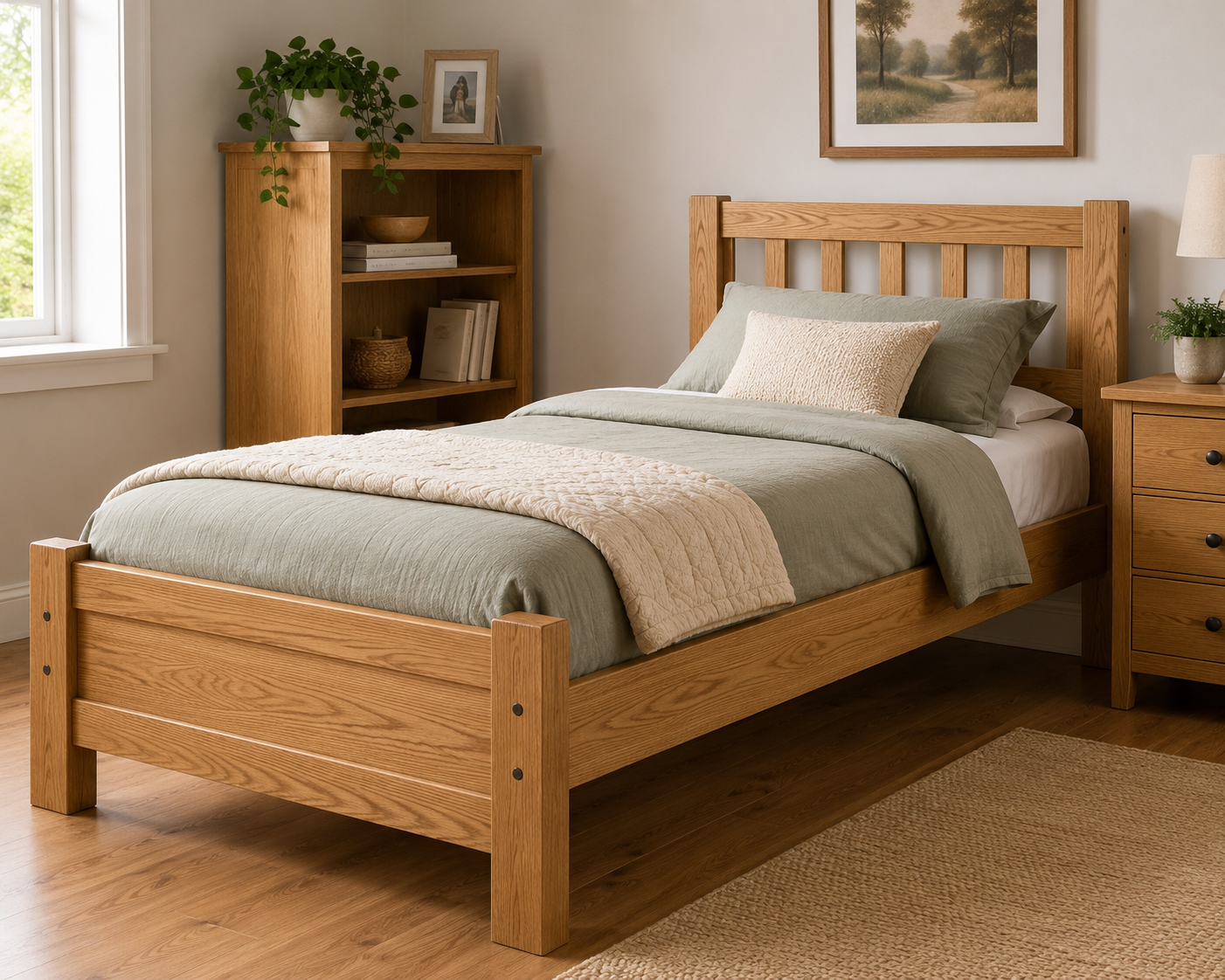
Shopping for a twin bed frame sounds simple. Then you start scrolling, and every listing claims to be “solid wood.” Some are. Many aren’t. A lot of frames labeled oak turn out to be veneer over particleboard, and that difference matters once you factor in years of daily use.
I’ve helped furnish guest rooms, kids’ bedrooms, and small apartments over the years. Oak keeps coming up as the material that actually holds up. It resists sagging. It survives moves and it doesn’t wobble after a few months the way cheaper composite frames do. This guide breaks down what makes a twin bed genuinely solid oak. It also covers what to check before you buy, and which frames earn your money in 2026.
Why Choose Oak for a Twin Bed Frame
Twin beds take more wear than people expect. Kids jump on them. Guests toss bags onto them. Dorm rooms and small apartments push them against walls that take constant contact. Oak handles all of that better than softer woods or metal frames with thin joints.
Oak resists dents and scratches naturally, thanks to its density. It also takes stain and finish beautifully, so you get flexibility with style. A real oak bed allows sanding and refinishing years down the road, unlike laminate or MDF frames that you eventually just replace. That’s a meaningful advantage if you’re furnishing a room that needs to last through a kid’s entire childhood or a decade of guest visits.
There’s a cost trade-off, though. Solid oak costs more upfront than pine, particleboard, or metal frames. Most buyers find the durability pays for itself over time, especially with a bed that gets daily use for years.
Standard Twin Bed Dimensions (And Why They Matter)
A standard twin mattress in the U.S. measures 38 inches wide by 75 inches long. A twin XL adds five extra inches of length, landing at 38 by 80 inches. It’s the size most college dorms across the country use.
Here’s where people get tripped up. Not every “twin” frame fits both sizes. Manufacturers cut some oak frames specifically for standard twin dimensions. A twin XL mattress simply won’t fit without an extra six inches hanging off the end unsupported.
Always check the interior frame measurements before ordering, not just the size label. Twin XL is usually the safer buy if you’re shopping for a dorm room or a growing teenager. It gives a taller sleeper more legroom without requiring a full upgrade later.
For a full breakdown of every mattress size sold in the U.S., check our bed sizes and dimensions guide before finalizing your frame choice.
What to Look for in a Solid Oak Twin Bed Frame
Buying oak furniture online takes a bit more scrutiny than buying it in a showroom, since you can’t run your hand over the grain first. A few details separate a genuinely solid frame from one that only looks the part.
Check the wood claim carefully. Listings often say “oak finish” or “oak-toned,” and that usually means a different wood or engineered material stained to resemble oak. Look for wording like “solid oak” or “100% hardwood” in the actual product specs, not just the title.
Look at the joinery. Quality oak frames use mortise-and-tenon joints, dowels, or heavy-duty bolted connections. Cheaper frames rely on glue and thin brackets, and those parts usually fail first after repeated use.
Confirm the slat system. Most modern platform beds skip the box spring entirely, so the slats need to sit close together and thick enough to support a mattress without sagging. As a rule, anything wider than three inches between slats risks premature mattress wear.
Ask about weight capacity. A well-built twin oak frame should support at least 500 pounds, and many quality options handle significantly more. This matters even for a twin, since it’s often used by growing teenagers or as a guest bed for adults.
Factor in assembly and shipping. Oak is heavy, so most frames ship flat-packed in multiple boxes. Read the assembly instructions and estimated time before buying if you’re not confident tackling furniture assembly solo.
Top Solid Oak Twin Bed Options to Consider in 2026
Several brands stand out this year for genuinely solid construction rather than veneer dressed up as hardwood.
Zinus offers platform-style oak-toned frames that use real solid wood construction with close-spaced slats, strong enough to skip a box spring entirely. These tend to be a reliable pick if you want real hardwood without paying designer prices, and major online retailers carry them widely.
Get Laid Beds specializes in fully customizable solid oak frames, including twin sizing, with a wide range of finish options from natural to stained tones. This route works well if you want a specific color to match existing bedroom furniture, since the company makes everything to order.
Plank + Beam builds solid wood twin frames with included headboards. The company has built a strong reputation for straightforward assembly and long-term durability, based on years of consistent customer feedback.
Wayfair’s Edward collection brings a more traditional look, with a solid oak frame and a spindled headboard for a classic silhouette. Consider this option if you want something with more visual detail than a plain platform bed.
If you’re drawn to a design that blends materials, such as Article’s Basi collection, double-check the spec sheet first. Some of these combine oak veneer with solid wood legs rather than using solid oak throughout, and that affects both price and long-term durability.
Oak Twin Bed Price Ranges in 2026
Budget matters just as much as material when you’re comparing frames. Prices for solid wood twin frames generally start around $200 for simple platform designs and climb past $1,200 for fully customized or heirloom-quality builds. Most well-made solid oak twin frames land in the middle of that range, typically between $400 and $800, depending on finish options and included features like a headboard or built-in storage.
Sales events happen often throughout the year, particularly around Presidents Day, Memorial Day, and Labor Day. Timing a purchase around one of those weekends can meaningfully lower the final price.
Styling an Oak Twin Bed for Different Rooms
Oak works across a surprising range of design styles, which explains why it stays popular year after year.
A natural or honey-toned finish highlights the wood grain and suits Scandinavian or modern farmhouse rooms especially well. A walnut-stained oak frame reads richer and more traditional, and it pairs nicely with deeper color palettes. A whitewashed finish keeps things light for a coastal or breezy look, while still showing the texture underneath.
Room size should guide the overall frame style too. A low-profile platform bed grounds a small bedroom without visually crowding it. A frame with a tall headboard and slightly raised legs, on the other hand, works better in larger rooms, where it can serve as a focal point rather than overwhelming the space.
The Sleep Foundation’s wooden bed frame guide notes that wood frames generally offer strong durability and stability compared to other materials. That said, surface damage can build up over time without proper maintenance.
Maintenance Tips to Make Oak Last for Decades
Solid oak rewards a little upkeep with decades of use, so a few simple habits go a long way.
Dust the frame regularly with a soft, dry cloth rather than harsh cleaning sprays, since those can strip the finish over time. Keep the frame out of direct sunlight where possible, since UV exposure gradually fades and dries out wood finishes. Tighten bolts and joints every few months, especially during the first year, since wood naturally settles after initial assembly. Scratches and dents don’t spell disaster either. Light sanding and a fresh coat of finish typically restore oak to like-new condition without replacing the whole frame.
Frequently Asked Questions
Is a solid oak twin bed worth the extra cost compared to particleboard or metal? For most buyers, yes. Oak resists sagging, dents, and structural wear far better than particleboard or thin metal frames. A quality oak frame can last decades and take a refinish instead of a replacement, so the higher upfront cost often works out cheaper over time.
Can a twin XL mattress fit on a standard oak twin bed frame? Usually not without modification. A twin XL mattress runs five inches longer than a standard twin, and most standard twin frames match the shorter dimension. Check the interior frame length before buying if you already own a twin XL mattress.
Do solid oak bed frames need a box spring? Most modern oak platform beds skip this requirement. They use close-spaced wooden slats designed to support a mattress directly. Always confirm the slat spacing and weight capacity in the product specs before skipping a box spring.
How do I know if a bed frame is really solid oak and not veneer? Check the product description for the exact wording. Terms like “oak finish” or “oak-toned” usually point to a different wood or material stained to look like oak, while “solid oak” or “100% hardwood” confirm genuine oak construction throughout.
What’s the average price for a good solid oak twin bed frame in 2026? Most quality solid oak twin frames fall between $400 and $800. Simple platform designs can start around $200, while fully customized options can run over $1,200.
How long does it take to assemble a solid oak twin bed frame? Assembly time varies by design, but most flat-packed oak frames take between 30 minutes and two hours with two people. Frames with more decorative detail, like spindled headboards, generally take longer than simple platform designs.
Can oak bed frames be refinished if they get scratched? Yes, and this is one of the biggest advantages of solid oak over engineered wood. Light sanding followed by a fresh coat of stain or finish can remove most surface scratches and restore the original appearance.