

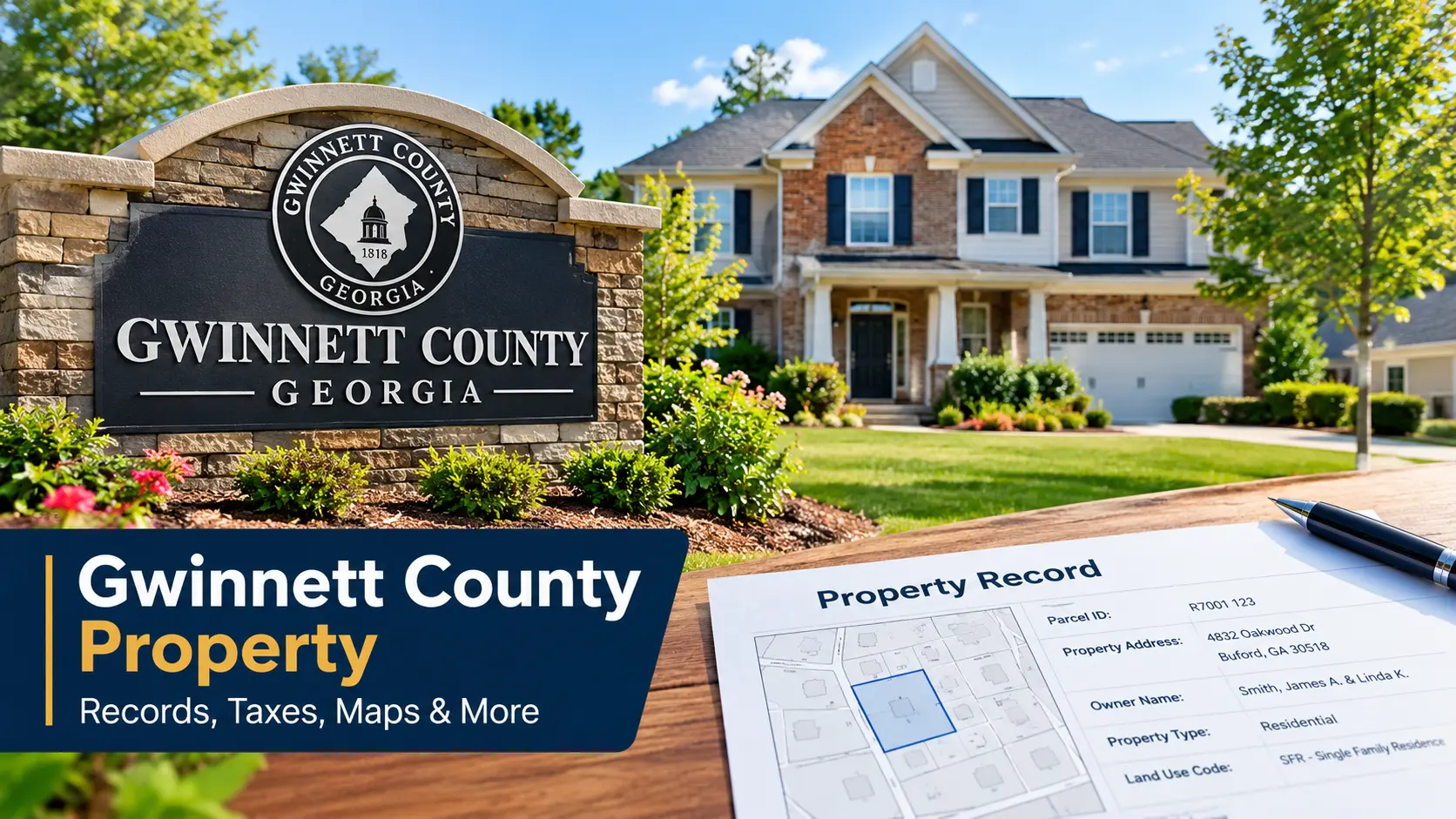
Gwinnett County splits property information among three offices. Most of the frustration people have with property searches comes from not knowing which one holds what. The Tax Assessor holds values and property characteristics. The Tax Commissioner handles bills, payments and homestead exemptions. The Clerk of Superior Court holds deeds, liens and plats. County websites do not show homes for sale.
Here’s the short version, before the details:
| What you want to know | Where to go |
|---|---|
| Assessed value, square footage, lot size, year built, exemptions on file | Gwinnett County Tax Assessor (Gwinnett-Assessor.com) |
| Whether taxes are paid, bill amounts, due dates, homestead applications | Gwinnett County Tax Commissioner (GwinnettTaxCommissioner.com) |
| Who owns it, deed history, mortgages, liens, plats | Clerk of Superior Court, via the GSCCCA statewide portal |
| Homes currently for sale | A real estate brokerage site or agent with MLS access |
Start with the Assessor for most property questions
If you have an address and want to find out what the county knows about a property, the Assessor’s search is the place to start. Each parcel record usually shows the owner listed with the county, the appraised value, details about the property’s features and any exemptions that apply. The Board of Assessors in Gwinnett County tells owners to go to Gwinnett-Assessor.com to check notices, look up market values and file appeals.
You can search using the address, the owner’s name or the parcel ID. The parcel ID is the dependable choice because addresses can be written in different ways and owner names change after a sale. You’ll find the parcel ID on your tax bill and often on closing papers.
Here are three important things to keep in mind when looking at the information:
The value shown is a tax value, not the market price. In Georgia property taxes are based on 40 percent of the market value. So if the county appraises a home at $400,000 the assessed value will be $160,000. The county multiplies that smaller number by the millage rate. People sometimes see both numbers and assume one of them is wrong. They’re actually two parts of the same tax calculation.
The valuation is based on January 1. The county’s appraisal reflects the condition of the property as of January 1 of the tax year. If you did a renovation in March or if a neighbor’s house sold for an amount in July those changes won’t show up in that year’s value.
The owner’s name might not be up to date. After a home sale, the county must record and process the deed before the assessor updates its records. If you’re checking a house that someone recently sold, the deed records (which we cover below) will likely be more current than the owner name in the assessor’s system.
Gwinnett County also offers a GIS map and an open data portal for people who need parcel boundaries or want to download datasets. These tools help you see lot lines, nearby parcels and layers like flood zones. A GIS map is a reference tool, not a legal survey, so don’t use it to settle a fence dispute.
Reading your Notice of Assessment
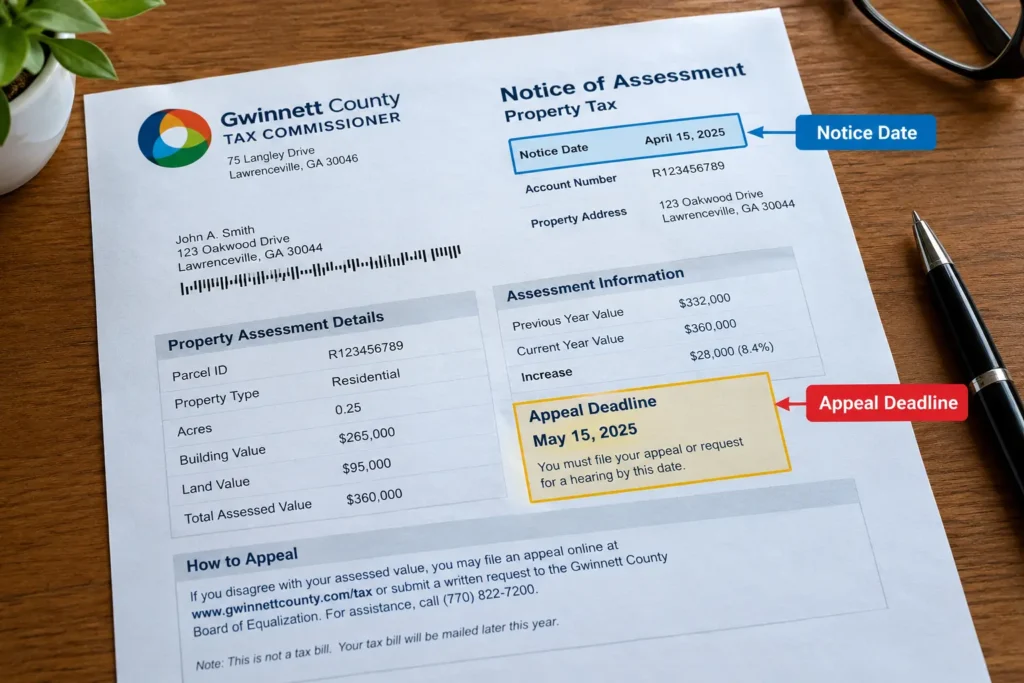
Every spring, the Board of Assessors mails annual notices. In 2026 that was roughly 311,000 notices, mailed May 15. The county is explicit that the notice is not a tax bill. It shows last year’s value, this year’s value, and any exemptions or preferential assessments the county will apply when it calculates taxes later in the year.
The date printed on the notice matters more than anything else on it. The appeal window is 45 days from that date, not from when it arrives in your mailbox. For 2026 notices, that put the residential deadline at June 29. That window has closed for this year, so if you disagree with your 2026 value, the practical move now is to gather evidence and prepare for the spring 2027 notice.
If you want to appeal in a future year, the strongest cases tend to rest on one of two things:
- A factual error in the record. Wrong square footage, an extra bathroom that doesn’t exist, a finished basement that’s actually unfinished. Pull your record before the notice arrives and check it line by line. This is the easiest kind of appeal because it’s verifiable.
- Comparable sales. Recent sales of similar homes nearby that closed for less than the county’s value. Similar means similar size, age, condition, and location. A house two streets over with a different school zone or a renovated kitchen is a weak comparison.
An appeal can lower your value, but it can’t guarantee a particular outcome. If the assessors don’t resolve it to your satisfaction, the process continues to the Board of Equalization, and after that to Superior Court.
Tax bills, due dates, and the Tax Commissioner
The Tax Commissioner collects the money. Their site is where you look up a bill, see payment status, and pay online or by mail. According to the county’s 2026 millage announcement, bills are mailed in September with payment due in November. The exact date can shift from year to year with the millage-rate schedule, so confirm your 2026 due date and payment options on GwinnettTaxCommissioner.com.
Unpaid taxes don’t just sit there. A 5 percent penalty applies if any part of the bill remains unpaid 120 days after the due date, with further penalties possible after additional 120-day periods, up to a 20 percent cap. If you’re buying a home, confirm the current year’s taxes are paid or properly prorated at closing. A paid bill is a quick thing to verify on the Commissioner’s site, and it’s worth doing even if your closing attorney says they’ll handle it.
Why your bill isn’t just assessed value times one rate
Your total bill combines several separate millage rates: county government, the school system, and in many areas a city. One mill equals $1 of tax per $1,000 of assessed value. The county’s own announcement notes that rates vary by service district based on things like police, fire, and code enforcement. So two homes with identical values can have different bills depending on whether they’re in unincorporated Gwinnett or inside a city such as Lawrenceville, Duluth, or Suwanee. When you compare tax costs between houses you’re considering, compare the actual bills (or the district millage), not just the county headline rate.
Homestead exemption and the value offset
If you own and live in the home, homestead exemption is the single most useful thing to check. Gwinnett’s Tax Commissioner uses one application for all of its exemptions (regular, senior, and disabled), and applications are accepted year-round. To have the exemption apply to the current tax year, though, apply by the appeal deadline on your Notice of Assessment. Some third-party sites cite April 1 as the cutoff, but the Tax Commissioner’s own guidance points to the notice deadline, so go by the official source.
Homeowners with the regular homestead exemption also get the Value Offset Exemption, which holds the county government portion of your assessed value at a base-year level. The county has noted that with a steady millage rate, this means the county’s share of a homeowner’s bill won’t rise just because the home’s value does. It applies to the county portion only, not school or city taxes, so your total bill can still change.
When you look up a property’s record, the exemption codes tell you something. A homeowner’s record will show homestead-related codes. If you’re a buyer and the current owner has an exemption, that doesn’t carry over to you. You’ll need to apply on your own after you buy.
Deeds, liens, and ownership history
Real estate recording in Georgia runs through the Clerk of Superior Court, and the practical way to search is the Georgia Superior Court Clerks’ Cooperative Authority (GSCCCA) portal at search.gsccca.org. Gwinnett’s clerk says its records date back to September 26, 1871, the date records were restarted after an earlier loss in a fire.
What you can find there: warranty and quitclaim deeds, security deeds (Georgia’s version of a mortgage), cancellations, plats, and lien filings. If you want to know when a house last sold, who the prior owners were, whether a mortgage was released, or whether a contractor filed a lien, this is where you look.
A few practical points:
- Searching the index is free. The statewide real estate index covers deeds recorded since January 1, 1999, and Gwinnett’s own records go further back. Viewing images requires an account, and printing carries per-page fees. Fees change and third-party sites often list outdated figures, so check the GSCCCA site for the current fee schedule.
- In-person viewing works too. The Clerk’s office at 75 Langley Drive in Lawrenceville offers in-office search and viewing, and their FAQ says there’s no charge to view documents there.
- A record search is not a title search. Looking up a deed tells you what was recorded. It doesn’t tell you whether there are unrecorded claims, errors in the chain of title, or other defects that a title company or real estate attorney is trained to catch. Even if you do your own research, a lender will require title work before closing. Records also say nothing about a home’s physical condition, so pair them with our house inspection checklist.
Finding homes for sale
County systems don’t list active homes for sale. If your goal is to find a house to buy, you’ll combine two types of sources: a listing site or agent for what’s on the market, and county records for the facts behind each listing. You can find more buying guides in our Real Estate section.
Once you find a house you like, run it through the county records. Compare the listing’s square footage and bedroom count to the assessor’s record. Check the last sale date and price in the deed records. Look at the tax history and see whether a homestead exemption is in place, because the seller’s current bill may be lower than yours will be. That last point catches many buyers off guard: a home’s current tax bill reflects the seller’s exemptions, including the value offset on the county portion, and those don’t transfer to a new owner. You’ll need to apply for your own homestead exemption, so your first bill after buying may look different.
Considering a foreclosure or auction purchase instead? Our guide to buying a foreclosed home covers auctions, REO properties and short sales.
Common mistakes people make
Treating the assessor’s value as the home’s worth. It’s a mass-appraisal estimate for taxation. It can be above or below what the home would actually sell for.
Using the assessor’s site to confirm a sale. For ownership changes, the deed record is the primary source.
Ignoring the date on the notice. The 45-day clock starts on the notice date. Waiting until you’ve “had time to think about it” can use up half the window.
Assuming a seller’s exemptions will continue. Homestead is tied to the owner-occupant, not the house.
Searching only by address. If a result looks wrong or doesn’t appear, try the parcel ID. Condo and townhome addresses are especially prone to mismatches.
Paying a third-party site for public records. Plenty of websites repackage county data and charge for it. The core records are available directly from the county offices above.
A quick checklist before you buy or appeal
- Find the parcel ID on the tax bill or closing papers, then pull the property on the Assessor’s site.
- Compare the Assessor’s square footage, bedroom count and bathroom count with what you expect, and note any errors.
- Check the Tax Commissioner’s site to confirm taxes are paid and see which exemptions are on file.
- Search the GSCCCA portal for the last deed, any open security deed (mortgage) and any liens.
- If you’re buying, plan to file your own homestead exemption after closing.
- If you plan to appeal, note the date on your Notice of Assessment and start gathering evidence before the 45-day window runs out.
Frequently asked questions
Is the Gwinnett County property search free?
Yes, for the basics. Searching assessor records and viewing a tax bill online are free. The GSCCCA index is free to search, though printing deed images costs a small per-page fee.
Can I find out who owns a property in Gwinnett County?
Yes. The assessor’s record lists the owner of record, and the deed records show how ownership was transferred. If the two disagree, the recorded deed is more current.
Where do I look up whether property taxes have been paid?
The Tax Commissioner’s site. Search by address or parcel ID and review the bill and payment status.
How do I contest my property’s assessed value?
File an appeal with the Board of Assessors within 45 days of the date on your Notice of Assessment. It’s free, and you can file online, by mail, or in person. Have comparable sales or documentation of record errors ready.
What is the difference between the Tax Assessor and the Tax Commissioner?
The assessor determines what your property is worth for tax purposes. The commissioner sends the bill, collects payment, and handles homestead applications.
Do I need to reapply for homestead exemption every year?
Generally no. According to the Tax Commissioner, if you already have an exemption you don’t need to reapply unless something changes, such as your eligibility. If an exemption is denied or removed, you can reapply for the following tax year or appeal within 45 days.
Why did my tax bill change if my county value stayed flat?
School and city taxes are separate from the county portion. Their millage rates and your value for those taxing authorities can change independently of the county’s value offset.
Can I see a property’s sale history online?
Yes, through deed records on GSCCCA. Prior sale prices may also appear on the assessor’s record, but verify against the recorded deed if accuracy matters.
Sources & References
- Gwinnett County Tax Commissioner, About Gwinnett Homestead Exemptions
- Gwinnett County news release on the 2025 millage rate and value offset exemption — gwinnettcounty.com
- Gwinnett County news release on the 2026 millage rate, bill mailing and due dates — gwinnettcounty.com
- Gwinnett County Clerk of Court, Deeds and Land Records and FAQs (gwinnettcourts.com)
[…] guide: Researching property in another county? See our Gwinnett County property search guide for taxes and records, or browse more real estate […]
[…] Georgia assesses property at 40 percent of fair market value, then applies millage rates from several taxing authorities. For a home inside Tucker, that means the city, DeKalb County, and the school district, each with its own rate. For a comparison with a neighboring county, see our guide to Gwinnett County property search, taxes and records. […]
[…] search systems vary a lot by county. For contrast, here’s how property search works in Gwinnett County, Georgia, which is a useful comparison if you’re evaluating several […]