


The official Dakota County, Minnesota property search is a free tool run by the county. You can search by parcel ID, house number or street address. It covers your tax statement, parcel details and value history. Recorded documents like deeds and mortgages sit in a separate, paid system called RecordEASE. Most people only need the free tool.
This guide covers where each record lives, what each tool costs, and when taxes and value notices arrive. It also explains what to do if a value looks wrong. Everything here is about Dakota County in Minnesota, the metro county south of Saint Paul that includes Hastings, Apple Valley, Eagan, Burnsville, Lakeville and Inver Grove Heights. There is also a Dakota County in Nebraska with its own, separate records.
Start here: the free Property Information Search
The county’s free lookup is the Property Information Search. It is the front door for most questions about a Minnesota parcel: what it’s worth on paper, what taxes are due, and what your notices said.
One tip from the county’s payment page is easy to miss. To see what you owe, go to the Property Information Search and enter your house number only. Typing a full street address with “Drive” or “Court” is a common way to get no results, because spellings and suffixes don’t always match the county’s records. Start with the number alone, then narrow down.
If you can’t find a property, try these in order:
- Enter just the house number, then pick the correct street from the list.
- Search by parcel ID. It is printed on your tax statement and valuation notice, which labels it the Property ID Number.
- For new construction or a recently split lot, try the neighboring address. Parcel records can lag a new lot.
Tax statements and proposed tax notices are also stored there. The county says you can view your notice and other tax documents through the Property Information Search. That makes it the best place to find a past statement for a refinance, a sale, or your own records.
Which tool answers which question
| What you need | Where to look | Cost |
|---|---|---|
| Taxes owed, parcel details, valuation notice | County Property Information Search | Free |
| Deeds, mortgages, easements, Torrens certificates | RecordEASE | Fee-based (see below) |
| Alerts when something is recorded on your property | Property Watch | Free |
| Value or classification questions | Assessing Services, 651-438-4200 | Free |
| Pay taxes | County payment page | Free by mail or autopay; fees on cards |
Search sites on the web will tell you they offer “Dakota County property records.” Some are tidy, but they are third-party aggregators that can be stale. Use the county’s own tools for anything you plan to act on, and never pay property taxes through a site other than the county’s official payment page.
The Minnesota property tax calendar
Minnesota’s cycle confuses newcomers because the value and the tax bill are a year apart. The assessment on January 2 forms the basis for the following year’s tax. The county’s own notice about its June 2026 appeal board says a 2026 assessment may affect your 2027 property taxes.
The yearly rhythm looks like this:
- Mid-March: Valuation notice arrives. The 2026 review period ran from March 11 to May 1.
- May 15 and October 15: The two halves of a typical residential bill are due.
- Early June: The Special County Board of Appeal and Equalization meets.
- Mid-November: The Proposed Property Tax Notice, also called the Truth in Taxation notice, is mailed in mid-November. It estimates next year’s bill.
- December 31: Homestead applications are due for the following year’s taxes.
- Next March: Final tax statements go out. The state Department of Revenue said final statements should be mailed no later than March 31.
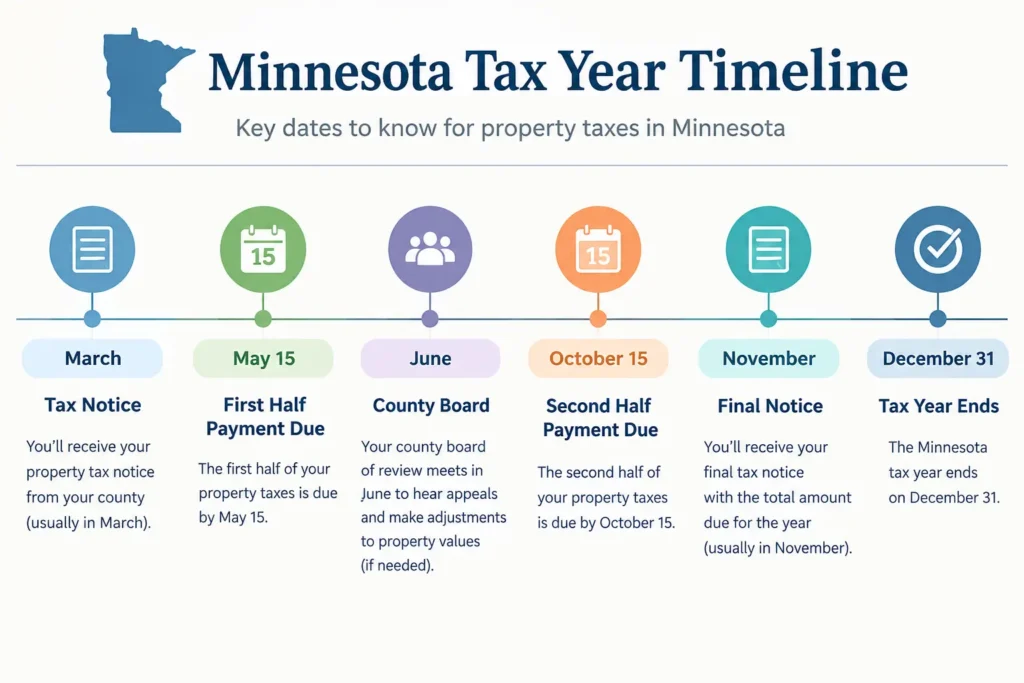
Due dates differ by property type. Real property is due May 15 and October 15, while manufactured homes are due August 31 and November 16. Agricultural property is due May 15 and November 16, and personal property is a single May 15 payment. As of this writing, the second half of 2026 real property taxes was due October 15. If you missed it, call the county promptly, since mailed payments must be postmarked by the due date or penalties apply.
Reading the lookup: value and tax are different things
New owners often see an “estimated market value” and assume the tax is that number times a flat rate. It isn’t. The assessor sets the value and classification (homestead, rental, farm and so on). Cities, school districts, the county and special districts then set their levies. Your bill is the result of both.
This matters when your bill jumps. The county says its portion is small: on average about 18 percent of a homeowner’s total property tax bill. The county’s published tax facts for its 2026 proposed taxes estimated the county share on a median-value home at $783, against an estimated metro average of $1,210. Those figures belong to that specific notice cycle, so check the county’s tax facts page for the current year. The takeaway holds either way: if your total rose sharply, look at your school district and city lines first.
The proposed notice is also only an estimate. It can differ from the final bill because of passed referendums, a late homestead filing, lowered levies, or special assessments added to the statement. A city street or sewer assessment, for example, shows up on your tax statement as its own amount. For a payoff figure, Hastings directs residents to a form or to the county’s Property Taxation & Records office, and other cities have similar processes.
Paying your taxes: methods and what each costs
The county’s page lays out the options. The costs differ more than most people expect:
| Method | Fee |
|---|---|
| Online bank transfer (Paymentus) | $0.35 |
| Online card (Discover, MasterCard, Visa) | 2.29% |
| Visa Debit Program | $2.95 |
| In person, card | 2.49% |
| By mail (check) | None |
| Direct payment (autopay) | Free |
Online payments are capped at $100,000 per transaction, and a submission isn’t complete until you get an emailed receipt. On a $5,000 half-year payment, a card fee of 2.29% runs about $114, while a bank transfer costs 35 cents. Cards can make sense if you’re chasing rewards that beat the fee, but for most people the bank transfer is the better deal.
Autopay has real limits. You’re eligible only if a mortgage company isn’t paying your taxes and you have no overdue taxes. As of the page’s October 2026 update, new forms take effect for taxes due in 2027, and cancellations must be submitted at least 15 days before the due date. If your lender pays through escrow, check the statement anyway. The responsibility stays with the owner.
If the value looks wrong
The county says it can’t change a 2026 value after the Special Board meeting, which was held June 8, 2026. For the 2026 assessment, the only formal option left is a property tax petition with the Minnesota Tax Court. The county points to an April 30 filing deadline in the year taxes are payable, so for the 2026 assessment that means April 30, 2027. You aren’t required to go through the county board before filing in Tax Court. Check the Tax Court’s current rules before filing, since procedures change.
For next year, the sequence that works best is straightforward:
- When the March notice arrives, compare the estimated market value to what similar homes nearby actually sold for. The county advises gathering recent appraisals or recent sales of like property.
- Contact Assessing Services early, during the informal review period.
- If that doesn’t resolve it, ask about the Special Board. The county says to call 651-438-4200 by May 1.
Don’t wait until June. Missing the informal window removes your cheapest option.
Ways to lower the bill
Homestead classification. This is the biggest lever for most owners. Homestead is for owners who also live in the home as their primary residence, applications are due December 31 and affect the next year’s taxes, and you must tell the assessor within 30 days if you move, sell, have a relative move in, or convert the home to a rental. Buying in the fall? Apply before the year ends.
State refunds. The Minnesota Department of Revenue runs a separate Homestead Credit Refund based on income and taxes paid, with a special refund for large increases. In August 2026, the state noted that the August 15 deadline applies, claims for the 2024 credit expired August 15, 2026, and the 2025 credit, which has a one-time 15% increase, remains available until August 2027. The state also said the average credit tops $1,330. Eligibility depends on your income and situation, so confirm with the Department of Revenue.
The county also lists a senior deferral, a blind and disabled homestead, and an open space program on its relief page.
Recorded documents: where RecordEASE fits
Deeds, mortgages, easements and similar documents aren’t in the free tax tool. They live in RecordEASE, the county’s commercial records system. It lets you search by legal description, grantor and grantee names, and document type. You’ll also see Torrens certificates, which cover property registered under Minnesota’s alternate title system run by the Registrar of Titles. You may never need one, but a title company will recognize the term.
An occasional user pays $5 per session, $1 per search and $2 per document viewed. Subscribers pay $30 per month, $0.50 per search and $1.50 per document. By that table, finding and viewing one deed as an occasional user costs about $8. The subscription only makes sense if you pull records regularly, such as a real estate professional or researcher. It also requires an escrow account.
Before paying, ask the county whether your need can be met another way. Property Taxation & Records is reachable at 651-438-4597 or records@co.dakota.mn.us. Also note that scraping and bulk downloads are prohibited.
Protect yourself: Property Watch and deed solicitations
Deed fraud, where someone records a forged document against a property, is rare. It’s also the kind of problem that’s much cheaper to catch early. Dakota County offers a free tool for it. With Property Watch, you enter your name and your property’s legal description with an email address, and you get an alert whenever a matching document is recorded afterward. Two caveats: it only watches from the day you sign up, and an alert tells you something was recorded after the fact. It’s an early-warning system rather than a lock. Using your legal description alongside your name keeps a common name like yours from flooding your inbox.
One more thing to watch for: official-looking mail offering your “property profile” or a copy of your deed for a fee. Other Minnesota counties have warned about mailings that look like government bills and ask for upwards of $90 for a deed copy, and point to the Attorney General’s office for updates. If you get something like that, check with the county before paying.
Common mistakes
- Searching the full address and giving up. Use house number only, then refine.
- Assuming lender-paid taxes are handled. Confirm the escrow payment actually posted.
- Waiting until June to question a value. The informal window is March through May 1.
- Treating the November notice as the final bill. It’s an estimate. Referendums and assessments can change it.
- Forgetting the December 31 homestead deadline, especially after a fall closing.
- Using third-party sites for payment or filings. Stick with the county.
What the search won’t tell you
The free lookup is for taxes and parcel data, not a complete due diligence package. It won’t show liens or title defects, and it won’t show every recorded document. For a purchase, you need a title search from a title company, and you may need a survey and an inspection. Tax records also reflect history: they can lag a recent sale, split or new build.
Property search systems vary a lot by county. For contrast, here’s how property search works in Gwinnett County, Georgia, which is a useful comparison if you’re evaluating several markets.
Frequently asked questions
Is the Dakota County property search free?
Yes. The county’s Property Information Search is free to use. Only recorded-document access through RecordEASE carries fees.
How do I find my parcel ID?
Look for the Property ID Number on your valuation notice or tax statement. Otherwise search by house number and open the parcel record.
When are Dakota County property taxes due?
Residential real property is due May 15 and October 15. Manufactured homes, farm property and personal property follow different schedules, listed above.
Can I pay property taxes with a credit card?
Yes, with Discover, MasterCard or Visa, and a convenience fee applies. A bank transfer is much cheaper, and mailed checks carry no fee.
How do I get a copy of my deed?
You can view recorded documents in RecordEASE, which charges per document. Contact Property Taxation & Records first to see if they can help directly.
What if I miss the appeal deadline?
The county board’s window for the current year closes in June. After that, a Minnesota Tax Court petition is the remaining formal route, and a late informal request applies to the next assessment.
Does Property Watch stop someone from recording a fake deed?
No. It alerts you after a matching document is recorded, so you can act quickly.
Sources & References
- Dakota County: Online Property Records and RecordEASE fees
- Dakota County: Pay Property Taxes
- Dakota County: Inquire About or Appeal an Assessment
- Dakota County: Homestead & Tax Relief Programs
- Dakota County: Property Watch
- Dakota County: 2026 Proposed Property Taxes