

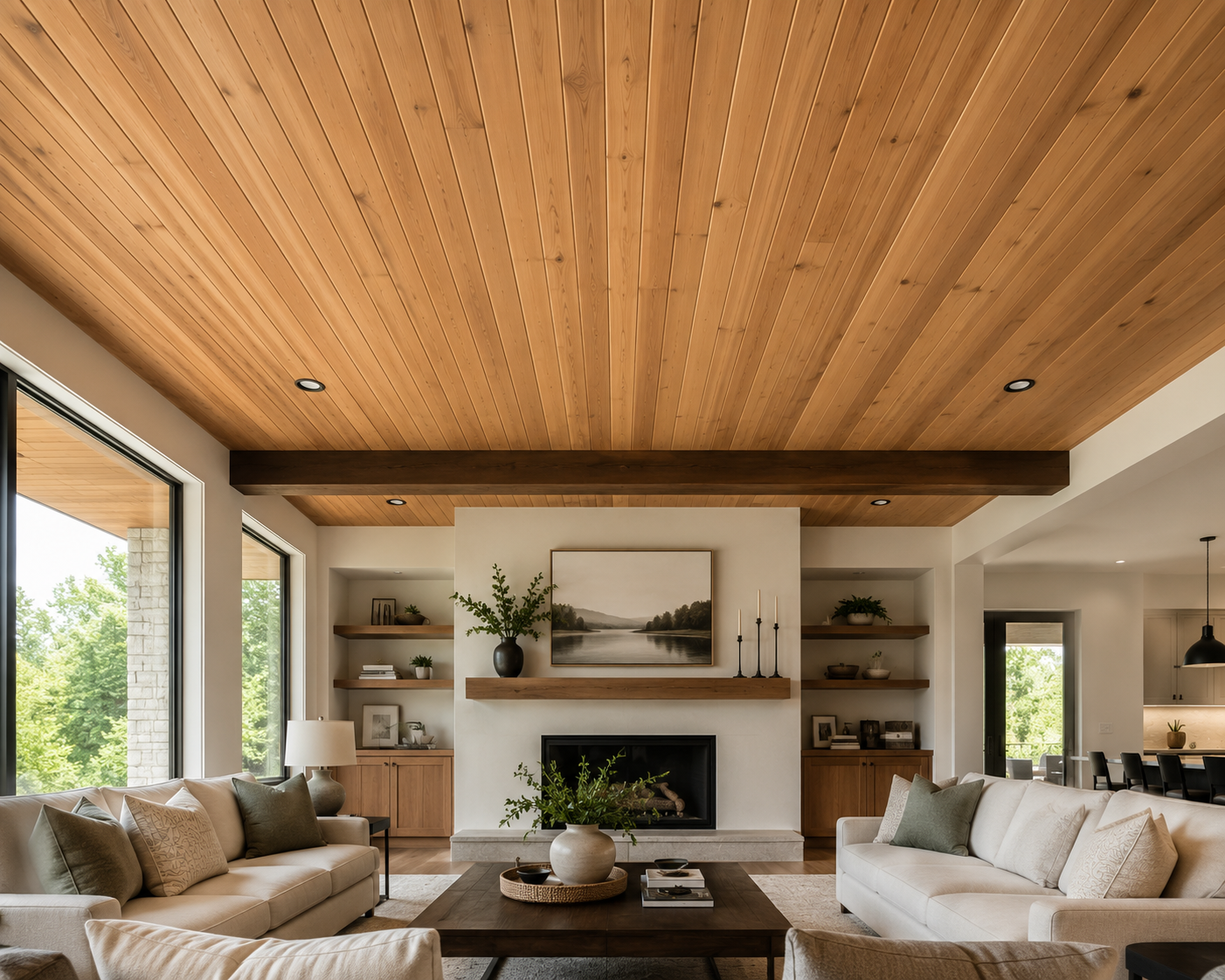
If you’ve been scrolling through home design feeds lately, you’ve probably noticed that ceilings are having a serious moment. Tongue and groove ceilings, in particular, have moved well beyond their traditional cabin-and-farmhouse roots. As a result, homeowners across the United States are now installing them in living rooms, kitchens, bathrooms, and even home offices. The results are nothing short of spectacular.
What makes this style so enduring? The interlocking plank system creates a seamlessly continuous surface that adds warmth, texture, and architectural character to any room. Whether you’re renovating a craftsman bungalow in Portland, Oregon, or updating a coastal cottage in the Florida Panhandle, tongue and groove ceilings offer a level of design flexibility that few other finishes can match.
What Is a Tongue and Groove Ceiling?
Before diving into the design ideas, it helps to understand exactly what you’re working with. A tongue and groove ceiling is made of individual planks, each with a protruding “tongue” on one edge that fits into a corresponding “groove” on the next plank. As a result, this interlocking system eliminates visible fasteners. And creates a tight, gap-free surface that looks both handcrafted and refined.
Originally used in historic American homes to cover rough structural beams, this ceiling style has been popular since the 19th century. Since then, the materials have expanded well beyond simple pine boards. Today, you’ll find tongue and groove options in cedar, white oak, poplar, shiplap-adjacent MDF, bamboo composites, and even PVC for moisture-prone spaces. The technique remains consistent — yet the aesthetic range is now virtually limitless.
25+ Tongue and Groove Ceiling Ideas for 2026
1. Classic White-Painted Pine
White painted tongue and groove is arguably the most universally loved version of this ceiling treatment. Painted in a bright white — Benjamin Moore’s “Chantilly Lace” OC-17 remains a top choice among interior designers — it amplifies natural light and makes rooms feel taller. Furthermore, this look works beautifully in coastal interiors, farmhouse kitchens, and traditional American living rooms.
2. Natural Honey Pine (Unstained)
Raw, unstained pine brings a golden warmth that painted ceilings simply can’t replicate. The natural grain patterns vary from plank to plank, giving the ceiling organic movement and depth. As a result, this is a particularly popular choice in mountain homes across Colorado, Montana, and the Pacific Northwest, where the wood echoes the landscape outside the windows.
3. Whitewashed Cedar
Whitewashing preserves the grain while softening the natural color of cedar to a pale, driftwood-like finish. Applied with a diluted white paint mixture or a commercial whitewash product, this technique lends a beachy, relaxed quality ideal for sunrooms and coastal bungalows. In addition, it works exceptionally well in light-filled reading nooks where a casual, airy atmosphere is the goal.
4. Dark Stained Walnut
For a dramatic, moody atmosphere, dark-stained walnut tongue and groove delivers serious impact. Pair it with warm brass fixtures and linen upholstery for a modern organic aesthetic that feels curated rather than heavy. However, this option works best in rooms with generous natural light or strong artificial lighting to prevent the space from feeling cave-like.
5. Gray-Washed Shiplap-Style Planks
Gray-washed planks occupy the space between rustic and contemporary with remarkable ease. Wider planks — around 6 to 8 inches — in a soft gray wash suit modern farmhouse interiors and transitional home styles exceptionally well. Moreover, this look has genuine staying power because gray reads as neutral while still adding distinct visual texture to the ceiling plane.
6. Knotty Pine for Rustic Cabins
Knotty pine is practically synonymous with American cabin culture, and for very good reason. The knots and character marks give this style authenticity that clear-grade lumber simply can’t replicate. Consequently, if you’re finishing a lake house in Minnesota or a hunting cabin in the Appalachians, knotty pine on the ceiling immediately signals that warm, unplugged retreat feeling.
7. White Oak with a Natural Oil Finish
White oak has become the darling of contemporary interior design, and for good reason. Its tight grain and subtle ray fleck create a sophisticated look when finished with a simple hardwax oil. Furthermore, when used on ceilings, oiled white oak reads as quiet luxury without ostentation — making it a top pick for design-forward homes in Austin, Nashville, and the greater Los Angeles area.
8. Painted Navy or Midnight Blue
Painting tongue and groove ceilings a deep navy or midnight blue is one of the bolder moves in 2026 home design — and it pays off in a big way. A deep blue ceiling creates an enveloping, jewel-box effect in dining rooms and bedrooms. Moreover, when combined with crisp white walls and natural brass or unlacquered hardware, the overall combination feels both timeless and refreshingly current.
9. Sage Green for a Nature-Forward Feel
Soft sage green has been climbing interior design trend lists for several years. Its appearance on ceilings feels fresh and intentional. A sage-painted tongue and groove ceiling in a kitchen or sunroom subtly connects the interior to the outdoors in a sophisticated way. To complete the look, pair with terracotta accents or natural rattan for a grounded, earthy palette that feels cohesive from floor to ceiling.
10. Vertical Plank Installation
Most tongue and groove ceilings run horizontally, following the length of the room. By contrast, orienting the planks vertically — from the ridge beam downward — is an unexpected choice that draws the eye upward. And creates a more dramatic, tent-like effect. This works particularly well in rooms with vaulted or cathedral ceilings where height is a feature, not just a structural fact.
11. Mixed-Width Plank Patterns
Alternating between narrow and wide planks — say, 3-inch and 6-inch widths — within the same ceiling creates rhythm and visual interest without requiring any additional material. The varied widths feel artisanal and bespoke. Something you’d typically find in a well-appointed boutique hotel or a high-end custom home. As a bonus, the pattern makes the ceiling appear more intentionally designed than a standard uniform-width installation.
12. Painted Black for Maximum Drama
Black-painted tongue and groove ceilings sound intimidating, but they’re surprisingly livable in the right context. In open-plan loft spaces, covered outdoor patios, or industrial-modern kitchens, a matte black ceiling recedes visually while the plank texture still reads beautifully. Think of it, therefore, as the design equivalent of a perfectly worn leather jacket — confident, unconventional, and ultimately timeless.
13. Two-Tone Color Blocking
One of 2026’s freshest approaches involves painting different ceiling sections in contrasting colors to define zones in open-plan spaces. For example, the kitchen area ceiling might be in warm white while the adjacent dining zone features the same tongue. And groove boards in a soft terracotta or dusty rose. As a result, the plank continuity connects the spaces while the color shift separates them without the need for a physical divider.
14. Beamed Tongue and Groove Combination
Exposed structural or decorative beams paired with tongue and groove infill panels between them is a classic American craftsman detail that remains deeply appealing. The beams give the ceiling structure and shadow, while the panels add fine-grained texture in between.
15. Cerused (Limed) Oak Finish
Cerusing, or liming, involves pushing a white pigment into the open grain of oak to create a silvery, bleached effect that reads as both natural and refined. Applied to tongue and groove oak planks on a ceiling, this finish has a distinctly Scandinavian-meets-American-West quality. The result is cool, calm, and beautifully textured — and, notably, it photographs exceptionally well in both natural and artificial light.
16. Herringbone or Diagonal Installation
Breaking out of parallel plank installation opens up a world of geometric possibilities worth exploring. Diagonal installation at a 45-degree angle, for instance, adds dynamic energy to an otherwise flat plane without demanding complex craftsmanship. Herringbone is more complex to install, but it creates a ceiling surface that functions as true architectural artwork — best appreciated in smaller rooms where the full pattern can be taken in at a glance.
17. PVC Tongue and Groove for Bathrooms
Solid wood in bathrooms and laundry rooms carries real moisture risk that shouldn’t be underestimated. Instead, PVC tongue and groove panels — available in a convincing range of wood-look prints as well as solid colors — offer all the visual character of real wood with none of the warping or mold concerns. Importantly, quality PVC products are significantly more realistic-looking today than they were even five years ago, making this a genuinely attractive solution.
18. Bamboo Planks for Sustainable Design
For homeowners prioritizing sustainable materials, bamboo tongue and groove is worth serious consideration. Bamboo matures in three to five years versus the decades required for hardwoods, making it a genuinely renewable choice by comparison. In addition, bamboo ceiling planks have a fine, even grain with a slight golden tone that suits modern, minimalist, and biophilic design schemes equally well.
19. Reclaimed Wood for Authentic Character
Reclaimed barn wood, factory flooring, or old-growth pine salvaged from demolished structures brings an irreplaceable depth of character to a ceiling. Every plank carries nail holes, saw marks, and patina that new wood simply cannot replicate, regardless of how skillfully it’s distressed. Beyond aesthetics, using reclaimed wood is also an act of environmental stewardship. Keeping good material out of landfills and into beautiful, long-lasting homes.
20. Subtle Chevron Pattern
Chevron differs from herringbone in that the planks meet at a center point, creating a V-shaped arrow pattern rather than an offset brick-like effect. On a ceiling and painted in a single color, chevron reads as sophisticated geometry without feeling overtly trendy or theme-heavy. For maximum restraint, white-on-white chevron — where the planks and background share the same color — offers texture with absolute visual discipline.
21. Coffered-Style Tongue and Groove Panels
Coffered ceilings — with their recessed panel grid — are traditionally associated with formal, high-end interiors. Filling those panels with tongue and groove planks rather than smooth drywall, however, adds warmth and tactile interest to what can otherwise feel like a cold architectural feature. This combination suits traditional, transitional, and even updated colonial-style homes across the American Northeast and Mid-Atlantic.
22. Accent Ceiling in the Primary Bedroom
Rather than covering an entire ceiling, consider using tongue and groove as a feature treatment on just one surface — typically directly above the bed. This creates a headboard-less accent that grounds the sleeping area without requiring full-room installation or budget. Moreover, a warm stained wood panel directly above the bed, contrasting with painted drywall on the rest of the ceiling, feels intimate and unmistakably intentional.
23. Painted Ceiling with Contrasting Stained Beams
This variation flips the classic approach in an interesting and effective way: the tongue and groove fill panels are painted in a light, airy color. While the structural or faux beams between them are stained a rich, contrasting wood tone. The effect honors traditional craftsmanship while feeling considerably fresher. And more contemporary than a fully stained wood ceiling might read in today’s interiors.
24. Outdoor-Rated Tongue and Groove for Covered Porches
Covered porches, pergolas, and outdoor living rooms across the American South, Southeast, and Southwest are increasingly being finished with tongue and groove ceilings. Properly rated cedar, redwood, or treated pine performs exceptionally well in covered outdoor applications where direct rain exposure is limited. In particular, a painted white porch ceiling is a beloved tradition in Southern architecture — simultaneously functional, beautiful, and deeply familiar to generations of homeowners.
25. Modern Minimalist: Narrow Planks, Matte White
Narrow tongue and groove planks — as little as 2.5 inches wide — painted in a true flat or matte white create a ceiling with subtle linear texture that reads as refined rather than rustic. This is a sleek, contemporary approach that complements modern. And transitional interiors without competing with other design elements in the room. Above all, the restraint of this option is precisely what makes it so effective in spaces that rely on simplicity.
26. Stained Planks with White Shadow Gaps
A small but meaningful detail: leaving a deliberate shadow gap between planks rather than a tight fit creates definition between each individual board. When the boards are stained and the shadow gap exposes white substrate beneath. The result is a clean, graphic ceiling that bridges the gap between rustic plank aesthetics and modern graphic sensibility. As a finishing touch, this technique works especially well when paired with recessed lighting aligned with the plank direction.
Materials: What to Use and Where
Choosing the right material is just as important as choosing the right design. Solid pine and fir are affordable, widely available at Home Depot and Lowe’s, and perform well in climate-controlled interior spaces. Cedar, on the other hand, is naturally aromatic and resistant to insects, making it a smart upgrade for screened porches. White oak and walnut are premium choices for main living areas and primary bedrooms where design investment is fully warranted.
For kitchens, bathrooms, and laundry rooms, take moisture seriously. Even well-sealed wood will expand and contract with humidity cycles, which can lead to cracking or warping over time. As a practical alternative, PVC tongue and groove is the pragmatic solution for high-humidity spaces. In bathrooms specifically, pairing PVC planks with a quality exhaust fan eliminates the risk almost entirely and still delivers excellent visual results.
Reclaimed wood, meanwhile, requires more careful selection than standard lumber. Source from reputable salvage dealers who can confirm the wood is dry and free of lead paint — particularly important if the reclaimed material comes from pre-1978 structures. Fortunately, many salvage yards in cities like Portland, Chicago, and Atlanta specialize in properly prepared and tested architectural materials.
Installation Basics: What USA Homeowners Should Know
Tongue and groove ceiling installation is a DIY-accessible project for confident home improvers, though most homeowners benefit from professional help for larger rooms or vaulted ceilings. The standard process involves installing horizontal furring strips perpendicular to the joists, then blind-nailing the planks through the tongue so fasteners remain invisible in the finished surface.
Acclimating the wood is critical — bring your planks into the home for at least 48 to 72 hours before installation so they can adjust to your indoor humidity and temperature. Skipping this step, unfortunately, leads to gaps or buckling after installation that are difficult to correct without removal. In regions with pronounced seasonal humidity swings, like the Gulf Coast or the Midwest, allowing for slight expansion gaps is especially important for long-term performance.
Most tongue and groove ceiling projects in the United States require a building permit only if structural changes — like removing ceiling drywall to expose joists — are involved. Cosmetic installations over existing ceilings typically do not require permits; however, always confirm with your local municipality before beginning work. Resources like the This Old House installation guide provide step-by-step guidance from experienced professionals who have worked through real-world installation challenges.
For an accurate picture of what related structural upgrades might involve, see our guide on estimating home renovation costs by room for a deeper look at budgeting ceiling projects alongside other improvements.
Cost Breakdown: What to Budget in 2026
Material and labor costs vary meaningfully by region and material choice. As of early 2026, here’s a realistic range for USA homeowners:
Pine tongue and groove (painted): $3–$6 per square foot for materials; $5–$9 per square foot installed.
Cedar: $5–$9 per square foot for materials; $7–$13 per square foot installed.
White oak: $10–$18 per square foot for materials; $14–$22 per square foot installed.
PVC tongue and groove: $2–$5 per square foot for materials; $4–$8 per square foot installed.
Reclaimed wood: $8–$20+ per square foot for materials depending on species and source; $12–$25 installed.
A 200-square-foot living room ceiling in painted pine, professionally installed, typically runs between $1,600 and $3,000 in most US markets. By contrast, labor rates in high cost-of-living cities like San Francisco, New York, and Seattle will push toward the higher end of any range — sometimes beyond it in premium neighborhoods.
2026 Design Trends Worth Knowing
Several broader trends are shaping how tongue and groove ceilings are being used in American homes right now. Biophilic design — the practice of incorporating natural materials and forms to support human wellbeing — is driving demand for natural wood finishes over painted versions. As a result, homeowners increasingly want to see and feel the grain rather than cover it with opaque paint.
Bold color is also gaining meaningful ground in ceiling design. Painted ceilings in rich, saturated hues like deep green, warm terracotta, and midnight blue are increasingly common. And tongue and groove surfaces make these colors even more dynamic because the plank lines create shadow and depth. Additionally, sustainability credentials matter more than they did five years ago. Certifications like FSC (Forest Stewardship Council) for new wood and documented provenance for reclaimed materials are increasingly requested by design-conscious buyers who want their renovation choices to reflect their values.
Frequently Asked Questions
Is tongue and groove ceiling still popular in 2026? Absolutely. Tongue and groove ceilings have moved well beyond their farmhouse niche and now appear in modern, transitional, coastal, and even contemporary industrial interiors. Their versatility in material, finish, and installation direction keeps them relevant across design cycles.
How much does a tongue and groove ceiling cost to install in the USA? Costs vary by material and location. A basic pine installation runs roughly $8–$15 per square foot fully installed, while premium materials like white oak can reach $22 or more per square foot. A 200-square-foot room in painted pine typically costs between $1,600 and $3,000 with professional labor.
Can I install tongue and groove over existing drywall? Yes, in most cases. Installing tongue and groove planks over existing ceiling drywall is a common approach that avoids demolition and typically does not require a permit. The planks attach to furring strips screwed through the drywall into the joists above.
What wood species is best for a tongue and groove ceiling? Pine is the most popular and affordable choice for painted ceilings. Cedar suits outdoor and porch applications particularly well. White oak and walnut are top picks for premium, naturally finished interiors. PVC is the best option for bathrooms and other high-moisture spaces where wood would be at risk.
How do I clean and maintain a tongue and groove ceiling? Painted tongue and groove ceilings can be cleaned with a lightly damp microfiber cloth or a long-handled dusting brush. Naturally finished or oiled wood ceilings should be dusted regularly and re-oiled every two to three years to maintain their finish and protection. In either case, avoid steam or excess moisture near any wood ceiling surface.
Does a tongue and groove ceiling add resale value to a home? Tongue and groove ceilings are generally considered a value-adding upgrade, particularly in markets where buyers prioritize architectural detail. Real estate agents in markets like Austin, Nashville, and the Pacific Northwest often note that quality ceiling treatments contribute to stronger buyer interest and faster sales, though exact ROI varies by home price point and local market conditions.
What is the difference between shiplap and tongue and groove ceilings? Shiplap planks have a rabbet (step) cut into each edge that allows them to overlap slightly, leaving a visible reveal or gap between boards. Tongue and groove planks, by contrast, interlock precisely with no visible gap. Both are popular for ceilings. But tongue and groove creates a tighter, more traditional look while shiplap produces a more casual, gap-lined aesthetic.
Can tongue and groove ceilings be used outdoors? Yes, with the right material selection. Cedar, redwood, and pressure-treated pine are appropriate for covered outdoor applications like porches and pergolas. These species must be properly sealed or painted for outdoor exposure; otherwise, moisture will cause premature deterioration. PVC tongue and groove is another excellent option for covered patios where moisture exposure is a recurring concern.