

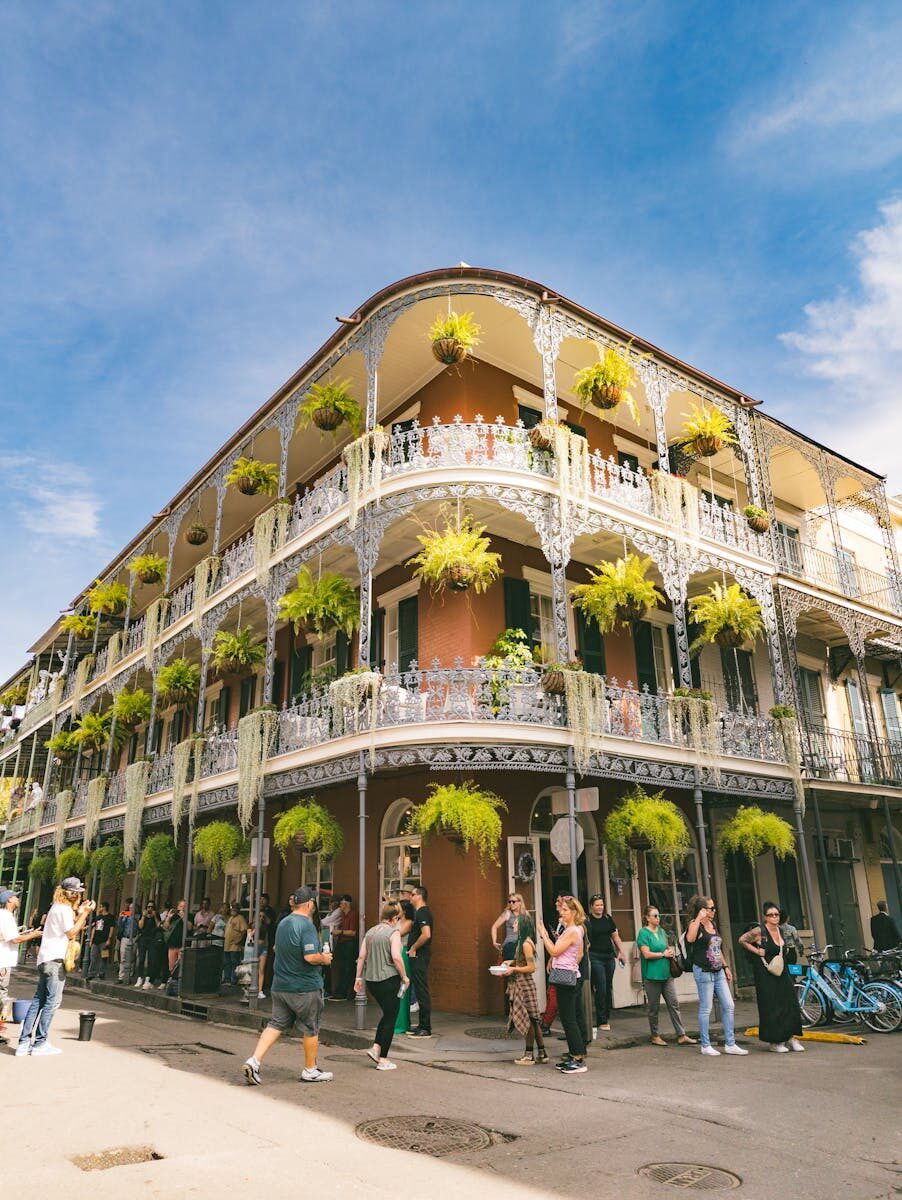
There’s a moment every French Quarter resident knows well.
It’s early evening. The heat breaks just a little. Jazz drifts up from the street below. You’re standing on a wrought-iron balcony with a cold drink in hand, watching the fog roll in off the Mississippi.
That moment is why people move here — and why they stay.
But finding the right apartment in the French Quarter takes more than just loving the vibe. Prices vary wildly. Some streets are heaven; others are not so much. And the rental market in 2026 looks different than it did even a year ago.
This guide will walk you through everything you need to know — current prices, the best streets to live on, what affordable and luxury actually look like here, and practical tips to land a great lease.
What Makes the French Quarter Worth Living In
The French Quarter — or the Vieux Carré, meaning “Old Square” in French — is the oldest neighborhood in New Orleans. French colonists founded it in 1718. Today, 85 square blocks of it are listed on the National Register of Historic Places as a Historic Landmark District.
That history is not just a tourist selling point. It defines your daily life as a renter.
Your apartment might have original heart-of-pine floors. The walls could be exposed brick. Windows are often floor-to-ceiling with working shutters. Courtyards hide behind ordinary-looking doors. These are not renovated reproductions — they’re the real thing, and they exist at price points that would be unthinkable in cities like New York or San Francisco.
The neighborhood runs from Canal Street to Esplanade Avenue, bordered by the Mississippi River and North Rampart Street. Inside that rectangle you get Bourbon Street nightlife, the gallery-lined elegance of Royal Street, the riverfront buzz of Decatur, and dozens of quiet residential blocks that go almost completely still after 10 p.m.
It is busy. It is noisy at times and it is also one of the most walkable, culturally rich, and architecturally beautiful places to live in the entire United States.
French Quarter Rent Prices in 2026: The Real Numbers
Here’s the honest picture of what things cost right now.
As of May 2026, the median rent across all unit types in the French Quarter sits at $1,762 per month — about 10% below the national average. Prices have fallen roughly 12% over the past year, which means renters currently have more negotiating power than they’ve had in quite a while.
That said, the range here is unusually wide. You can find a compact studio for under $1,200. You can also find a full-floor riverfront penthouse for over $8,000. Both are legitimately “French Quarter apartments.” Knowing where you fall in that range helps you search smarter.
Here’s a practical breakdown:
Studios — $1,100 to $1,600/month Compact, usually 400–550 sq ft, but often packed with character. Exposed brick, tall ceilings, original floors. Great for solo renters or remote workers who’d rather have a great address than a large square footage.
One-Bedrooms — $1,500 to $2,558/month The sweet spot for most renters. The midrange here lands around $1,882 to $1,961 per month. At this price, you can realistically find a unit with a private balcony, courtyard access, and updated kitchen — all inside a 19th-century building.
Two-Bedrooms — $1,500 to $7,074/month The range is this wide because “two-bedroom” in the French Quarter covers everything from a modest walk-up to a luxury townhome. A solid, well-maintained two-bedroom in a good location typically runs $2,500 to $3,500 per month.
Three-Bedrooms — $2,852 to $7,074/month These are rare. Most are historic townhomes or upper-floor units in larger residential buildings. If you find one in good condition at the lower end of that range, move quickly.
Luxury Rentals — $1,500 to $8,536/month The luxury tier here averages around $2,848 per month, with top-end properties climbing well above that. Average size in this segment is around 904 sq ft — smaller than you might expect, but the views, finishes, and building quality more than make up for it.
The Best Streets to Live On in the French Quarter
Not every block offers the same experience. Here’s how the main streets actually compare for full-time residents.
Royal Street Most long-term residents would put Royal Street at the top of any list. It’s lined with antique shops, art galleries, and respected restaurants, but it quiets down significantly after dinner. An upper-floor apartment here with balcony access over the street is one of the finest addresses in New Orleans — full stop.
Chartres Street Running parallel to Royal, Chartres is equally beautiful and slightly less foot-trafficked. Some of the Quarter’s most elegant historic residential buildings are here. The walk to Jackson Square takes about five minutes.
Burgundy Street Underrated and underpriced. Burgundy is deeply residential, genuinely quiet for the French Quarter, and tends to attract long-term locals rather than tourists. If you want the architecture and the neighborhood without the noise, look here first.
Esplanade Avenue The far eastern edge of the Quarter, where it meets the Marigny. Rents run a bit lower, the street has a beautiful live oak canopy, and the vibe is noticeably more laid-back. The trade-off is you’re a longer walk from the Quarter’s core.
Decatur Street Lively, convenient, close to the French Market and Café du Monde. Great if you love being in the middle of everything. Be honest with yourself about noise tolerance before signing a lease here, though — it runs high on weekends.
Bourbon Street For a very specific type of person. The nightlife is legendary. The noise is constant. Most long-term French Quarter residents actively avoid living directly on Bourbon. That said, the residential blocks between Iberville and St. Ann can be more livable than you’d expect if you keep to the upper floors.
Affordable Options: How to Actually Find a Deal Here
The market has softened in 2026. That’s good news if you know how to use it.
Prices are down 12% year-over-year, inventory is up, and landlords are more willing to negotiate than they were 18 months ago. Here’s how to work that to your advantage.
Go residential. The blocks nearest to North Rampart Street and toward Esplanade tend to price lower than the tourist-heavy central area. You’re still inside the Quarter — still getting the architecture, the walkability, the culture — just without paying the premium for the most-photographed corners.
Skip the amenity packages. A historic building with in-unit washer/dryer, rooftop access, and a gym runs $500 to $800 more per month than an equally beautiful apartment that just doesn’t have those extras. If you can use a laundromat and find a nearby gym membership, your dollar goes much further.
Search in summer. New Orleans summers are genuinely brutal — hot, humid, and not peak moving season. Rental demand typically softens between June and August. If your timeline is flexible, searching now through August often yields better pricing and more landlord willingness to negotiate.
Look beyond the big platforms. Some of the best deals in the French Quarter never hit Apartments.com or Zillow. Local property managers, Craigslist New Orleans, and neighborhood Facebook groups surface listings that the aggregators miss — often at meaningfully lower prices.
Buildings worth checking at the affordable end: DH Holmes Apartments (810 Bienville St, starting around $1,509 for a 1BR), 1101 Decatur Apartments, and smaller boutique buildings along Burgundy Street consistently show up as strong value options.
Luxury Options: What Premium Living Looks Like Here
Luxury in the French Quarter is unlike luxury anywhere else in America.
You’re not getting generic high-rise finishes and a rooftop pool (though those exist too). You’re getting private full-floor residences in buildings that have stood for 150 years and you’re getting Carrara marble countertops inside walls that have original plaster molding from the 1800s.
The price range for luxury apartments in the French Quarter currently runs from $1,500 to $8,536 per month. There are approximately 25 Class A buildings in the neighborhood with around 98 to 102 high-end units available.
The Annex is one of the most talked-about luxury properties in the Quarter right now. It offers one-, two-, and three-bedroom apartments and penthouses with a rooftop pool, soleil deck, and unobstructed views over the entire neighborhood. It sits next door to The Ritz-Carlton and a short walk from the Saenger Theater — which tells you something about the caliber of the location.
The Strand takes a different approach. Positioned above a first-class hotel, it offers some of the most dramatic views in New Orleans — the French Quarter, the Superdome, and the Mississippi River all in one frame.
For renters relocating from major metros, the math is striking. What passes for a mid-tier luxury apartment in Manhattan or San Francisco buys you a genuinely extraordinary space in the French Quarter — with architecture that no new construction can replicate.
What Living Here Is Actually Like Day to Day
People either love the French Quarter for the long haul, or they burn out and move to the Garden District. Here’s an honest picture of both sides.
The walkability is exceptional. The neighborhood scores near the top of any walkability index in Louisiana. Groceries, restaurants, coffee, the riverfront, jazz clubs, public transit — almost everything you need daily is within a short walk. Many residents here don’t own cars at all.
Noise is real. Even on the quieter residential streets, you will hear music on Friday and Saturday nights. During Mardi Gras, Jazz Fest, and major events, the whole neighborhood becomes a festival. Long-term residents tend to embrace this as part of the deal. Others find it exhausting after six months. Be honest with yourself before you sign a 12-month lease.
The community is tighter than it looks. About 61% of French Quarter households rent rather than own, and despite the tourist traffic, the permanent resident community is genuinely close-knit. As one five-generation New Orleanian and longtime Realtor put it: “The French Quarter is a lifestyle. It’s busy, but then the residential areas can be very calm and still. And it’s beautiful to stroll in the evenings when the fog rolls through.”
Parking will cost you extra. Most apartments don’t include dedicated parking. Budget an extra $100 to $300 per month for a nearby spot, or get comfortable with the city’s permit system.
The food and culture access is unmatched. Café du Monde, the French Market, Preservation Hall, Galatoire’s, Antoine’s, Brennan’s — all walkable from most addresses in the Quarter. That kind of daily access to world-class food and live music is something most cities simply can’t offer.
French Quarter vs. Nearby Neighborhoods: How Do They Compare?
If the Quarter feels like a stretch budget-wise — or if noise is genuinely a dealbreaker — here’s how the surrounding areas stack up in 2026.
Central Business District (CBD): Just across Canal Street, averaging around $2,044/month. Similar pricing but a more corporate, high-rise feel. Less architectural character, more modern amenities.
Marigny and Bywater: Right downriver past Esplanade. Some of the best renter value in New Orleans. Prices typically run $200 to $600 lower per month than the Quarter, with a similar music-and-culture vibe. Many Quarter regulars eventually migrate here and never look back.
Garden District: Tree-lined streets, grand Victorian homes, quieter residential energy. Prices are comparable to or slightly above the French Quarter, but you’re trading walkable nightlife for neighborhood tranquility. A different lifestyle, not a lesser one.
For renters who specifically want to be in the heartbeat of New Orleans — the music, the food, the architecture, the history — the French Quarter in 2026 is the strongest it’s been as a renter’s market in years.
Practical Tips for Locking Down Your Lease
Good units here still move fast, even in a softer market. These tips will help you act quickly when the right place comes up.
Have your paperwork ready before you start touring. Pay stubs, bank statements, references, and ID — have them all ready to submit on the spot. Smaller landlords in the Quarter move quickly when they find a qualified tenant. Being unprepared costs you apartments.
Visit on a Friday or Saturday night. Before you sign anything, go back to the apartment on a weekend evening. Walk the block. Listen. You need to know what you’re actually agreeing to live next to.
Watch for Mardi Gras clauses. Some French Quarter leases include provisions about short-term sublets during major festival periods. Read every line before signing.
Understand your rights as a Louisiana renter. Louisiana has specific rules around security deposits, habitability, and lease termination that every renter should know. You can find clear, reliable guidance through the Legal Services Corporation — a high-authority federal resource for tenant rights across all 50 states.
Budget for utilities. Older historic buildings often have older HVAC systems. New Orleans summers are intense. Ask about average utility costs during summer months, and realistically budget an extra $150 to $200 per month from June through September.
Read our guide to renting in New Orleans as a newcomer for more on neighborhoods, lease timing, and how to negotiate with local landlords.
The Bottom Line
The French Quarter in 2026 is genuinely one of the better moments to rent here in recent memory.
Prices are down. Inventory is up. Landlords are more flexible than they’ve been in years. And the neighborhood itself — the architecture, the culture, the food, the music — isn’t going anywhere.
If you want silence and ease, the Quarter may not be your match. But if you want to live inside one of America’s great cultural landmarks, with world-class food and live music at your doorstep every day of the week, it’s hard to think of a better address in the country.
Start your search on Zumper for the most current French Quarter listings, updated daily.