

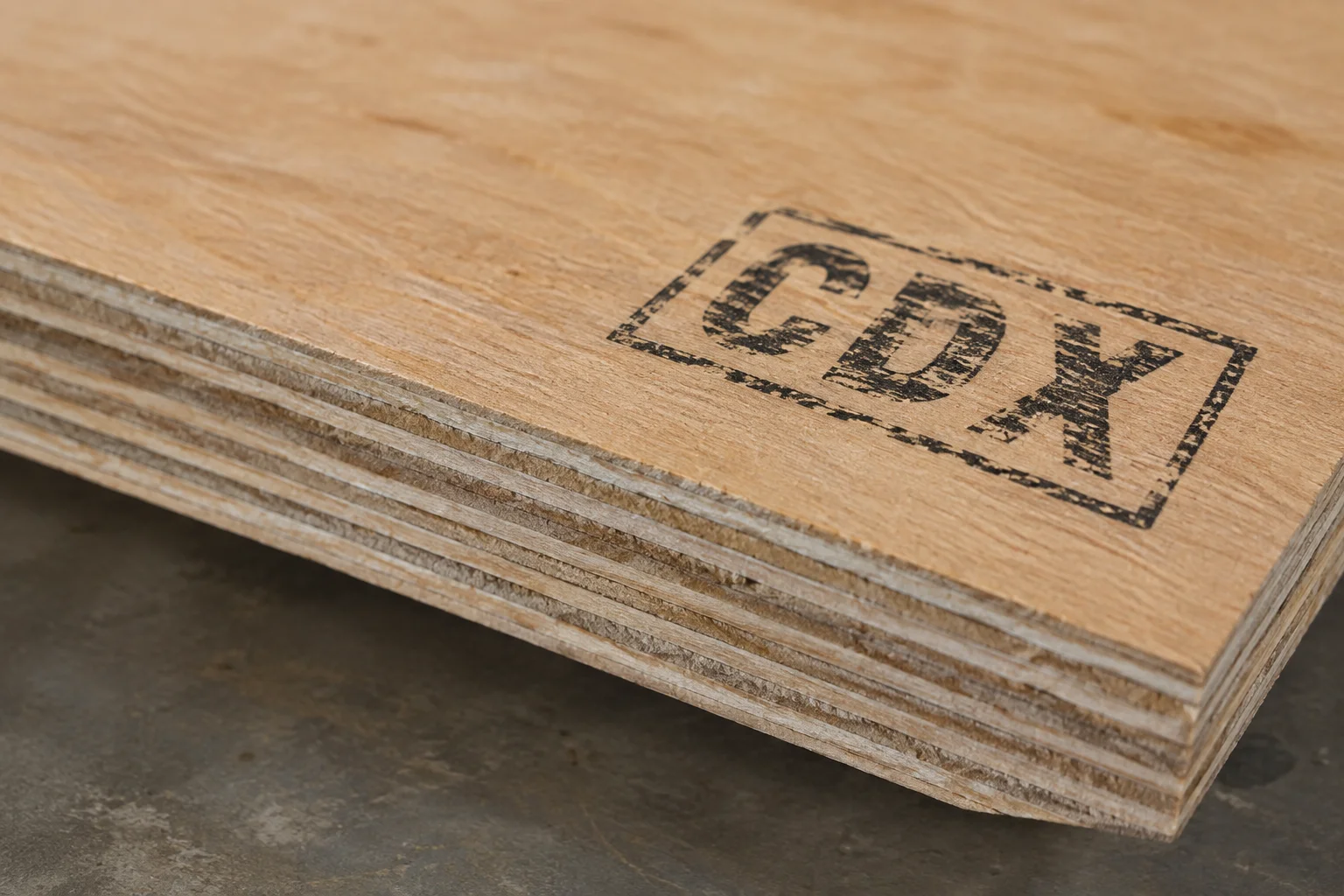
CDX plywood is a construction-grade sheathing panel made with a C-grade face veneer, a D-grade back veneer, and moisture-resistant exterior glue. It’s the plywood contractors reach for when the panel is going to be covered up — under roofing, under siding, under finish flooring — not when it needs to look good. A 4×8 sheet typically runs somewhere between $25 and $45 depending on thickness, region, and current lumber pricing. It comes in standard thicknesses from 3/8 inch up to 3/4 inch, with 1/2 inch and 5/8 inch covering most residential jobs.
That’s the short answer. Below is what the letters actually mean, which thickness fits which job, what it costs compared to OSB, and one detail that almost every other guide on this topic skips entirely.
What Does CDX Actually Mean?
The name breaks into three parts. C is the grade of the face veneer — the “good” side. It allows tight knots and some minor patches, but it’s not furniture-grade smooth. D is the grade of the back veneer, which allows larger knots, knotholes, and rougher patching. X refers to the glue: an exterior-type, moisture-resistant adhesive (usually phenolic resin) that won’t delaminate if the panel gets rained on during a job.
Here’s the part that trips people up: X does not mean waterproof. It means the panel can survive incidental wetting during construction — a rainstorm before the roof gets shingled, for instance — without the layers separating. It’s officially classified as “Exposure 1” by the APA – The Engineered Wood Association, which is different from true “Exterior” grade plywood rated for permanent outdoor exposure. If you leave CDX sitting outside uncovered for a season, it will eventually cup, swell, and delaminate.
One thing worth knowing: the APA itself has moved away from the term “CDX” in formal specifications. Its current guidance recommends specifying panels by grade, span rating, and bond classification (for example, “APA Rated Sheathing, Exposure 1, 32/16 span rating”) rather than the informal shorthand.
CDX Plywood Sizes and Thicknesses
Standard CDX comes in 4-foot by 8-foot sheets, which is the size you’ll find stacked at nearly every home center and lumberyard in the country. Some suppliers also stock 4×9 and 4×10 sheets, mostly for tall-wall sheathing where fewer horizontal seams are useful, but these are special-order items in most markets, not something you’ll grab off the rack.
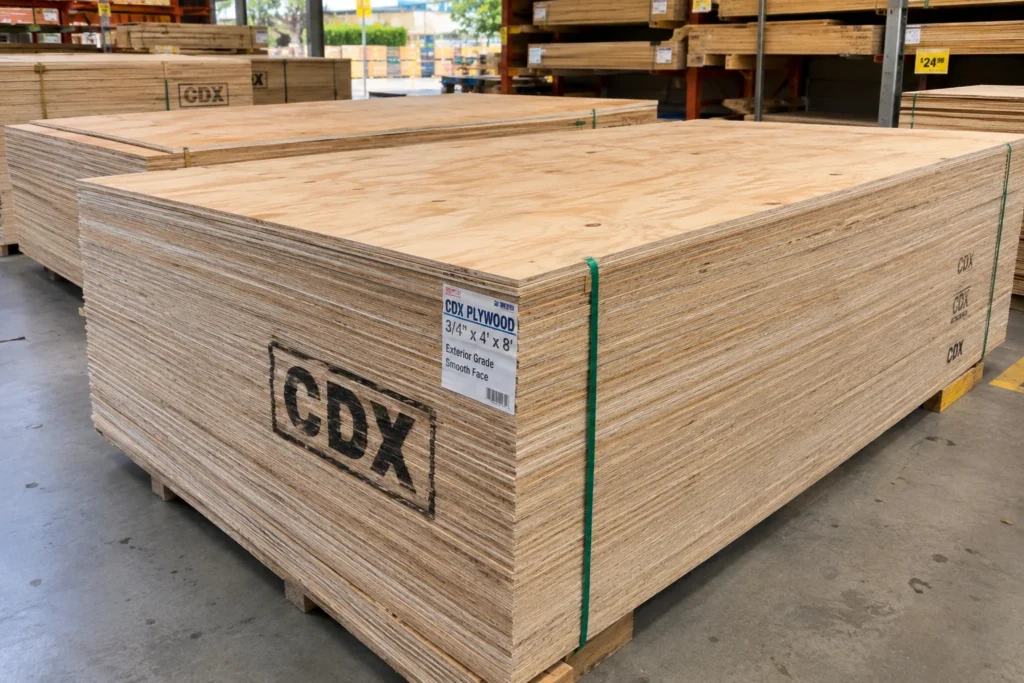
Thickness is where the real decision-making happens. Here’s how the common sizes break down:
| Nominal Thickness | Actual Thickness | Typical Use |
|---|---|---|
| 3/8″ | 11/32″ | Light wall sheathing, 16″ stud spacing |
| 1/2″ | 15/32″ | Wall sheathing, light roof decking |
| 5/8″ | 19/32″ | Roof sheathing, 24″ rafter spacing |
| 3/4″ | 23/32″ | Subflooring, concrete formwork |
The gap between “nominal” and “actual” thickness surprises a lot of first-time buyers. A sheet labeled 3/4 inch actually measures 23/32 inch — a little under 3/4. This isn’t a manufacturing defect; it’s standard across the plywood industry and accounts for sanding tolerances. If you’re calculating flush transitions between plywood and another material, always measure the actual thickness rather than trusting the label.
Where CDX Plywood Is Actually Used
Roof sheathing. This is CDX’s bread and butter. Typically installed in 1/2-inch or 5/8-inch thickness, with the thicker option required for wider rafter spacing (24 inches on center) or heavier snow loads. The panel becomes the nailing surface for shingles, underlayment, or metal roofing once it’s up.
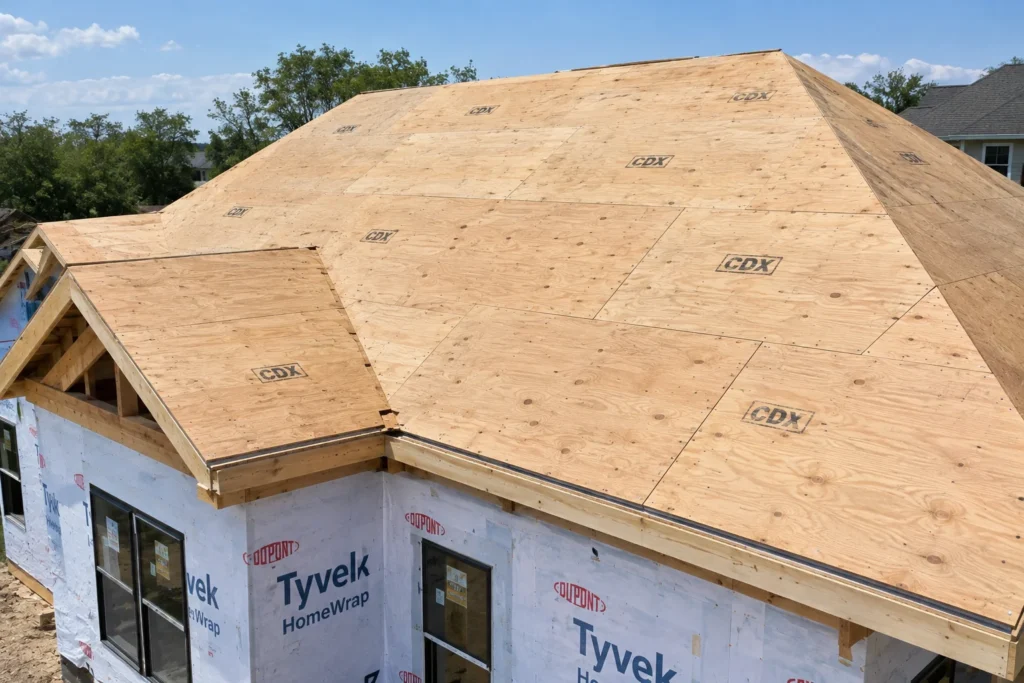
Wall sheathing. 1/2-inch CDX is common here, providing the structural skin under house wrap and siding. It adds racking resistance to the wall assembly, which matters more in high-wind and seismic zones.
Subflooring. 3/4-inch CDX (often with a tongue-and-groove edge for tighter joints) goes down over floor joists before finish flooring — hardwood, tile, or carpet — is installed on top. Tongue-and-groove panels are worth the small price premium here because they eliminate squeaks caused by panel edges flexing independently.
Concrete formwork. CDX is a common, inexpensive choice for building forms that hold poured concrete in place while it cures. Since the form typically gets stripped and discarded or reused only a handful of times, there’s little reason to spend more on a premium panel.
Temporary job-site uses. Staging platforms, temporary fencing, floor protection during renovation — anywhere a rough, disposable surface is useful and appearance is irrelevant.
What CDX is not good for: cabinets, shelving, furniture, or any interior surface that will be visible or painted for a finished look. The rough D-grade back and the knots and patches on the C-grade face will show through paint and won’t sand to a smooth finish the way birch or maple plywood will.
CDX vs. OSB: Which Should You Use?
This comes up on almost every sheathing job, and the honest answer is that both work — the choice usually comes down to price, availability, and local building practice more than performance.
| CDX Plywood | OSB | |
|---|---|---|
| Typical cost (4×8, comparable thickness) | Slightly higher | Slightly lower |
| Moisture behavior | Dries out faster if wetted; swells at the edges | Absorbs moisture more slowly but swells more and dries out slower |
| Weight | Generally lighter | Generally heavier |
| Nail-holding strength | Slightly better, especially at edges | Good, but edges are more prone to crumbling if over-driven |
| Regional availability | Widely stocked everywhere | Very widely stocked, often the regional default |
In the Southeast and parts of the Midwest, OSB tends to be the cheaper, more common default for wall and roof sheathing. In the Northeast and parts of the West, CDX plywood sees more use, partly due to local supply chains and partly due to contractor habit. Building codes generally allow either material as long as the span rating matches the application — check your specific local code before assuming one is required over the other.
What CDX Plywood Costs
Pricing is genuinely volatile and tied to lumber futures, so treat these as general ranges rather than fixed numbers. As of mid-2026, a standard 4×8 sheet of 1/2-inch CDX commonly runs in the $25 to $40 range at big-box retailers and lumberyards, with 3/4-inch sheets running somewhat higher, often $40 to $60. Prices swing by region, by current softwood lumber futures, and by whether you’re buying single sheets or a full pallet at a contractor discount.
Common Mistakes to Avoid
Assuming X means waterproof. It doesn’t. CDX left exposed to weather for an extended period will eventually fail. If a project needs true long-term outdoor exposure — an uncovered deck substrate, for example — you want Exterior-grade plywood, not CDX.
Buying by thickness alone instead of span rating. A sheet labeled “1/2 CDX” from one mill isn’t guaranteed to perform identically to another mill’s 1/2-inch sheet. The APA span rating stamp (a number like 32/16) tells you the actual allowable span for roof and floor use — that’s the number an inspector or engineer will actually care about, not just the nominal thickness.
Skipping the grade stamp check. Reputable suppliers stock panels with a visible APA (or equivalent agency) grade stamp. If a panel doesn’t have one, its structural performance hasn’t been verified to a recognized standard, and it shouldn’t go into a structural application.
Using it where appearance matters. This one’s obvious in hindsight but happens more than you’d think on tight-budget renovation projects — someone reaches for the cheap sheet on hand for a visible shelf or cabinet back and ends up sanding and filling far more than the material savings justified.
Storing it flat on wet ground. Even exterior-rated glue doesn’t protect the wood plies themselves from prolonged ground contact. Stack sheets on stringers, off the dirt, and cover them if they’ll sit on a job site for more than a few days before installation.
Frequently Asked Questions
What does CDX stand for in plywood?
C and D refer to the grades of the face and back veneers, and X refers to the exterior-type, moisture-resistant glue used to bond the plies. Officially, this glue classification is called Exposure 1.
Is CDX plywood waterproof?
No. It resists temporary moisture exposure during construction, but it isn’t rated for permanent outdoor use. Prolonged wetting will eventually cause swelling and delamination.
What thickness of CDX plywood is used for roof sheathing?
Most residential roofs use 1/2-inch or 5/8-inch CDX, with the thickness matched to rafter spacing — 5/8 inch for 24-inch spacing, 1/2 inch often acceptable at 16-inch spacing. Always confirm against the span rating and local code rather than thickness alone.
Can I use CDX plywood for subflooring?
Yes. 3/4-inch CDX, ideally with a tongue-and-groove edge, is standard for residential subfloor applications over joists.
What’s the difference between CDX and OSB?
Both are engineered wood sheathing panels that perform similarly for structural purposes. CDX is made from layered wood veneers; OSB is made from compressed wood strands. Cost and regional availability usually drive the choice more than performance differences.
How much does a sheet of CDX plywood cost?
A standard 4×8 sheet typically runs $25 to $60 depending on thickness, region, and current lumber market pricing. Get a current local quote for anything beyond a rough budget estimate.
Can CDX plywood be used outdoors permanently?
It’s not recommended. For permanent outdoor exposure — like an open deck substrate — use true Exterior-grade plywood rated for continuous weather exposure instead.
What size sheets does CDX plywood come in?
The standard size is 4 feet by 8 feet. Some suppliers carry 4×9 or 4×10 sheets for tall-wall applications, typically as a special order.
Choosing the right sheathing material is one of many decisions that affect how a renovation or new build performs over time. If you’re planning a project that involves structural or roofing work, this GI flashing guide covers another material worth understanding before you order supplies — flashing works alongside sheathing to keep water out of the building envelope.
Sources & References