

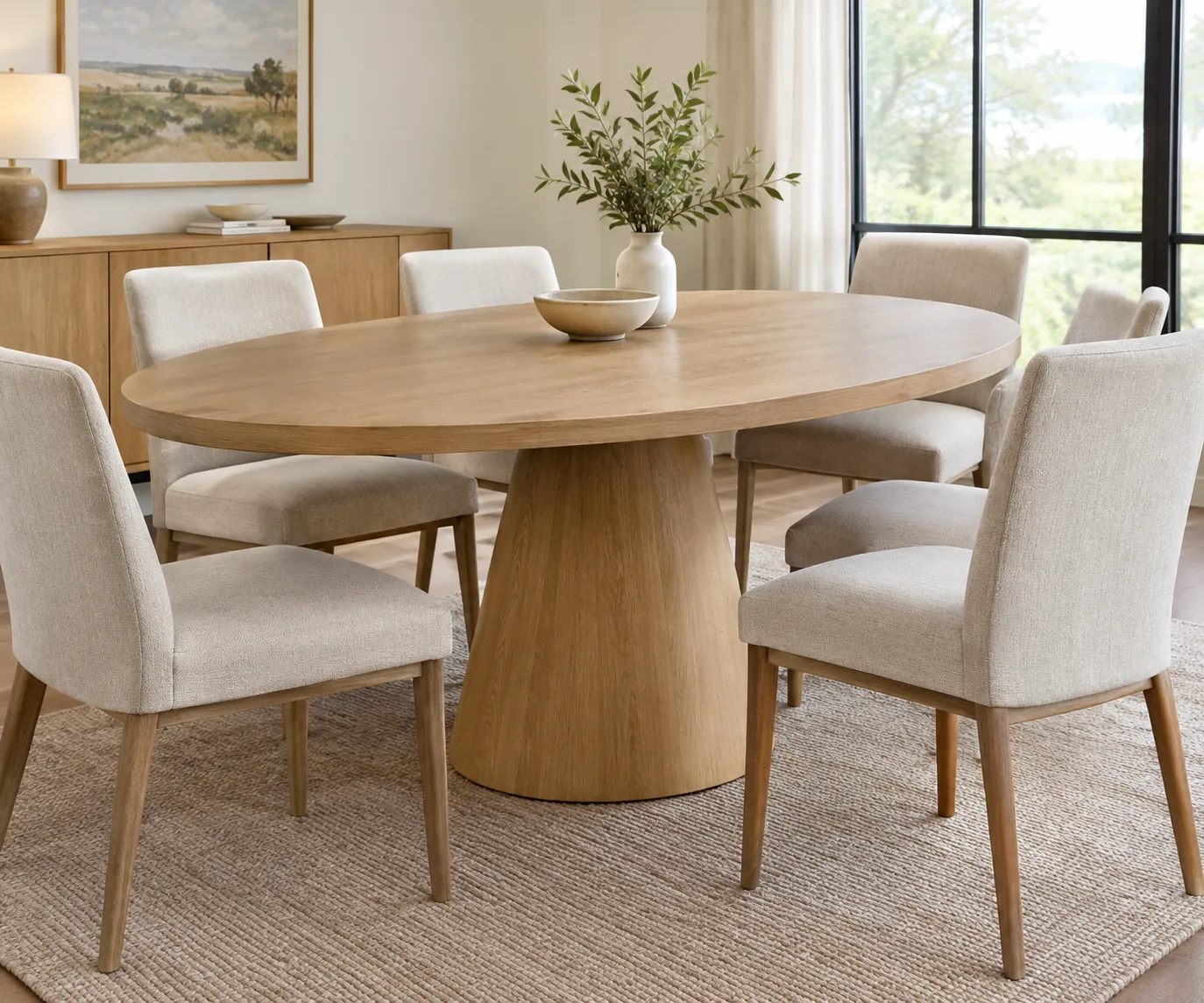
The Aero is a pedestal-base oval dining table sold by RH (Restoration Hardware). It has an oak or walnut top and a cast steel base, and it comes in two fixed sizes: 78 inches, which seats up to six, and 96 inches, which seats up to ten, according to RH’s product page.
It’s a good fit if you want a sculptural, midcentury-leaning table with no legs at the corners. It’s a poor fit if you need extension leaves, are working with a budget under a few thousand dollars, or want a top you can sand and refinish over and over.
The rest of this guide covers how the specs play out in a real dining room, why the price varies so much, and the small details buyers often miss until the table arrives. Specs and prices were checked against RH’s pages and retailer listings in 2026, and both can change.
Quick specs at a glance
These figures come from RH’s product listing for the wood version of the table.
| 78″ Oval | 96″ Oval | |
|---|---|---|
| Top size | 78″L x 48″W | 96″L x 54″W |
| Height | 30″ | 30″ |
| Top thickness | 1½” | 1½” |
| Base footprint | 35½”W x 23¾”D | 35½”W x 23¾”D |
| Weight | 140 lbs. | 151 lbs. |
| Seats (per RH) | Up to 6 | Up to 10 |
| Room needed (see below) | About 12.5′ x 10′ | About 14′ x 10.5′ |
The top is described as solid wood and engineered wood with oak or walnut veneers, with a smooth beveled edge. The base is cast steel, dry brushed and coated for a matte, textured finish. Base options on the listing I reviewed were Antiqued Pewter, Antiqued Brass, and Cast Iron. Wood finishes shown across RH’s pages and resale listings include Light Oak, Natural Oak, Black Oak, Ash Grey Oak, and a dark walnut. RH also sells a stone version (marble or travertine) in the same shapes, but that’s a different table with different weight and care needs.
What makes this table different from other oval tables
Most oval dining tables sit on four legs or a trestle. The Aero has a single central base that sweeps outward, which changes how the table lives in the room in three ways.
Seating is flexible. With no legs at the corners, chairs can sit anywhere along the edge. At a four-leg oval, someone always ends up straddling a leg. This matters most on the 96″ size, where people tend to cram onto the long sides when a crowd shows up.
The footprint is small relative to the top. The base is 35½ by 23¾ inches. That leaves plenty of knee room, but it also means the top does all the visual work. Pair it with chairs that are too heavy or too fussy and the table disappears. Simple, lower-profile chairs let the curved base show.
It’s visually quiet from a distance and busier up close. The matte, textured cast steel reads as a solid dark or metallic shape from across the room. Close up, you notice the finish. Antiqued Brass will likely look warmer and more decorative than Cast Iron, so choose it deliberately rather than as a default.
The design is also gentle on traffic. An oval has no corners at hip height, which helps in dining rooms that double as a walkway to the kitchen or backyard.
Choosing between the 78″ and 96″
This is the decision most people get wrong, usually by buying a bigger table than the room can handle.
RH’s seat counts are maximums. A common rule of thumb is about 24 inches of edge space per person for comfortable dining. On an oval, the curved ends are less usable than a rectangle’s, so the 78″ is more realistic for six than for eight. The 96″ works for eight comfortably and ten for a holiday.
The 18-inch gap between sizes is big. If you regularly host six to eight, the 78″ may feel slightly tight and the 96″ may be more table than you need. In that case, let the room decide.
A simple room check. Many designers suggest leaving at least 36 inches between the table edge and any wall or furniture so people can pull out chairs and walk behind them; 42 to 48 inches is more comfortable where there’s traffic. That’s a design rule of thumb, not a code requirement. Add 72 inches to each dimension of the table (36 on each side) and you get the minimum room size listed in the table above. A 96″ Aero in a 12-foot-wide dining room will technically fit, but one side will feel pinched.
If your room is smaller than about 10 by 12 feet, RH’s Aero Round tables (30″ to 72″) use the same base design and might serve you better. RH lists the smaller round sizes as seating up to four.
Price: what to expect and why it varies
RH’s pricing is unusual, and it’s the main source of confusion online.
RH lists a “Regular” price and a lower “Member Sale” price. On the RH pages I found while researching this article, different Aero Oval listings showed starting prices of roughly $6,300 regular / $3,745 member and $7,140 regular / $4,239 member, and one page showed a member price of $3,525. I couldn’t confirm which size or finish each figure applied to, and RH changes prices frequently, so treat these as snapshots, not quotes. Check the current price for your exact size, wood, and base.
Some practical points:
- The member price depends on a paid membership. RH’s membership has a yearly fee, and the fee and discount rates have changed over time. RH’s own pages in different regions and sections showed different numbers when I checked, so confirm the current terms on RH’s membership page before relying on any third-party summary. For a large purchase such as a table plus chairs, the fee can pay for itself quickly, but only if the member price applies to your items.
- “Starting at” prices can be misleading. The lowest advertised price may apply only to one size or finish combination.
- Shipping and delivery are separate. RH FAQ pages I found say member savings don’t apply to shipping charges. Check RH’s current US shipping page and factor delivery fees into your total.
- Financing terms change. RH’s credit card pages showed different issuers and terms at different times in 2026, so read the current terms rather than assuming.
Buying pre-owned. Aero tables show up regularly on resale sites such as AptDeco and Chairish, often at a discount to new. Two cautions. First, older units can differ from the current design. One resale listing showed dimensions of 77.5″ x 49″ x 29″, slightly different from the current 78″ x 48″ x 30″, so measure against your chairs. Second, ask for photos of the top surface under angled light, since veneer damage shows best that way.
The veneer question
RH describes the top as solid wood and engineered wood with oak or walnut veneers. That’s a common construction for a large tabletop, since a single solid slab that size would be heavier, costlier, and more prone to movement with humidity changes. But it affects how you should care for it.
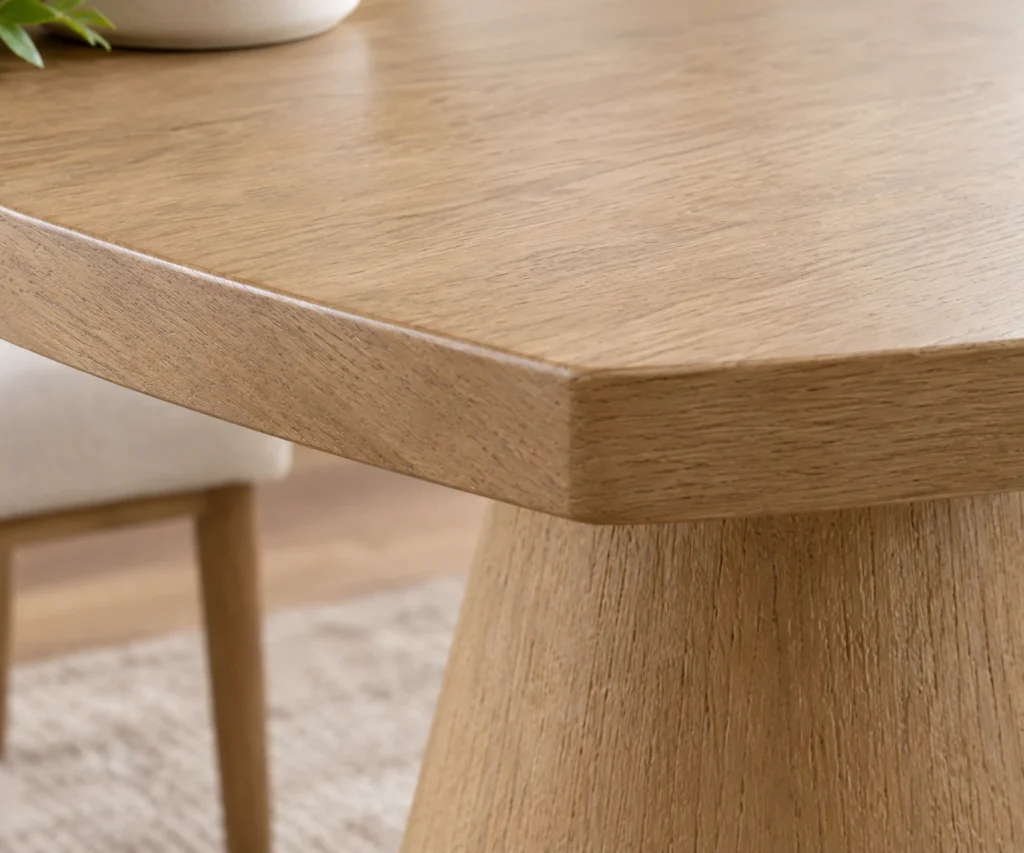
A veneer top can usually be touched up and re-waxed or recoated, but heavy sanding risks cutting through the veneer layer. RH doesn’t state the veneer thickness on the pages I reviewed, so if you expect to strip and refinish a table every decade, this isn’t the right table. If you’d rather have a solid-wood table you can resurface repeatedly, look at fully solid-wood options instead and expect a different look and a different price.
Everyday care:
- Use coasters and trivets. No finish is immune to heat rings.
- Wipe spills promptly and avoid soaking the surface.
- Keep the table out of long stretches of direct sun, which can fade wood unevenly.
- Watch for humidity swings. Placing the table directly over a heating vent or next to a drafty window is a common cause of dryness and movement in wood.
- Matte, textured metal is generally less prone to showing fingerprints than polished metal, but I can’t speak to how any specific base finish ages over the long term.
Delivery and setup: the details buyers overlook
The top is a single piece 48″ or 54″ wide, and the table weighs 140 to 151 pounds assembled. RH’s listing says assembly is provided upon delivery. A resale listing says the top unscrews from the base with an Allen wrench, but I couldn’t confirm that on RH’s own page, so ask RH before counting on it if you plan to move the table later. Either way, you need a clear path for the top itself.
Before you order, measure:
- Front doors and any interior doors on the route
- Stair turns and landings, if the dining room is upstairs or downstairs
- Elevator dimensions, for condos and apartments
Also confirm return and exchange terms before purchase. Furniture of this size is expensive to ship back, and policies for large items often differ from smaller goods. Check RH’s current returns page rather than assuming.
Who should buy it, and who shouldn’t
It suits you if:
- You like midcentury-inspired or sculptural modern design and want the table to be a focal point.
- You often seat guests along the long sides and are tired of table legs getting in the way.
- You have a dining room at least 10 feet wide and want a softer shape than a rectangle.
- You’re comfortable with a veneered top and want a finished look without a lot of upkeep.
Skip it if:
- You need to expand from a small table to a large one. RH lists two fixed sizes, and I didn’t find leaves or extension options.
- You want a fully solid-wood table you can refinish many times.
- Your room is narrow. An oval is forgiving, but a 96″ table still needs about 14 feet of length to feel comfortable.
- The price is a stretch. At the member prices above, you’re paying designer-retailer pricing, and other sellers offer pedestal ovals at a range of price points.
A decision shortcut: if you seat six or fewer regularly and have a standard-size dining room, choose the 78″. If you host eight or more at least a few times a year and have 14 feet of room, choose the 96″ and if you’re between the two, the room’s width is usually the tiebreaker.
If the Aero’s modern look isn’t what you want, a very different style is worth comparing. Our Ashley Woodanville dining table set review covers a farmhouse-style option.
When you’re choosing chairs for a table like this, it helps to know what to check on any dining chair, from seat height to overall size. Our Tyler Creek dining chair review and Ashley Jorlaina dining chair review show how we evaluate those details.
Common mistakes
- Buying for the biggest holiday, not everyday use. A 96″ table in a room that barely fits it will feel cramped 360 days a year.
- Ignoring rug size. A rug should be large enough that chair legs stay on it when people pull back. With a table this size, that usually means a very large rug.
- Choosing chairs after the table arrives. Seat height, arm width, and leg style all affect whether the table’s curves look elegant or crowded.
- Assuming “seats 10” means ten comfortable adults. It means ten is possible.
- Not checking the finish in person. Wood tones and metal finishes photograph differently under different lighting. If you can visit an RH Gallery, look at both the top and base finish in daylight.
Frequently asked questions
How many people does the Aero oval dining table seat?
RH says the 78″ size seats up to 6 and the 96″ size seats up to 10. Those are maximums. For everyday comfort, think six on the smaller table and eight on the larger one.
How big does my dining room need to be?
Allow about 36 inches of clearance around the table. That works out to roughly 12.5 by 10 feet for the 78″ and 14 by 10.5 feet for the 96″. More clearance is better if the room is a walkway.
Is the Aero table solid wood?
Not entirely. RH describes the top as solid wood and engineered wood with oak or walnut veneers. The base is cast steel.
Does it have leaves or extensions?
RH’s listing shows two fixed sizes. I didn’t find any leaf or extension option in the product details.
How much does it cost?
RH’s regular and member prices vary by size and finish and change often. Pages I reviewed showed starting prices from roughly $3,525 to $4,239 for members and $6,300 to $7,140 regular, but confirm the current price for your configuration on RH’s site.
Can I buy it used?
Yes. Resale sites list pre-owned Aero tables. Check the dimensions carefully, since older units may differ slightly, and ask for close-up photos of the top.
What finishes and bases are available?
Listings show oak and walnut tops in several tones, plus Antiqued Pewter, Antiqued Brass, and Cast Iron bases. Availability changes, so check the current options.
Is the table heavy to move?
Assembled, it weighs 140 to 151 pounds per RH. One resale listing says the top unscrews from the base, which would help, but that isn’t confirmed on RH’s page. Plan for at least two people either way.
Sources & references
- RH product page for the Aero Oval Dining Table (dimensions, materials, seating): rh.com/us/en/catalog/product/product.jsp/prod32050062
- RH Credit Card and Members Program pages (financing and membership terms, which change): rh.com
- Resale listings on AptDeco and Chairish (for pre-owned details and older-unit dimensions)
Prices, specs, and membership terms were checked in 2026 and may have changed. Confirm current details with RH before buying.