

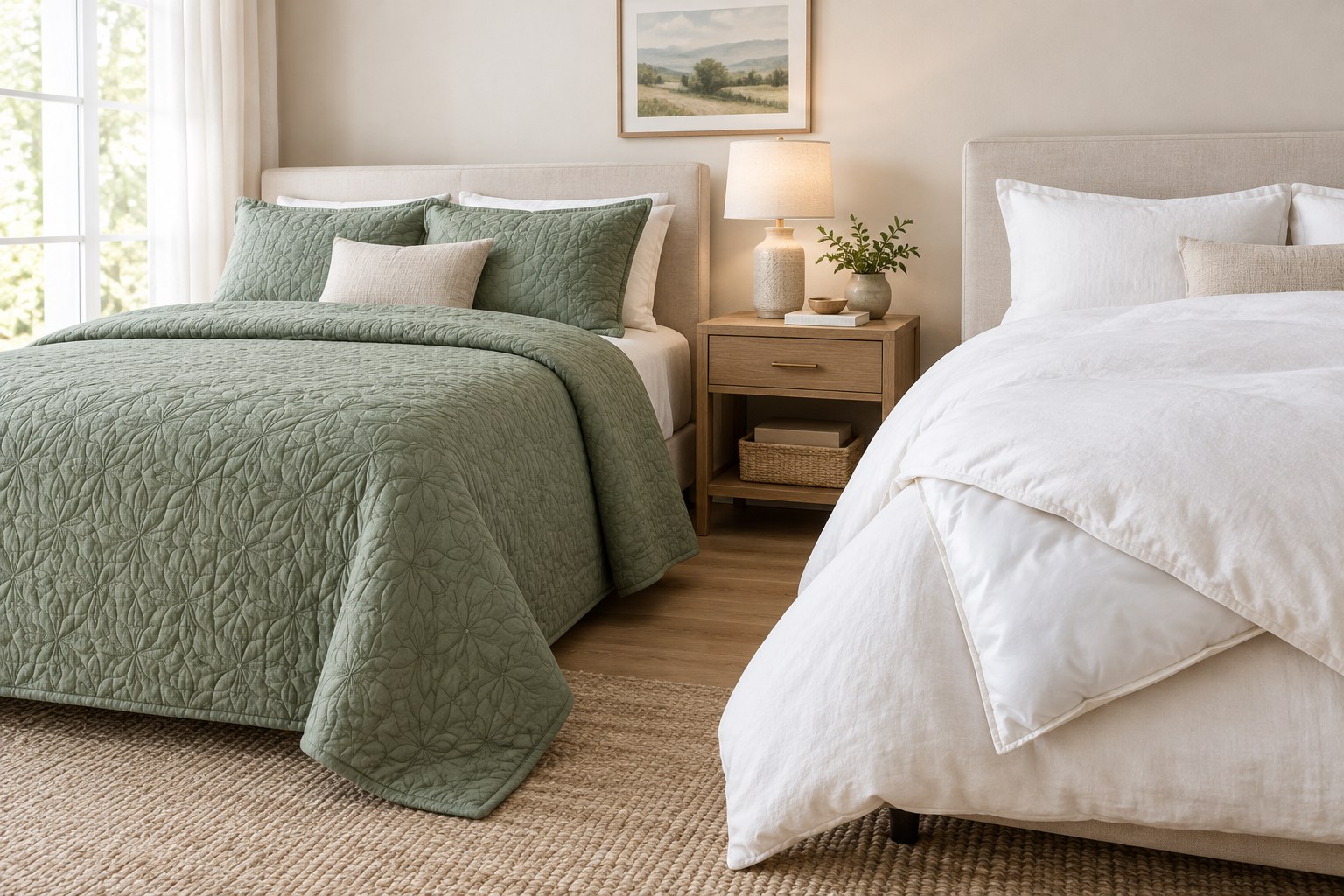
A comforter is a quilted blanket that you lay straight on the bed. A duvet is an insert filled with down or a synthetic alternative that goes inside a removable cover. That removable cover is the main thing that sets a duvet apart from a comforter.
Choose a comforter if you want a simple, ready-made setup and don’t mind washing a bulky item. Choose a duvet if you want cleaner bedding, the freedom to change your bedroom’s look cheaply, or the ability to swap warmth levels each season. Many people also use a comforter as a duvet insert, which gives them a bit of both.
Duvet vs. comforter at a glance
| Comforter | Duvet (insert + cover) | |
|---|---|---|
| What you buy | One finished piece | Two pieces: an insert and a cover |
| Appearance | Decorative as sold | Plain insert, patterned or colored cover |
| Washing | You wash the whole comforter | You usually wash the cover and wash the insert less often |
| Changing the look | Buy a new comforter | Buy a new cover |
| Warmth options | Fixed | Swap the insert, or use different weights by season |
| Bed-making effort | Low | Higher: inserting it in the cover takes some work |
| Typical drawback | Bulky to wash at home | Insert can shift or bunch inside the cover |
What is a comforter?
A comforter is a quilted blanket. Stitching keeps the fill steady between two layers of cloth and the outer cloth is usually printed or colored so you can use the comforter without any cover. Fill choices include polyester (commonly called down alternative), cotton, wool or down itself. Many stores sell matching comforter sets that come with shams and sometimes decorative pillows.
Comforters look flatter and aren’t as puffy as a duvet. Some comforters have a “tailored” look that works well on a made bed with a sheet and decorative pillows.
What is a duvet?
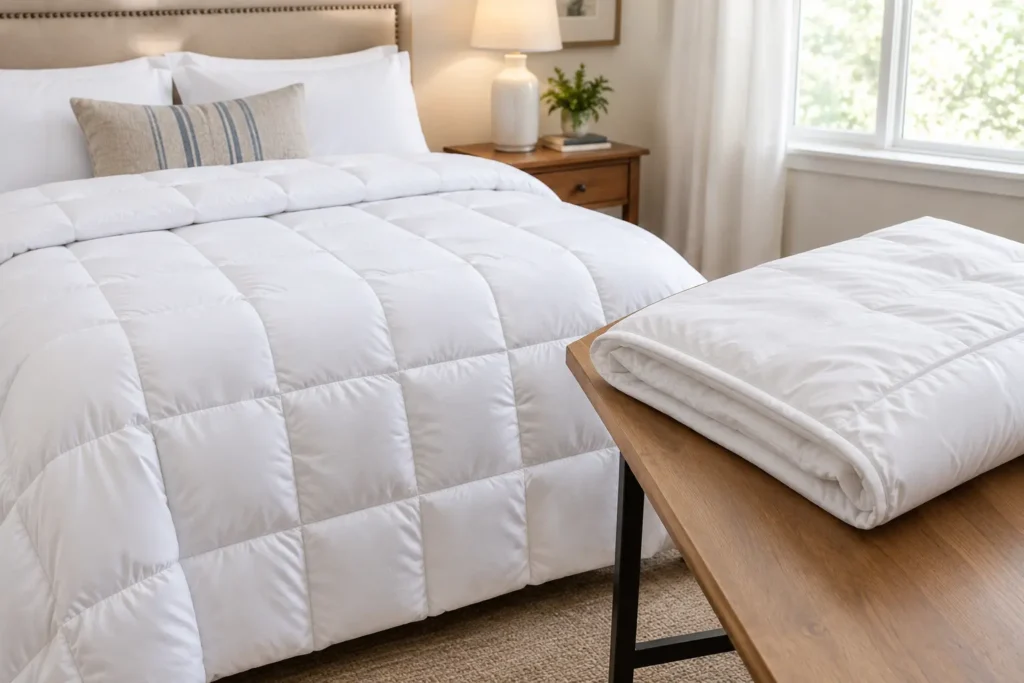
A duvet is made up of two parts: an insert and a duvet cover. The insert is a flat bag that holds the fill. The fill is usually down feathers, wool, silk or a synthetic alternative. The cover works like a pillowcase that can be closed with a zipper, buttons or ties around the insert. The word “duvet” comes from the word for down and the idea of a duvet came from Europe.
Because the cover takes the dirt, you can wash it like sheets while the insert stays protected inside. A duvet usually feels fluffier and looks rounder than a flat quilted comforter.

The labeling confusion you’ll run into
Retailers don’t always use these terms in this way. That can lead to mistakes when shopping.
- Many products called “down comforter” are actually duvet inserts. They are plain, often white or neutral in color, and are meant to be used inside a cover.
- Some items labeled “duvet” are sold with a cover and work more like a complete comforter set.
- A true comforter, meant to be used on its own, usually has decorative fabric and stitching.
Don’t just trust the name. Read the product description carefully, check whether it says “insert,” look for corner tabs or loops that attach to a cover, and see whether it’s sold with or without a cover.
How they compare in daily life
Washing and upkeep
The biggest practical difference is washing. A comforter has no removable layer, so you must wash the whole thing, which can be awkward for a king-size comforter in a home washer. A duvet cover goes into the laundry with your sheets, which is why people who wash bedding often prefer duvets. Many sleep brands suggest washing a cover about as often as your sheets and the insert only a few times a year, depending on how you sleep and whether you have pets.
Check the care label on any duvet insert. Some can be machine washed, while others say dry clean only. A large-capacity front-loading washer, at home or at a laundromat, usually handles a king-size insert better than a standard top-loader with an agitator. Dry the insert thoroughly, because a damp insert can develop odor or mildew.
Warmth and seasonal flexibility
Two numbers affect how warm down bedding is, and many people mix them up. Fill power measures how much space one ounce of down takes up, in cubic inches. A higher number means the down is fluffier and insulates better, so you need less of it. Fill weight is the amount of down in the product. A duvet with a high fill power can feel lighter and warmer than one with lower fill power at the same weight, but total warmth also depends on how much down is inside. REI’s guide explains fill power in detail.
With a duvet, you can use a lighter insert in summer and a warmer one in winter under the same cover, or you can choose one all-season insert. With a comforter you get a single level of warmth, so in winter you add a blanket on top and in summer you take the comforter off.
Climate matters here. In the Southeast, the Southwest and other warm areas, a lightweight duvet or a thin comforter usually works all year. In the Northeast, the Upper Midwest and mountain regions, a heavier insert is a good idea. Couples with different temperature preferences sometimes use two separate duvets on the same bed, a common practice in parts of Europe that avoids arguments over one covering.
Cost
A comforter is bought as one item, so it can be cheaper up front. A duvet needs both an insert and a cover, so the initial price is often higher. The difference shows over time: covers are cheaper to swap than whole comforters, so updating the look of your bedroom costs less later. Prices vary a lot by fill and fabric, so compare actual products instead of assuming one type is always more expensive.
Style and customization
A duvet lets you change the look easily. You can pick covers in cotton percale, which feels crisp and cool; sateen, which is smooth and a bit warmer; linen, which is loose and breathable; or flannel, which is soft and cozy for colder months. Just swap the cover when the season changes, with no need to buy a new duvet. With a comforter, you’re stuck with the design you bought until you replace it.
Ease of making the bed
Comforters win on simplicity: lay one down and you’re done. Duvets can be frustrating at first, because you have to get a large, floppy insert into a cover and fit the corners. Some covers have internal ties or loops to anchor the insert, which helps prevent bunching. Without ties, the insert tends to migrate and clump in a corner.
Allergies
Many people with allergies choose synthetic-filled inserts or comforters, since they’re generally easier to wash at home than natural down. Washing covers regularly also helps reduce dust. If allergies are a serious concern, ask your allergist what bedding fits your situation rather than relying on product marketing.
Construction details worth checking
Baffle-box versus sewn-through. Quality down inserts often use baffle-box construction, where fabric walls inside the insert create compartments that keep the fill from moving and prevent cold spots. Sewn-through designs stitch the top and bottom layers directly together, which is cheaper and flatter but can leave thin spots along the stitch lines.
Fill type. Down is the undercoat of ducks or geese. Feathers are firmer and heavier, and they can poke through fabric. A “down and feather” blend costs less but feels less airy. If you want ethically sourced down, look for third-party certification such as the Responsible Down Standard, which sets animal welfare requirements.
Cover fabric and weave. Choose a fabric that suits how you sleep. Percale feels crisp and cool, sateen feels smoother, and flannel feels warmer.
Sizing: get this right before you buy
Bedding sizes follow standard U.S. mattress dimensions:
| Mattress size | Dimensions (inches) |
|---|---|
| Twin | 38 x 75 |
| Twin XL | 38 x 80 |
| Full | 54 x 75 |
| Queen | 60 x 80 |
| King | 76 x 80 |
| California King | 72 x 84 |
Insert and cover sizes vary by brand. A queen insert typically measures around 86 to 90 inches square, and a king is roughly 102 to 108 inches wide, but check the listed dimensions. Match your insert size to your cover size. A cover that’s much larger than the insert leaves empty corners and causes shifting, while a cover that’s too small bunches the fill. Some people buy an insert one size larger than the cover for a fuller look, though that can make it harder to fit.
If you’re buying for a college dorm, note that many U.S. dorm beds are Twin XL, and a regular Twin duvet cover may be too short.
Can you use a comforter as a duvet insert?
Yes. A comforter works as a duvet insert if you slip it into a cover, and it’s a good way to use something you already own. Keep these points in mind:
- A quilted pattern can show through a thin cover.
- A comforter is usually thinner and flatter, so the finished look is less puffy.
- Use a cover with ties or corner loops to hold it in place.
A comforter has no sewn-in handling features like tabs, so it may shift more than a purpose-built insert.
Which one should you choose?
| Your situation | Likely best choice |
|---|---|
| You want the easiest setup | Comforter |
| You wash bedding often | Duvet, so you only launder the cover |
| You like changing your decor | Duvet |
| You have pets or children | Duvet, since the cover takes the mess |
| You live where seasons vary | Duvet with a seasonal insert |
| You’re furnishing a rental or dorm on a budget | Comforter, or a comforter in a cover |
| Partners have different temperature needs | Two separate duvets |
| You want a plush, hotel-style look | Duvet |
Before you buy: a quick checklist
- Decide whether you want one finished piece (comforter) or an insert plus a removable cover (duvet).
- Measure your mattress, including its depth, and match it to the standard size chart above.
- Read the product description for the word “insert,” and check whether a cover is included.
- Compare the insert and cover dimensions, and avoid a cover much larger or smaller than the insert.
- Check the care label: machine washable, or dry clean only?
- Pick a warmth level for your climate, looking at both fill power and fill weight if you’re buying down.
- Look for corner ties or loops on the cover and insert so the insert stays in place.
- Choose a cover fabric (percale, sateen, linen or flannel) that matches how you sleep.
- If you want ethically sourced down, look for a certification such as the Responsible Down Standard.
- Make sure your washer, or a nearby laundromat machine, is large enough for an insert.
Common mistakes
Buying a cover without checking the insert size. Check both sets of dimensions.
Ignoring the care label. A “dry clean only” insert is a poor fit if you wash bedding at home.
Judging warmth by fill power alone. Fill weight matters too.
Overstuffing the washer. Cramming a large insert into a small machine leaves it wet in the middle and prone to clumping.
Skipping ties. A duvet insert without corner ties or loops will bunch.
Assuming “comforter” and “duvet” mean the same thing on every product page. Read the details.
Finishing the room? See our guides to wooden curtain rods and the Ashley Chadton accent table.
Frequently asked questions
Is a duvet warmer than a comforter?
Not automatically. Warmth depends on the fill type, fill power, and amount of fill. A thick comforter can be warmer than a lightweight duvet.
Do you need a top sheet with a duvet?
No. The cover acts as a barrier, so a top sheet is optional. Some people use one to protect the cover or for layering.
How often should I wash a duvet cover?
Many people launder it about as often as sheets. Wash it more often if you sleep hot, have pets, or have allergies.
Can I wash a duvet insert at home?
Often yes, but follow the care label. Use a large machine, a gentle cycle, and dry it completely.
What is a duvet insert called in stores?
Sometimes a “comforter,” a “down comforter,” or an “insert.” Check the description for details.
What’s the difference between a comforter and a quilt?
A quilt is usually thinner and has stitched patterns with light filling, while a comforter is thicker and puffier. A quilt works well as a layer in warm weather.
What size duvet insert should I buy?
Match your cover size, and use the mattress dimensions as a starting point. A deeper mattress may need a larger size for coverage.
Is a down comforter the same as a duvet?
Not exactly. A down comforter is meant to be used as is, while a duvet insert is designed to go inside a cover, though many down comforters are also used as inserts.
Sources & References
- REI Co-op Expert Advice, What Is Down Fill Power?
- Textile Exchange, Responsible Down Standard overview
- Retail bedding guides from Wayfair, The Home Depot, and Amerisleep (definitions of duvets, inserts, and covers)
Product details, sizes, and care instructions vary by brand. Follow the label on the item you buy. This article is general information, not medical advice.