

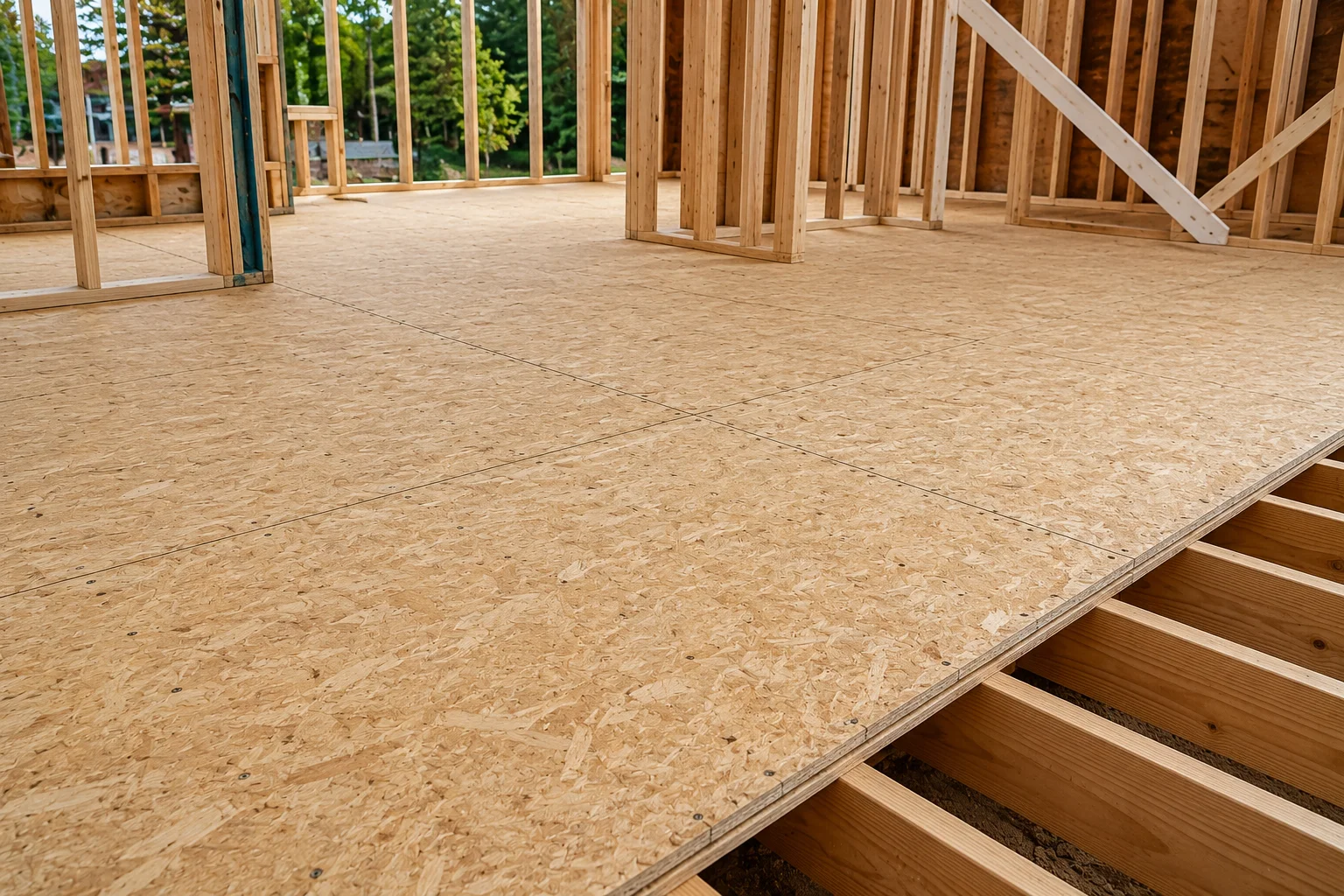
If you’ve priced out flooring for a new build or a major renovation, you’ve probably run into the name AdvanTech. It shows up on nearly every builder spec sheet across the country, and for good reason. It’s become the default upgrade for anyone who wants a subfloor that stays quiet, stiff, and squeak-free for decades.
I’ve worked alongside contractors on several builds where AdvanTech was the spec, and I’ve also seen the difference firsthand on projects that used cheaper standard OSB instead. The gap shows up fast, especially a few years in, once seasonal humidity and foot traffic start testing the floor’s limits.
This guide breaks down everything you need to know in 2026. That includes real-world cost ranges, how installation actually works, the benefits that justify the higher price tag, and how it stacks up against plywood and standard OSB.
What Is AdvanTech Subfloor?
Huber Engineered Woods makes AdvanTech, a structural subfloor panel built from oriented strand board, or OSB. The company uses a proprietary resin system that resists moisture far better than standard OSB or plywood.
The panels come in 4×8-foot sheets. You’ll typically find three thickness options: 23/32-inch, 7/8-inch, and 1-1/8-inch. Most residential builds use 23/32-inch as the standard spec, and installers typically place it over joists spaced at 16, 19.2, or 24 inches on center.
Every panel features tongue-and-groove edges. That design locks adjoining sheets together tightly, which reduces gaps, deflection, and squeaks once builders finish the floor. Huber has manufactured this product since the late 1990s, and production builders and custom home contractors now widely specify it as one of the top subfloor brands on the market.
The panels also use a no-added-urea-formaldehyde resin system, which manufacturers often label NAUF. That matters for indoor air quality, especially in tightly sealed modern homes where off-gassing from building materials can accumulate.
What Makes AdvanTech Different From Standard OSB or Plywood
The core difference comes down to moisture performance. Standard OSB absorbs water readily and can swell significantly if rain hits it during construction, which happens more often than most homeowners realize. AdvanTech’s resin technology keeps thickness swell under 5% after a 24-hour water soak, based on manufacturer testing. Standard OSB can swell closer to 20% under the same conditions.
That moisture resistance translates directly into fewer callbacks for contractors and fewer squeaks for homeowners down the road. Swollen, uneven subfloor panels commonly cause squeaky floors, popped fasteners, and uneven finished flooring.
Screw-holding strength differs meaningfully too. AdvanTech panels generally hold roughly twice the withdrawal strength of standard OSB, according to manufacturer data. That extra grip matters most under heavy fixtures, tile installations, and high-traffic areas.
Plywood still holds a slight edge in raw puncture resistance. But most builders find that AdvanTech’s moisture resistance, consistent thickness, and warranty terms outweigh that narrow advantage for typical residential subfloor use.
AdvanTech Subfloor Cost in 2026
Pricing varies by region, thickness, and current lumber market conditions, so treat these as general ranges rather than fixed numbers. As of 2026, expect to pay roughly $28 to $58 per 4×8 sheet for standard 23/32-inch AdvanTech at most lumberyards and home improvement retailers. Some regions and suppliers charge more, particularly for thicker panels or treated-edge versions that shed water more effectively during construction.
On a per-square-foot basis, that generally works out to somewhere between $0.90 and $1.80 installed, though labor costs, project size, and local material pricing all shift that number. For a typical 1,500-square-foot single-story home, subfloor material costs alone often land somewhere in the $4,000 to $8,000 range before labor, depending on thickness and local pricing.
A few cost factors worth knowing:
- Thickness increases cost. Moving from 23/32-inch to 1-1/8-inch panels raises the price per sheet noticeably, since thicker panels use more material.
- Treated-edge versions cost slightly more than standard panels but offer better protection against water exposure before builders fully dry in the home.
- Adhesive adds to the total. Huber’s compatible subfloor adhesive typically runs $15 to $22 per tube, and most installations require several tubes depending on square footage.
- Buying in bulk often reduces per-sheet cost. Contractors ordering large quantities frequently negotiate better pricing than a homeowner buying a handful of sheets retail.
For an accurate number on your specific project, get quotes from at least two or three local suppliers, since regional pricing swings can be significant.
Is AdvanTech Worth the Extra Cost?
This is the question every owner-builder eventually asks, since AdvanTech typically costs 20% to 50% more than commodity OSB. In most cases, yes, it’s worth it, particularly for anything beyond a small outbuilding or shed.
The math generally favors AdvanTech once you factor in long-term value. Fewer squeaks, less risk of moisture damage during construction, and a stronger warranty all reduce the odds of expensive repairs or callbacks once builders finish the home. For a whole-house build, the price difference between AdvanTech and standard OSB often amounts to a small fraction of the total construction budget, while the performance gap remains significant.
Where standard OSB might still make sense: smaller, budget-conscious projects like sheds, workshops, or other structures where moisture exposure and long-term structural performance matter less.
How AdvanTech Subfloor Installation Works
Proper installation matters just as much as the product itself. Even the best subfloor panel will squeak and shift if installers put it in incorrectly.
1. Confirm joist spacing and panel orientation. Manufacturers rate AdvanTech panels for 16, 19.2, or 24-inch on-center joist spacing, depending on thickness. Check your local building code and the manufacturer’s span rating chart before installing.
2. Apply construction adhesive to the joists. Run a continuous bead of subfloor adhesive along each joist before setting panels in place. This step earns Huber’s squeak-free warranty and dramatically improves the finished floor’s stiffness.
3. Set panels with the tongue-and-groove edges engaged. Stagger the seams between rows, similar to a brick pattern, so joints don’t line up across adjacent panels. This improves overall structural strength.
4. Leave the recommended gap at panel edges. Most manufacturers recommend a small gap, often around 1/8 inch, between panel ends to allow for slight expansion. Check current Huber installation guidelines for the exact spec, since Huber updates its recommendations periodically.
5. Fasten with nails or screws per code requirements. Follow local building code and manufacturer fastening schedules for spacing and fastener type. Screws generally offer better long-term squeak resistance than nails alone, though many contractors still use ring-shank nails successfully.
6. Protect the panels from prolonged water exposure. AdvanTech resists moisture significantly better than standard OSB, but it still can’t handle standing water indefinitely. Keep the site reasonably dry during construction whenever possible, and address any water pooling promptly.
Most professional crews can install a typical single-story home’s subfloor in one to three days, depending on square footage and crew size. DIY installers should budget considerably more time, especially without prior subfloor experience.
Key Benefits of AdvanTech Subfloor
- Superior moisture resistance. The proprietary resin system keeps panels performing well even when rain hits the jobsite during construction, a common real-world scenario most subfloor materials can’t handle.
- Strong warranty coverage. Huber backs AdvanTech with a 50-year limited warranty and a 500-day no-sanding guarantee against edge swell from rain exposure before builders enclose the home.
- Quieter, stiffer floors. The combination of tongue-and-groove edges, proper adhesive installation, and consistent panel thickness significantly reduces squeaks and floor deflection.
- Better screw-holding strength. Roughly double the withdrawal strength of standard OSB means fixtures, subfloor-mounted hardware, and finish flooring stay secure longer.
- Healthier indoor air. The no-added-urea-formaldehyde resin reduces off-gassing compared to some older engineered wood products.
- Consistent panel quality. Manufacturing consistency reduces the odds of warped, uneven, or defective sheets making it into your build, which matters for a smooth, level finished floor.
Common Installation Mistakes to Avoid
- Skipping the adhesive. Nailing or screwing panels down without construction adhesive causes many squeaky AdvanTech floors, and it can void warranty eligibility.
- Ignoring the expansion gap. Butting panels tightly against each other without any gap can cause buckling as the material naturally expands with humidity changes.
- Using the wrong fastener spacing. Under-fastening leads to more movement and squeaks over time. Follow the manufacturer’s and local code’s fastening schedule closely.
- Leaving panels exposed to standing water for extended periods. Even moisture-resistant panels benefit from reasonable protection during construction.
- Mismatching panel thickness to joist spacing. Using a thinner panel than your joist spacing requires can lead to excessive deflection and a bouncy, unstable floor.
If you’re planning a larger renovation and weighing subfloor materials against other structural options, it helps to compare span ratings and moisture performance across products before finalizing your build plan. Our guide to choosing the right subfloor material for your renovation breaks down how AdvanTech compares to plywood and standard OSB across different climate zones and project types.
Frequently Asked Questions
How much does AdvanTech subfloor cost per sheet? As of 2026, standard 23/32-inch AdvanTech typically runs $28 to $58 per 4×8 sheet, depending on region, supplier, and current lumber market conditions. Thicker panels and treated-edge versions cost more.
Is AdvanTech better than plywood for subfloors? For most residential applications, yes. AdvanTech generally offers better moisture resistance, more consistent panel quality, and a stronger warranty than standard plywood, though plywood retains a slight edge in raw puncture resistance.
How thick should AdvanTech subfloor be? Most residential builds use 23/32-inch panels over standard joist spacing. Thicker options, 7/8-inch and 1-1/8-inch, suit wider joist spacing or projects requiring extra stiffness, such as tile installations.
Does AdvanTech subfloor need adhesive? Yes, for best results. Huber requires construction adhesive between panels and joists for squeak-free warranty coverage, and it significantly improves the finished floor’s stiffness and quiet performance.
How long does AdvanTech subfloor last? Huber backs AdvanTech with a 50-year limited warranty, and properly installed panels commonly last the lifetime of the home as long as they avoid chronic moisture problems unrelated to normal construction exposure.
Can AdvanTech subfloor get rained on during construction? Yes, to a much greater degree than standard OSB. The panels carry a 500-day no-sanding guarantee against edge swell from typical rain exposure before builders fully enclose the home, though you should still avoid prolonged standing water.
What joist spacing works with AdvanTech subfloor? Manufacturers rate AdvanTech panels for 16, 19.2, or 24-inch on-center joist spacing, depending on thickness. Always check the manufacturer’s current span rating chart and local building code before installation.
Is AdvanTech worth the extra cost over standard OSB? For most homes, yes. The price premium, typically 20% to 50% over commodity OSB, usually amounts to a small fraction of total construction cost, while the improvement in moisture resistance, strength, and long-term performance stays significant.
Final Thoughts
AdvanTech has become the go-to subfloor choice for good reason. It handles the messy realities of a real construction site, including rain, foot traffic, and imperfect scheduling, far better than standard OSB or plywood. The higher price tag reflects genuine performance differences, not just marketing.
Get the installation details right, especially the adhesive and proper fastening schedule, and you’ll end up with a subfloor that stays quiet and solid for decades. That’s exactly what you want underneath floors you’ll never see again once you finish the project.
For detailed technical specifications, installation guidelines, and current product information, the Huber Engineered Woods official AdvanTech resource page offers manufacturer-verified installation instructions and span rating charts for different project types.