

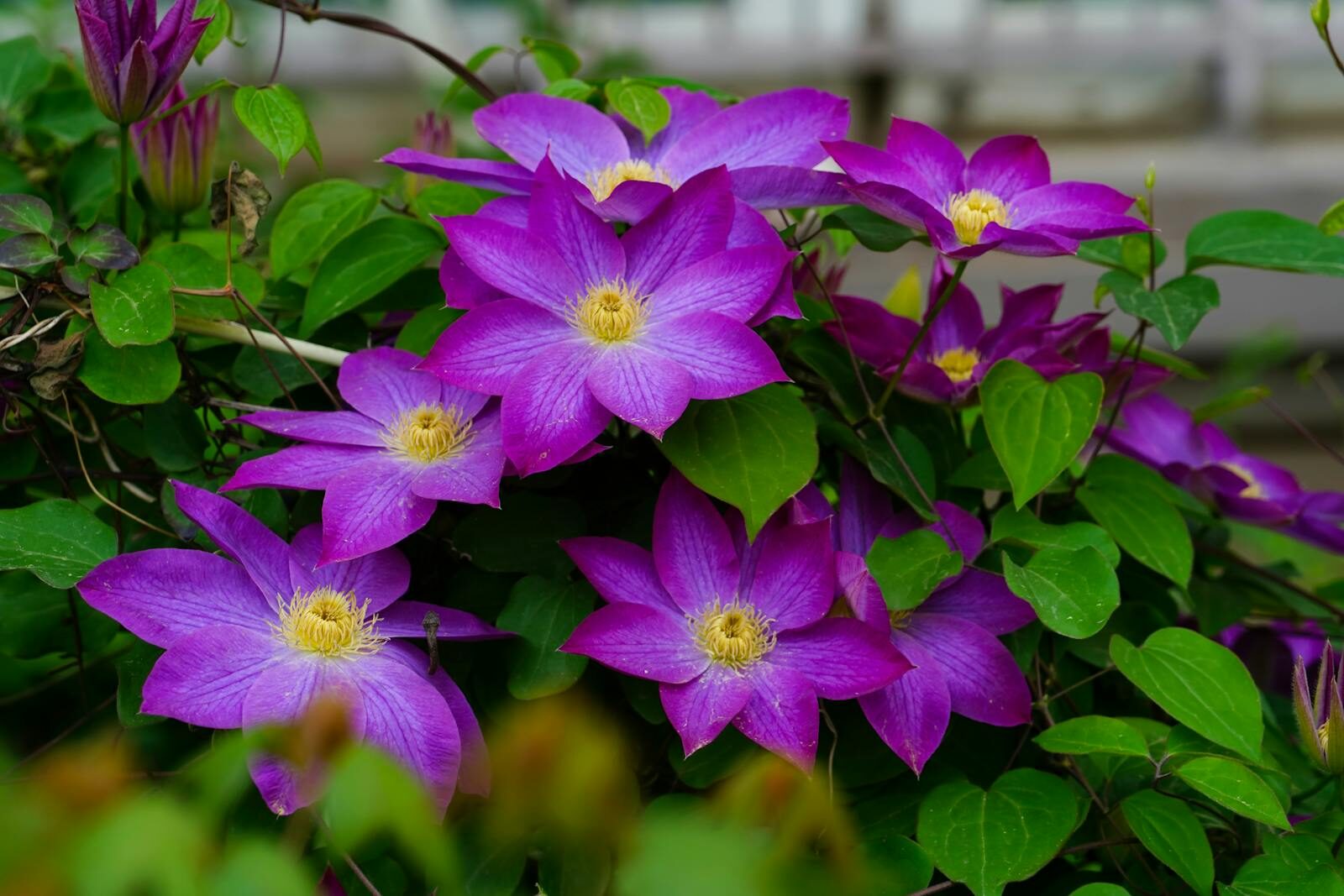
Every garden has a problem corner. Maybe it’s that north-facing fence the sun barely touches, a shaded walkway between two buildings, or the darker side of the yard where your trees cast long shadows all afternoon. For years, gardeners have assumed that shade means no flowers. Clematis proves that assumption wrong.
The right clematis in the right shady spot will absolutely bloom — sometimes more beautifully than it would in full sun, because many varieties actually prefer cooler, partly shaded conditions to intense afternoon heat. The trick isn’t avoiding shade. It’s knowing which clematis to choose.
This guide covers 12 of the best shade-tolerant clematis varieties available to U.S. gardeners in 2025–2026, including their bloom times, USDA hardiness zones, pruning groups, and honest notes on how they actually perform in low-light conditions.
Can Clematis Really Grow in Shade?
Yes — with a few honest caveats. Most clematis prefer at least six hours of sunlight a day, but quite a few varieties will bloom productively in partial shade (three to six hours of sun), and some thrive against north-facing walls or under the canopy of a light tree. What no clematis will tolerate is dense, permanent shade where no direct light reaches the top growth at all. That’s a wall too far for even the most forgiving varieties.
The key biological reason some clematis handle shade so well is worth understanding: clematis blooms are naturally sensitive to intense sunlight. Many varieties produce flowers in pinks, purples, and whites — colors that reflect rather than absorb light. This adaptation is what allows them to keep their cool (literally) in lower-light environments, and why flowers on shade-grown clematis often hold their color longer than those in full sun.
The three pruning groups also matter here. Group 1 clematis — which includes alpinas, montanas, armandii, and cirrhosa — are consistently the most shade-tolerant because they bloom in early spring on old wood and naturally thrive in woodland-edge and cool conditions. Group 2 large-flowered hybrids like Nelly Moser handle partial shade particularly well.
One more rule that every successful clematis grower knows: keep the roots cool and shaded even if the top growth gets some sun. This is actually easier to achieve in shadier spots — and it’s one reason many gardeners find their shade-grown clematis healthier in the long run.
The 12 Best Clematis for Shade
| Variety | USDA Zones | Bloom Time | Pruning Group |
|---|---|---|---|
| Nelly Moser | 4–8 | Late spring + late summer | Group 2 |
| Clematis alpina | 3–9 | Early spring (Mar–Apr) | Group 1 |
| Clematis macropetala | 3–9 | Spring | Group 1 |
| Clematis montana | 6–9 | Late April–June | Group 1 |
| Clematis armandii | 7–9 | Feb–April | Group 1 |
| Hagley Hybrid | 4–9 | June–September | Group 2 |
| The President | 4–9 | Late spring–summer | Group 2 |
| Polish Spirit | 4–9 | July–September | Group 3 |
| Étoile Violette | 4–9 | July–September | Group 3 |
| Avant Garde | 4–9 | Summer | Group 3 |
| Rooguchi | 4–9 | May–September | Group 3 |
| Markham’s Pink | 3–9 | April–May | Group 1 |
1. Clematis ‘Nelly Moser’ — The Classic Shade Performer
If you ask any experienced gardener which clematis to plant against a shady wall, “Nelly Moser” is almost always the first name out of their mouth — and with good reason.
This Group 2 large-flowered hybrid is arguably the most reliable shade-tolerant clematis in cultivation. Its iconic pinwheel blooms reach 8 inches across in pale pink, each petal marked with a bold rosy-carmine central bar. In full sun, those colors fade fast. In partial shade, they hold their vibrancy for weeks. That’s actually the original reason Nelly Moser became associated with shady spots — she looks better there.
She blooms twice: a magnificent first flush in late spring on last year’s wood, and a smaller but still impressive encore in late summer on new growth. Hardy in USDA zones 4–8, she climbs to 8–12 feet and needs a trellis or arbor for support.
Pruning: Group 2 — light pruning only in late winter. Remove dead wood and cut back to the topmost pair of healthy buds. Don’t cut her hard or you’ll lose the spring display.
Best for: North-facing fences, shaded pergolas, or anywhere the afternoon sun is blocked.
2. Clematis alpina — The Early Spring Gem
Clematis alpina is a Group 1 species clematis and one of the most reliably shade-tolerant of all. It blooms in early spring — often as early as March or April — with delicate, nodding, single bell-shaped flowers in shades of blue, purple, violet, or white, depending on the cultivar. The flowers are smaller than hybrid varieties (typically 2–3 inches), but the plant makes up for it by being utterly unfussy and wilt-resistant.
Because it blooms on old wood and belongs to Group 1, alpina requires virtually no pruning — just tidy up immediately after flowering if you need to control the size. This makes it one of the most beginner-friendly clematis on this list.
Popular cultivars include ‘Frances Rivis’ (deep blue), ‘Willy’ (pale pink), and ‘White Columbine’ (creamy white). Hardy in zones 3–9, it reaches 6–10 feet and is a natural fit for woodland-style gardens or shaded wall corners.
Pruning: Group 1 — minimal to none. Tidy after flowering if needed.
Best for: Early spring color on north or east-facing walls, woodland gardens, or slopes under deciduous trees.
3. Clematis macropetala — Double Bells in the Shade
Often grouped alongside alpina and sharing many of its qualities, Clematis macropetala is a slightly showier version of its cousin. Where alpina produces single nodding bells, macropetala offers semi-double flowers with an inner skirt of petal-like stamens that give each bloom a fuller, more complex appearance. The effect in a shaded garden is genuinely lovely.
It blooms in spring on old wood, producing flowers in lavender-blue, purple, pink, or white depending on the cultivar. ‘Markham’s Pink’ is a long-time favorite with double soft-pink blooms. ‘Blue Bird’ offers rich violet-blue. Both are hardy in zones 3–9.
Like alpina, macropetala is wilt-resistant and requires minimal pruning. It tends to grow to around 10–12 feet, and after flowering it produces attractive, silky seed heads that extend its garden interest well into summer.
Pruning: Group 1 — light tidy after flowering only.
Best for: Shaded fences, scrambling through hedges, or paired with spring shrubs like forsythia for textural contrast.
4. Clematis montana — The Vigorous Shade Champ
If you have a large shaded wall, a north-facing fence, or an outbuilding that needs covering in a hurry, Clematis montana is your answer. This is one of the most vigorous climbers in the garden world, capable of producing 20 feet of growth in a single season once established, and it’s entirely comfortable in partial shade.
Montana clematis produce thousands of small, four-petaled flowers in late spring — late April through June in most of the U.S. — in white or pink, often with a pleasant almond scent. The sheer volume of bloom is breathtaking when a mature plant is in full flower; it can completely cover a wall with color for three to four weeks.
‘Rubens’ is the most popular pink form, with rosy-pink flowers and bronze-tinged foliage. ‘Elizabeth’ is a soft pale pink with a strong vanilla fragrance and is widely regarded as the easiest, most rewarding montana to grow. For white flowers, ‘Grandiflora’ is a reliable, vigorous choice.
Hardy in zones 6–9, montana needs a sturdy support — a lightweight trellis will not hold a mature plant. This is a Group 1 clematis that requires no regular pruning, though you’ll want to cut it back after flowering every few years to keep it within bounds.
Pruning: Group 1 — prune only to control size, immediately after flowering.
Best for: Large shaded walls, covering outbuildings, growing over pergolas or sturdy fencing.
5. Clematis armandii — Evergreen Beauty for Warmer Zones
Most clematis are deciduous, dropping their leaves in winter and leaving behind bare twiggy stems until spring. Clematis armandii is the exception — it’s one of the few truly evergreen clematis available to U.S. gardeners, keeping its long, leathery, dark green leaves year-round and providing visual structure even in January.
In late winter to early spring (February–April), it produces clusters of white, intensely fragrant flowers that arrive like a gift before most other garden plants have stirred. The scent is often compared to almond or vanilla and carries noticeably through the cool spring air.
Armandii needs a sheltered spot — it doesn’t like harsh winter winds — and excellent drainage to prevent root rot. It’s hardy in zones 7–9, which limits it to the South, Pacific Coast, and warmer parts of the Mid-Atlantic for most U.S. growers, but in those zones it’s an outstanding performer in partial shade. It’s a Group 1 clematis that requires only occasional pruning to remove dead wood after flowering.
Pruning: Group 1 — remove dead or wayward growth after flowering.
Best for: Mild-climate gardens needing year-round evergreen cover on shaded walls or fences.
6. Clematis ‘Hagley Hybrid’ — Soft Pink That Loves the Cool
Here’s a large-flowered hybrid that actually performs better in shade than in full sun. Hagley Hybrid produces pretty, mid-sized flowers in a soft shell pink with a contrasting bar and deep purplish-brown anthers at the center. In hot sun, the petals can look bleached and washed-out quickly. In partial shade, that soft pink stays luminous and fresh for much longer.
It’s a Group 2 clematis, blooming from June through September with a re-bloom in late summer. Hardy in zones 4–9, it reaches about 6–8 feet — more compact than some varieties, which makes it a good choice for smaller shaded spaces or growing up a shorter fence section. The compact habit also makes it suitable for large containers in partly shaded courtyards.
Pruning: Group 2 — light pruning in late winter, removing dead wood and cutting to healthy buds.
Best for: Shaded patio areas, east-facing walls, compact fence sections, and large containers.
7. Clematis ‘The President’ — Deep Purple That Holds Its Color
‘The President’ is one of the great all-around clematis — reliable, hardy, abundantly blooming, and more shade-tolerant than its large, showy flowers might suggest. It produces rich blue-purple blooms up to 7 inches wide with silvery undersides, creating a two-toned effect when the breeze catches the petals and turns them in the light.
Like most deep-colored clematis, The President actually benefits from partial shade because intense afternoon sun causes purple pigments to fade faster. In a spot with morning sun and afternoon shade — an east-facing wall, for instance — the color stays deep and saturated far longer.
Hardy in zones 4–9, it reaches 8–12 feet and blooms from late spring through summer on both old and new wood. It’s a Group 2 clematis with a well-earned reputation for being beginner-friendly.
Pruning: Group 2 — light tidy in late winter.
Best for: East-facing walls, shaded archways, growing through climbing roses to extend the seasonal show.
8. Clematis viticella ‘Polish Spirit’ — Wilt-Proof and Shade-Tough
Viticella clematis are the workhorses of the clematis world, and ‘Polish Spirit’ is the best of the group for shaded conditions. It’s wilt-resistant (a significant advantage in shadier, potentially more humid spots), tolerates poorer soils than most clematis, and produces deep purple-blue, nodding 3-inch flowers in remarkable abundance from July through September.
It holds the RHS Award of Garden Merit — one of the most respected endorsements in horticulture — and is hardy in zones 4–9. At 10–15 feet, it’s vigorous enough to cover significant ground quickly, and its late-season bloom time fills a gap when many other shade plants have finished flowering. As a Group 3 clematis, it’s pruned hard in late winter — cut down to 12–18 inches above ground — which makes maintenance simple.
Pruning: Group 3 — hard prune in late winter or early spring, cutting to 12–18 inches above soil.
Best for: Large shaded structures, growing through trees, filling summer color gaps on shaded walls.
9. Clematis ‘Étoile Violette’ — Late Summer Purple for Shaded Spots
Another viticella with serious credentials, ‘Étoile Violette’ produces masses of deep violet-purple flowers with creamy-yellow anthers from July through September. Like Polish Spirit, it carries the RHS Award of Garden Merit and is reliably wilt-resistant.
What sets Étoile Violette slightly apart is its exceptional flower count — when in full bloom, a mature plant can appear almost entirely purple with barely a leaf visible. It’s also one of the better viticella choices for growing through other plants, particularly climbing roses, where its late-summer flowers create a layered effect with the rose’s later flushes.
Hardy in zones 4–9, it grows to 12–15 feet and handles partial shade well, though it’ll give its best display with at least three to four hours of daily light.
Pruning: Group 3 — hard prune in late winter.
Best for: Growing through climbing roses or large shrubs, shaded arches, and late-season color on east-facing walls.
10. Clematis ‘Avant Garde’ — Striking Two-Tone for Shaded Gardens
If you want something a little more unusual than the classic purple-blue clematis palette, ‘Avant Garde’ delivers. It produces distinctive dahlia-like blooms in a two-tone pink: outer petals in soft rose-pink surround a center of deeper raspberry-pink stamens, creating a layered, almost art-deco effect that stands out in any garden.
It grows to 10 feet, is hardy in USDA zones 4–9, and handles partial shade reliably. Nursery growers often list it specifically as one of the top shade-tolerant clematis for north-facing walls. It works well in containers too — use a pot at least 18–24 inches wide and deep, with a sturdy support structure.
Pruning: Group 3 — hard prune in late winter.
Best for: Shaded north-facing walls and fences, large patio containers, gardens where an unusual flower form is the priority.
11. Clematis ‘Rooguchi’ — Non-Vining Bell Flowers for Shaded Borders
Most clematis are climbers, but ‘Rooguchi’ (sometimes spelled Roguchi) takes a different approach. It’s a non-vining, scrambling or mounding type that produces elegant, indigo-purple nodding bell-shaped flowers on slender stems throughout summer — typically May through September. Rather than climbing a wall, it works beautifully weaving through other border plants, draping over low structures, or scrambling along a slope.
Hardy in USDA zones 4–9, it reaches about 4–6 feet and is notably tolerant of partial shade, including east-facing spots that get morning sun only. It also attracts butterflies and hummingbirds, adding wildlife value to shadier corners that often get overlooked in pollinator planting schemes.
Pruning: Group 3 — cut back hard in late winter.
Best for: Shaded mixed borders, scrambling through ornamental grasses, slopes, and east-facing garden beds.
12. Clematis ‘Markham’s Pink’ — Double Spring Bells in Soft Pink
Wrapping up this list with one of the most charming spring-blooming shade clematis available: ‘Markham’s Pink’ is a macropetala cultivar with fully double, lantern-shaped blooms in a warm dusky rose-pink. The double flower structure gives each bloom an almost peony-like fullness that’s unusual among spring-flowering climbers.
It blooms in April and May on old wood, produces silky silver seed heads after flowering that extend its garden interest, and requires virtually no maintenance. Hardy in zones 3–9 — one of the hardiest on this list — it grows to around 10 feet and is a completely reliable performer in partial to moderate shade.
For gardeners in colder USDA zones (3–5) who struggle to find shade-tolerant climbers that survive harsh winters, Markham’s Pink is one of the most forgiving and rewarding choices available.
Pruning: Group 1 — minimal. Light tidy after flowering only.
Best for: Cold-climate gardens, early spring interest on shaded walls, east-facing fences, and wood structures.
How to Grow Clematis in Shade Successfully
Choosing the right variety is half the battle. The other half is getting the planting right. Here’s what actually makes the difference between a struggling vine and a thriving one.
Plant deep. Set your clematis 2–3 inches deeper than it sits in the nursery pot. This protects the crown from clematis wilt and allows the plant to regenerate from below the soil surface if the top growth is affected. This is especially important in shadier spots where humidity can be slightly higher.
Keep roots cool and shaded. Clematis need their roots cool and moist even when the top growth is in sun or partial shade. Mulch generously — 2–3 inches around the base — or plant low-growing perennials or groundcovers around the base of the vine. Hostas, lamium, and ajuga all work beautifully as natural root shaders in low-light gardens. If you’re planning a broader shade bed, our guide to acid-loving plants for U.S. gardens covers several companion options that thrive in the same cool, moist conditions.
Soil matters. Clematis prefer fertile, moisture-retentive but well-drained soil. In shaded areas, soil can become compacted or waterlogged — both harmful. Work in compost before planting and check that the site drains well after rain.
Support from day one. Every climbing clematis needs something to grip. Provide a trellis, arbor, wire, or netting from the moment you plant. Young vines left without support develop poorly and take much longer to establish.
Water consistently in the first season. Newly planted clematis are vulnerable to drought stress, and shaded spots can sometimes dry out faster than they appear. Water regularly until the plant is well established — usually the first full growing season.
Know your pruning group. This is the single most common mistake with clematis. Pruning a Group 1 or Group 2 clematis like a Group 3 (cutting it to the ground) means losing an entire season of flowers. Check the label when you buy and keep a note of which group each plant belongs to.
For a deeper dive into clematis care, the Royal Horticultural Society’s clematis growing guide is one of the most comprehensive and trustworthy resources available, with specific guidance on soil preparation, pruning, and variety selection that applies equally to U.S. growers.
Which Shade Clematis Is Right for You?
If you want the most reliable performer for a north-facing wall, start with Nelly Moser or The President. They are proven, widely available, and rarely disappoint in partial shade.
If you want minimum maintenance and early color, an alpina or macropetala variety is your best bet — no annual pruning required, and they bloom before most other climbers wake up.
If you need to cover a large area fast, Clematis montana will do it with spectacular results. Just make sure your support structure is genuinely sturdy before you plant.
If you’re a beginner gardener who wants something nearly foolproof, any viticella variety — Polish Spirit, Étoile Violette, or Avant Garde — is forgiving of imperfect conditions, wilt-resistant, and easy to prune because you simply cut everything down hard in late winter.
And if you’re working in USDA zones 3–5 and struggle to find climbers tough enough for harsh winters, ‘Markham’s Pink’ and most alpina varieties are among the hardiest flowering climbers available anywhere. For another cold-hardy shade performer, our Taylor Juniper growing guide covers a tough evergreen option for the same tricky corners.
Final Thoughts
Shade doesn’t have to mean a bare, uninspiring wall or fence. Twelve gorgeous clematis varieties say otherwise — and that’s just the beginning of what’s available to American gardeners willing to look beyond the “full sun only” section of the plant nursery.
The golden rule, worth repeating one more time: choose the variety for your specific light level, plant the crown a few inches deep, keep the roots shaded and moist, and know your pruning group. Do those things, and a shady clematis will reward you every single year with more beauty than you expected.
The shadiest corner in your garden might just become your favorite spot.