

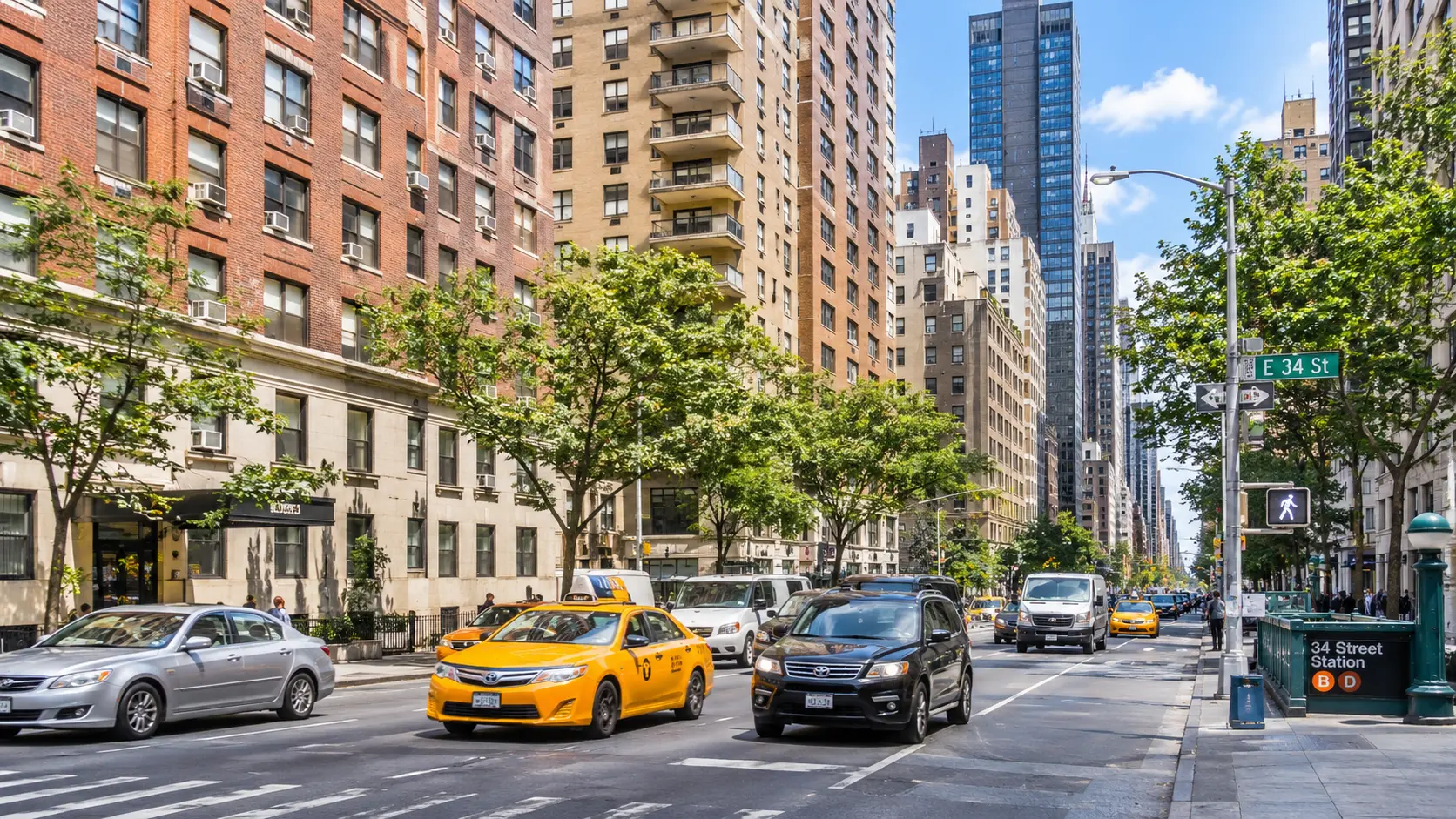
East 34th Street is a good option for people who want a Midtown location with a more residential feel than the avenues around Herald Square. The trade-offs are a busy crosstown street, hospital sirens, and a limited supply of true luxury inventory.
Most of the housing here is in mid-century and newer high-rises, with older walk-ups and prewar buildings on some blocks. Studios and one-bedrooms dominate. Large family-sized apartments are rare. In a quick scan of recent listings, studio asking rents clustered in the high $3,000s to low $4,000s, and one-bedrooms mostly ran from the low $4,000s into the $5,000s. Condo purchases ranged from roughly $580,000 for a small studio to $1.6 million for a two-bedroom. I’ll explain what drives those differences below.
What “East 34th Street” actually means for a renter or buyer
East 34th Street runs from Fifth Avenue to the East River, but the residential stretch most people mean is east of Park Avenue. Listings along it are usually labeled Murray Hill or Kips Bay, and the border between the two is blurry. StreetEasy’s area description even notes that Kips Bay mostly lacks distinction from Murray Hill to its north. Zillow describes the 10016 zip code as blending historic brownstones with high-rise convenience between Park Avenue and the East River.
The practical difference is geography:
- Park to Third Avenue: closer to the 6 train and Midtown offices. Buildings here include rentals such as Murray Park.
- Third Avenue to First Avenue: a mix of towers, including the 34-story Eastlight condominium at Third Avenue, and a strong grocery and restaurant presence.
- First Avenue and east: the hospital corridor and the river. Quieter at night, but with more ambulance traffic and a longer walk to the subway.
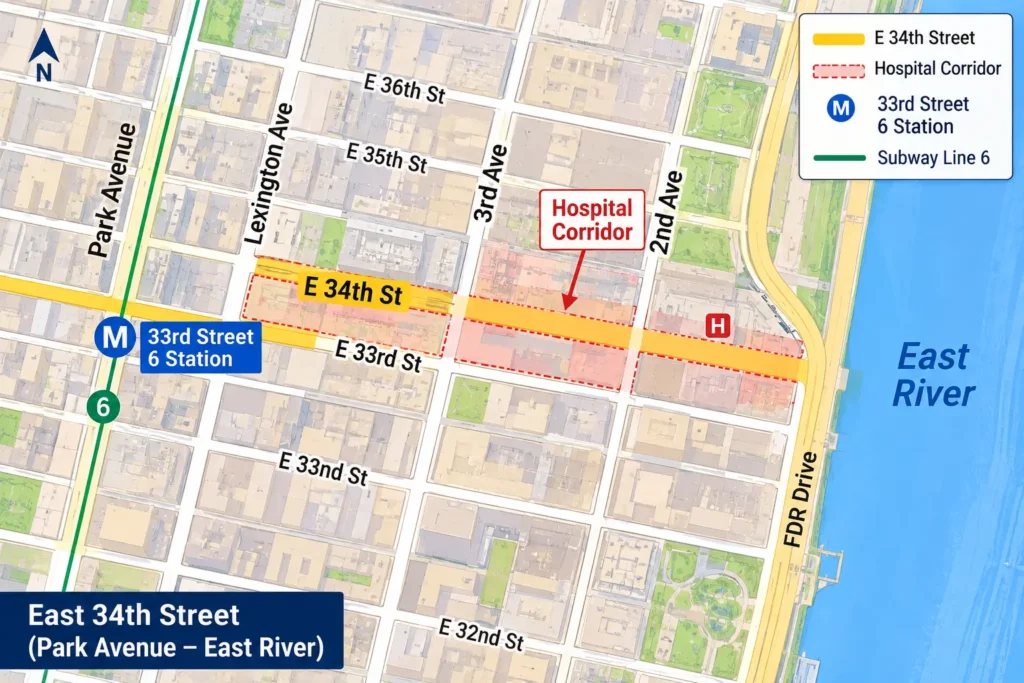
When you search listings, use both “Murray Hill” and “Kips Bay,” or you’ll miss a chunk of what’s available.
Renting on East 34th Street
What rents look like
Manhattan as a whole is very tight right now. Corcoran’s July 2026 report put the borough’s median rent at a record $5,295, up 6% from a year earlier, with three out of every 200 Manhattan apartments available for rent, the lowest July level since 2019. A separate Miller Samuel analysis reported a different record median of $5,000 for July. The two numbers differ because they use different samples, not because one is wrong. Both measure signed leases citywide, so they are a backdrop and not a price for this street.
East 34th Street listings I reviewed sat below the Manhattan median for studios and one-bedrooms, which fits the neighborhood’s mid-priced reputation. These are asking rents from a handful of listings of varying dates, not a formal average:
| Unit type | Typical asking range seen in listings | Notes |
|---|---|---|
| Studio | about $3,600 to $4,100 | One 140 E 34th listing was around $3,620 for roughly 500 sq ft |
| One-bedroom | about $4,100 to $5,300 | Higher end tends to be views, renovated kitchens, or higher floors |
| Two-bedroom or flex two | about $5,500 and up | Some at 166 E 34th were advertised near $5,500 |
| Large luxury unit | $15,000 or more | A three-bedroom at The Anthem (222 E 34th) was advertised around $15,000 |
Treat the table as a way to spot an unusually cheap or expensive listing, not as a quote.
The broker fee rule changed the math
Since June 11, 2025, it has been illegal in New York City for landlords to charge renters broker fees for brokers the landlord hired. The city’s Department of Consumer and Worker Protection (DCWP) enforces this. If you hire your own broker to search on your behalf, you may still owe that broker’s fee.
Two practical points are worth knowing:
- Landlords have partly offset the lost fee by building it into the rent. A “no fee” apartment at $4,500 may not be cheaper over two years than a slightly lower-priced apartment from a building that used to charge. Compare total cost over the lease term, not just the upfront cost.
- Enforcement has been uneven. Reporting in early 2026 said DCWP had received more than 1,400 complaints and filed roughly 50 summonses. If someone asks you for a fee you didn’t agree to, document it and file a complaint at nyc.gov/consumers or by calling 311.
Other move-in costs and requirements
New York State law limits security deposits to one month’s rent. Application fees are capped at $20. Most landlords in the city still want to see annual income of about 40 times the monthly rent, which for a $4,500 apartment means $180,000. If you don’t meet that, expect to need a guarantor or a larger upfront payment. Those are standard New York practices, but individual buildings differ, so confirm requirements before you pay for a credit check.
What to check before you sign
Because East 34th Street includes buildings from several eras, rental quality varies more than the address suggests.
- Rent stabilization. Older buildings may have stabilized units, which come with renewal-rent limits. Ask whether the apartment is stabilized and request the rent history. For market-rate units in newer buildings, ask what the renewal increase is likely to be.
- Concessions. Some larger buildings advertise free months, but they are less common now. One report found only 4.2% of Manhattan listings included a concession in July 2026, the rarest of any borough. Look at the net effective rent, which spreads free months across the lease, and check what lease length the offer requires. One listing in the area offered two months free on an 18-month lease.
- Street noise. If the apartment faces 34th Street itself, visit during a weekday rush hour and again in the evening. A bedroom facing an interior courtyard or a side street can feel like a different neighborhood.
- Laundry, doorman, and elevator count. In 150-plus-unit buildings built in the 1960s, elevator waits can matter more than the lobby finish. Walk in at 8:30 a.m. and see.
Buying on East 34th Street: condos, co-ops, and “condops”
Condos are the minority
New York’s buyer market is split among condos, co-ops, and a hybrid called a condop. Co-ops dominate overall and are cheaper, but they come with board approval, stricter financial requirements, and often limits on subletting. Condos are easier to buy, finance, and rent out, which is why they carry a premium.
In April 2026, PropertyShark reported a median condo sale price in Kips Bay of about $1.1 million, based on only nine sales. The co-op median was about $555,000 across 24 sales. With samples that small, I wouldn’t treat either figure as a price guide. They do show the gap: condos here run well above co-ops.
Condo prices seen on East 34th Street
These were asking prices on listings reviewed in 2026, not sale prices:
| Building / Address | Type | Unit seen | Asking price |
|---|---|---|---|
| 155 E 34th St (Warren House) | Condo, built 1961, 330 units | Studio, 508 sq ft | about $580,000 |
| 155 E 34th St | Condo | 1-bed, 684 sq ft | about $599,000 after a $30,000 cut |
| 155 E 34th St | Condo | 1-bed, #15H | about $700,000 (about $1,254 per sq ft) |
| 333 E 34th St | Condo | 2-bed/2-bath, 1,135 sq ft | about $1,249,000 |
| 225 E 34th St | Condo | 2-bed/2-bath, 1,345 sq ft | about $1,600,000 |
| Eastlight, 501 Third Ave | New condo, opened 2023 | Various | Check current listings |
The pattern is that older, plainer condo buildings come in at the low end, and newer buildings with amenity floors cost more. StreetEasy’s March 2026 area averages put Kips Bay near $1,343 per square foot and Murray Hill near $1,251, though individual buildings swing widely around those figures.
Monthly carrying costs matter as much as the price
A $600,000 apartment and a $900,000 apartment can have very different monthly costs. One nearby Kips Bay listing at East 33rd Street, asking $915,000, showed common charges of $877 a month and real estate taxes of $12,288 a year. Tax figures in listings may reflect abatements that expire, so ask the broker or the building’s managing agent what happens to the tax bill in the future.
Also budget for closing costs. New York buyers typically pay a mortgage recording tax if financing, title insurance for condos (co-ops usually skip this), and, on purchases above $1 million, the state’s “mansion tax.” A real estate attorney should confirm the numbers for your specific deal.
Questions worth asking about a specific building
- Does the building allow pied-à-terre use or renting out the unit? Some listings on this street explicitly say yes. Others restrict it.
- What is the reserve fund, and has the building announced any special assessments? Older towers can face facade and boiler work.
- How long has the unit been listed, and has the price changed? The 1-bed at 155 E 34th Street was marked down by $30,000 after about four months on the market, which tells you something about negotiating room.
Street-specific things most guides skip
Flood risk. Parts of the Kips Bay waterfront and the East River side of Midtown flooded during Hurricane Sandy in 2012. Before renting a ground-floor or garden unit, or buying anywhere east of First Avenue, check the address in the NYC Flood Hazard Mapper and ask the building how it handled past storms.
Noise from a major crosstown street. 34th Street carries heavy bus, truck, and emergency traffic. The area also has a hospital cluster along First Avenue, so sirens are a fact of life. High floors and windows facing away from the street help, and a quick evening walk-through will tell you more than any listing.
Transit. The 6 train at 33rd Street is the main subway option on the east side, so the farther east you go, the longer the walk. Crosstown buses and the East River ferry landing at 34th Street fill some of the gap, but confirm current routes and schedules with the MTA and NYC Ferry before relying on them.
Neighborhood character. This isn’t a nightlife district. Evenings are quiet outside the immediate avenues, and many residents are hospital workers, graduate students, and young professionals who want Midtown access without Midtown prices. If you want a lively street scene, Gramercy or the East Village will suit you better.
Who East 34th Street suits, and who should look elsewhere
A good fit: people who work in Midtown or at the nearby hospitals, renters who want elevator-building convenience at a price below the Manhattan median, and buyers who want a condo with flexibility for renting out later.
Probably not: anyone who needs a quiet, tree-lined streetscape right outside the door, families who need three bedrooms at a moderate price, or anyone relying on a long subway commute from the far east end of the street.
My practical advice for a renter is to widen the search to East 31st through East 36th Streets. The listings I saw there were priced similarly, and you may find a quieter exposure for the same money. For buyers, compare the same building type across several blocks before paying a premium for the 34th Street address itself.
Common mistakes
- Comparing “no fee” and “fee” rents without adding them up. Since the FARE Act, fees are often built into rent.
- Trusting a listing’s neighborhood label. The same building may appear under Murray Hill, Kips Bay, or Midtown East depending on the broker.
- Ignoring the lease length behind a concession. Free months on an 18-month lease are not the same as free months on 12.
- Skipping the building’s financial documents on a condo purchase. The common charges, reserves, and assessments matter as much as the unit.
- Touring only in the daytime. Street noise and elevator traffic change by hour.
FAQ
Is East 34th Street a good place to live?
It suits people who prioritize convenience and building amenities over street life. It’s central, relatively affordable for Manhattan, and close to hospitals and the East River. It’s also busy and noisy on the main crosstown corridor.
How much does a studio cost on East 34th Street?
Listings I reviewed asked roughly $3,600 to $4,100 for studios, with some buildings charging more for renovated units or views. Check current listings before budgeting, since Manhattan rents were at record highs in mid-2026.
Are there condos on East 34th Street, or mostly rentals and co-ops?
There are condos, including Warren House at 155 E 34th Street, buildings at 225 and 333 E 34th Street, and the newer Eastlight tower at Third Avenue. Rentals and co-ops make up much of the rest of the housing nearby.
Do I have to pay a broker fee in NYC?
Not for a broker the landlord hired. Under the FARE Act, which took effect June 11, 2025, landlords can’t pass their broker’s fee to you. You may owe a fee if you hire your own broker.
Is the area safe from flooding?
Parts of the East River waterfront flooded during Hurricane Sandy. Check any specific address in the NYC Flood Hazard Mapper, and ask about the building’s flood history, especially for lower floors.
How much income do I need to rent here?
Most landlords look for annual income around 40 times the monthly rent, or a guarantor who earns closer to 80 times. Individual buildings set their own rules, so ask before you apply.
Is Kips Bay the same as Murray Hill?
No, but they border each other, and the line is blurry on East 34th Street. Listing sites often use both names for the same blocks.
Should I buy a condo or a co-op here?
Co-ops are generally cheaper but come with board approval and tighter rules. Condos cost more and are easier to finance, sell, and rent out. A real estate attorney can explain the closing-cost differences for your situation.
For a broader look at neighborhood-by-neighborhood choices in the city, see [INTERNAL LINK: Add the most relevant PlazmaHomes article here].
Sources & References
- NYC Department of Consumer and Worker Protection, Renter Rights Regarding Broker Fees (official guidance on the FARE Act)
- Corcoran, NYC Residential Rental Market Report, July 2026
- Miller Samuel / The Real Deal, July 2026 Manhattan rental data