

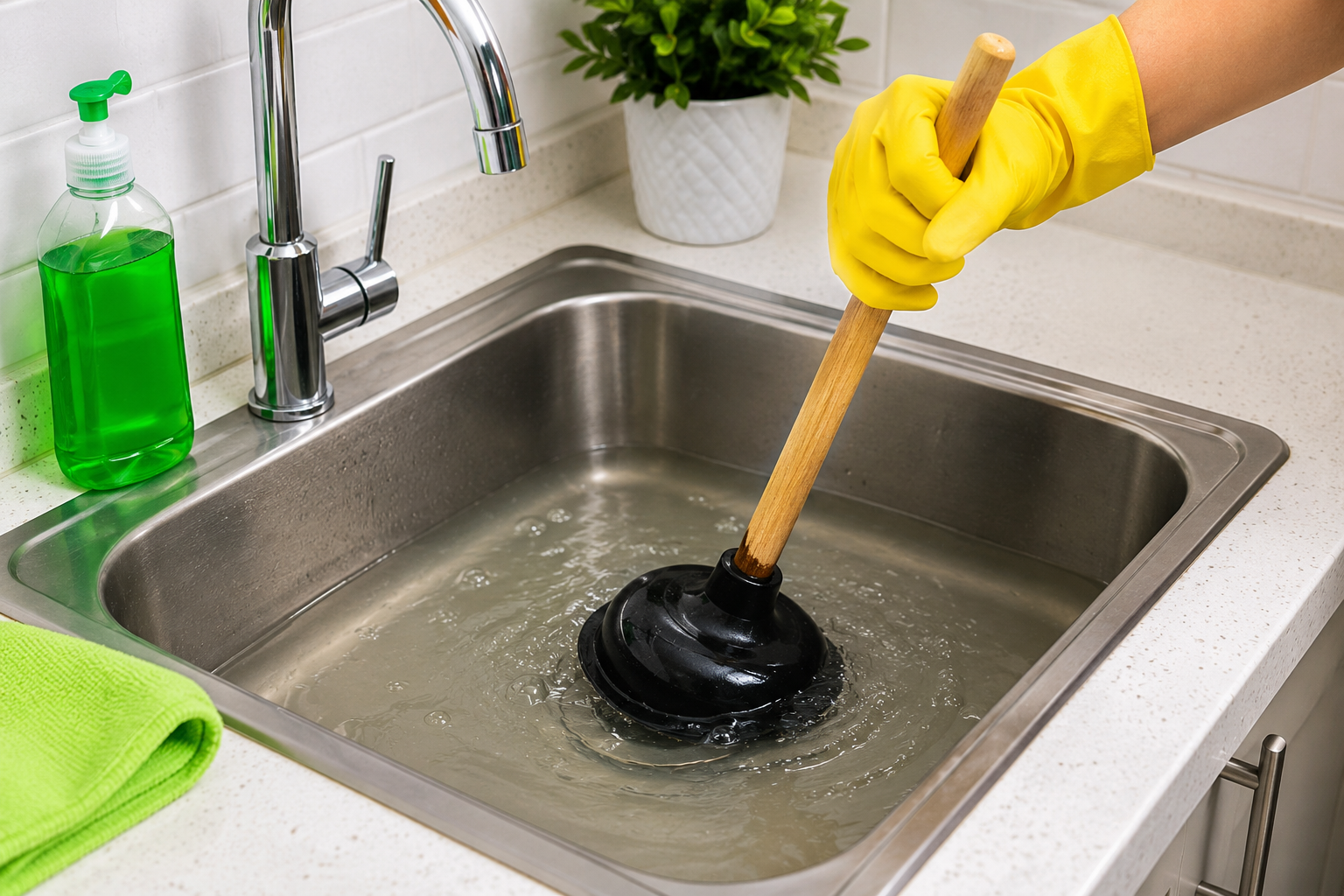
There’s never a good time for a clogged kitchen sink. One minute you’re rinsing dishes, the next you’re watching a pool of murky water refuse to drain. It’s frustrating, gross, and — if you’ve ever called a plumber for it — surprisingly expensive.
Here’s the good news: the vast majority of kitchen sink clogs are completely fixable without any professional help. I’ve dealt with stubborn sink clogs in older homes across the Midwest and Southwest, and I can tell you from hands-on experience that these seven methods work. Whether you’re in a New York City apartment dealing with an aging P-trap or a suburban house in Texas with hard-water buildup, the approach is essentially the same.
This guide walks you through every method in order — from the simplest and least invasive to the more hands-on fixes — so you can stop the problem before it gets worse.
Why Kitchen Sinks Clog in the First Place
Before you start plunging, it helps to know what you’re actually fighting. Kitchen sink drains are magnets for a specific type of buildup that bathroom drains rarely see.
The most common culprits are grease and cooking oil. Even when you pour “liquid” fat down the drain, it cools as it travels through your pipes and solidifies into a sticky film that catches everything else — food scraps, soap residue, coffee grounds — until the pipe is essentially blocked.
Other common causes include:
- Food particles that slip past the strainer
- Soap scum combined with hard water minerals (especially common in states like Arizona, Nevada, and parts of California where hard water is widespread)
- A buildup of debris around the garbage disposal splash guard
- A blocked P-trap (the curved pipe under the sink)
- In older homes, partially corroded or narrow pipes that restrict flow
Knowing the cause helps you pick the right fix. Let’s get into it.
What You’ll Need (Have These Ready Before You Start)
Most of these methods use things you already have at home. For the more involved fixes, here’s a quick shopping list:
- Rubber cup plunger (not a toilet/flange plunger)
- Baking soda and white vinegar
- Dish soap
- A bucket and rubber gloves
- A drain snake or hand auger (available at any Home Depot, Lowe’s, or Ace Hardware for around $20–$40)
- Adjustable pliers or a pipe wrench
- Old towels or rags
Method 1: Boiling Water (Start Here Every Time)
This is the first thing I try, every single time. It works surprisingly often — especially when grease is the culprit — and it costs you absolutely nothing.
How to do it:
- Boil a full kettle or pot of water.
- Carefully pour it directly down the drain in two or three slow stages, waiting 20–30 seconds between each pour to let the hot water work.
- Run the faucet to see if the drain is clearing.
The heat melts and flushes away soft grease and soap buildup that’s partially restricting the pipe.
Important note: Don’t use this method if you have PVC pipes, which are common in homes built after the 1970s. Boiling water can soften or warp PVC. In that case, use the hottest water from your tap instead — still warm enough to break up grease but safe for plastic pipes. If you’re not sure what kind of pipes you have, check under the sink: white or gray plastic is PVC, while copper or dark metal indicates metal pipes where boiling water is fine.
Method 2: Dish Soap and Hot Water
If boiling water alone doesn’t cut it, add dish soap. This combination works because dish soap is a degreaser by design — it’s literally formulated to break up grease and oil.
How to do it:
- Squirt a generous amount of dish soap (a few tablespoons) directly into the drain.
- Follow it with very hot (not boiling, for PVC pipes) water poured slowly down the drain.
- Let it sit for five minutes, then flush with more hot water.
Dawn Original is a particularly good choice here — it’s what wildlife rescue organizations use to cut oil off animals after spills, which tells you something about how well it breaks down grease.
Method 3: Baking Soda and Vinegar (The Classic Combo)
This method has been around forever, and it genuinely works for mild to moderate clogs. The chemical reaction between baking soda (a base) and white vinegar (an acid) creates fizzing action that can loosen debris clinging to pipe walls.
How to do it:
- Remove any standing water from the sink with a cup or small bowl.
- Pour one cup of baking soda directly into the drain — use a spoon to push it past the strainer if needed.
- Follow immediately with one cup of white vinegar.
- Quickly cover the drain with a stopper or a folded cloth to keep the fizzing action directed downward into the clog rather than back up.
- Let it sit for 15–30 minutes.
- Flush with a kettle of hot water (or hot tap water for PVC).
This works best as a maintenance method or for soft clogs. For a completely blocked drain, you’ll likely need to combine this with another method or move on to the plunger.
Method 4: Use a Plunger Properly
Most people own a plunger but don’t use it correctly on a kitchen sink. The technique matters here.
How to do it:
- If you have a double sink, seal the second drain opening with a wet rag or stopper. This forces pressure to go where you want it — down into the clog — rather than escaping through the other drain.
- Add enough water to the clogged side to cover the rubber cup of the plunger (about 2–3 inches).
- Place the plunger cup firmly over the drain opening, making a tight seal.
- Plunge with firm, steady up-and-down strokes — 15 to 20 pumps — then pull the plunger up sharply to create suction.
- Repeat two or three times and then run the water to check drainage.
Use a flat-bottomed cup plunger, not a toilet plunger (which has a flange designed for toilet bowls). If you only own one type, the flat cup type is the right one for sinks.
Method 5: Clean the P-Trap
The P-trap is the curved section of pipe under your sink — it looks like the letter “P” or “U” depending on your angle. It’s specifically designed to hold a small amount of water that blocks sewer gases from entering your home. It’s also a prime location for clogs.
If you’ve tried the above methods and water is still pooling, there’s a good chance the blockage is right here.
How to do it:
- Clear out everything under the sink and place your bucket directly under the P-trap.
- Put on rubber gloves — this part can get messy.
- Unscrew the slip nuts on either side of the curved section by hand or with pliers. Most modern P-traps are plastic and can be loosened by hand.
- Remove the P-trap and let the water drain into your bucket.
- Look inside the trap. If you see a packed mass of grease, food, or debris, you’ve found your clog.
- Clean it out thoroughly with an old bottle brush or by flushing it with water in another sink.
- Check the pipe going into the wall as well — sometimes the clog extends just past the trap.
- Reattach the P-trap, hand-tighten the nuts (don’t overtighten), and run water to check for leaks.
This is one of the most effective methods for kitchen sinks and takes about 10 minutes once you know what you’re doing.
Method 6: Use a Drain Snake (Hand Auger)
When the clog is deeper in your pipes — past the P-trap and further into the drain line — a drain snake is the right tool. This is a long, flexible metal cable that you feed into the pipe to physically break up or pull out the clog.
You can rent one from most hardware stores in the US (typically $10–$20 per day), or buy a basic hand auger for around $25–$40 at Home Depot, Lowe’s, Walmart, or online.
How to do it:
- Remove the P-trap first (see Method 5) to give yourself direct access to the pipe in the wall.
- Feed the snake into the drain pipe, turning the handle clockwise as you push.
- When you feel resistance, you’ve hit the clog. Work the snake back and forth, rotating it to break up or grab the debris.
- Pull the snake back out slowly — you may pull out a satisfying clump of gunk.
- Flush the line with hot water before reattaching the P-trap.
- Reassemble and test.
For a deeper look at when a drain snake is appropriate versus when you need a professional hydro-jetting service, the Family Handyman’s guide to drain snakes covers the topic well.
Method 7: Check and Reset Your Garbage Disposal
If your kitchen sink has a garbage disposal and it’s connected to the clogged side, the disposal itself might be the problem — or at least contributing to it.
How to do it:
- First, check whether the disposal is humming but not spinning (a jam) or completely silent (tripped circuit).
- If it’s jammed, turn it off and unplug it. Use the hex key (Allen wrench) that came with the unit — or a ¼-inch Allen wrench — and insert it into the socket at the bottom of the disposal. Turn it back and forth to manually free the jam.
- If it’s silent, find the reset button on the bottom of the disposal unit (it’s usually a small red or black button). Press it firmly until you feel it click.
- Plug the unit back in and test.
- Run cold water and turn the disposal on. Cold water keeps grease solid so it can be chopped up rather than coating the pipes.
Never put these items down a garbage disposal, as they’re responsible for a huge number of clogs across the US: fibrous vegetables (celery, artichoke, asparagus), coffee grounds, eggshells, potato peels, pasta, and rice.
When to Call a Plumber
These seven methods resolve the overwhelming majority of kitchen sink clogs. But there are a few signs that you’re dealing with something beyond a DIY fix:
- Multiple drains in your home are slow or backed up at the same time (this suggests a main sewer line issue)
- You hear gurgling from other drains when you use the sink
- There’s a persistent sewage smell even after cleaning
- You’ve tried everything above and the sink still won’t drain
- Water is backing up into your dishwasher through the drain connection
In these cases, call a licensed plumber. In the US, the average cost for professional drain cleaning ranges from $150 to $350, according to recent national estimates — still much cheaper than emergency service fees, so don’t wait until it’s a crisis.
How to Prevent Kitchen Sink Clogs Going Forward
The best fix is the one you never have to do. These habits will keep your kitchen sink clear year-round:
Never pour grease down the drain. Let it cool in a container and throw it in the trash. This single habit eliminates the most common cause of kitchen clogs.
Run hot water after every use. Flushing the drain with hot water for 30 seconds after washing dishes helps push any residual grease through before it can solidify.
Use a mesh strainer. A simple strainer basket costs less than $5 and catches food particles before they enter the drain. Empty it after every use.
Do a monthly baking soda and vinegar flush. Even without a visible clog, this helps keep buildup from accumulating. Think of it like changing the oil in your car.
Run cold water when using the garbage disposal. Always run water before, during, and for 30 seconds after using the disposal to flush debris fully through the pipes.
For more on keeping your home’s plumbing in good shape throughout the year, check out our home maintenance checklist guide that covers seasonal plumbing tasks from top to bottom.
Frequently Asked Questions
Q: What is the fastest way to unclog a kitchen sink?
The fastest method is boiling or very hot water poured directly down the drain in stages. This takes only 2–3 minutes and works immediately on grease-based clogs. If that doesn’t work within one or two tries, move to the dish soap and hot water method, which adds a degreasing agent and takes about 10 minutes total.
Q: Can I use Drano or liquid drain cleaners on a kitchen sink?
You can, but use them with caution and as a last resort. Chemical drain cleaners like Drano or Liquid-Plumr can work on soft organic clogs, but they contain harsh chemicals (sodium hydroxide, bleach, or sulfuric acid) that can damage older metal pipes, corrode rubber gaskets in P-traps, and are harmful if they splash on skin or surfaces. Many plumbers in the US advise against regular use. If you do use one, follow the label instructions exactly, ensure good ventilation, and never mix different drain cleaners or combine them with the baking soda and vinegar method.
Q: Why does my kitchen sink keep clogging even after I clear it?
Recurring clogs usually point to one of a few root causes: a grease buildup that’s not being fully cleared each time, a partial obstruction further down the line that’s trapping debris, tree roots entering older clay or cast-iron pipes (more common in homes older than 30–40 years), or a venting problem that affects drainage pressure. If your sink clogs repeatedly within a few weeks, it’s worth having a plumber run a camera inspection of the line — it’s around $100–$300 but gives you a definitive answer.
Q: Is it safe to use a plunger on a kitchen sink?
Yes, a cup plunger is completely safe for kitchen sinks. Just make sure you’re using the right type — a flat rubber cup plunger, not a flange plunger designed for toilets. The only thing to be careful about is sealing the second drain first if you have a double sink, and not plunging too aggressively if your pipes are older and potentially fragile.
Q: How do I unclog a kitchen sink with standing water in it?
Don’t wait for the water to drain on its own — it may not. Remove as much standing water as you can with a cup, bowl, or wet/dry vacuum first. Then use the plunger method (Method 4), which actually works better with a small amount of water remaining to help form a seal. If you’re going straight to the P-trap (Method 5), place your bucket under the sink before loosening anything, since all that standing water will flow out when you open the trap.
Q: My garbage disposal hums but won’t turn. What’s wrong?
A humming disposal that won’t spin is almost certainly jammed. Turn it off and unplug it immediately — running a jammed disposal can burn out the motor. Use a ¼-inch Allen wrench in the hex socket on the bottom of the unit to manually free the jam, then look inside with a flashlight (never put your hand in) to remove whatever caused the blockage. If the disposal is completely silent, press the reset button on the bottom first before assuming anything is broken.
Q: How much does it cost to have a plumber unclog a kitchen sink?
According to 2025–2026 national data, professional drain cleaning for a kitchen sink typically runs between $150 and $350 in the United States, depending on your region, the severity of the clog, and the time of day (emergency or after-hours calls cost significantly more). In high-cost-of-living cities like San Francisco, New York, or Boston, you might pay $400 or more. That’s exactly why trying these DIY methods first is worthwhile — you can resolve most clogs for free or for the cost of a $25 drain snake.
Q: Can coffee grounds go down the kitchen sink?
No — coffee grounds are one of the most deceptive offenders. They feel light and look like they’d wash away easily, but they actually clump together and accumulate in the bends of your pipes. Over time, they combine with grease and other debris to create a dense, stubborn blockage. Always put coffee grounds in the trash, compost bin, or garden (they’re excellent fertilizer for acid-loving plants like tomatoes and blueberries).
Final Thoughts
A clogged kitchen sink is annoying, but it’s almost never a reason to panic or call a plumber right away. Work through these seven methods in order, and there’s a very high chance you’ll have clear drainage within 20–30 minutes using nothing more than things you already have at home.
Start simple — hot water, dish soap, baking soda — and escalate only if needed. Clean the P-trap if the basic methods fail, and reach for a drain snake if the clog is deeper in the line.
Once it’s clear, build the small habits that prevent it from happening again: no grease down the drain, a mesh strainer, and a monthly baking soda flush. Your future self will thank you.