

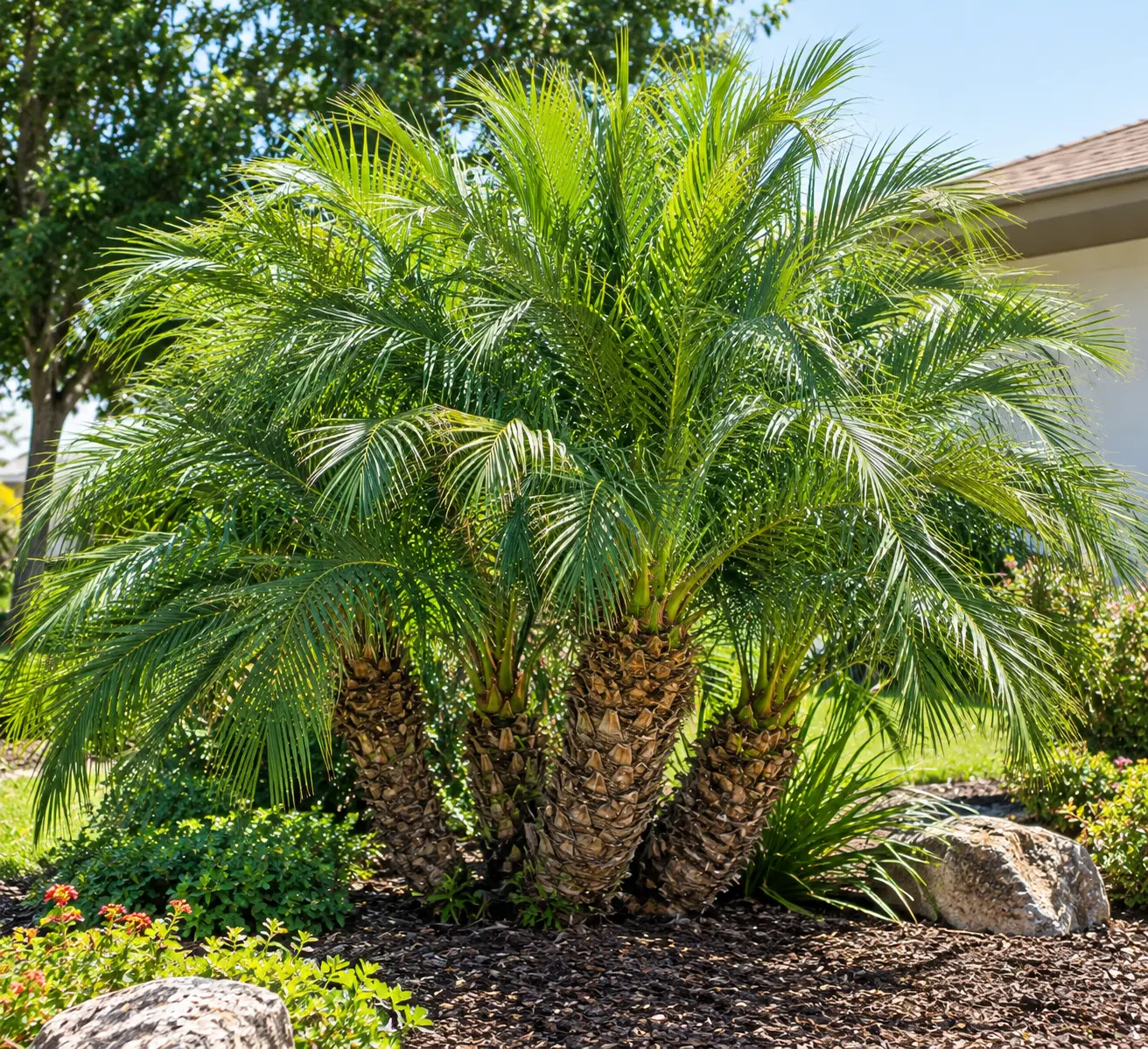
A pygmy date palm (Phoenix roebelenii) thrives in bright light and fast-draining soil. Water it when the top inch or two of soil feels dry, and feed it with a palm-specific fertilizer rather than a general-purpose one. Outdoors, it is reliably hardy in USDA zones 10 and 11 and can be grown in zone 9b with some risk. Trim only fronds that are fully brown, because yellowing fronds are still helping the plant.
That covers about 80 percent of success with this palm. The rest of this guide explains the reasoning, so you can adjust when your light, climate or soil does not match those conditions.
What a pygmy date palm is (and what it isn’t)
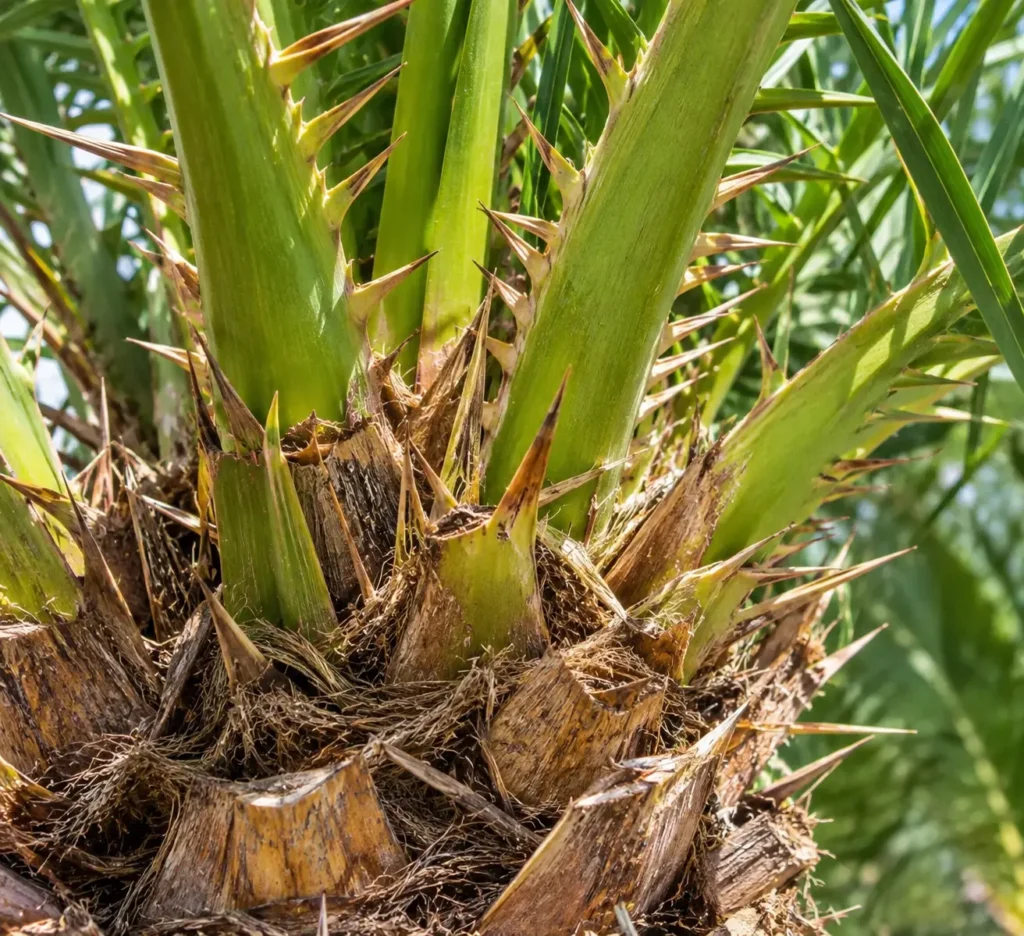
The pygmy date palm is a slow-growing palm native to tropical Asia. It is one of the most commonly planted small palms in Florida, and it is sold across the country as a patio plant and houseplant. According to the University of Florida’s extension service, it usually grows to about 12 feet tall and spreads 6 to 8 feet wide. The trunk is slender, often bent or crooked, 3 to 6 inches thick, and covered with leaf bases that look like pegs.
Two things matter when you plan to grow or care for one:
- First, it is often sold as a clump. Nurseries usually plant two to four palms close together, which makes the plant look like it has several stems. If you want to repot or divide it, treat each one as its own plant even though they share a pot.
- Second, it has spines. The lowest leaflets on each frond turn into spines about 2 to 3 inches long. Think carefully before planting one near a walkway, a pool deck or a place where children play. Always wear gloves and eye protection when you prune or handle the plant.
In a container, it generally stays smaller than the landscape numbers above. A potted palm is limited by root space, so don’t expect 12 feet in a living room.
Where it will grow: climate and USDA zones
The UF/IFAS Extension says the pygmy date palm can survive in USDA zone 10A, where winter lows reach about 30°F. It also says people grow it in zone 9B, where lows reach about 25°F. That 9B detail matters because many homeowners on the Gulf Coast, in Georgia, and in parts of Texas and California plant these palms. They usually do fine through the winter, until a hard freeze occasionally arrives.
| Where you live | What to expect |
|---|---|
| Zones 10–11 (South Florida, Florida Keys, parts of coastal Southern California, Hawaii) | Suitable as an in-ground landscape palm |
| Zone 9b (parts of central Florida, Gulf Coast, South Texas, some California areas) | Possible, but expect occasional frost damage; choose a sheltered spot |
| Zone 9a and colder | Grow in a container and bring it indoors for winter |
Frost is the threat because palms have a single growing point at the top. A Florida extension answer on frost-damaged pygmy date palms makes the point well: if that growing point freezes, the whole palm can die. If a freeze burns the fronds but the crown survives, recovery may not show until spring or summer. In that situation, resist the urge to dig the palm up in February. Watch the center spear instead.
The species also doesn’t tolerate salt spray or salty soils, which surprises coastal buyers. A seaside lot in the Carolinas or on the Gulf is not automatically a good home for it, even when the temperature is fine.
Light: what “bright” actually means
Outdoors, pygmy date palms handle full sun to partial shade. In the hottest inland areas of the Southwest, afternoon shade helps keep fronds from scorching, especially on a newly planted palm that hasn’t built roots yet.
Indoors, light is the make-or-break factor. A palm that looks fine for two months and then slowly declines is almost always getting too little light. Aim for the brightest spot you have, typically a south- or west-facing window with direct sun for part of the day. A north-facing room usually won’t do it. If your home is dim, a full-spectrum grow light is more reliable than hoping.
Some practical habits:
- Rotate the pot a quarter turn every week or two so fronds don’t lean toward the window.
- Move it outdoors for summer if you can, but acclimate it over a week or two. A palm that goes from living room to full afternoon sun will burn.
- Bring it back in before nights drop toward the 40s °F in fall.
If you are planning a sunny planting area around the palm, our list of best plants for full sun and heat has companions that handle the same conditions.
Watering: the part most people get wrong
How often should you water a pygmy date palm? Water when the top inch or two of soil feels dry, then water thoroughly until it drains from the bottom. There’s no reliable calendar schedule, because the right interval depends on pot size, light, temperature, and soil.
Both errors are common:
Overwatering is the more frequent killer indoors. Constantly wet soil damages roots, and the symptoms (yellowing, drooping, browning) look a lot like underwatering, which tempts people to water more. Check the soil with your finger or a wooden skewer before watering, not the calendar.
Underwatering shows up as dry, crispy leaflet tips and fronds that brown from the outside in. A pot that has dried out completely can repel water at first, so water slowly in stages or soak the pot in a basin for a while.
For in-ground palms, the first few months after planting are the critical window. Water regularly until the root system establishes. After that, a pygmy date palm tolerates normal dry spells better than most tropical-looking plants, though it looks best with occasional deep watering in extended heat. Deep, less frequent watering beats frequent light sprinkling.
Always empty the saucer after watering. Standing water under a pot is the quickest route to root problems.
Soil, potting, and planting depth
Drainage is more important than the exact soil recipe. UF/IFAS describes the pygmy date palm as adaptable to a wide range of soil types, which is good news for in-ground planting. In pots, use a quality potting mix with extra drainage (a cactus/palm mix, or standard mix amended with coarse sand or perlite), and always choose a pot with drainage holes.
Two points worth knowing:
- Don’t plant too deep. UF/IFAS notes that iron deficiency in this palm can occur when it’s planted too deep or in poorly drained soil. Set the root ball so the top is level with, or very slightly above, the surrounding soil.
- Repot only when you have to. Palms don’t love root disturbance. Repot when roots circle the pot or push out of the drainage holes, and move up only one pot size.
Alkaline soil is worth a mention. In parts of the Southwest and in limestone-based soils in South Florida, manganese deficiency becomes common (more on that below).
Fertilizer: why the label matters more than the brand
This is where many generic care guides fall short. According to UF/IFAS, most pygmy date palms in Florida show potassium deficiency on their oldest leaves, and a lot of the “mystery problems” people report are nutritional.
The extension recommendation for landscape palms is a fertilizer with an analysis of 8-2-12 (or 8-0-12), with the nitrogen, potassium, and magnesium in controlled-release form and micronutrients like manganese and iron in a water-soluble form. Look for products labeled specifically as palm fertilizer. That isn’t marketing fluff here. Palms have particular needs, and the wrong product can create new problems: UF/IFAS notes that fertilizers high in nitrogen or potassium but low in magnesium, including those applied to nearby lawn, can trigger magnesium deficiency in the palm.
That last point is a common trap. If your palm sits in a lawn that gets regular “weed and feed,” check what’s in it.
For houseplants, follow the product label for rate and timing. Palms are slow growers and are easily overfed, and fertilizer salts can build up in pots and brown the leaf tips. An occasional deep flush of water through the pot helps keep salts down.
Pruning: less is better
Remove only fronds that are entirely brown. A frond that’s yellow-orange at the tips is still contributing to the plant. UF/IFAS specifically says potassium-deficient leaves shouldn’t be removed until completely dead because they serve as a supplementary source of potassium. The university’s own research (Broschat, 1994) found that removing potassium-deficient leaves accelerated the palm’s decline.
So the unattractive-but-alive frond stays, and you fix the cause with better fertilization. As the palm improves, the crown fills out and the symptoms fade.
Don’t cut green fronds to “tidy” the shape, and never top the palm. Cutting the growing point kills it.
Diagnosing common problems
| What you see | Likely cause | What to do |
|---|---|---|
| Yellow-orange older leaves with dead tips | Potassium deficiency | Switch to a palm fertilizer; don’t remove the leaves yet |
| Broad yellow band along the edges of leaves, with dark green centers | Magnesium deficiency | Use a palm fertilizer containing magnesium; check for high-N or high-K products nearby |
| New leaves yellow overall | Iron deficiency, often from poor drainage or deep planting | Fix drainage and planting depth; iron products may not fully solve it |
| Frizzled, streaked new leaves, especially in alkaline soil | Manganese deficiency | Use a palm fertilizer with micronutrients; severe cases may need manganese sulfate |
| Several new spear leaves that won’t open, or crumpled new fronds | Boron deficiency | Consult your local extension office before treating |
| White, powdery coating on new leaves | Often normal | Young leaves naturally carry a whitish material that wears off |
| Closed fronds, premature leaf aging, white waxy masses at frond bases | Possible red date scale | Inspect the frond base and roots; contact your local extension |
| Spreading dead spots on leaves in cool, damp weather | Pestalotiopsis leaf spot | Improve airflow; avoid overhead watering |
| Decay at the base of the trunk | Ganoderma butt rot | No known control; plan to replace the palm |
A couple of notes on this table. The whitish powder that appears on fronds is the most frequent false alarm. UF/IFAS points out that this natural material is often mistaken for whitefly, mealybug or scale. If the powder is on young leaves and wears away as they age, that is normal. Red date scale looks different: it tends to concentrate irregularly where the leaflets emerge and can be found on the frond bases, the midrib and the roots.
Indoors, spider mites are a common pest on many palms, especially in dry heated rooms. Checking the undersides of fronds with a flashlight is a good habit. UF/IFAS lists spider mites among the pests of this species.
Indoors or outdoors: which suits you?
Plant it in the ground if you live in zone 10 or warmer, have a sunny, well-drained spot, can keep it away from foot traffic, and are not near saltwater spray.
Choose a container if you live in zone 9 or colder, have a patio, or want the option to move the palm around. A pot lets you shelter the palm during cold snaps and keep it out of reach of kids and pets.
Think twice about it as a houseplant if your home receives very little direct light. This palm is more demanding than the low-light palms sold for offices. Many people have better luck with a parlor palm or a ponytail palm in dim rooms and save the pygmy date for a bright sunroom, a south window or a covered patio in warm months. For a larger, more tropical look outdoors, compare it with our guides to the Sylvester palm and the dwarf banana tree.
A realistic care routine
Rather than a rigid schedule, here’s what a sensible routine looks like in practice:
- Check the soil weekly. Water deeply only when the top inch or two is dry.
- Give the palm as much light as your space allows, and rotate it regularly.
- Feed with a palm-specific fertilizer according to the label, not a general plant food.
- Inspect fronds and frond bases monthly for pests, especially in winter indoors.
- Remove only completely brown fronds.
- Protect from cold well before the first forecast freeze.
Frequently asked questions
Why are the tips of my pygmy date palm turning brown?
Several causes can overlap: low humidity, dry soil, fertilizer salt buildup, or nutrient deficiency. If older leaves also turn yellow-orange, suspect potassium deficiency, which extension specialists describe as very common in this species. Check watering habits first, then your fertilizer.
Can a pygmy date palm survive winter outside?
In zones 10 and 11, yes. In zone 9b it often survives mild winters but can be damaged by hard freezes. Below that, it should be treated as a container plant and brought inside.
How fast does a pygmy date palm grow?
Slowly. Don’t expect rapid height gains, particularly in a pot or in low light. Most of what you’ll notice year to year is fuller fronds, not a taller plant.
Is it okay to cut off yellow fronds?
Wait until they’re fully brown. Partially yellow fronds are still supplying nutrients, and removing them early can weaken the palm.
Why won’t the new fronds open?
Unopened or stuck spear leaves can point to boron deficiency, according to UF/IFAS, though other causes are possible. If it’s an outdoor palm, a local extension office can help confirm.
Are the spines dangerous?
They’re sharp enough to puncture skin and can cause painful injuries, so wear gloves and eye protection when handling or pruning. For pet or child safety questions about the plant itself, check a source like the ASPCA’s plant database, and keep the plant out of reach regardless.
Does it need a big pot?
No. Choose a pot slightly larger than the root ball. An oversized pot holds extra wet soil, which raises the risk of root problems.
Can I grow one from seed?
It’s possible, but palm seeds are slow and unpredictable. Most home growers get better results from a nursery plant. If you want a pygmy date palm for a specific spot, buying a healthy established one saves a lot of time.
Where to look next
For the underlying plant science, the University of Florida’s fact sheet on this species is the best single reference I found, and it’s free: UF/IFAS Extension, Phoenix roebelenii: Pygmy Date Palm. It’s written for Florida conditions, so treat its fertilizer specifics as a guide to the nutrient balance palms need, and check with your local extension office for your region.
Sources & References
- Broschat, T.K., Klein, R.W., and Hilbert, D.R. Phoenix roebelenii: Pygmy Date Palm (ENH-600/ST441). UF/IFAS Extension. Original publication 1993; revised 2014 and March 2024. https://edis.ifas.ufl.edu/publication/ST441
- UF/IFAS Assessment of Non-Native Plants in Florida’s Natural Areas, Phoenix roebelenii entry (not considered a problem species in Florida).
- UF/IFAS Extension, Nassau County. Q&A on frost damage to pygmy date palms (2017).
- UF/IFAS Extension Pest Alert blog. What is killing my pygmy date palm? (red date scale and nutrient problems).
[…] that stays green all year. Planning other evergreen plantings for a warm-climate yard? See our pygmy date palm care guide or our Sarah Bernhardt peony guide for more garden […]
[…] more low-maintenance plants for warm or shady spots? See our pygmy date palm care guide and our azalea shrubs […]