

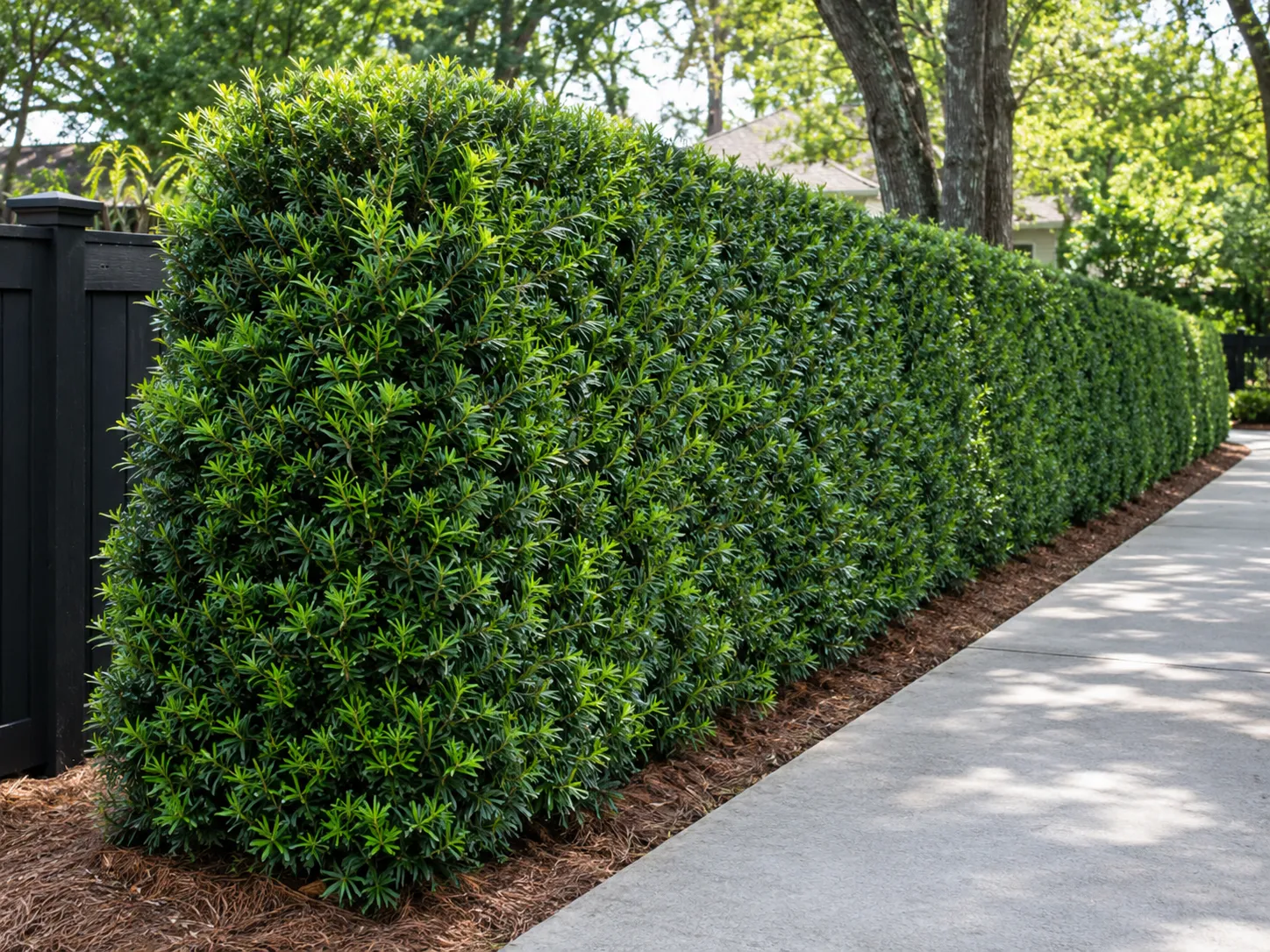
Podocarpus hedge does best in USDA zones 8b through 11 in sun to part shade, in soil that drains well. For a hedge place medium-sized nursery plants about 2 to 4 feet apart. Plant them no deeper than they were in the pot. Trim them lightly and often with hand pruners if you want the look. If you don’t keep up with it it stops being a hedge: this plant naturally grows into a tree that reaches 30 to 40 feet tall.
Podocarpus is a dark green evergreen that handles poor soil and salt air, which is why it’s sold at nearly every garden center in the warmer parts of the country. It also has one known weakness: it rots in wet ground. Most hedge problems come from drainage and planting depth, not from anything complicated.
Is podocarpus right for your hedge?
Most hedges that people call podocarpus are actually Podocarpus macrophyllus. Podocarpus macrophyllus is also known as yew podocarpus, southern yew or yew pine. The University of Florida fact sheet says Podocarpus macrophyllus grows best in USDA zones 8b to 11. An older version of the sheet said Podocarpus macrophyllus can grow in zone 7b and you still see that number on plant tags and websites. If you live in zone 7b or 8a, treat it as a gamble. Cold damage to new growth makes dieback more likely. (More on that below.)
Podocarpus macrophyllus works well in these regions:
- Florida, the Gulf Coast and the Southeast coastal plain
- Southern and coastal Texas
- Mild parts of Arizona along with coastal and inland-valley California
- Hawaii
Podocarpus macrophyllus is a poor choice in the Midwest, the Northeast and most of the Mountain West. If you live in a zone colder than 8b, consider boxwood, inkberry holly or yew (Taxus) instead. Our guide to the best foundation hedges by zone and height compares more options, and your county extension office can tell you what works best locally.
Where it does well: Full sun gives the best growth and form. In shade it grows more slowly and looks looser, though UF notes it will grow on the north side of a tall building with little direct sun. It tolerates clay, sand and loam, and both acidic and alkaline soil, as long as water drains away. It’s very drought tolerant once established, and its tolerance of salt spray is rated high, which is why you see it near the coast.
Where it doesn’t: Anywhere water stands. UF’s guidance is blunt: don’t plant it on wet soils.
Not every podocarpus makes a good hedge
Nurseries use “podocarpus” loosely, so check the tag.
| Plant | Typical use | Notes |
|---|---|---|
| Podocarpus macrophyllus (yew podocarpus) | Clipped hedge, screen | Slow growth, zones 8b–11 per UF/IFAS. The standard hedge choice. |
| P. macrophyllus ‘Pringles’ | Short hedge | Naturally dwarf, 3 to 5 feet tall at maturity, so it needs less pruning. |
| P. macrophyllus var. maki | Narrow hedge or screen | Columnar, with shorter leaves (1.5 to 3 inches). |
| Afrocarpus gracilior (fern pine, formerly Podocarpus gracilior) | Informal screen, tree | Faster growing and much larger. Sources generally list zones 9–11. |
Fern pine can be a trap for gardeners. One comparison source says yew podocarpus, which is smaller and slower, is the better choice for a hedge that will be sheared regularly, while fern pine is best used as a shade tree. An Arizona State University plant library entry also warns that many Southern Californians don’t realize how large fern pine can grow, even when it’s planted as a hedge. If you want a low-maintenance hedge, buy yew podocarpus or a dwarf cultivar and confirm the botanical name on the tag.
How to plant a podocarpus hedge
1. Plan before you dig. Call 811 first. It’s the national number that gets utility lines marked. UF/IFAS Charlotte County also says to keep shrubs from growing close to the house, since crowded plants trap moisture and are hard to trim. Leave space to walk behind the hedge with pruning shears. For more on spacing plants from a foundation, see our foundation hedges guide.
2. Check the roots. UF’s disease guide says to inspect nursery plants before you plant them. Gently slide the plant out of its pot. Healthy roots are firm and pale. If roots are brown, soft or fall apart when you touch them it’s root rot. Send that plant back. Don’t mistake the nodules on podocarpus roots for nematode damage. UF says they are beneficial fungi (mycorrhizae) that form a natural partnership with the plant.
3. Pick a planting time that avoids hot weather. UF notes that wet soil combined with warm to hot temperatures promotes root rot. In most of the South, that means fall through spring is safer than midsummer. This is an inference from disease patterns, not a rule from one source, so factor in your local rainy season.
4. Set the plants at the right depth. According to UF, planting too deep is a root rot risk. Keep the top of the root ball level with or slightly above the surrounding soil. In clay, plant a bit higher and slope the soil up around the edges. If water collects after rain, a raised bed or low berm can help, and it’s worth the work.
5. Water, then ease off. Keep the root ball moist while the plant settles in, then reduce watering. Once established, podocarpus can handle dry spells but not soggy roots. If you have an irrigation system, check whether the hedge shares a zone with your lawn. A lawn zone that runs every day usually gives shrubs far too much water.
How far apart should you space podocarpus?
UF/IFAS Charlotte County’s guidance for medium-sized plants is 2 to 4 feet apart for a formal hedge, and 4 feet or more for a screen where you want a less groomed, more natural look. Your choice depends on starting plant size, how fast you want the gaps to close, and how formal the hedge will be.
The trade-off is cost and crowding against patience. A Hawaii garden columnist worked through the math: 100 feet of hedge takes about 20 plants at 5-foot spacing and about 33 at 3-foot spacing. Close spacing also means more plants to prune and more competition for water and light over time, so the hedge costs more to maintain.
| Spacing | Plants per 100 ft | Best for |
|---|---|---|
| 2 ft | ~50 | Fast, tight formal hedge from small plants; highest plant cost |
| 3 ft | ~33 | Good balance for a formal hedge |
| 4 ft | ~25 | Looser hedge or screen; slower to fill in |
| 5 ft | ~20 | Informal screen; visible gaps for a few years |
Podocarpus is slow, so a hedge planted at 4 to 5 feet can take years to knit together. Larger plants set at wider spacing can cost about the same as more small plants set closer together, and they fill in sooner. Whichever you choose, stagger plants in a double row only if you need a thick screen. For most side-yard hedges, a single row is easier to prune.
How to prune a podocarpus hedge
UF’s fact sheet says the plant is one of the few trees that can be pruned into a nice hedge, and that it looks better when pruned with hand pruners than when sheared with a hedge trimmer. That’s the best-looking approach, but it’s also slower, so on a long hedge most people shear anyway. Both work. The difference is how clean the result looks, since shearing cuts through leaves and leaves brown edges.
Shape matters more than most people think
For formal hedges, UF/IFAS Charlotte County recommends a trapezoid shape: narrow at the top and wider at the base, so light reaches the lower branches. A hedge cut flat-sided or wider at the top shades its own base, and the bottom goes thin and bare. The look you’re trying to avoid is a green top over a leafless trunk line.
Timing
Extension sources don’t agree on one date, so use your climate and the plant’s growth cycle to decide.
- Light shaping: After a flush of new growth finishes and the new leaves have hardened off.
- Hard cutting to encourage low branching: Gardening publisher Harvest to Table suggests pruning hard before midsummer so new growth has time to harden before winter. One home-gardening source recommends late winter or early spring before growth starts. In zone 8b or 9 where frost is possible, the earlier-summer approach makes sense. Avoid heavy cuts in fall, which trigger tender new growth that cold can burn.
UF’s pest guide gives a reason to be careful: injury from shearing, sunscald, and cold-damaged new growth all raise the chance of dieback infection, and spores spread by splashing water. It’s reasonable to infer that you should prune on dry days and avoid heavy shearing right before a stretch of rain, but that’s an inference, not a quoted rule.
Training a young hedge
In the first couple of years, don’t clip it into a box. Let the plants fill out, and tip-prune to push branching and thicken the base. Pruning tall, lanky growth stimulates side buds and makes a bushier plant. Establish the width first, then raise the height gradually.
Keeping it at hedge height
Most homeowners hold podocarpus hedges at 4 to 5 feet. Trimming once or twice a year is typical in the South, though a slow-growing hedge in lean soil may need less. UF lists the pruning requirement for the plant as “little required,” meaning it doesn’t need trimming for its health. You trim for size and shape.
If a hedge has been neglected and has grown tall, extension sources don’t give a clear rule about how hard you can cut into old, leafless wood. Reduce it in stages across a couple of seasons rather than in one drastic cut, and watch for regrowth before going further.
Podocarpus hedge checklists
Before you plant
- Confirm your USDA zone is 8b or warmer.
- Check the tag for the botanical name: Podocarpus macrophyllus (or the dwarf ‘Pringles’ or var. maki), not fern pine.
- Call 811 to have utility lines marked.
- Pick a spot with well-drained soil, where water doesn’t stand after rain.
- Decide on spacing (2 to 4 feet for a formal hedge) and multiply by your hedge length to count plants.
- Slide each plant out of its pot and check that the roots are firm and pale, not brown or soft.
- Leave room to walk behind the hedge with pruning shears.
- Plan to plant in fall through spring, not midsummer.
Yearly care
- Year one: keep the root ball moist while the plants settle in, then reduce watering.
- Every year: make sure your irrigation isn’t over-watering the hedge, especially if it shares a zone with your lawn.
- Spring: check new growth for curled tips and small dark aphids, and go easy on fertilizer.
- After each flush of growth: shape lightly once the new leaves have hardened off.
- Before midsummer: do any hard cutting you need, and keep the sides sloped so the hedge is narrower at the top.
- Whenever you prune: choose a dry day and remove any dead tips back to green tissue.
- Fall: avoid heavy cuts, which trigger tender growth that cold can burn.
- All year: watch for yellowing or browning lower leaves, especially on one side, which can signal root rot or fusarium wilt.
Problems to watch for
UF describes yew podocarpus as resistant to pests and diseases, with nothing of major concern. A few things still turn up.
- Root rot is the big one. Early signs are discoloration and death of lower leaves, sometimes on one side of the plant. By the time leaves look bad, the roots are already significantly rotted, and fungicides help little after symptoms appear. Prevention means drainage, correct depth, and not overwatering.
- Fusarium wilt shows as gray-green, then brown lower leaves, often on one side. UF says fungicides are not effective.
- Tip dieback causes dead shoots after a growth flush. Cut affected wood back to green tissue and dispose of it. There are no effective fungicide treatments.
- Podocarpus aphids are small, dark reddish-purple, and cluster on new growth, causing stunted, curled tips and sooty mold. They peak in spring. High nitrogen produces fast flushes of new growth that aphids like, so go easy on fertilizer. Insecticidal soap or oil is the lower-toxicity option; read the label.
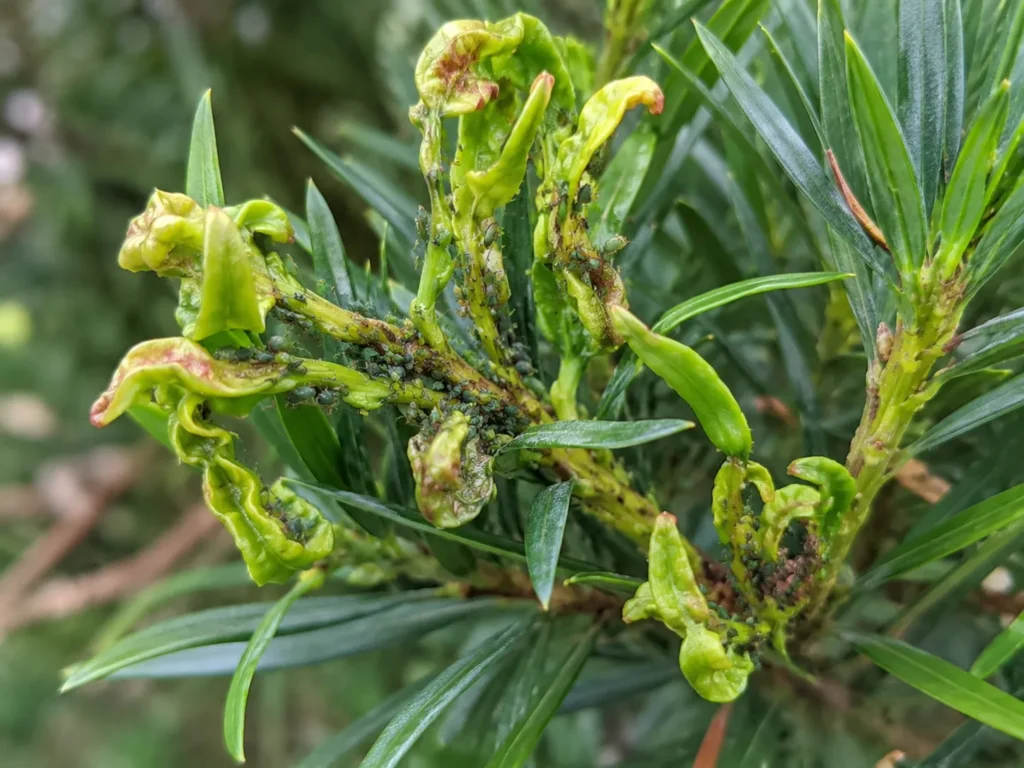
- Scale shows up as sooty mold or spotted leaves. Crawlers, the young stage, are the easiest to control.
- Yellowing on sandy soil may be magnesium deficiency, which UF says is easily corrected with magnesium sulfate. Confirm with a soil test before treating.
- Eriophyid mite (Paracalacarus podocarpi) has been found only in Florida and attacks only podocarpus. It stunts new leaves and scars twigs. Prune out and destroy affected growth.
One safety note: UF says the fleshy fruit on female plants is edible, but the seeds are toxic and it’s best to avoid eating any part of the tree that resembles fruit. If you have young children or pets, that’s worth knowing, though a hedge that’s regularly clipped will produce less fruit.
When a podocarpus hedge is the wrong choice
- You’re in zone 7 or colder, or an area with hard freezes. The edge-of-range risk isn’t worth it.
- The site stays wet. Fix the drainage first or pick a different plant.
- You want a fast privacy screen. Podocarpus is slow. Expect patience, buy larger plants, or consider a faster evergreen such as Emerald Green arborvitae in colder zones.
- You can’t prune. A hedge left alone is a tree, and a large one.
FAQ
How fast does a podocarpus hedge grow?
Slowly. UF/IFAS lists the growth rate as slow. Expect several years before a hedge planted from small containers fills in completely.
How tall can a podocarpus hedge get?
Left unpruned, yew podocarpus can reach 30 to 40 feet. Most homeowners keep hedges to 4 or 5 feet, and dwarf types like ‘Pringles’ stay around 3 to 5 feet naturally.
Does podocarpus grow in shade?
Yes, but more slowly and with a looser look than in full sun. UF says it will grow on the north side of a tall building with little or no direct sun.
Why is my podocarpus turning yellow or brown?
Check drainage first. Lower leaves yellowing or browning, especially on one side, can point to root rot or fusarium wilt. Yellowing on sandy soil may be magnesium deficiency. Curled, stunted new growth points toward aphids.
Can I grow podocarpus in zone 7?
Older sources list 7b, but UF/IFAS’s current fact sheet lists 8b through 11. Zone 7 would be a risk, particularly in a cold winter.
Is podocarpus invasive?
UF/IFAS does not consider yew podocarpus a problem species at this time. Invasiveness varies by region, so check with your state or county extension office.
Should I use a hedge trimmer or hand pruners?
UF says hand pruners give a better look. Hedge trimmers are fine for large, formal hedges where speed matters, though expect more browned leaf edges.
Can I plant podocarpus close to my house?
Extension guidance advises against it. Close planting creates moisture and access issues. Leave room for airflow and for pruning from behind.
Sources & References
- UF/IFAS Extension, Podocarpus macrophyllus: Podocarpus (fact sheet ST495). ask.ifas.ufl.edu/publication/ST495
- White, B., et al. Key Plant, Key Pests: Southern Yew (Podocarpus macrophyllus) (ENH1373). UF/IFAS Extension, 2023.