

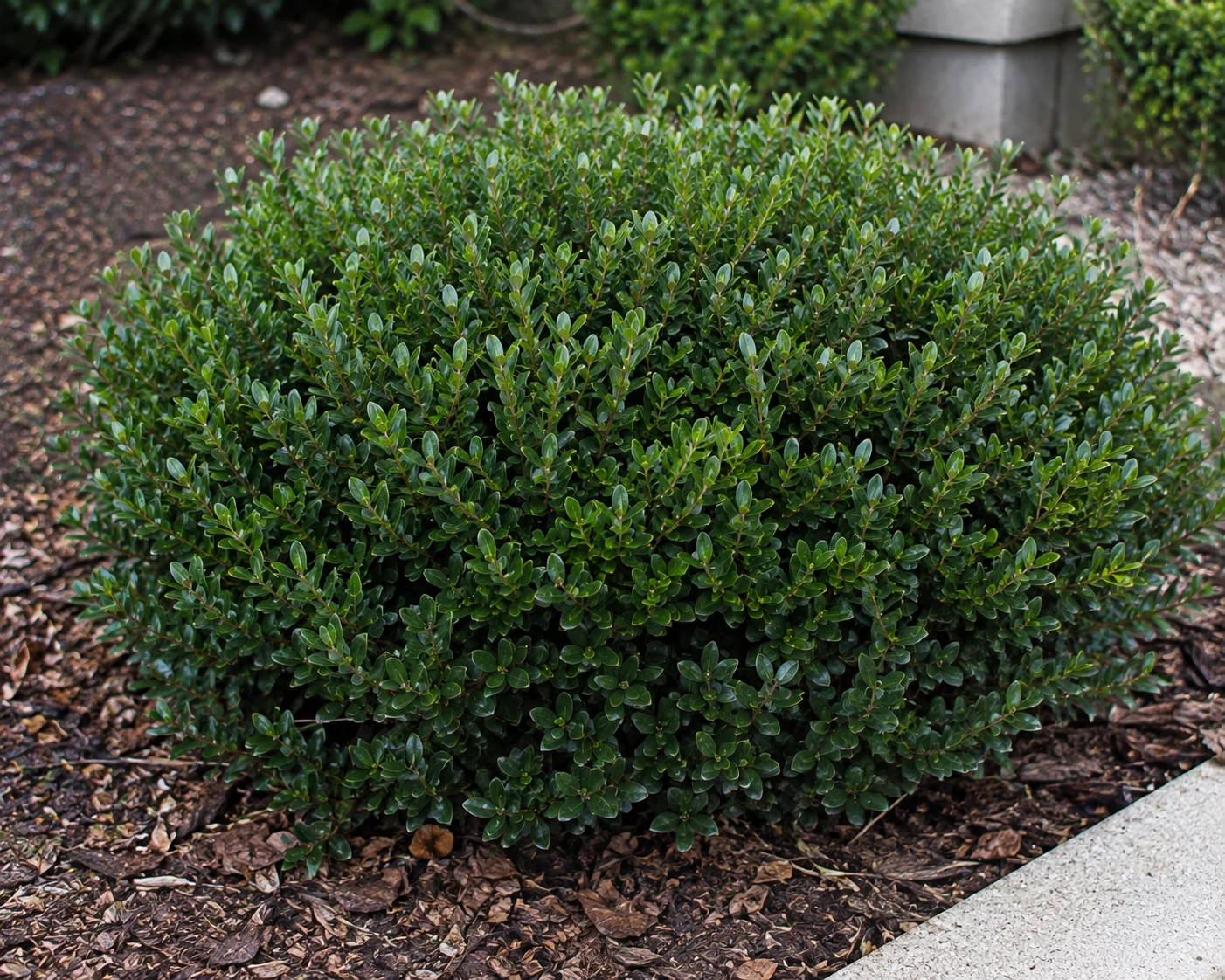
Walk through almost any foundation planting in the eastern United States, and you’ll likely spot a small, rounded, deep-green shrub tucked along the front of the house. There’s a good chance it’s a Shamrock inkberry holly. It’s compact, it’s tidy, and it’s one of the few native shrubs that gives boxwood real competition.
I’ve worked with this plant in gardens across several regions, and it’s become one of my go-to recommendations for people who want a low-maintenance, native alternative to boxwood or privet. It’s not flashy. It won’t stop traffic with big flowers or bold color. But it does its job quietly, year after year, and that’s exactly what most homeowners actually want from a foundation shrub.
This guide covers what you need to know in 2026. That includes planting, watering, feeding, pruning, common issues, and how to use it well in your landscape.
What Is a Shamrock Inkberry Holly?
Shamrock inkberry holly (Ilex glabra ‘Shamrock‘) is a compact cultivar of American inkberry, a broadleaf evergreen native to the coastal plain of the eastern United States. You’ll find its wild relatives growing naturally from Nova Scotia down through Florida and along the Gulf Coast, often near swamps, bogs, and sandy woodlands.
The ‘Shamrock’ cultivar was bred for a tighter, more compact habit than the straight species. Most mature plants reach 3 to 4 feet tall and wide, though some sources list heights up to 5 feet under ideal conditions. That’s a manageable size for foundation plantings, borders, and low hedges.
The foliage is small, glossy, and dark green, with a spineless, smooth-edged leaf that looks a lot like boxwood from a distance. New spring growth often emerges bright, almost lime-green, before deepening to that classic dark green through summer.
Here’s an important detail: Shamrock inkberry holly is a female cultivar. It needs a male inkberry planted nearby to produce its small black berries. Without a male pollinator, you’ll still get a healthy, attractive shrub. You just won’t see the berries that birds love through winter.
USDA Hardiness Zones and Where It Grows Best
Inkberry holly thrives across USDA hardiness zones 4 through 9, and some sources extend that range to zone 11 in favorable microclimates. That covers an enormous portion of the country, from the colder Northeast and Upper Midwest down through the Southeast and into parts of Texas and the Gulf Coast.
Because it’s native to the Eastern Seaboard, it performs especially well in that region’s naturally acidic, sandy soils. A few regional notes are worth knowing:
- In the Northeast and Mid-Atlantic, where the plant is native, it handles both wet and dry conditions with ease. It even tolerates periodic flooding.
- In the Southeast, it holds up well in humid summers, though good air circulation still helps prevent fungal issues in dense plantings.
- In the Midwest and colder zones, it performs reliably as long as soil drainage is decent and the site isn’t exposed to constant harsh winter wind.
- In coastal areas, it tolerates salt spray better than many broadleaf evergreens, making it a solid choice for seaside landscapes.
Planting Your Shamrock Inkberry Holly
Getting the planting stage right sets this shrub up for decades of easy care. Inkberry holly has shallow, wide-spreading roots, which changes how you should prepare the site compared to deeper-rooted shrubs.
1. Choose full sun to partial shade. This plant tolerates a range of light conditions, from full sun to fairly deep shade. For the best foliage density and that classic tidy shape, aim for at least four to six hours of direct sun.
2. Test your soil pH. Inkberry holly prefers acidic soil, ideally in the 4.5 to 6.0 pH range. If your soil leans alkaline, consider a soil test before planting and amend accordingly with sulfur or an acidifying fertilizer.
3. Prepare a wide bed, not just a hole. Because the roots spread laterally near the surface, loosen the soil across a wide area, roughly two to five feet wide, rather than just digging a narrow hole. This gives the shallow root system room to establish quickly.
4. Match planting depth to the root crown. Measure from the crown, where the branches meet the roots, down to the bottom of the pot or root ball. Dig to that same depth. Planting too deep is a common cause of stress for shallow-rooted shrubs like this one.
5. Backfill, water, and mulch. Fill in with loosened native soil, water deeply to settle the roots, and add a 2 to 3-inch layer of mulch. Mulch helps retain the moisture this plant likes while keeping weeds down around those shallow roots.
Best planting time: early spring or fall, when temperatures are mild and rainfall is more consistent. This reduces transplant stress and gives the shallow root system time to establish before extreme heat or cold arrives.
Watering: What This Plant Actually Wants
Inkberry holly is naturally adapted to moist, sometimes soggy, ground. That makes it more tolerant of wet soil than most broadleaf evergreens. It’s also more tolerant of drought than you might expect once established, but consistent moisture keeps it looking its best.
During the first year, water deeply once or twice a week. Adjust based on rainfall and soil type. Sandy soils dry out faster and need more frequent watering than clay.
Once established, this shrub handles both average moisture and occasional dry spells well. If you’re in a low-lying or naturally damp part of your yard, that’s actually a good spot for inkberry holly, since it tolerates conditions that would stress many other shrubs.
Feeding and Fertilizing
Shamrock inkberry holly isn’t a heavy feeder. A single application of a balanced, slow-release fertilizer formulated for acid-loving plants in early spring is usually enough. Products made for azaleas, rhododendrons, or camellias work well here too, since they share similar soil preferences.
Avoid over-fertilizing. Excess nitrogen pushes soft growth that’s more vulnerable to pests and winter damage. If your soil is already fertile and slightly acidic, an established planting may need little to no supplemental feeding at all.
Pruning: Understand the Natural Habit First
This is the part where most people go wrong with inkberry holly, myself included on my first attempt years ago. The plant has a naturally open interior growth habit. Foliage clusters toward the top and outer edges, while the inside stays relatively bare. That’s not a problem. It’s simply how the species grows.
Heavy or frequent shearing makes this worse, not better. Regular shearing encourages a thin outer shell of leaves while the interior becomes increasingly bare underneath. Over time, that can leave a hollow-looking shrub with visible stems at the base.
Here’s how to prune it well:
- Prune lightly, and prune with a purpose. Light shaping in early spring, just before new growth starts, works best.
- Skip aggressive shearing if you want to preserve a fuller look long-term. A light touch keeps the plant denser than constant hard shearing does.
- Remove dead or damaged wood as you notice it, rather than doing one big cleanup once a year.
- Manage root suckers. This species spreads by underground stolons and will send up new shoots around the base. Remove unwanted suckers regularly if you want to keep a tidy, contained shape rather than a spreading colony.
- Consider newer dwarf cultivars if bare lower growth bothers you. Some compact varieties retain foliage closer to the ground better than older cultivars do.
If your plant has already become leggy and bare at the base, resist the urge to hack it back hard. According to horticultural extension guidance, aggressive pruning has only limited success at forcing this species to fill back in, since that’s simply not how it naturally grows. A better fix is often planting low, shade-tolerant perennials in front to hide bare stems.
Common Pests and Problems
Inkberry holly is a genuinely tough, low-drama native shrub. Still, a few issues show up occasionally:
- Spider mites can appear during hot, dry weather, leaving fine webbing and stippled, dull foliage. A strong hose spray or insecticidal soap handles most minor cases.
- Scale insects sometimes attach to stems and leaves, causing yellowing or weak growth. Horticultural oil applied in late winter helps control them.
- Root or crown issues are rare, since this plant actually tolerates wet soil well. Problems are more likely tied to extremely poor drainage in heavy clay than to overwatering alone.
- Chlorosis, a yellowing between leaf veins, can appear if soil pH is too alkaline for the plant’s acid-loving preferences. A soil test and appropriate amendment usually resolves it.
Routine inspection during regular yard maintenance is typically enough to catch these issues before they become serious.
Landscaping Uses: Where This Shrub Really Shines
Shamrock inkberry holly earns its popularity through sheer versatility:
- Boxwood alternative. As boxwood blight has become a growing concern in many regions, inkberry holly offers a native, disease-resistant substitute with a similar look.
- Foundation planting. Its compact, rounded shape fits neatly along the front of a house without constant pruning to keep it in bounds.
- Low hedges and borders. Space plants roughly two to three feet apart for a fairly solid, low hedge with minimal gaps.
- Rain gardens and wet areas. Its natural tolerance for periodically wet soil makes it a smart choice for low spots where other shrubs struggle.
- Pollinator and wildlife gardens. The small spring flowers attract bees and other pollinators, and the berries, when present, feed birds through winter.
If you’re comparing native shrub options for a foundation planting or low hedge, it’s worth looking at how inkberry holly stacks up against other compact evergreens for your region. Our guide to choosing native shrubs for foundation plantings walks through several options suited to different soil types and light conditions.
A Quick Seasonal Care Checklist
- Spring: Apply acid-loving plant fertilizer, do any light shaping before new growth starts, and check for winter damage.
- Summer: Watch for spider mites during dry spells, water deeply if rainfall is scarce, and remove unwanted root suckers.
- Fall: A good window for new planting, plus a chance to clean up any dead interior wood.
- Winter: Minimal care needed. Foliage generally stays attractive unless temperatures drop well below zero.
Frequently Asked Questions
Does Shamrock inkberry holly need a male plant to survive? No. The shrub survives and grows fine on its own. A male inkberry nearby is only necessary if you want the female ‘Shamrock’ to produce its small black berries.
How big does Shamrock inkberry holly get? Most mature plants reach 3 to 4 feet tall and wide, with some specimens reaching up to 5 feet under ideal growing conditions. Its compact size makes it well-suited to small gardens and foundation plantings.
Why is my inkberry holly bare at the bottom? This is a natural growth habit for the species, not a sign of disease. Inkberry holly tends to hold foliage toward the top and outer edges as it matures. Frequent hard shearing tends to make this worse rather than better.
Is inkberry holly a good boxwood substitute? Yes. Many gardeners choose it specifically as a native alternative to boxwood, especially in areas dealing with boxwood blight. It offers a similar compact, evergreen look with better regional disease resistance.
Does Shamrock inkberry holly tolerate wet soil? Yes, remarkably well. It’s native to swamps, bogs, and periodically flooded coastal areas, which makes it more tolerant of wet or poorly drained soil than most broadleaf evergreens.
How much sun does inkberry holly need? It tolerates a wide range, from full sun to fairly deep shade. For the fullest, densest foliage, aim for at least four to six hours of direct sunlight daily.
When is the best time to prune inkberry holly? Early spring, just before new growth begins, is generally best. Light, purposeful pruning maintains shape without triggering the thin, hollow look that comes from frequent hard shearing.
Does inkberry holly spread aggressively? It can spread gradually through underground root suckers, forming small colonies over time if left unchecked. Removing unwanted suckers regularly keeps the plant contained to its intended spot.
Final Thoughts
Shamrock inkberry holly offers something increasingly rare in landscaping: a native shrub that looks polished without demanding constant upkeep. It tolerates wet soil, handles a wide range of light conditions, and asks for very little beyond occasional light pruning and the right soil pH.
Understand its natural growth habit before you reach for the hedge shears, and you’ll avoid the most common mistake gardeners make with this plant. Get that right, along with a well-prepared planting bed, and you’ll have a dependable, attractive evergreen for years to come.
For more detailed growing information, the NC State Extension Gardener Plant Toolbox offers a thorough profile of Ilex glabra, including native range, soil preferences, and wildlife value across different U.S. growing regions.