

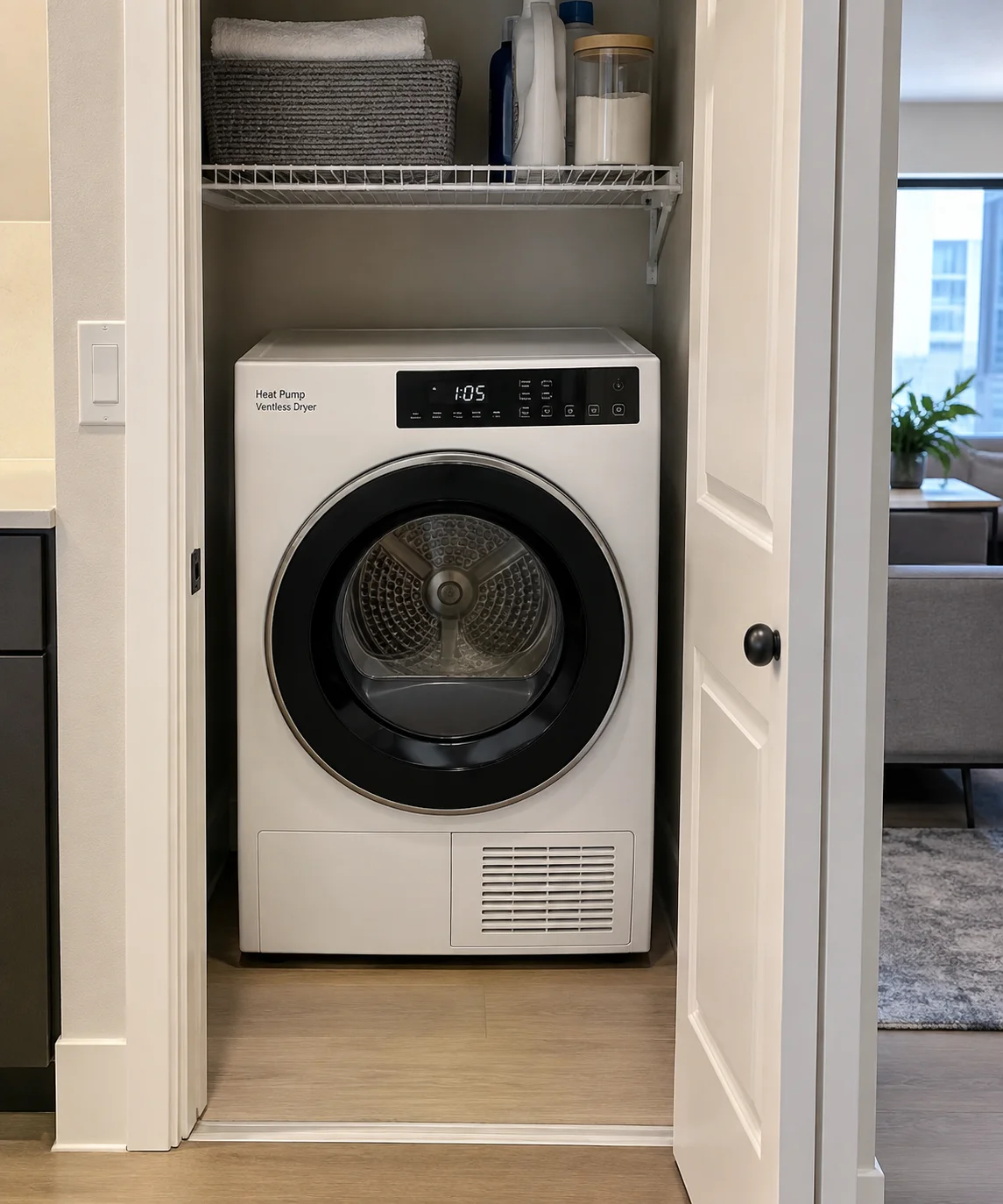
If your laundry room, apartment, or condo doesn’t have an outside vent, a ventless dryer is likely your only realistic option. Fortunately, this technology has improved a lot in recent years. As a result, “ventless” no longer means “compromise.”
So here’s the short answer. For most households, a heat pump ventless dryer beats a condenser model. That’s because it uses roughly half the energy. On top of that, it’s gentler on fabrics. However, the tradeoff is a higher upfront cost and a slower dry cycle. Strong 2026 options include the LG DLHC1455W for apartments, the Samsung DV25FG62B0BEA2 compact heat pump dryer, and the Bosch WQB245AXUC 800 Series for a European-style compact footprint. Below is what actually separates these machines, where ventless dryers fall short, and how to pick the right one for your space.
Quick Answer: What Is a Ventless Dryer?
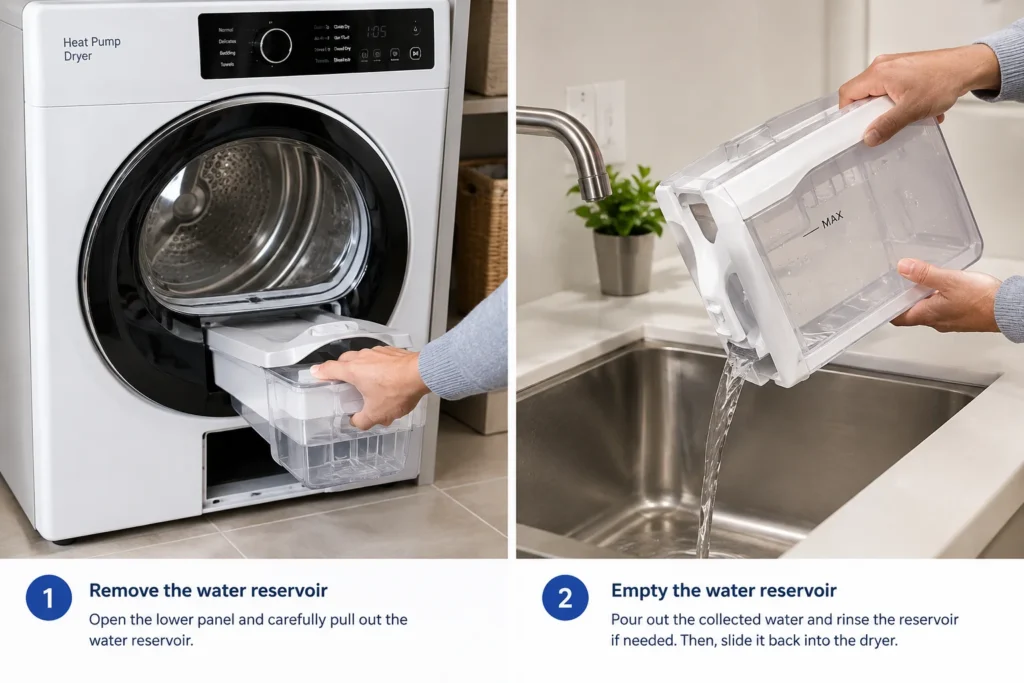
A ventless dryer dries clothes without pushing hot, moist air outside through ductwork. Instead, it handles moisture one of two ways. On one hand, condenser dryers cool the air down and collect the water. On the other hand, heat pump dryers use a refrigerant-based system to recycle warm air in a closed loop, pulling moisture out along the way. Either way, the collected water goes into a removable tank. You then empty it after each cycle, or, alternatively, you can plumb some models directly to a drain.
This matters more than people expect. After all, many American homes have no place to run exterior venting. This is especially true for older apartments, condos, and multi-family buildings. Consequently, it’s a big reason ventless machines have become common in the U.S. rental market over the past decade.
Heat Pump vs. Condenser Dryers: The Real Difference
This is the single most important distinction when shopping. Yet a lot of listings blur it, so it’s worth being precise.
Condenser dryers use a conventional heating element to warm air. That air then passes through the drum, and afterward gets cooled to pull the moisture out. Overall, it’s a simpler, older technology. However, that simplicity comes at a cost: higher energy use per load than a heat pump.
Heat pump dryers, in contrast, work more like your refrigerator or air conditioner. Specifically, they use a refrigeration cycle to extract heat from the air and reuse it, instead of generating new heat every cycle. Because the heat gets recycled, these dryers run at lower temperatures. As a result, they also use noticeably less electricity per load than condenser models.
Naturally, the tradeoffs run in predictable directions. For instance, condenser dryers usually cost less to buy. They also dry clothes faster. Plus, they’re simpler mechanically, so there’s less that can go wrong. Heat pump dryers, meanwhile, cost more upfront. They also take longer per cycle, and some models run heavier too. Still, they save real money on electricity over the appliance’s lifetime. In addition, they treat fabrics more gently, since they skip the high heat.
So if you do laundry several times a week, the energy savings on a heat pump model add up. Over several years, for example, that can offset some or all of the higher purchase price. But if you dry infrequently, or price is your main constraint, a condenser dryer isn’t a bad choice either.
Best Ventless Dryer Models in 2026
The picks below reflect current market data across major appliance categories. However, prices are approximate. Because they’ll shift with retailer promotions, treat these numbers as directional, not fixed.
Best Overall: LG WKHC252HBA (heat pump, full-size)
This isn’t a compact ventless unit. Instead, it’s a full-size heat pump dryer, and it posts one of the highest combined energy factors on the market. Even so, it still handles a large load, roughly 7.8 cubic feet. So if you have the space for a full-size machine but still can’t vent to the outside, this is one of the most efficient options sold in the U.S. right now. Expect a price point near the top of the category, roughly $1,800.
Best for Apartments: LG DLHC1455W (compact heat pump)
This is a strong runner-up for smaller spaces. Specifically, it balances efficiency with a footprint that fits in a closet or stacked laundry setup. It runs around $1,500. Consequently, apartment and condo dwellers who want real energy efficiency without a full-size unit tend to land here.
Best Value Compact: Samsung DV25FG62B0BEA2 (4.0 cu. ft. heat pump)
Samsung’s compact ventless heat pump dryer includes Wi-Fi connectivity, an AI-assisted drying dial, and smart sensors that adjust cycle time based on load moisture. As a result, reviewers frequently name it a strong overall pick. In short, it offers smart features without the price jump of a premium European brand.
Best Compact European-Style: Bosch WQB245AXUC 800 Series
Bosch’s 800 Series heat pump dryer is a reviewer favorite for two reasons: quiet operation and fabric-friendly low-temperature drying. Both, in fact, are characteristic of European compact laundry design. So it’s a good match if you already run a compact or stackable laundry setup and want a machine built specifically for that smaller footprint.
Best High-End: Miele TXR860
Miele’s ventless heat pump dryer sits at the premium end of the category. It’s known, above all, for the build quality and longevity that typically comes with a Miele appliance. Naturally, that quality comes with a correspondingly higher price tag. Still, it’s a reasonable choice if you plan to keep the machine for well over a decade and want to minimize the odds of needing service.
Best Large-Capacity Ventless: Asko T411HS.W
For a ventless machine, the Asko T411HS.W offers an unusually large capacity: 5.1 cubic feet. This matters especially if you regularly do bulky loads, like bedding or towels, and don’t want to split them across multiple cycles.
Best Budget Ventless: Kenmore compact ventless condenser models
Want something straightforward and lower-cost, without needing heat pump efficiency? Then Kenmore’s compact condenser dryers are a common value pick. They work especially well for smaller households or infrequent laundry days.
Comparison Table
| Model | Type | Capacity | Best For | Approx. Price |
|---|---|---|---|---|
| LG WKHC252HBA | Heat pump | ~7.8 cu. ft. | Highest efficiency, full-size | ~$1,800 |
| LG DLHC1455W | Heat pump | Compact | Apartments, condos | ~$1,500 |
| Samsung DV25FG62B0BEA2 | Heat pump | 4.0 cu. ft. | Smart features, value | ~$1,000–$1,200 |
| Bosch WQB245AXUC 800 Series | Heat pump | Compact | Quiet, gentle drying | ~$1,300–$1,500 |
| Miele TXR860 | Heat pump | Compact | Long-term durability | Premium tier |
| Asko T411HS.W | Heat pump | 5.1 cu. ft. | Largest ventless capacity | Premium tier |
| Kenmore compact condenser | Condenser | Compact | Budget-conscious buyers | Under $1,000 |
Pros and Cons of Ventless Dryers
Pros:
- Installs anywhere with standard power, so no exterior venting or ductwork is needed
- Heat pump models use significantly less energy than vented or condenser dryers, which in turn can lower electricity costs over time
- Lower drying temperatures on heat pump models are gentler on fabrics, so they cut down on shrinkage and wear
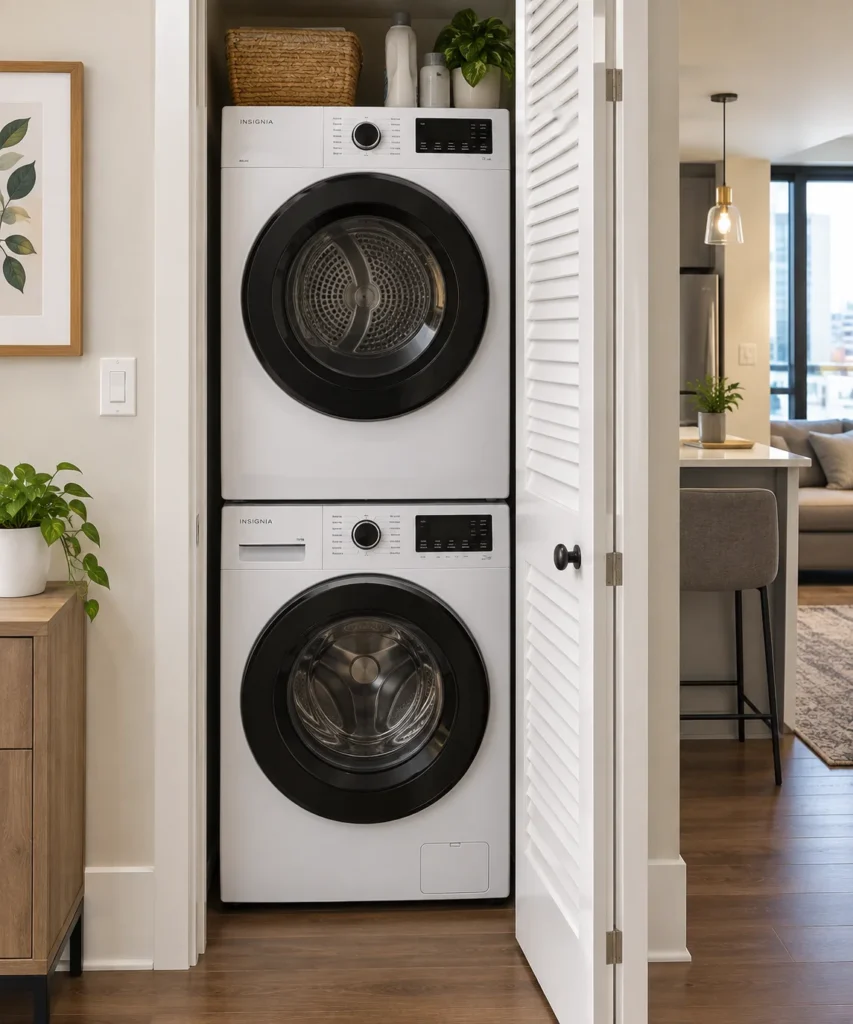
- Compact designs fit apartments, condos, and stacked laundry closets that otherwise can’t fit a full-size vented unit
- No heat or lint gets pushed into a wall cavity, which some homeowners therefore see as a fire-safety advantage over a poorly maintained vented system
Cons:
- Heat pump models usually take longer per cycle than a comparable vented dryer, often close to double the time for a full load
- Upfront cost for heat pump models runs noticeably higher than a standard vented electric dryer
- Water reservoirs need regular emptying unless the unit is plumbed to a drain, which adds a step vented dryers don’t require
- Lint and condenser filters need more frequent cleaning than vented dryer lint traps, otherwise efficiency and airflow start to drop
- Heat pump units run heavier and cost more than basic condenser dryers
Common Mistakes When Buying a Ventless Dryer
Confusing condenser and heat pump models. Unfortunately, retail listings don’t always spell out the difference in the title. So check the product specs directly for “heat pump” versus “condenser” technology before assuming you’re comparing similar machines. After all, the price and performance gaps are real.
Underestimating cycle time. If you’re used to a vented dryer, the longer cycles on heat pump ventless models will take some adjustment. This matters most, in particular, for households running multiple loads a day. So factor it into your routine, not just your purchase decision.
Skipping the drain-plumbing option. Many ventless dryers, in fact, can connect directly to a household drain line instead of relying on a manual water tank. If your laundry space already has drain access nearby, this saves you from emptying a reservoir after every load. Yet it’s a detail that’s easy to miss when comparing specs.
Ignoring maintenance requirements. Ventless dryers, heat pump models especially, need more consistent filter and condenser cleaning than vented dryers. Otherwise, drying times stretch out and efficiency drops, sometimes within a few months of regular use.
Not checking your electrical setup. Some full-size ventless dryers still need a 240-volt outlet, just like a standard electric dryer. Many compact models, however, run on standard 120-volt household outlets instead. So confirm this before you buy, especially if you’re replacing a gas dryer or installing in a space without existing 240V wiring.
U.S.-Specific Considerations
Space and building type matter more with ventless dryers than with almost any other major appliance. For example, older apartment buildings in cities like New York, Boston, and Chicago often prohibit exterior venting entirely. As a result, ventless units become close to mandatory rather than optional there. Homeowners in the South and Midwest with detached houses, on the other hand, usually have a choice between vented and ventless. Many, therefore, lean toward vented for faster cycle times, and instead save ventless models for secondary laundry areas, like a mudroom or upstairs closet without existing ductwork.
Humidity is a regional factor too. In already-humid climates like the Gulf Coast or parts of the Southeast, for instance, condenser dryers release some residual heat and moisture into the room. Consequently, that can make a small laundry closet feel noticeably warmer and stickier during summer months. Heat pump dryers, by contrast, don’t vent heat into the room the same way. That’s why they tend to be the more comfortable choice in these climates.
Frequently Asked Questions
Are ventless dryers as good as vented dryers?
In terms of drying performance, a well-maintained heat pump ventless dryer gets clothes fully dry. It just takes longer than a vented dryer. However, for efficiency and fabric care, heat pump models often beat standard vented electric dryers. So the main tradeoff is cycle time, not final results.
Do ventless dryers need special electrical outlets?
It depends on the model. Many compact ventless dryers, for example, run on a standard 120-volt outlet. Some full-size heat pump dryers, however, need a 240-volt connection, similar to a conventional electric dryer. Either way, always check the specific model’s electrical requirements before you buy.
How often do I need to empty the water tank?
This varies by model and load size. Typically, many users empty the reservoir after every one or two loads. However, if you plumb the dryer directly to a drain, this step disappears entirely.
Are heat pump dryers worth the extra cost?
If you do laundry frequently, yes, often. That’s because the energy savings can offset a meaningful chunk of the higher purchase price over several years, based on the U.S. Department of Energy’s efficiency comparisons for heat pump technology. If you use a dryer only occasionally, though, the payback period stretches out, so a condenser model may make more financial sense instead.
Can I install a ventless dryer myself?
Most ventless dryers just need a standard power outlet. Larger units, however, sometimes need a nearby drain connection too, if you’re skipping the manual water tank. Overall, installation is generally simpler than a vented dryer, since there’s no ductwork to run. Even so, follow the manufacturer’s specific setup instructions.
Do ventless dryers take much longer to dry clothes?
Heat pump ventless dryers typically take longer per cycle than a standard vented electric dryer, sometimes close to double the time for a full load. Condenser ventless dryers, by comparison, dry faster than heat pump models, but still generally slower than vented dryers.
Is a ventless dryer a fire risk?
Actually, ventless dryers remove the risk tied to clogged or poorly maintained exterior dryer vents, a leading cause of dryer-related house fires according to fire safety data. That said, they still need regular lint filter cleaning to run safely and efficiently, just through a different mechanism than vented models.
If you’re outfitting a laundry space in a smaller home or apartment, similar space constraints come up with other fixtures too — see PlazmaHomes’ guide on tankless toilets for another way to reclaim square footage in a tight bathroom or utility area.