

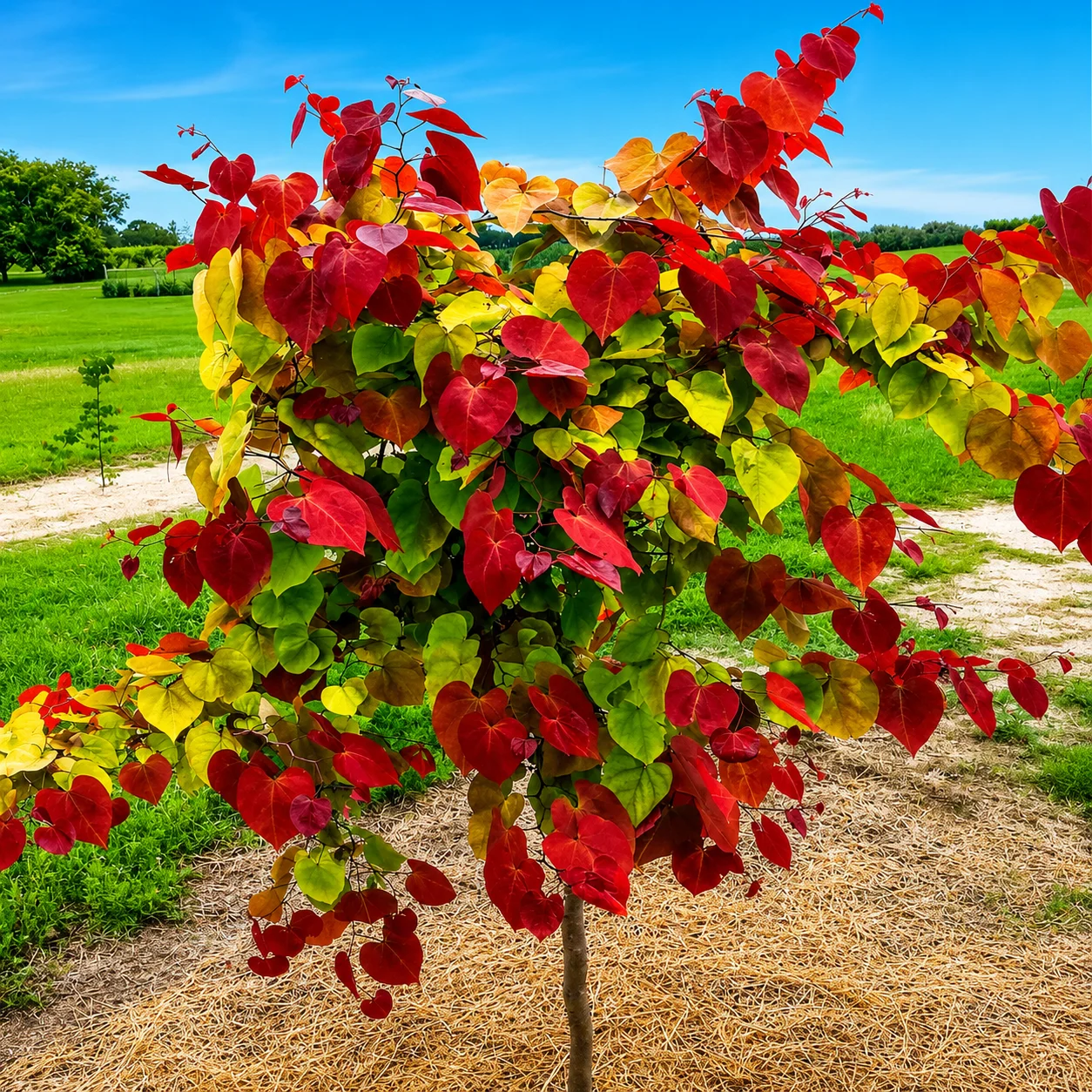
Most flowering trees settle into one or two colors and stick with them. Flame Thrower Redbud refuses to do that. On a single branch, you’ll spot burgundy, red, orange, yellow, and lime green leaves all at once. Each leaf shifts color at its own pace as it matures. It’s genuinely one of the most eye-catching ornamental trees you can plant in a home landscape.
However, that dramatic color show doesn’t mean this tree is complicated to grow. Dr. Dennis Werner bred it at North Carolina State University, and it hit the market in 2020. Researchers designed it to be both showy and low-maintenance. This guide covers exactly how big it gets, how fast it grows, and what it needs to thrive in your yard.
What Is a Flame Thrower Redbud?
Flame Thrower Redbud (Cercis canadensis ‘NC2016-2‘) is a patented cultivar of the native Eastern Redbud. Researchers created it by crossing a burgundy-leaved redbud with a golden-leaved variety. The result inherited traits from both parents. Instead of settling into a single leaf color, each new flush cycles through purple, red, reddish-bronze, and finally yellow-green as it ages.
Different leaves mature at different rates. Because of this, the tree displays four to five colors at once throughout the growing season. Spring adds another layer of interest. Clusters of small, pea-shaped, rosy-pink to magenta flowers bloom directly on bare branches before the leaves even emerge.
This redbud fits nicely into small to mid-sized landscapes. Its slightly pendant, non-weeping growth habit gives it a graceful, layered silhouette. That’s a nice contrast to the stiffer, more upright form some ornamental trees have.
Flame Thrower Redbud Growth Rate
Growth rate estimates vary a bit depending on the source. Because of that, it helps to look at the full range rather than a single number. Most nurseries report a moderate growth rate of about 1 to 2 feet per year under good conditions. That lines up with typical Eastern Redbud growth patterns.
Timeline estimates for reaching full size vary more widely. Some nurseries suggest a fuller canopy develops within 3 to 5 years. Others estimate closer to 5 to 10 years for the tree to reach its complete mature dimensions. That range likely comes down to soil quality, regional climate, and how consistently the tree gets watered early on.
Either way, this tree doesn’t keep you waiting for years before it starts showing off. Many young Flame Thrower Redbuds display strong foliage color within their first couple of growing seasons. Some even produce a few spring blooms that early too.
Mature Size
According to NC State University’s Extension Gardener Plant Toolbox, Flame Thrower typically reaches 15 to 20 feet tall. Its spread runs 10 to 15 feet at maturity. That sizing lines up closely with figures from major nurseries too. Most place the mature height between 15 and 20 feet, with a spread ranging from 10 to 20 feet depending on growing conditions and pruning.
Because of this relatively compact footprint, Flame Thrower Redbud fits comfortably into most residential yards. It won’t overwhelm smaller lots the way some ornamental trees do. It works equally well as a specimen tree in a front yard or as an accent piece near a patio, where its color display can be appreciated up close.
Where Flame Thrower Redbud Grows Best in the U.S.
This cultivar is hardy across a wide swath of the country. Most sources place it in USDA zones 4 through 9, though a few list a slightly narrower range of zones 5 through 9. Checking your exact zone before planting is always worth the extra minute, since local microclimates can shift the practical range slightly.
- Southeast (North Carolina, South Carolina, Georgia, Virginia): As a native NC State introduction, Flame Thrower performs exceptionally well here. The Eastern Redbud already grows wild throughout this region.
- Midwest (Ohio, Indiana, Illinois, Missouri): Cold winters aren’t a problem, since the parent species tolerates freezing temperatures well. Well-drained soil remains the key factor for long-term success.
- Texas and the South-Central states: Nurseries in North Texas specifically recommend this cultivar for local landscapes. It handles regional heat and varied soil conditions well.
- Northeast (Pennsylvania, New York, New Jersey): Gardeners here should stick close to zone 5 hardiness recommendations. Choose a planting site sheltered from harsh winter winds during the tree’s first few years.
- Pacific Northwest: Mild, temperate conditions suit this tree well. Watch for consistently moist, well-drained soil rather than heavy clay.
How to Plant a Flame Thrower Redbud
Getting the planting process right early on sets your tree up for healthy, long-term growth.
1. Choose a full sun to partial shade location. This tree tolerates a range of light conditions. Full sun typically produces the most vivid color contrast between leaves.
2. Dig a generous hole. Aim for a hole at least three feet by three feet and roughly 18 inches deep. Break up any compacted soil as you go, since compaction restricts root development significantly.
3. Keep the root flare level with the ground. Planting too deep is one of the most common tree-planting mistakes. It can smother the root system over time.
4. Gently loosen circling roots before placing the tree in the hole, particularly if it came from a container. This encourages roots to spread outward instead of continuing to circle.
5. Backfill with a mix of native soil and organic matter. Redbuds generally prefer moist, well-drained soil that’s rich in organic content. Working some compost into the backfill helps significantly.
6. Water thoroughly right after planting. Then continue a consistent watering schedule through the first one to two growing seasons while the roots establish.
7. Avoid transplanting once established. Like most redbuds, this cultivar doesn’t handle being moved well after its root system settles in. Choose your planting site carefully the first time.
Ongoing Care
Watering
Water weekly during the first couple of years, especially through dry spells, to support strong root development. Established trees show moderate drought tolerance. Even so, a weekly deep watering during extended heat still helps maintain vibrant foliage color.
Fertilizing
Proper fertilization actually enhances the tree’s signature trait, since new growth produces the most vivid color display. That said, timing matters. Avoid high-nitrogen fertilizers after midsummer. This triggers tender new growth that won’t have time to harden off before winter arrives. Soft, late-season growth is far more vulnerable to frost damage and pest issues the following year.
Pruning
Light pruning helps maintain shape and can even stimulate additional colorful new growth. However, aggressive pruning stresses the tree unnecessarily. Stick to removing dead, damaged, or crossing branches during the dormant season instead of reshaping the entire canopy at once.
Pest and Disease Watch
Flame Thrower Redbud stays relatively low-maintenance on the pest front. Deer occasionally sample young growth, though they generally prefer other plants when given the choice. Aphids can sometimes appear on new foliage. Rinsing the leaves with water or applying insecticidal soap typically resolves the issue without needing a stronger treatment.
Landscaping Ideas for Flame Thrower Redbud
Because of its compact size and constant color shifting, this redbud works well in more design roles than you might expect.
Specimen tree: Planted alone on a front lawn, its ever-changing foliage makes it an obvious focal point nearly year-round.
Patio or courtyard accent: Its manageable mature size means it won’t overwhelm a smaller outdoor living space the way a larger shade tree might.
Understory planting: This species naturally adapts to understory growing conditions. It performs well planted beneath larger canopy trees, where dappled light still lets its colors shine.
Container growing when young: Nurseries note that Flame Thrower can grow in a large container during its early years. Long-term performance is strongest once it’s planted directly in the ground, though.
If you’re comparing this cultivar against other colorful ornamental trees for your yard, our guide to the best small flowering trees for front yards covers additional options worth weighing before you decide.
Frequently Asked Questions
How fast does a Flame Thrower Redbud grow? It grows at a moderate rate, typically adding 1 to 2 feet of height per year. Most trees reach a fuller, more established canopy somewhere between 3 and 10 years, depending on growing conditions.
How tall and wide does a Flame Thrower Redbud get? NC State University’s Plant Toolbox lists mature trees at 15 to 20 feet tall with a spread of 10 to 15 feet. Some nurseries report a spread as wide as 20 feet under ideal conditions.
What USDA zones is Flame Thrower Redbud hardy in? Most sources place it in zones 4 through 9. A few list a slightly narrower range of zones 5 through 9, so checking your specific zone before planting is worth the extra step.
Does Flame Thrower Redbud need full sun? It tolerates full sun to partial shade well. Full sun tends to produce the most vibrant color contrast, while partial shade still supports healthy growth with a slightly softer display.
Why does my Flame Thrower Redbud show multiple leaf colors at once? Each leaf changes color independently as it matures, moving from purple to red to reddish-bronze and finally yellow-green. Leaves emerge at different times throughout the season, so several colors appear on the tree at once.
Can Flame Thrower Redbud be grown in a container? Yes, particularly while young, making it a good option for patios or courtyards. Planting it directly in the ground works best for the strongest long-term growth and color display.
Is Flame Thrower Redbud deer resistant? It’s not completely deer-proof. Deer generally prefer other plants when other food sources are available, so damage tends to stay minimal in most landscapes.
How do I get the best color from my Flame Thrower Redbud? Proper fertilization encourages new growth, which is where the tree’s boldest colors appear. Just avoid high-nitrogen fertilizer after midsummer, since late-season growth won’t harden off properly before winter.
Final Thoughts
Flame Thrower Redbud earns its dramatic name honestly. It delivers a genuinely unmatched foliage display without demanding much in return. Its moderate growth rate, manageable mature size, and low pest pressure make it one of the more forgiving ornamental trees you can add to a yard. That’s especially true for gardeners who want serious visual impact without a high-maintenance commitment. Give it well-drained soil, a thoughtful planting site you won’t need to change later, and consistent watering through its first couple of seasons. This redbud will likely reward you with years of ever-shifting color.