

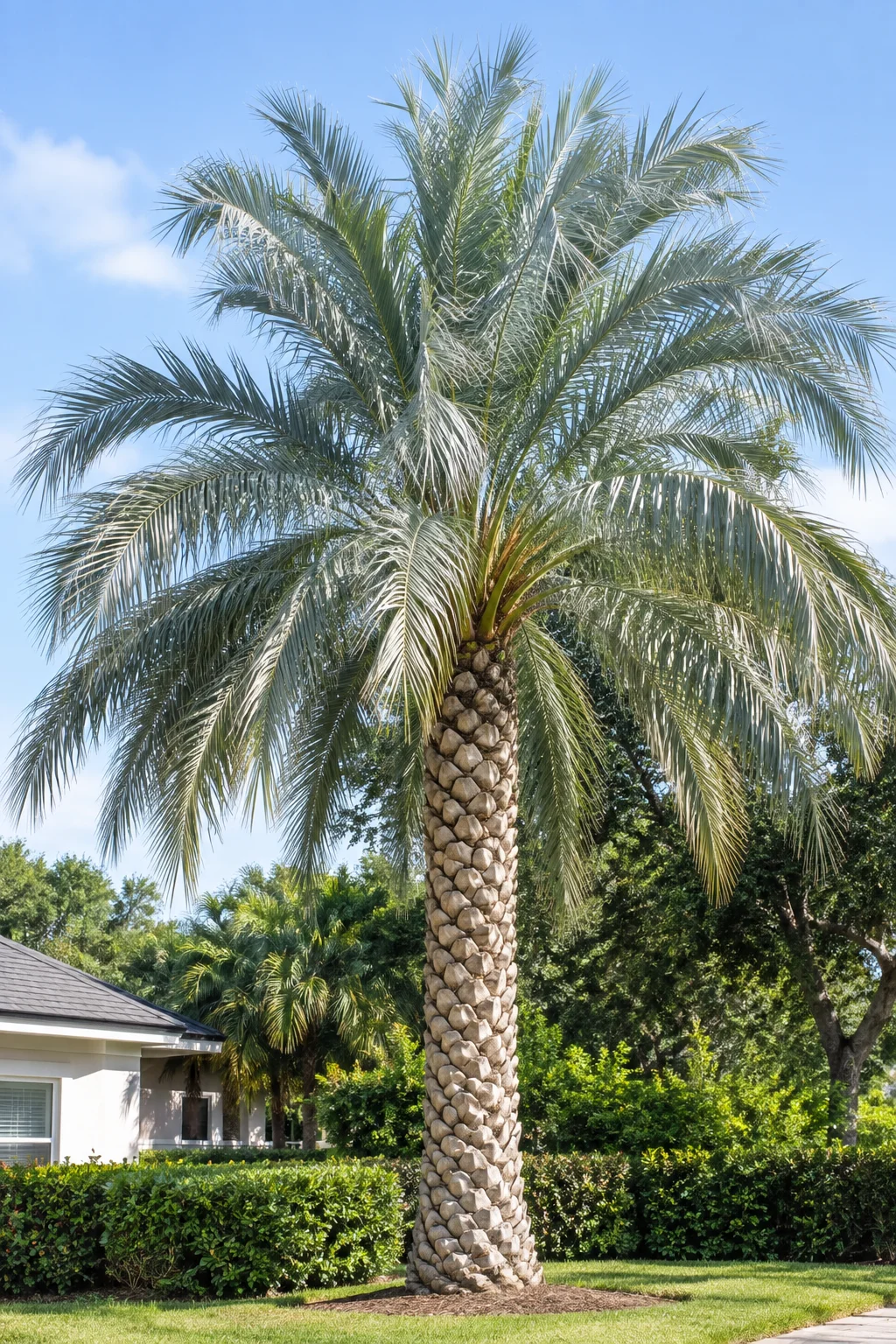
The Sylvester palm (Phoenix sylvestris) is a slow-growing, cold-hardy palm native to the Indian subcontinent. It’s prized for its silvery-blue arching fronds and the distinctive diamond-patterned trunk that forms as older leaf bases fall away. It grows well in USDA zones 8b through 11. It tolerates both drought and moderate salt exposure once established, and reaches a mature height of roughly 30 to 50 feet with proper care. This guide covers what it actually takes to grow one, including a couple of real problems that most care guides skip over entirely.
Quick Answer
Plant a Sylvester palm in full sun to light shade, in well-drained soil, and water it regularly for the first year while it establishes a root system. After that, it tolerates drought well and needs only occasional deep watering. It’s a genuinely low-maintenance palm once established. But it’s also susceptible to two serious problems worth knowing about upfront: manganese deficiency (commonly called frizzle top) and lethal bronzing disease, a fatal phytoplasma infection with no cure. Catching either one early makes the difference between a full recovery and losing the tree.
What a Sylvester Palm Actually Is
Growers also call it the Indian date palm, wild date palm, sugar date palm, silver date palm, or toddy palm. Phoenix sylvestris is native to Pakistan, India, Bangladesh, Nepal, Bhutan, Sri Lanka, and Myanmar. It’s closely related to two other palms you’ve likely seen in American landscapes: the Canary Island date palm (Phoenix canariensis) and the true date palm (Phoenix dactylifera). The true date palm is the species behind commercial dates.
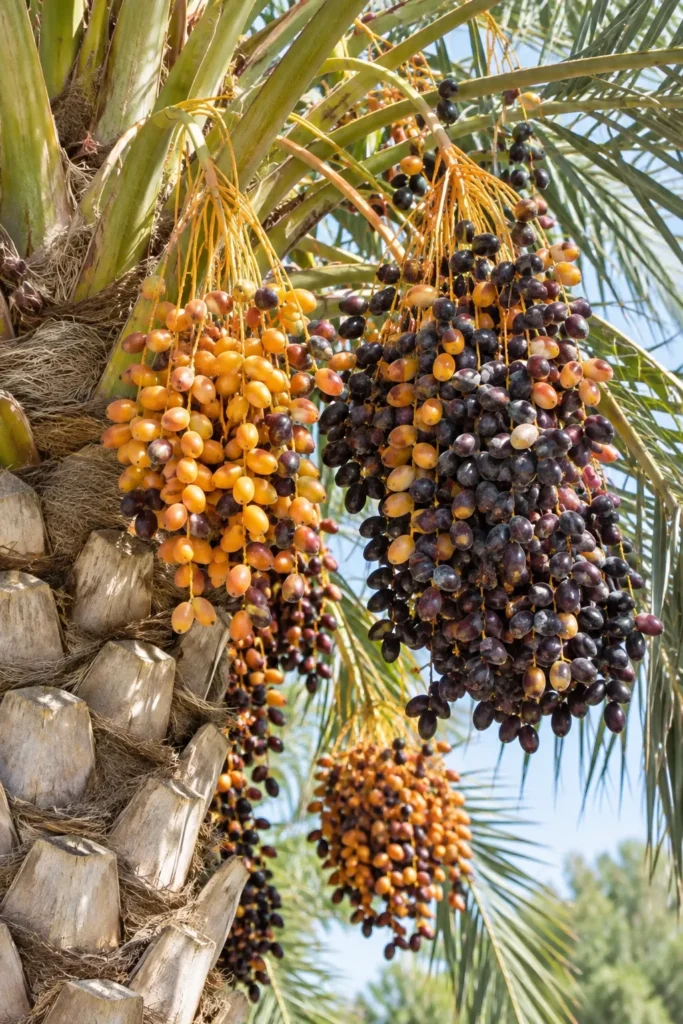
Compared to the Canary Island date palm, the Sylvester has a noticeably thinner trunk and a more compact overall footprint. That makes it a popular substitute for gardeners who like the look of a large Phoenix palm but don’t have the space for the Canary Island’s massive, heavy canopy. It’s not the same plant as the true date palm, though people sometimes confuse the two because both produce edible dates. The Sylvester’s fruit runs smaller. Growers typically use it for jam, wine, and traditional sugar production rather than selling it as table dates.
Appearance and Growth Characteristics
The trunk is the Sylvester palm’s signature feature. As older fronds drop, they leave behind triangular leaf-base scars. These scars build up into a striking diamond-cut pattern running the length of the fibrous, brownish-green trunk. This pattern becomes more pronounced and more attractive as the tree matures. That’s part of why it’s such a popular specimen tree despite its slow growth rate.
The fronds themselves are stiff, feathery, and arch gracefully, running around 10 feet long with individual leaflets reaching about 18 inches. Color ranges from deep green to a striking silvery blue-gray, depending on the specimen and growing conditions. The palm is evergreen, so it doesn’t drop its fronds seasonally, and it holds its canopy year-round.
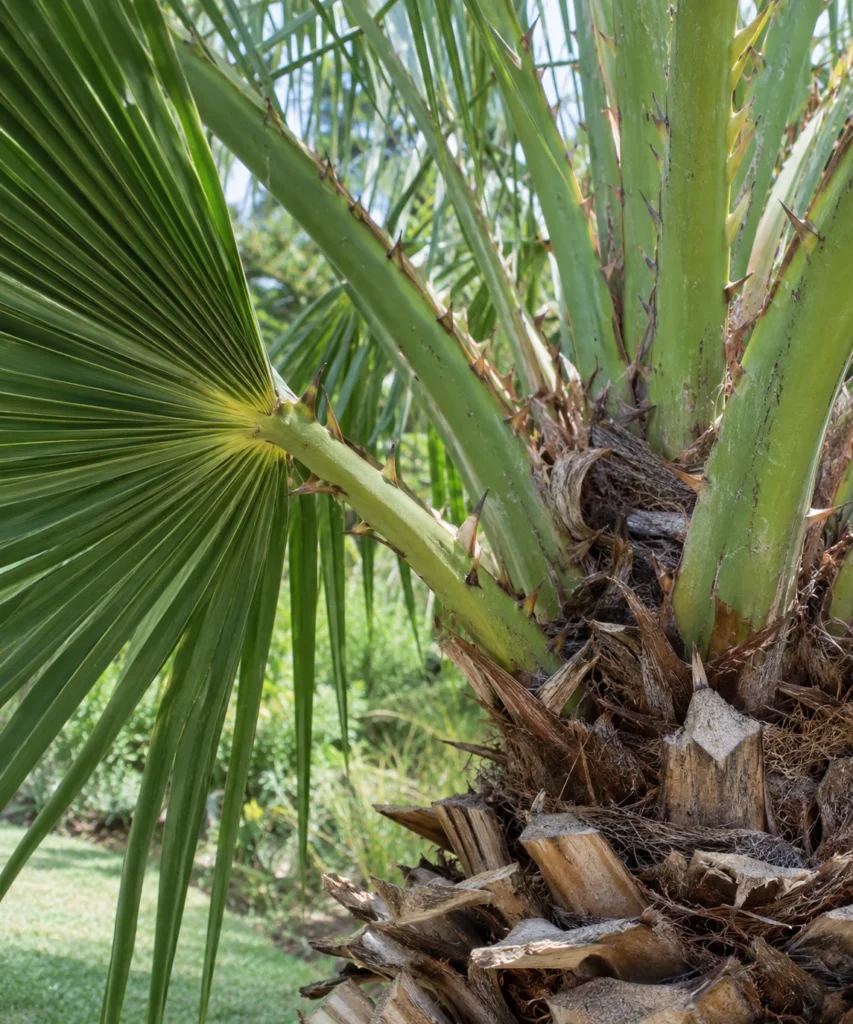
One detail is worth knowing before you plant one near a walkway or patio. The frond stems carry tough, sharp thorns along roughly the bottom three feet of each leaf. This isn’t a minor cosmetic detail. It affects where you should plant the tree and how you handle pruning, which we’ll come back to below.
Mature size varies by source and growing conditions. Expect somewhere in the range of 30 to 50 feet tall with a canopy spread of 8 to 20 feet. In exceptionally favorable conditions, some specimens have reached closer to 60 feet. Growth is genuinely slow — expect roughly 1 to 2 feet of new trunk height per year, sometimes less. This is not a fast-growing shade tree; it’s a long-term landscape investment.
Growing Zones and Climate
Sylvester palms grow reliably outdoors in USDA hardiness zones 8b through 11. Growers rate them cold-hardy down to around 20°F, particularly once the tree is established with a few years of growth behind it. In the coldest parts of that range, young or newly planted specimens benefit from frost protection during hard freezes. A frost cloth or temporary wrap during an unusual cold snap can make the difference for a tree that hasn’t fully established itself yet.
Outside zone 8b, you can still grow a Sylvester palm in a large container. Bring it into a greenhouse, sunroom, or other protected space for the winter. Given its eventual mature size, though, this works better as a shorter-term arrangement than a permanent solution for colder climates.
Planting and Site Selection
Choose a full-sun to partial-shade location — this palm performs best with at least six hours of direct sun a day, though it tolerates somewhat less. Well-drained soil matters more than soil type. Sylvester palms adapt to a range of soil conditions, from sandy to loamy, as long as water doesn’t sit around the root zone.
Because of its eventual size and the thorny frond bases, plant it well away from walkways, patios, pools, and anywhere people will regularly brush past the lower canopy. Give it enough horizontal space to reach its full 8- to 20-foot canopy spread without crowding structures, power lines, or other trees. This is a mistake that’s hard to correct once the palm has spent a decade slowly growing into an inconvenient spot.
Watering and Fertilizing
During the first year after planting, water consistently. Aim for roughly two to three times a week for the first month, tapering to about once a week for the remainder of the first year. Keep the soil moist but not waterlogged. Once established, the Sylvester palm becomes genuinely drought-tolerant, needing supplemental water mainly during extended dry spells.
Use a palm-specific fertilizer rather than a general landscape fertilizer. Palm-specific formulas include the micronutrients — particularly manganese, magnesium, and potassium — that palms need in different ratios than turf grass or typical ornamental shrubs. This matters more than it might seem, and it connects directly to the most common health problem this species faces.
Common Problems Most Guides Skip
Manganese deficiency (frizzle top). Like many palms grown in alkaline or improperly fertilized soil, Sylvester palms are genuinely susceptible to manganese deficiency. This condition causes new fronds to emerge stunted, crinkled, and undersized while older fronds look normal. Left untreated, it can progress to killing the palm’s central growing point, which is unrecoverable. You can treat this if you catch it early with soil testing, a palm-specific fertilizer program, and manganese sulfate applications. For a full breakdown of causes, symptoms, and treatment steps, see our palm tree frizzle top guide, which covers this condition across several susceptible palm species, including this one.
Lethal bronzing disease. This is the problem most casual care guides don’t mention, and it’s serious. Lethal bronzing — formerly known as Texas Phoenix Palm Decline — is a fatal phytoplasma infection. Researchers have confirmed it affects Phoenix sylvestris along with several other Phoenix species. A piercing-sucking insect spreads it, and there’s no cure once a palm is infected and tests positive.
Symptoms progress in a fairly recognizable order. First comes fruit drop, then reddish-brown necrosis starting on the oldest leaves and working forward. Finally, the central spear leaf dies, which indicates the growing point itself has died. University of Florida IFAS Extension recommends removing a palm promptly once it shows symptoms and tests positive for the phytoplasma, to reduce the risk of spreading the disease to nearby palms. If you’re in a region where this disease has appeared — primarily Florida and parts of Texas — and you notice progressive leaf bronzing or fruit drop, contact a local extension office or certified arborist for testing. Don’t wait to see if the tree recovers on its own.
Pruning injuries from the thorns. The sharp thorns along the lower frond stems make pruning a genuine hazard if you’re not prepared for it. Heavy gloves and long sleeves are non-negotiable when you trim a Sylvester palm. For anything beyond removing a low, easily reached dead frond, hiring a professional with proper equipment is generally the safer call, especially once the tree has grown tall enough to require a ladder or lift.
Common Mistakes to Avoid
Planting too close to walkways or seating areas. Between the eventual canopy spread and the thorny frond bases, a Sylvester palm planted too close to high-traffic areas becomes a recurring hazard rather than a landscape feature. Plan for its mature size from the start, not just how it looks as a young specimen.
Using general-purpose fertilizer instead of a palm-specific formula. This is one of the most common contributors to manganese deficiency in landscape palms generally, and it’s an easy problem to prevent with the right product from the start.
Assuming drought tolerance applies from day one. Established Sylvester palms handle dry spells well, but a newly planted specimen still needs consistent watering through its first year while it builds out a root system. Treating a brand-new planting like a mature, drought-tolerant tree is a common way to lose it before it ever gets established.
Ignoring early bronzing or fruit drop symptoms. Given how serious and untreatable lethal bronzing disease is once confirmed, waiting to see if symptoms resolve on their own is a real risk. That risk extends to the individual tree and to any other Phoenix-genus palms nearby.
Who This Palm Fits Best
A Sylvester palm makes sense for larger residential or commercial landscapes in warm-climate states — particularly Florida, Texas, California, and the Gulf Coast. Its slow growth and long-term specimen value reward gardeners who think in years rather than a single growing season. It’s a strong choice for anyone who wants the visual impact of a large Phoenix palm without the sheer bulk of a mature Canary Island date palm.
It’s a weaker fit for small residential lots, areas close to walkways or pools where the thorns become a real liability, or anyone hoping for fast growth. This is a patient gardener’s tree, not an instant landscape solution.
Frequently Asked Questions
How fast does a Sylvester palm grow?
Slowly. Expect roughly 1 to 2 feet of new trunk height per year, which means reaching full mature height can take several decades depending on growing conditions.
What’s the difference between a Sylvester palm and a Canary Island date palm?
They’re closely related, but the Sylvester palm has a noticeably thinner trunk and a more compact overall size. That makes it a better fit for landscapes that can’t accommodate the much larger, heavier Canary Island date palm.
Can Sylvester palm dates be eaten?
Yes. The fruit is edible, and growers traditionally use it to make jam, wine, and sugar, though it’s smaller and less commonly eaten fresh compared to true dates from Phoenix dactylifera.
What USDA zones can Sylvester palms grow in?
They’re reliably hardy outdoors in zones 8b through 11, tolerating temperatures down to around 20°F once established. Give younger trees frost protection during hard freezes.
Why are my Sylvester palm’s new fronds stunted and crinkled?
This is a classic sign of manganese deficiency, commonly called frizzle top. You can treat it with soil testing and a palm-specific fertilizer or manganese sulfate application if you catch it early.
Is lethal bronzing disease treatable?
No. Once a palm tests positive for the lethal bronzing phytoplasma, there’s no cure. University of Florida IFAS Extension recommends prompt removal of infected trees to help limit further spread.
Is a Sylvester palm safe to plant near a pool or walkway?
Not ideally. The thorny frond bases and eventual canopy size make it better suited to open landscape areas rather than tight spaces near high-traffic zones.
Sources & References
- University of Florida IFAS Extension, Lethal Bronzing Disease (LB)
- Florida Department of Agriculture and Consumer Services, Texas Phoenix Palm Decline Pest Alert
- Texas Department of Agriculture, Lethal Bronzing in Palms
- PlazmaHomes, Palm Tree Frizzle Top: Causes, Symptoms, and Best Treatment Options
[…] you’re mapping out what else will thrive alongside an avocado in a warm yard, our Sylvester palm growing and care guide covers another heat-loving tree and its cold […]