

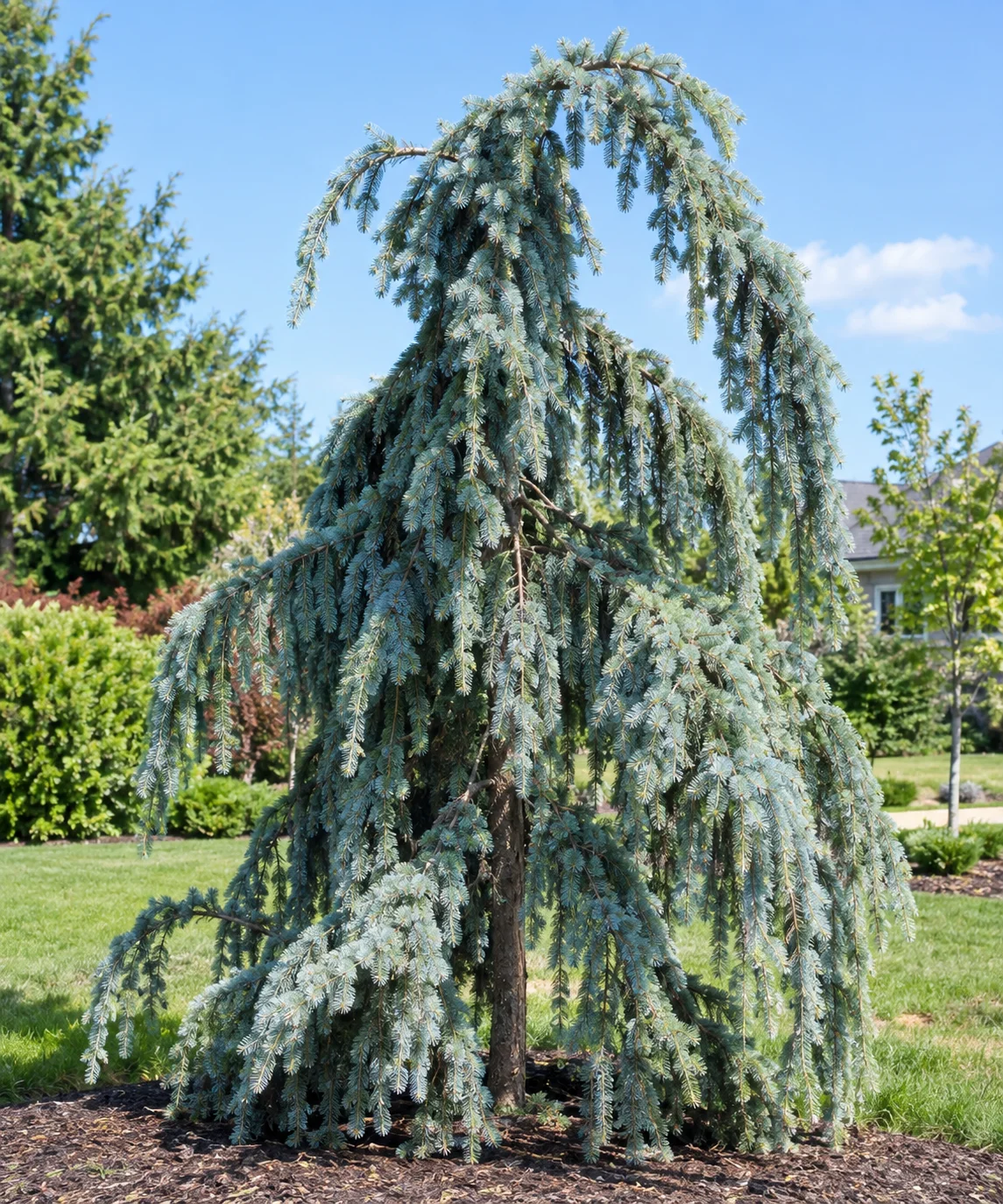
If you want height and evergreen structure without giving up half your yard, the weeping white spruce (Picea glauca ‘Pendula’) is worth a look. It’s a naturally narrow conifer, often just 4 to 6 feet wide even at 20-plus feet tall. Its branches drape downward against a straight central trunk. The result is sculptural, almost intentional-looking — a shape most evergreens can’t match.
It’s hardy through most of the northern and central United States. It’s low-maintenance once established and it’s also one of the few large evergreens that actually fits a small yard. But it has real limits, especially around heat and humidity, that a lot of retail plant tags gloss over. This guide covers what it needs to thrive, where it struggles, and how it compares to the other “weeping” conifers it often gets confused with.
Jump to a section:
What Is a Weeping White Spruce?
Weeping white spruce is a cultivar of the native white spruce. The species is found across Canada and the northern tier of the U.S., from Alaska down through the Great Lakes region and into New England. The ‘Pendula’ cultivar was discovered as a natural mutation in a French park in the 1860s. It’s been propagated ever since for one trait: a single upright central leader with side branches that sweep down close to the trunk instead of spreading outward.
The needles are short, stiff, and bluish-green, with a faint waxy, silvery cast. That’s a family trait of white spruce, and it gives the whole tree a cool, frosted look even in summer. It doesn’t flower in any ornamental sense. Small, inconspicuous cones appear on mature trees, usually a couple of inches long.
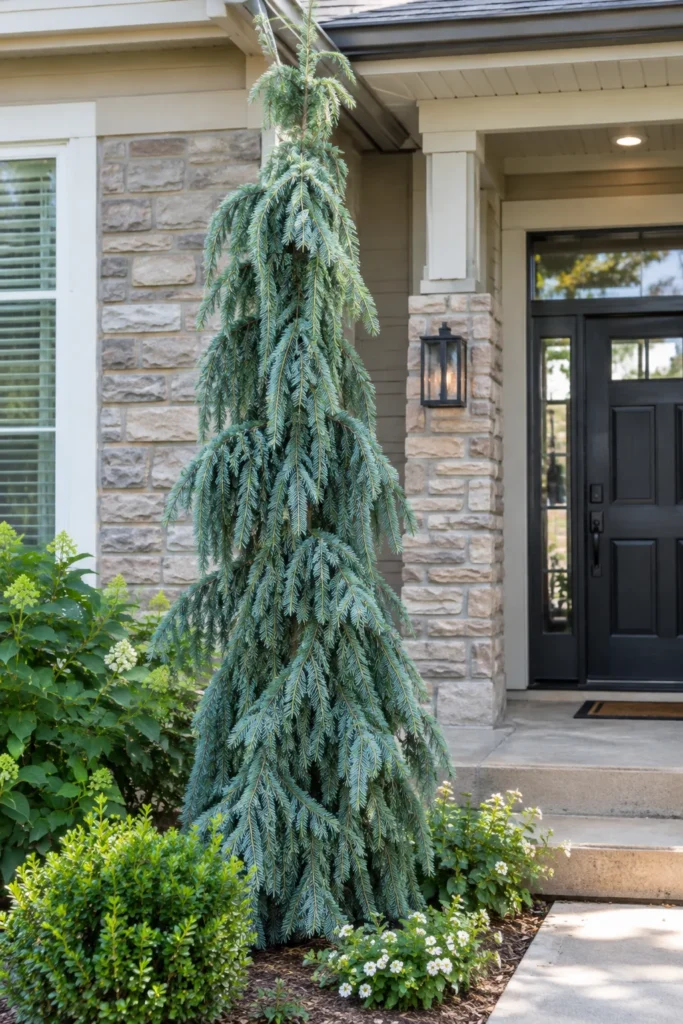
Because it grows almost entirely upward rather than outward, it reads more like a living exclamation point than a typical Christmas-tree-shaped evergreen. That’s the whole appeal. It’s also why it needs a bit more attention early on than a standard spruce.
Size and Growth Rate
Expect a mature weeping white spruce to reach 20 to 30 feet tall. Some older specimens push past that. Width stays narrow, usually 4 to 8 feet, even at full height. Growth rate is moderate — typically 8 to 12 inches of new growth per year under decent conditions, slower in poor soil or drought.
That narrow footprint is the main reason people choose this tree over a standard spruce. A regular white spruce can eventually reach 60 to 80 feet tall and 20-plus feet wide, which rules it out for most residential lots. The weeping form gives you the vertical presence and evergreen structure of a spruce in a space closer to what you’d give a large shrub.
One thing worth planning for: this is still a tree that will eventually clear power lines and roofline eaves if you’re not careful about placement. Give it at least 6 to 8 feet of horizontal clearance from structures. Think about mature height, not the 4- or 5-foot specimen you’re bringing home from the nursery.
USDA Hardiness Zones — and Why the Zone Range You See Varies
This is where a lot of plant descriptions get muddled. It’s worth untangling, because it affects whether this tree will actually do well where you live.
Different reputable sources list slightly different ranges. Some say zones 2 to 6, others say 2 to 8 or 3 to 8. Both are technically defensible, but they’re measuring different things. USDA zones only describe minimum winter temperatures. They say nothing about summer heat, humidity, or how a plant handles either.
Weeping white spruce is unquestionably cold-hardy down through zone 2, which covers interior Alaska and the coldest parts of the northern Plains. The disagreement is on the warm end. Growers in the West — Colorado, Utah, parts of the Mountain West — report the tree handling summer heat reasonably well, largely because that heat comes with low humidity. Missouri Botanical Garden works with the humid summers typical of the Midwest and eastern U.S. It specifically cautions against planting the tree south of zone 6 in the eastern half of the country, noting it struggles in high heat and humidity.
Practical takeaway: if you’re in the Northeast, Upper Midwest, Pacific Northwest, or the northern Mountain West, this tree is a safe, reliable choice. If you’re in the humid South, the lower Midwest, or anywhere with hot, sticky summers, treat zone 6 as roughly the southern edge of where it will thrive. Expect more stress, needle issues, and a shorter lifespan the further south of that you go — even if winter cold, on paper, wouldn’t be a problem.
Sun, Soil, and Water
Weeping white spruce wants full sun to light shade. At least 6 hours of direct sun is ideal. It will tolerate some afternoon shade, particularly in hotter climates, where a little relief from the harshest sun can help.
Soil should be moist, well-drained, and on the acidic side. It’s adaptable to loam or sandy soils. It doesn’t do well in heavy clay that stays wet, which can lead to root rot. If your yard has poor drainage, either amend the planting area generously or pick a different spot. Spruces are notoriously unforgiving of “wet feet.”
Watering needs shift a lot depending on the tree’s age:
- First two growing seasons: Water deeply, roughly twice a week in the absence of rain, so the root system can establish. Deep, infrequent watering builds a stronger root system than frequent shallow watering.
- Once established: Reasonably drought-tolerant, but not indifferent to it. In extended dry heat, inconsistent watering can cause needle drop or stalled vertical growth.
- Before winter, in dry climates: Give it a thorough soak in late fall. Spruces lose moisture through their needles all winter. A tree that goes into dormancy dry is far more likely to show winter burn — browned, scorched-looking needles — by spring.
Planting: Timing and the One Step Most People Skip
Plant in early spring or fall. That gives the roots time to settle before the stress of summer heat or winter cold sets in. Dig the hole roughly twice as wide as the root ball and no deeper than the root ball itself. Planting too deep is one of the most common ways to slowly kill a new conifer.
Before backfilling, check the roots. This is the step almost every retail plant tag leaves out, and it matters more for a weeping cultivar than for most trees. Container-grown spruces frequently develop circling roots that wrap around the inside of the pot. Plant that root ball as-is, and those roots keep circling underground instead of spreading outward. Eventually they can girdle the trunk or leave the tree poorly anchored. Gently tease apart or score the outer roots before planting, so they’re encouraged to grow outward into the surrounding soil.
Space multiple trees roughly 8 to 12 feet apart if you’re planting a row or screen. That’s tight enough to eventually form a visual line, but wide enough that the trees aren’t competing for root space or losing airflow — which matters for disease prevention (more on that below).
Staking the Leader (Don’t Skip This on Young Trees)
The whole appeal of this tree is a straight central trunk with weeping side branches. A young weeping white spruce genuinely needs help to grow that way. Left alone, especially in a container or a windy spot, the central leader can flop over or grow crooked. Once a spruce’s leader is damaged or lost, it’s very difficult to correct. The tree may fork or lose its upright form permanently.
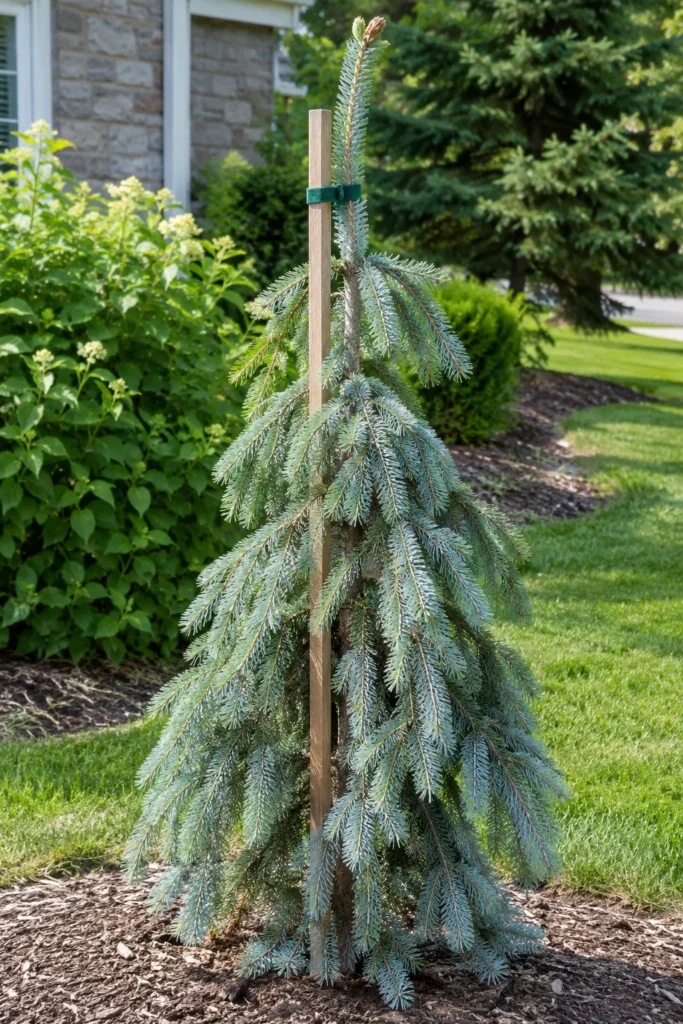
Stake the central leader straight and vertical for the first one to two years after planting. Use a soft tie that won’t cut into the bark as the trunk thickens. Remove the stake once the trunk has enough rigidity to stand on its own — usually after a full growing season or two. Leaving stakes on too long can restrict the trunk movement the tree needs to develop real structural strength, and ties left in place too long can girdle the bark.
Pruning and Shaping
Good news here: pruning needs are minimal. The cascading branch habit is what the tree does naturally. Heavy shaping usually works against the look you’re paying for. Most maintenance is limited to removing dead, damaged, or diseased branches as you notice them, plus an occasional light trim to control width if a lower branch is sprawling further than you’d like.
Avoid shearing it into a formal shape the way you might a hedge. It disrupts the natural drape of the branches, and on a conifer like this, cutting back too hard doesn’t reliably regrow the way a boxwood or yew would.
Common Pests and Diseases
Weeping white spruce is generally low-maintenance, but it’s not pest-free. Problems tend to show up when the tree is already stressed — by poor drainage, drought, or excessive heat.
- Spruce spider mites are one of the more common issues, especially in hot, dry conditions. Watch for stippled, dulled needles and fine webbing.
- Gall adelgids (Eastern spruce gall and Cooley spruce gall) cause small, pineapple-like or cone-like growths at branch tips. They’re unsightly but rarely fatal unless infestations are heavy.
- Spruce budworm and spruce sawfly are the more serious insect threats, particularly in regions with established forest populations, like the Upper Midwest and Northeast. Isolated yard trees are less at risk than trees in or near wooded areas, but an infestation nearby is worth monitoring for.
- Needle rust, canker, and root or trunk rot are the main disease concerns. These are almost always tied to poor drainage or persistently wet soil.
Weeping White Spruce vs. Other Weeping Conifers
People often land on this tree while comparing it to other narrow or weeping evergreens. Here’s how it stacks up against two it’s most commonly confused with:
| Feature | Weeping White Spruce | Weeping Norway Spruce | Dwarf Alberta Spruce |
|---|---|---|---|
| Growth habit | Upright central leader, branches weep close to trunk | Sprawling/mounding unless staked and trained upward | Dense, compact cone — not weeping at all |
| Mature height | 20–30 ft. | Varies widely by training (10–15 ft. common) | 6–10 ft. |
| Mature width | 4–8 ft. | Can spread 10+ ft. if not staked | 3–4 ft. |
| Needle color | Blue-green with waxy bloom | Deep green | Bright green |
| Best use | Vertical accent, narrow spaces | Sculptural feature, needs training | Small formal accent, containers |
| Heat/humidity tolerance | Moderate; struggles in Deep South | Similar limitations | Susceptible to spider mites in hot, dry spots |
The short version: weeping white spruce grows tall and narrow largely on its own, once the leader is staked early. Weeping Norway spruce needs active staking and training to go vertical instead of sideways. Dwarf Alberta spruce isn’t weeping at all — it’s a compact cone shape often mistaken for a “mini” version of these trees. If you want a non-weeping columnar option instead, our Skyrocket Juniper growth guide covers one of the narrowest evergreens available.
Where It Works Best in a Landscape
Its narrow profile makes it useful in spots where a full-size spruce simply wouldn’t fit:
- As a vertical accent near an entryway or foundation planting, where width is limited but height adds visual interest
- In a row as a narrow, semi-formal screen — spaced 8 to 12 feet apart, it reads as a soft, textured privacy line without the bulk of arborvitae or a standard spruce hedge (our Hicks Yew guide covers a denser broadleaf-evergreen alternative for screening)
- As a single specimen tree in a small or medium yard, where it provides year-round structure without eventually overwhelming the space
- In a large container for several years while young, since its slow-to-moderate growth rate makes it manageable in a pot longer than most spruces
It’s less suited to hot, exposed, windswept sites in warm climates. It also struggles in heavy clay soil with poor drainage — both push it toward the stress and disease issues described above.
Common Mistakes to Avoid
- Skipping the stake on a young tree. Without support, the central leader can bend. A crooked or forked leader is very hard to fix later.
- Planting too deep. The root flare should sit at or slightly above soil level, not buried.
- Ignoring root circling at planting time. Roots that were pot-bound will keep circling underground if you don’t loosen them first.
- Choosing a site south of its comfort zone without a heat-mitigation plan. If you garden in a hot, humid climate, this isn’t automatically off the table. Plan for afternoon shade, consistent moisture, and good air circulation — don’t assume it will perform the way it does in a cooler climate.
- Overwatering in heavy soil. More spruces are lost to root rot from soggy soil than to underwatering.
FAQ
Is weeping white spruce the same as dwarf Alberta spruce? No. Dwarf Alberta spruce (Picea glauca ‘Conica’) is a compact, cone-shaped cultivar of the same species. It tops out around 6 to 10 feet and doesn’t weep at all. Weeping white spruce is a taller, narrower cultivar with a distinct drooping branch habit.
How fast does a weeping white spruce grow? Expect roughly 8 to 12 inches of new growth per year under good conditions — moist, well-drained soil and adequate sun. Growth slows in poor soil, drought, or excessive heat.
Does it need full sun? It grows best in full sun, at least 6 hours a day. It will tolerate part shade, which can actually help it in hotter regions by reducing heat stress.
Can I keep it small with pruning? Not really, and it’s not the right approach. Heavy pruning disrupts its natural drape. It can leave bare, woody sections that won’t fill back in the way a broadleaf shrub would. If size is a concern, plan for its mature dimensions before planting, rather than trying to prune it smaller later.
Why is my weeping white spruce turning brown? Browning, especially on the tips or the side facing prevailing winter winds, is often winter burn from moisture loss during dormancy — particularly if the tree went into winter dry. Interior browning and needle drop in late summer can also be normal old-needle shedding. Persistent browning combined with sticky residue or fine webbing points toward spider mites. Browning tied to soggy soil suggests root rot.
Where does it grow best in the U.S.? It performs most reliably in the Northeast, Upper Midwest, Pacific Northwest, and northern Mountain West. Those regions share cold winters and moderate, less humid summers. It’s more marginal in the humid South and lower Midwest, where high heat and humidity increase stress, even in zones that are technically within its cold-hardiness range.
Does it need fertilizer? Established trees generally don’t need regular feeding in reasonably fertile soil. If growth seems stunted or needles look pale, an acidic, slow-release fertilizer formulated for evergreens in spring can help. It’s not a routine requirement, though.
Is it deer resistant? Reports vary by source and region. Some list it as deer resistant, others as only moderately so. In areas with heavy deer pressure, young trees are worth protecting with fencing or repellent until they’re well established, regardless of the general reputation.
Bottom Line
Weeping white spruce earns its popularity honestly. It’s one of the few evergreens that gives you real height and year-round structure in a footprint narrow enough for a small yard, and once established, it asks very little of you. The trade-off: it’s genuinely a cold-climate tree wearing a warm-climate reputation on some plant tags. If you garden in a hot, humid part of the country, go in with realistic expectations and a plan for extra shade and moisture. Or consider whether a different narrow evergreen might serve you better.
If you’re comparing it against other narrow, columnar evergreens for a tight side yard or foundation planting, our Taylor Juniper care and growing guide covers another compact option worth weighing against it.
Sources & References
- Missouri Botanical Garden Plant Finder: Picea glauca ‘Pendula’ — hardiness zone, regional heat/humidity limitations, and growth habit
- University of Minnesota Extension, Managing Spruce Budworm — pest identification and management background
[…] screening height. If you’re comparing other evergreens for your yard, see our guides to the Weeping White Spruce, another narrow evergreen, and the Lemon […]