

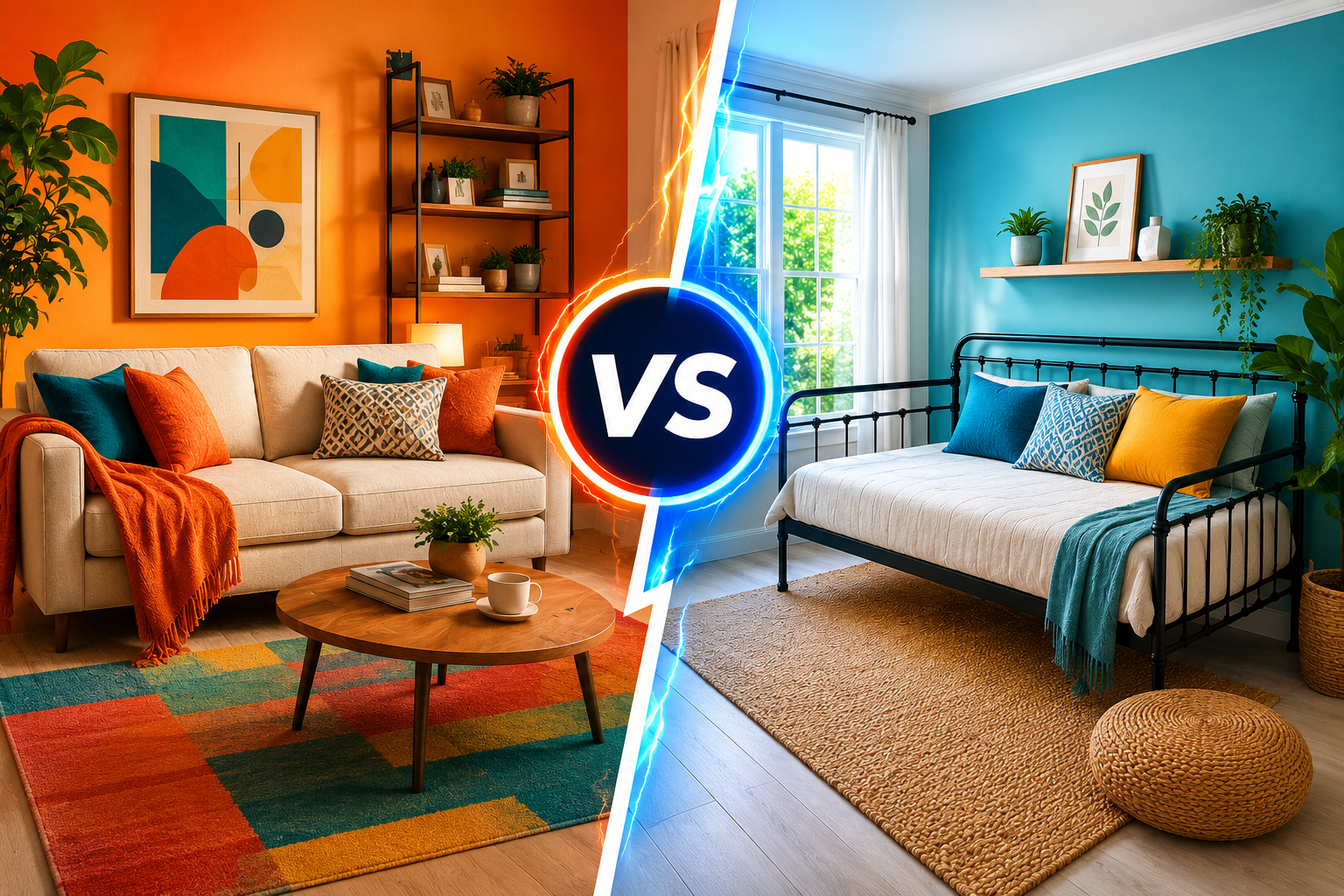
There’s a moment most people know well. You walk into a furniture store or start scrolling through Wayfair at midnight, and you find yourself staring at two very similar-looking pieces — one labeled “sofa,” the other “daybed.” Both are long, both are cushioned, and both seem like they could solve whatever seating problem you’re dealing with. But they’re not the same thing, and buying the wrong one is a frustrating (and expensive) mistake.
In 2026, this choice has become genuinely interesting. Daybeds have surged in popularity, with sleek new styles hitting the U.S. market that are a far cry from the traditional carved-wood guest-room pieces of the past. At the same time, sofas continue to evolve with deeper seats, modular designs, and 4-in-1 convertible options that blur the line further. So which one is actually right for you?
This guide breaks it all down — honestly, room by room, budget by budget — so you walk away with clarity, not confusion.
What’s the Actual Difference Between a Sofa and a Daybed?
This sounds obvious, but it’s worth getting precise, because the lines have blurred significantly.
A sofa is designed from the ground up for seated comfort. The cushions, back angle, seat depth, and frame are all engineered to support your body in an upright or slightly reclined position. You sit on it. You watch TV, host people, have conversations. Sleeping on it is an afterthought, not a design goal.
A daybed is fundamentally a bed frame built to look like seating. It holds a standard twin mattress (roughly 39 by 75 inches), and three sides — a back panel, a headboard, and a footboard — frame it like a couch. You can style it with throw pillows during the day and peel everything back at night for a proper sleep surface.
As John O’Leary, design director at Swyft, put it recently: “The key difference is intention. A daybed is centered around lounging and atmosphere, while a sofa bed focuses on practicality and accommodating overnight guests.”
That word — intention — is the most useful lens for this entire decision.
Comfort: Sitting vs. Sleeping
Here’s the honest truth that most buying guides skip over: a sofa is better for sitting, and a daybed is better for sleeping. Neither does the other thing especially well.
A daybed’s mattress surface and vertical back panel can’t replicate that, no matter how many throw pillows you stack behind you. People who put a daybed in their living room often end up wishing they had a sofa instead.
On the flip side, a daybed with a quality twin mattress — memory foam, innerspring, your choice — gives guests a genuinely comfortable night’s sleep. Sofa beds, with their fold-out mechanisms and thin foam pads, have improved in 2026 but still don’t match a real mattress. A good daybed mattress will.
Bottom line: If comfort while sitting is your priority, the sofa wins. If comfortable sleep matters more, the daybed wins.
Space and Room Fit: Who Has the Advantage in 2026?
American homes have gotten more creative about space in recent years. With studio apartments in cities like New York, Chicago, and Austin regularly running under 600 square feet, and with more people working from home in rooms that serve three purposes at once, multi-use furniture has become less of a novelty and more of a necessity.
Both sofas and daybeds can work in small spaces, but they do so differently.
A sofa is the default choice for a living room, and for good reason. It signals that the space is a sitting area. Guests understand how to use it. It anchors a room socially.
A daybed is more fluid. It works beautifully in a home office that doubles as a guest room, a sunroom, a reading nook, or a spare bedroom that you also want to use during the day. Interior designers have embraced this flexibility, and in 2026 there’s no shortage of slim, contemporary daybed designs that look completely at home in a modern living space — not clinical or guest-room-ish at all.
Some daybeds also include a trundle that pulls out to sleep a second person, which is a significant space advantage if you regularly host overnight guests. That’s something a standard sofa simply can’t offer without also buying a separate air mattress.
Price: What Are You Actually Paying in 2026?
Furniture prices have shifted noticeably in the U.S. over the past year. A 25% tariff on imported upholstered furniture — which took effect in October 2025 — has pushed retail prices higher across most sofa categories. Living room furniture prices were already up around 4.6% year-over-year by late 2025, and the trend has continued into 2026.
Here’s a realistic price snapshot for the U.S. market right now:
Sofas:
- Budget (big-box stores like IKEA, Walmart): $400–$900
- Mid-range (quality everyday use): $1,200–$2,500
- Average American household spend: $1,400–$1,800
- Premium/designer: $3,000 and up
Daybeds:
- Budget (metal or basic wood frames): $300–$700
- Mid-range (upholstered, solid construction): $800–$1,500
- Premium (designer brands, luxury upholstery): $2,000+
On price alone, a mid-range daybed with a good mattress often comes in cheaper than a comparable quality sofa. That said, the sofa delivers more value per dollar for everyday seated living if that’s how you use the room.
One thing worth flagging for anyone shopping right now: if you’re comparing online DTC brands to big-box stores, the quality gap is wide. Brands like Article, Floyd, and Burrow in the $1,200–$2,200 range are genuinely different products than what you’ll find at $600 price points in terms of frame materials and cushion density.
Style: Which One Looks Better in a Modern American Home?
A few years ago, the default answer was “sofa, obviously.” Daybeds carried a connotation of spare bedrooms and grandmother’s sitting rooms.
That has changed. In 2026, daybeds are having a genuine design moment. Clean-lined, low-profile daybed designs from brands like Atmosphera and Meridiani are appearing in upscale interiors, and interior design publications have noted the daybed’s rising presence in U.S. living rooms as a contemporary alternative to the traditional sofa. The horizontal profile echoes the body’s natural resting position in a way that designers find aesthetically compelling.
That said, the sofa still has a stylistic edge in most living room contexts. It reads as a “social” piece of furniture — the kind of thing people gather around. A daybed tends to communicate something more individual and contemplative.
If your priority is creating a warm, conversation-centered living room for family and friends, lean sofa. If you’re after a room that feels calm, personal, and multifunctional, the daybed might actually fit the vision better.
The Scenarios: Which One Wins Where?
Rather than a blanket recommendation, here’s how the decision shakes out by specific situation — because that’s actually how most people are making this choice.
You have a dedicated living room where people gather regularly. Buy a sofa. Full stop. The ergonomics for seated use, the social signal it sends, and the way it anchors a room all point in this direction.
You have a spare bedroom that you also want to use as an office or reading room. Buy a daybed. It gives your guests a real mattress, it gives you a functional daytime lounge seat, and it doesn’t turn the room into a bedroom that’s just waiting for a guest.
You have a studio apartment and need something that sleeps a guest maybe twice a year. This is where a daybed often wins on practicality and cost. The trundle option means you can sleep two people without a pull-out mechanism or replacing your mattress.
You want one piece that does everything — sits, lounges, sleeps a couple. Look at the new generation of 4-in-1 sofa-daybed hybrids. Products like the Wanda by Koala (available in the U.S. at around $3,295) function as a sofa, chaise, daybed, and queen bed with a reversible configuration. They’re expensive, but they genuinely deliver on the “one piece of furniture for everything” promise.
You’re furnishing a home office that doubles as a guest room on a moderate budget. A mid-range daybed with a good mattress — budget around $1,200 total — is likely your best value move.
What to Watch Out For (The Things Stores Won’t Tell You)
On sofas: Seat depth matters more than most people realize when shopping online. If you’re under 5’5″, a sofa with a 29-inch seat depth will leave your feet dangling and your lower back aching after a couple of hours. Always check the seat depth spec, not just the overall width.
On daybeds: Most are sold without a mattress. This is almost always the right call since you can pick your preferred firmness, but first-time buyers are often surprised by the additional cost. Budget $300–$600 for a decent twin mattress to go with it.
On pricing in 2026: The tariff impact on imported furniture is real. If a sofa is priced suspiciously low, the likely explanation is that the frame is soft wood instead of kiln-dried hardwood, or the cushion foam density is low and will compress within a year. For sofas you plan to use daily, the $1,200 floor is worth respecting.
A Quick Decision Framework
Still unsure? Run through these three questions:
- What will this room be used for most — sitting and socializing, or resting and sleeping? Sitting → sofa. Resting/sleeping → daybed.
- Do you need to accommodate overnight guests more than a few times a year? Yes → daybed (especially with trundle). No → sofa.
- Is this piece going in a living room or a flex space? Living room → sofa usually makes more sense. Office/guest room/sunroom/studio → daybed wins.
If your answers are mixed, consider whether the 4-in-1 hybrid category is worth the higher price point for your situation. For most people, it’s not — but for a true studio apartment or a single room that genuinely has to do everything, it can be.
For more detailed guidance on specific sofa styles and what to look for in frame construction, Consumer Reports’ furniture buying guide is one of the most reliable and unsponsored resources available in the U.S.
Where to Shop in the U.S. Right Now
Without endorsing any single brand, here are the categories worth exploring:
- For sofas: Article, Floyd, Burrow, Pottery Barn, West Elm (mid-range); Room & Board, Arhaus (higher end)
- For daybeds: IKEA (budget-friendly entry point), CB2, Anthropologie Home (mid-range modern styles), Restoration Hardware (premium)
- For hybrid sofa-daybeds: Koala (U.S. available), Albany Park, Joybird
If you’re in a major metro area, visiting a showroom before buying is still worth the trip for sofas specifically — cushion feel and seat depth are hard to judge from photos and dimensions alone.
Looking for guidance on how to measure your space before buying? Check out our room layout guide for living rooms and flex spaces for a practical walkthrough.
Frequently Asked Questions
1. Is a daybed the same as a sofa bed? No, and the difference matters. A sofa bed (or sleeper sofa) is a sofa with a fold-out mattress hidden inside the frame. A daybed is a bed frame designed to look like seating — it holds a standard twin mattress all the time. Daybeds generally offer better sleep quality because they use a real mattress; sofa beds usually win on seated comfort since they’re built as sofas first.
2. Can a daybed replace a sofa in a living room? It can, but with trade-offs. Daybeds in 2026 come in sleek, contemporary styles that look great in a living room. However, a daybed’s ergonomics are optimized for lying down, not sitting upright. If your living room sees a lot of movie nights, dinner parties, or family lounging, a sofa will serve you better over time.
3. How much does a good daybed cost in the U.S. in 2026? A solid mid-range daybed frame runs $800–$1,500. Remember to budget separately for a twin mattress ($200–$800 depending on type and brand), since most daybeds are sold without one. Total cost for a quality daybed setup: $1,100–$2,300.
4. Are sofa prices higher in 2026 than previous years? Yes. A 25% tariff on imported upholstered furniture (effective October 2025) has pushed prices up. Living room furniture was up roughly 4.6% year-over-year by late 2025.
5. What is a daybed with a trundle, and is it worth buying? A trundle daybed has a second mattress or pull-out frame hidden underneath the main sleeping surface. When pulled out, it creates a second sleeping area at floor level. It’s ideal for anyone who regularly hosts two guests but doesn’t have a spare bedroom. The value proposition is strong: one compact piece of furniture that sleeps two people without taking up much more floor space than a single daybed.
6. Which is better for a small apartment — a sofa or a daybed? For a studio or one-bedroom apartment where the living area also needs to function as an occasional guest room, a daybed with a trundle or a hybrid sofa-daybed tends to deliver more value. For apartments where you rarely host overnight guests and primarily need comfortable seating, a compact sofa or loveseat is still the better daily-use choice.
7. Do daybeds work for adults, or are they mainly for kids? Absolutely for adults. In 2026, daybeds are a mainstream interior design choice for adults, particularly for home offices, reading rooms, sunrooms, and studio apartments. The key is choosing an adult-appropriate frame size and a quality mattress. Standard twin daybeds (39 x 75 inches) are fine for most adults; look for twin XL options (39 x 80 inches) if you or your guests are taller than 6 feet.
8. What should I look for in a quality sofa or daybed frame? For sofas, look for kiln-dried hardwood frames (oak, maple, or ash), eight-way hand-tied springs or sinuous spring systems, and high-density foam cushions (1.8 lb/ft³ or higher). For daybeds, look for solid wood or steel construction, and check weight capacity — a well-built adult daybed should support at least 250–400 lbs. In both cases, avoid pieces with particleboard or MDF in the frame if you want them to last more than a few years.