

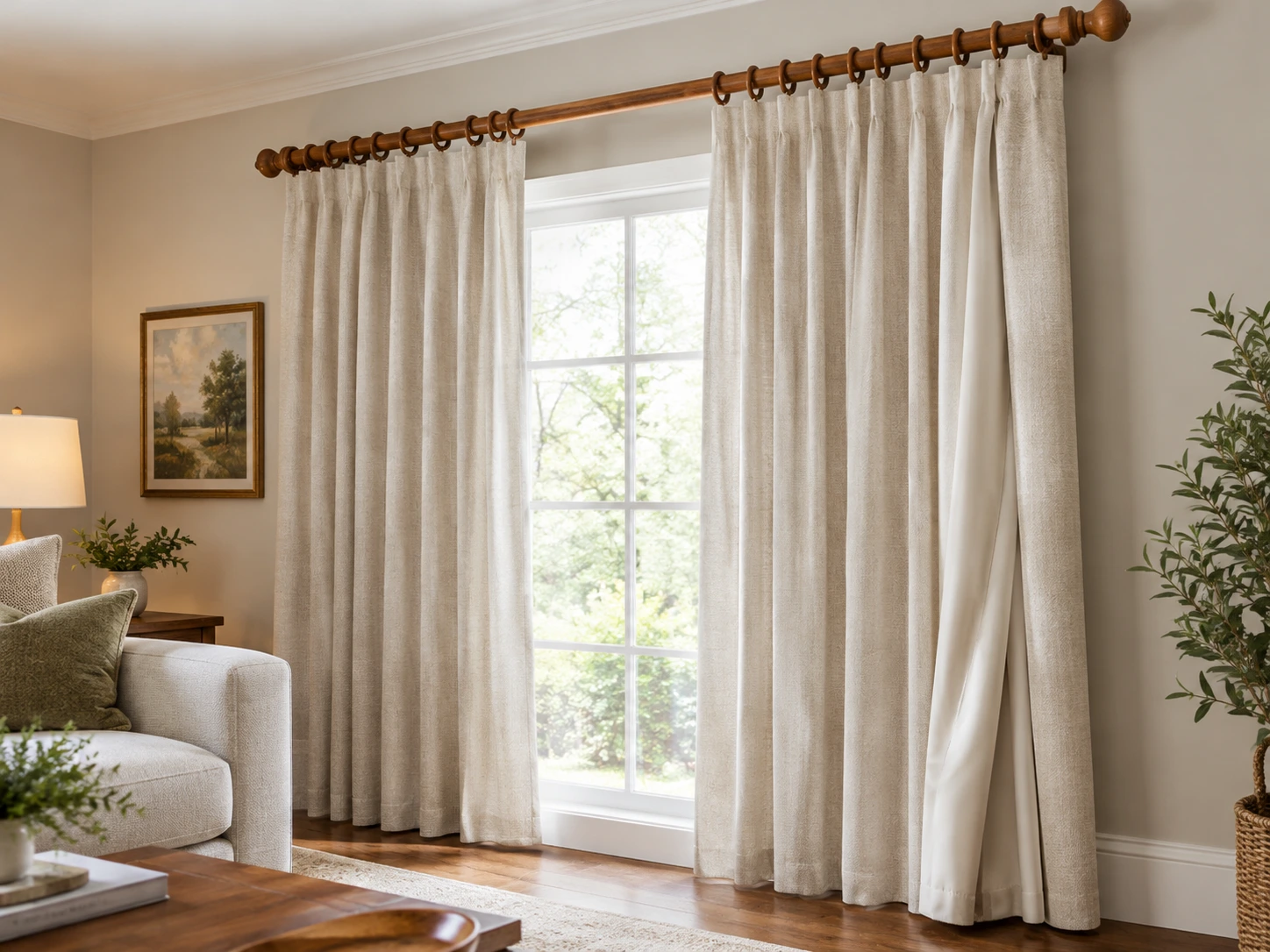
A wooden curtain rod is a great choice if your curtains are heavy, your windows are wide, or you want the hardware to blend with the room. It is also less forgiving than a metal rod. Wood is heavier, the brackets must match the diameter, and a rod that looks right in a picture can bend, bind or pull out of the wall if the details are wrong.
The short answer:
- Diameter: A 1-3/8 inch wooden curtain rod is the all-purpose size for standard windows and medium-weight panels. A 2 inch rod suits wide windows, tall ceilings and heavy drapes.
- Placement: Mount the rod 4 to 6 inches above the window frame and let it extend 3 to 6 inches past each side so the curtains can rest on the wall when open.
- Support: Anchor the brackets into studs whenever you can. Add a center support on long spans or with heavy fabric.
- Common failure: Mismatched brackets and weak wall anchors cause more problems than the rod itself.
Types of wooden curtain rods
Solid and pre-finished wood rods
The classic hardwood rod is sold either unfinished, so you can stain or paint it, or pre-finished in a ready-made color. Retailer listings for drapery lines often show rods in 4-foot, 6-foot and 8-foot lengths, with finishes like satin white or bronze on a tight-grain hardwood. Pre-finished rods save time, but the finish on the rod, the rings and the finials must match. That is easier to control when you buy them as a set.
Wood tension rods
Wood-look tension rods exist, but they are a different product. They rely on spring pressure inside the window frame and are meant for light curtains such as sheers or café panels. Do not expect them to carry drapes.
Wood poles with rings and finials
Most wooden rod sets are actually systems. They include the rod itself, a pair of decorative finials for the ends, brackets to hold the rod in place, and wooden rings that slide along the rod. The rings are what make a rod practical for panels you open and close every day. If you plan to hang curtains with grommets or a rod pocket, the diameter of the rod matters even more, as explained below.
What wood is it made from?
Common woods include maple, oak, poplar and pine. Hardware suppliers often suggest poplar as a paint-grade wood and hard maple as a stain-grade wood, though either can be painted or stained. Oak has a pronounced grain that suits traditional and farmhouse rooms. Walnut and cherry look more formal and are naturally darker. Keep in mind that a softer wood like pine dents easily, which matters if rings will knock against the rod every day.
Wood curtain rod sizes: what to choose
Diameter is the decision that affects strength, look and compatibility with everything else.
| Rod diameter | Best for | Notes |
|---|---|---|
| About 1 to 1-1/4 in. | Light curtains, small windows, sheers | Slim profile; less stiff over long spans |
| 1-3/8 in. | Most standard windows and medium-weight panels | The everyday workhorse size |
| 1-1/2 to 1-3/4 in. | Wider windows, heavier fabrics | A middle option some makers offer |
| 2 in. | Large windows, tall ceilings, heavy drapes | Bold look; needs heavy-duty brackets |
One supplier notes that its drapery rods come in two core sizes, 1-3/8 inch and 2 inch, with brackets made for each diameter. Treat that as one maker’s catalog, not a standard, because other brands offer additional sizes.
My recommendation
If you have a 3- to 5-foot window with lined cotton or linen panels, a 1-3/8 inch rod is a safe choice. If the window is wide, the curtains are lined with velvet or blackout fabric, or the room has high ceilings, a 2 inch rod is better because a thin rod can look undersized. This is a judgment call, not a rule, so always check the manufacturer’s weight and span ratings.
Length: how long should the rod be?
Crate & Barrel’s guide says each end of the rod should extend 3 to 6 inches past the window frame on both sides. Other sources suggest more, and this is one area where advice genuinely varies. A good way to decide is to think about what you want. If you want the curtains to clear the glass completely when open, choose the longer end of the range. If a wall corner or a piece of furniture sits near the window, keep the rod shorter on that side.
For example, a window that is 48 inches wide would need a rod about 54 to 60 inches long under that rule. Take the finials into account, because they add some length at each end.
Curtain length and height
Ready-made curtain lengths typically come in 63, 84, 96, 108 and 120 inches, which covers most rooms. When you hang the rod, think about both the window and the ceiling. Most people recommend placing the rod 4 to 6 inches above the window frame. Another useful rule is to set the rod between half and two-thirds of the distance from the window trim to the ceiling, leaving at least 2 inches of space below the ceiling. In American homes with eight-foot ceilings, the 4-to-6-inch rule is the most practical choice.
Wood versus metal: an honest comparison
Wood has the advantage in strength and visual weight. A thick solid rod resists bending under a lot of fabric better than a thin metal rod, and it pairs well with wood floors, wood trim and wood furniture. The downsides are real, though:
- Weight. A solid rod is heavier than a metal tube, so the brackets and the way they attach to the wall matter more.
- Finish care. Wood can get chipped, especially where the rings slide along it.
- Sun and humidity. Wood can shift slightly as humidity changes, and the finish can fade in strong sunlight. This is true of wood in general rather than something tested on specific products, but it is worth considering if you live somewhere very humid or sunny.
- Style limits. Wood works best in traditional, farmhouse and transitional rooms. In a sleek, minimal room, a thin metal rod usually looks better.
If you are matching the rod to your floors, our guide to pre-finished hardwood flooring can help you pick wood tones that work together.
Choosing rings, finials and curtain types
Match everything to the rod’s diameter. Wooden rings come sized for specific rods, such as 1-3/8 inch, and a finial that does not fit flush can leave a gap or a lip. If you are hanging grommet panels, the inner opening of the grommet must be larger than the rod. One source notes that a 2 inch rod needs grommets of at least 2-1/4 inches, which makes sense given the physical fit. Clip rings, which let you attach curtains without punching holes, are also available.
One more practical detail: for a full, plush look, fabric width is commonly two to two-and-a-half times the width of the rod. Flat panels stretched across the window look thin on a wooden rod.
How to install a wooden curtain rod
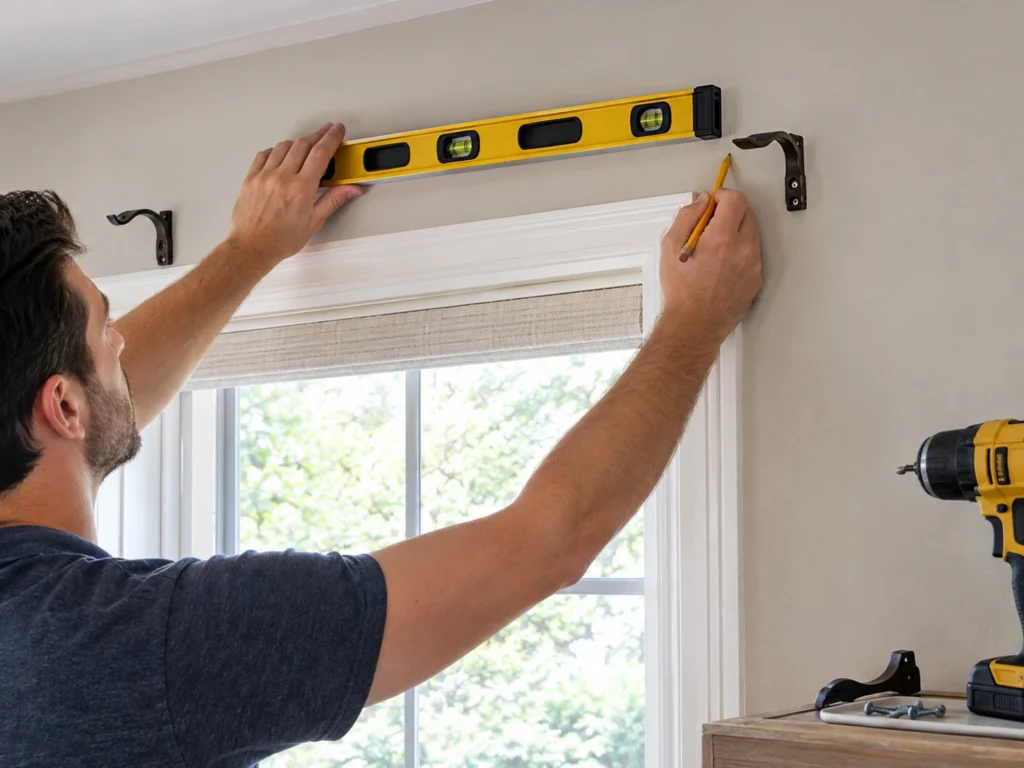
You will need a pencil, a tape measure, a level, a stud finder, a drill, and screws or anchors that suit your wall. Use the supplied hardware only if it can hold the weight.
- Decide the height and width of the rod. Mark a spot four to six inches above the frame, and decide how far beyond the frame the rod will reach.
- Mark where the brackets will sit. Place the end brackets just inside the finials, leaving space for the rings to slide. Use a level and make sure the marks are even on both sides.
- Find the studs. Scan the wall near your marks. If a stud is within an inch, consider shifting the bracket slightly to hit it.
- Pre-drill. Drill small pilot holes, especially when screwing into wood trim or hardwood brackets that might split.
- Mount the brackets. Screw them into studs whenever you can. If there is no stud, use heavy-duty anchors.
- Add the rings before you attach the finials. Slide the rings on first, then attach the finials. If you wait, you will have to remove them again.
- Place the rod, add a center support if needed, and hang the curtains. Check that everything hangs evenly and make adjustments.
Studs, anchors and weight
Drywall alone won’t hold much weight. The standard plastic anchors that come with the hardware are fine for light curtains, but for heavy drapes it is better to find a stud or use toggle bolts. Toggle bolts are often recommended for hollow walls because they spread out behind the drywall and provide a solid hold. Holding strength varies with bolt size and drywall thickness, so always check the package for the correct load rating.
In older homes, especially in the Northeast and Midwest, walls may be plaster and lath instead of drywall. Plaster can crack easily when drilled. To avoid damage, drill slowly and try to locate a stud or the wood framing around the window. That gives you a more secure mounting point for heavy items.
Center supports
Longer rods need a center bracket to keep them from sagging. Suppliers say heavier curtains or longer rods benefit from one, and at least one bracket maker recommends a center support every 60 inches. Manufacturers’ spans vary, so read the rod’s stated limit. One hidden problem is that a center bracket can stop rings from sliding past it. Plan your panels so they part at the center, or choose a rod and bracket system made for rings.
Common mistakes
- Using the wrong bracket size. A bracket made for a 1 inch rod will not hold a 2 inch rod properly, and the rod may fall.
- Mounting the rod too low. When the rod sits right at the frame, the window looks smaller and the curtains block light.
- Ignoring the weight of the wood. A heavy rod with lined drapes can pull out anchors.
- Forgetting about projection. Make sure the curtains will clear the window trim, blinds or radiators.
- Skipping finish matching. Mixed wood tones between the rod, rings and the rest of the room can look accidental.
Cost and availability
Prices vary widely depending on the type of wood, the finish, and whether you buy a full set or individual parts, so I have not included numbers here. You can find rods, brackets and finials at home centers, specialty drapery stores and online lumber and hardware shops. Buying parts separately lets you mix and match finishes. If you choose unfinished wood, remember to budget time and materials for staining or painting and sealing it.
For more ideas on styling the rest of the room, see our console table buying guide and our sofa table guide.
Frequently asked questions
What size wooden curtain rod do I need?
For regular windows and medium-weight panels, 1-3/8 inches is the right size. Use 2 inches if the window is very wide, the curtains are heavy or the ceiling is high. Always check the ratings for both the rod and the brackets.
How far should a curtain rod extend past the window?
One widely used guide suggests 3 to 6 inches past the frame on each side. The extra width lets curtains clear the glass when open, but available wall space and nearby furniture can limit how much you can add.
Do wooden curtain rods need a center support?
Often yes, for long rods or heavy curtains. Some manufacturers suggest one every 60 inches. Check the rod’s stated maximum span.
Can I hang wooden curtain rods into drywall without a stud?
For light curtains, quality anchors may be enough. For heavy drapes, use a stud or heavy-duty toggle bolts, and follow their weight ratings.
What’s the best wood for a curtain rod?
Oak and maple are common stain-grade choices, and poplar is often used where the rod will be painted. The best choice depends on the look you want and how often rings will scrape the surface.
Can I paint or stain unfinished wooden rods?
Yes. Suppliers sell rods, brackets and finials meant to be stained or painted. Seal the finish well, since rings can wear it down over time.
Will grommet curtains work on a wood rod?
Yes, as long as the grommet opening is bigger than the rod. A 2 inch rod needs grommets of at least about 2-1/4 inches.
Sources and references
- Crate & Barrel, How to Hang Curtains Guide
- Capitol City Lumber, drapery rod, bracket and finial product listings (Kirsch Wood Trends sizes, bracket diameters)
- TaskRabbit, how-to guide on curtain height and width
- Kwik-Hang, center support bracket guidance
- Hunker, guides on toggle bolts and wall anchoring
[…] Comparing other options? See our guides to the House of Hampton velvet sofa, the Eastre gray chenille power reclining sofa and the 5Z-Comfort power reclining sofa. To finish the room, see the Ashley Chadton accent table and our wooden curtain rods guide. […]
[…] the room? See our guides to wooden curtain rods and the Ashley Chadton accent […]