

The term ” doors” actually covers two very different kinds of products. One kind is for inside the house. Like in closets, pantries or laundry areas. These are the hinged, folding panels that slide open and close. They usually cost between $150 and $500 to buy and install based on Angi’s estimates. They come in sizes so you can often just pick one that fits your space.
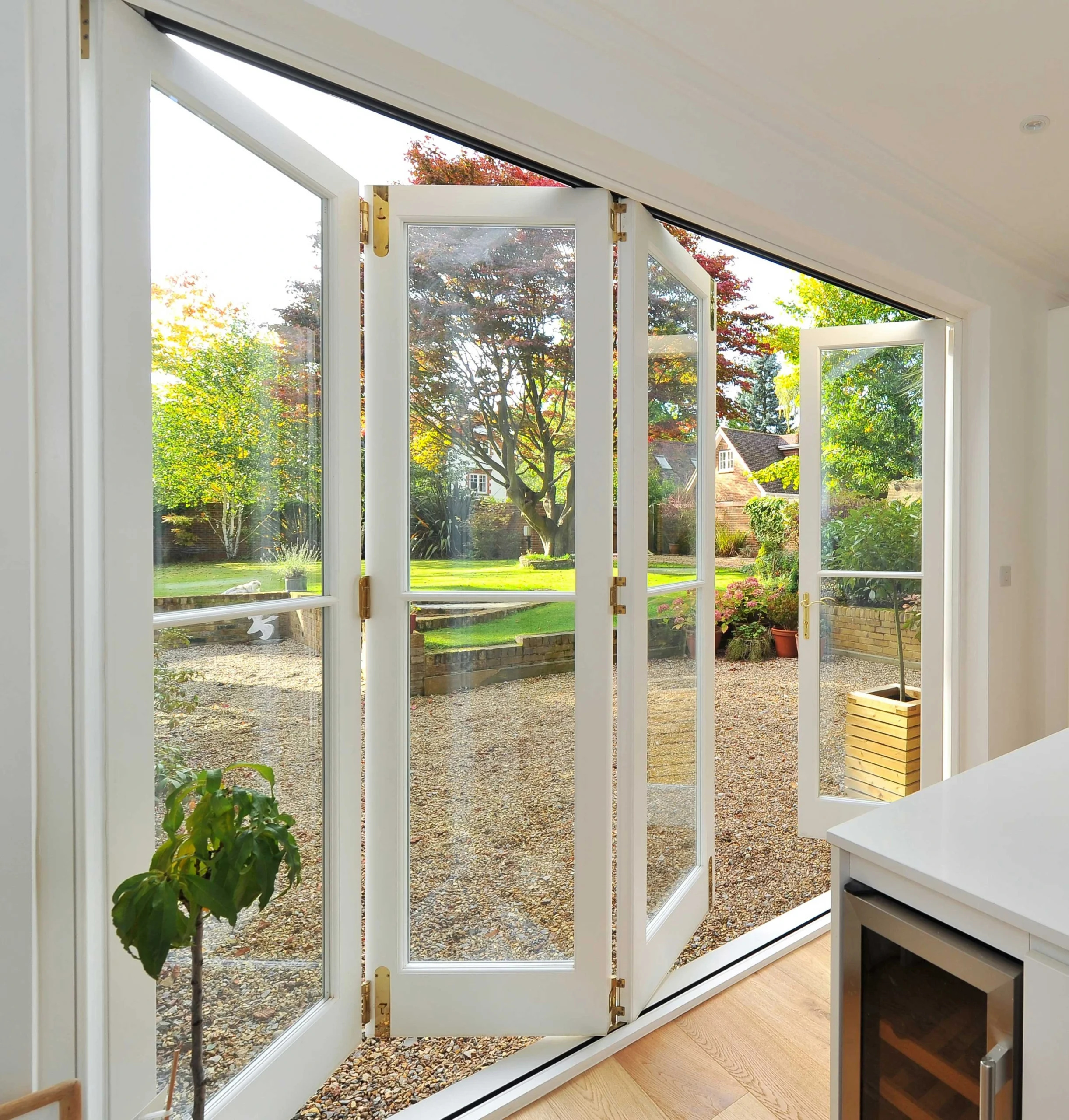
The other kind is for outside. Like on patios or balconies. These are glass folding doors that open up an entire wall. Angi’s 2026 data says these cost between $3,550 and $15,000 to install on average. The price goes up if you go for doors or higher-end materials.
If you’re looking for closet doors you’ll mostly be matching your opening to a size.. If you’re looking for patio doors you’ll need to think about things like what the frame is made of, how the sill is designed, how the glass performs and who will install it. Because you’ll need a professional for that.
This guide covers both types. It also explains why you shouldn’t compare them. They’re not the thing. One is for small indoor spaces, the other is for big outdoor views. Mixing them up can lead to choices and wasted money.
Two products, one name
Results from searching for “bifold doors” often mix the two types and many of them are from websites in the United Kingdom. In the United Kingdom the word “bifold” always refers to a folding glass wall that is measured in millimeters and costs are given in pounds. In the United States the word usually refers to a closet door. The outside version is commonly called a folding patio door, a folding glass wall or an accordion door.
Angi uses the term “accordion door” for the outside doors, which makes things more confusing. Low cost vinyl accordion doors that are sold for closets and for dividing rooms are a different product. Make sure to check what a listing is describing before you look at the prices.
Types of interior bifold doors
Interior bifolds are hinged panels that fold in half while sliding along a track. Bifold is ideal for spots where a swinging door would collide with a bed, a wall or another door.
By configuration
- Two-panel pairs fit openings. Bifold pairs are usually 24 to 36 inches wide.
- Four-panel sets fit closets. Bifold sets are usually 48, 60 or 72 inches wide.
By material and style
- Hollow-core molded composite is the budget option. The composite is light which makes track hardware easier to handle.
- Solid wood or solid-core panels are more expensive. Feel more substantial. However the solid panels are heavier. Put more stress on the track.
- Louvered panels allow airflow. This is helpful in closets and pantries.
- Mirrored and glass-paneled versions double as decor.. Mirrored panels are heavy and need hardware rated for the weight.
Compared with alternatives
A bifold gives access to most of the opening width when folded. Bypass sliding doors only expose half the closet at a time. A swinging door needs floor space in front of the closet. Bifold is a fit, for wide closets and tight rooms. However bifold depends on a track and pivots staying aligned.
Types of exterior folding patio doors
These are heavy, glazed systems, and the differences between them matter more than style.
Frame material
- Vinyl is the lowest-cost frame, though Angi describes it as the least durable.
- Aluminum is strong and allows slim sightlines. Thermally broken versions perform better in cold climates.
- Wood or wood-clad is common on premium systems and offers a warm interior, but it demands more care, especially in wet climates.
Opening direction
Some systems fold inward, and others fold outward. Andersen’s folding outswing doors, for example, are top-hung with a multi-point locking system. An outswing design keeps the folded panels off your floor space but means they stack on the porch or patio.
Sill (threshold) design
Sills are easy to overlook and have a real effect on performance. A raised, drainage-style sill is better at keeping water out. A low-threshold or flush sill is easier to step over and looks cleaner, but may give up some water protection. On Andersen’s folding doors, for instance, the published performance rating applies to the standard on-floor drainage sill, and the dealer listing notes that doors with other sill options are not rated. Read the spec sheet for the exact sill you’re being quoted.
Sizes
Interior bifold doors
Heights are usually 80 inches (6’8″). Taller 96-inch versions exist for 8-foot ceilings. Typical widths run from 24 to 36 inches for pairs, and 48, 60, and 72 inches for four-panel sets, though not every manufacturer offers every width.
| Closet opening width | Typical door setup |
|---|---|
| 24–36 in. | One two-panel pair |
| 48 in. | Four-panel set |
| 60 in. | Four-panel set |
| 72 in. | Four-panel set |
Nominal and actual sizes differ. A door sold as 36″ × 80″ may actually measure about 35½” × 79″ so it clears the opening. Measure the width at the top, middle, and bottom of your opening, and the height on both sides and in the center. Use the smallest numbers, then compare them with the manufacturer’s listed opening size rather than assuming the label matches.
If your opening doesn’t match a standard size, the options are a custom order or modifying the opening.
Exterior folding patio doors
Angi notes that these doors come in prefabricated sizes, usually 6 to 18 feet wide with a set number of panels for each width. You’ll see retailer listings like a 108 × 80 inch four-panel door. Premium systems can go much bigger. Andersen’s trade-press info for its folding door says openings can be up to 48 feet wide and 10 feet tall. Panels in the style can be up to 48 inches wide while in the traditional style they’re up to 39 inches. Make sure to check the specs before deciding.
Here’s the thing. More panels mean hinges, more seams and more places where air or water could leak in. A wider opening also means more of the doorway gets taken up by the folded stack when the doors are open. Before you get excited, about a 16-foot wall of glass where the stack will sit when the doors are open. It might block a walkway, a view or even a window.
What bifold doors cost in 2026
All figures below are estimates from published cost guides, and your local quotes will vary.
Interior bifold doors: Angi reports about $150 to $500 to purchase and hang. Door installation labor generally runs $40 to $90 per hour. Angi’s how-to guide rates a closet install as an intermediate job of about two hours.
Exterior folding patio doors: Angi’s 2026 data puts typical installed costs at $3,550 to $15,000. It lists material-only prices from about $3,050 for a 72-inch vinyl door to well over $13,000 for very wide aluminum units. Higher-end systems with custom sizing, wood-clad frames, and high-performance glass cost more than these ranges.
| Project | Typical range | What drives it |
|---|---|---|
| Interior closet bifold (bought and hung) | $150–$500 | Material, width, hardware, labor |
| Exterior folding patio door (installed) | $3,550–$15,000 | Width, panel count, frame, glass, structural work |
Here are the factors that most often push a quote up:
- Structural work. Widening an opening needs a properly sized header. Heavy glass panels also need solid support, and the framing under the threshold matters too (see our floor joist sizes, spacing and span guide).
- Glass upgrades. Low-E coatings, triple-pane glass, and laminated or impact glass add cost.
- Finishing. Trim, flooring changes, and exterior flashing are often not in the headline price.
- Permits. Requirements vary by city and county, and altering an opening is the kind of work that often needs one.
Ask every installer for an itemized quote so you can compare like with like.
Energy efficiency and your climate
Exterior folding doors have more seams than a fixed window or a standard door, so the glass, frame, and weatherstripping all matter. Look for an NFRC label showing U-factor and solar heat gain coefficient (SHGC). ENERGY STAR criteria are based on NFRC ratings and vary by climate zone, and ENERGY STAR notes that interior doors aren’t eligible.
How this plays out regionally:
- Northern states (Upper Midwest, Northeast, mountain West): Prioritize a low U-factor. That points toward thermally broken frames and often triple-pane glass. Under ENERGY STAR version 7.0, the Northern zone limit for patio doors is 0.26 or lower, according to Andersen’s summary. Confirm against the current ENERGY STAR criteria.
- Southern and Southwest states: Solar heat gain matters more. A low SHGC glass package keeps the room cooler, and dark aluminum frames in direct sun get very hot.
- Hurricane-prone coasts: Look for doors rated for impact and wind load where local code requires it. Not every folding door is.
- Rainy regions such as the Pacific Northwest: Water management and drainage matter more than the look of the sill, and a covered porch helps wood-clad frames last.
Cross-reference your ZIP code with the ENERGY STAR key product criteria to see which climate zone you’re in.
Installation: where DIY makes sense
Interior closet bifolds are a reasonable DIY project if you’re comfortable with a drill and a level. Most come with the track and hardware. The main failure mode is an out-of-square opening or a misaligned track, which makes the doors bind or pop off.
Exterior bifolds are a different job. Angi advises hiring a pro because the door has to be sealed, flashed, and supported correctly. Poor installation causes the failures that matter most: leaks, binding panels, and wear on hinges. A manufacturer’s warranty may also depend on professional installation, so check before you decide.
Common mistakes
- Comparing a closet bifold price with a patio bifold price. They’re different products.
- Ordering from nominal size without measuring. Check the opening in three places.
- Ignoring where the folded stack will sit. It can block a walkway, furniture, or a screen.
- Choosing a flush sill without considering exposure. It suits a sheltered porch better than a wind-driven rain exposure.
- Skipping the structural check. A heavy folding wall needs proper header support.
- Overlooking everyday use. If you’ll open the door daily for a pet or to carry groceries, the sill height and handle type matter more than the glass specs.
When bifold doors are not the right choice
- You need an easy daily pass-through. A sliding or hinged door is simpler to operate.
- The opening is narrow. A folding system adds cost and complexity without a big payoff in a standard doorway.
- The exposure is harsh and uncovered. Many seams plus wind-driven rain is a difficult combination.
- Your budget is tight. A standard sliding patio door costs far less for ordinary use.
- You need security above all. Many folding systems have multi-point locking, which helps, but a simple heavy-duty door can be easier to secure.
Not sure a folding door is the right fit? Our guide to prehung interior doors: sizes, types and buying advice covers a simpler hinged alternative.
Buying checklist
- Decide whether you need an interior closet door or an exterior system.
- Measure the opening in three places, and check the manufacturer’s size chart.
- For exterior doors, find your ENERGY STAR climate zone and check the NFRC label.
- Ask which sill is quoted and what its performance rating covers.
- Ask where the panels stack and whether they fold in or out.
- Request an itemized quote including structural work, trim, and permits.
- Confirm warranty terms and whether professional installation is required.
FAQ
Do I need a permit to install bifold doors?
It depends on the rules. Replacing a bifold door inside an existing opening may require review than widening an opening, which involves structural work. Check with your building department.
Can I install doors myself?
Closet bifolds are a DIY job for many homeowners. Exterior bifold systems are best left to professionals because of their weight sealing requirements and warranty terms.
Why does my closet bifold door keep falling off the track?
The usual causes are a top track, a loose pivot bracket or an opening that has shifted out of square. Re-level the track. Tighten the hardware before replacing the bifold door.
Are bifold doors better than sliding doors?
Bifold doors open a portion of the doorway but bifold doors cost more and have more parts to maintain. Sliding doors are simpler and cheaper. Sliding doors are often the better choice, for everyday access..
Do I need a permit to install bifold doors?
Whether you need a permit to install bifold doors depends on your local rules. Replacing a door inside an existing opening usually requires review than widening the opening because widening involves structural work. It is best to check with your building department.
Can I install doors myself?
You can install closet bifold doors yourself if you’re comfortable with a manageable DIY job. However installing bifold doors is best left to professionals because exterior bifold doors are heavy and need proper sealing and warranty terms may be affected.
Why does my closet bifold door keep falling off the track?
A closet bifold door keeps falling off the track because of reasons. These reasons include a top track, a loose pivot bracket or an opening that has shifted out of square. To fix it, re-level the track. Tighten the hardware before you replace the door.
Are bifold doors better than sliding doors?
Bifold doors open a portion of the doorway compared to sliding doors. Yet bifold doors cost more. Have more parts that need maintenance. Sliding doors are cheaper and often the better choice, for everyday access..
Sources and references
- Angi, “How Much Does It Cost to Install Folding Patio Doors? [2026 Data]”: https://www.angi.com/articles/folding-patio-doors-cost.htm
- Angi, “How to Install Bifold Doors”: https://www.angi.com/articles/how-to-install-bifold-doors.htm
- Angi, “Bifold and Accordion-Style Doors”: https://www.angi.com/articles/consider-bifold-doors-your-home-interior.htm
- ENERGY STAR, Residential Windows, Doors, and Skylights key product criteria: https://www.energystar.gov/products/residential_windows_doors_and_skylights/key_product_criteri