

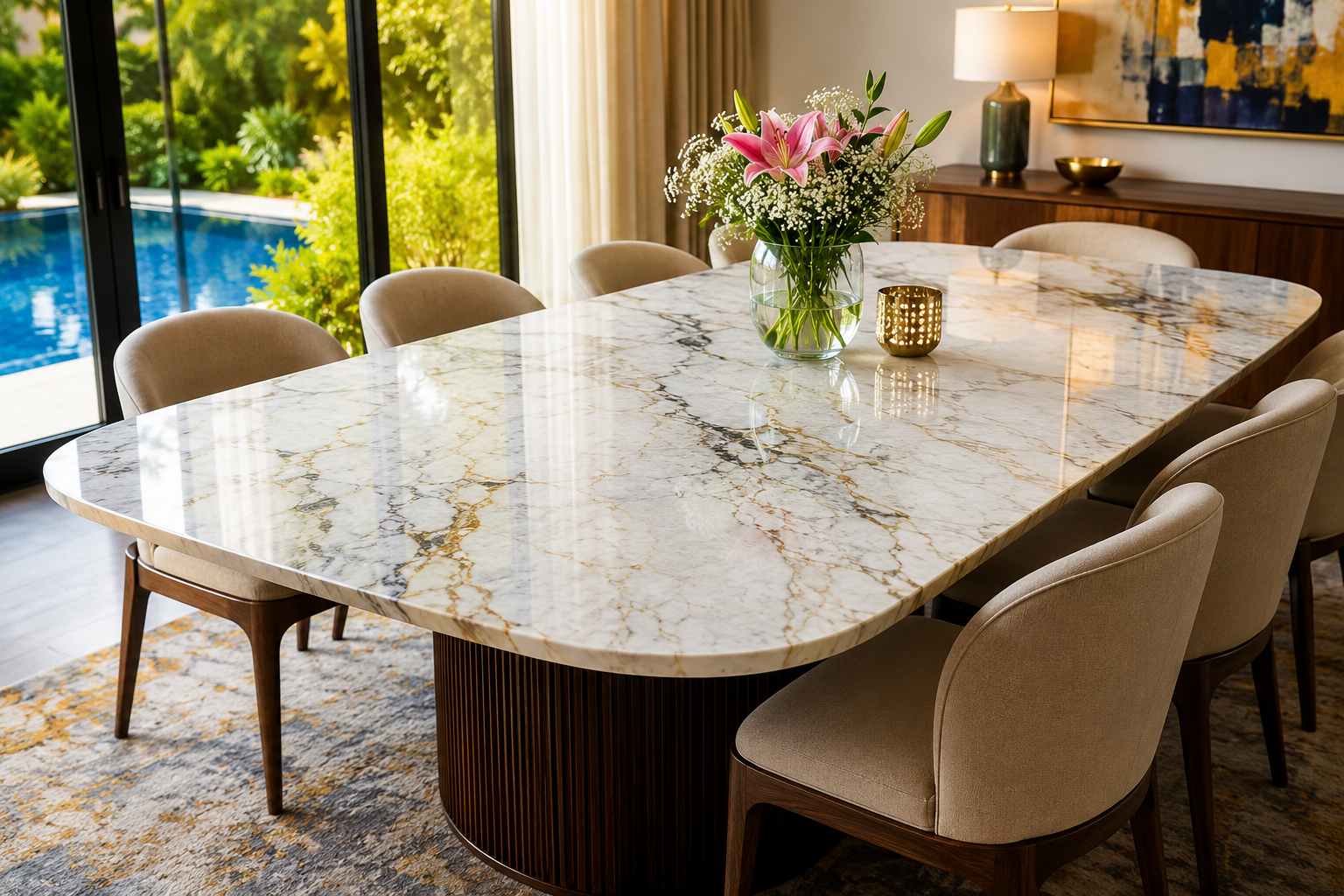
Picking a table top sounds simple — until you’re standing in a showroom surrounded by marble slabs, wood samples, and sintered stone panels, each one beautiful and each one promising to be the best choice. The truth is, the right table top depends entirely on how you live. A material that works perfectly for a quiet formal dining room can, in fact, be a nightmare in a busy family kitchen.
So this guide is here to make the decision easier. It covers the ten best table top materials available in the U.S. right now, based on 2026 design trends, real-world durability, and honest pricing. Whether you cook every night, host dinner parties on weekends, or simply need something that survives two kids and a dog — there’s a clear answer here for you.
What to Consider Before You Choose
Four things matter most when shopping for a table top. Understanding each one before you buy will save you from a decision you’ll regret.
Durability
How well the surface holds up to daily life — hot dishes, spilled coffee, homework sessions, and years of use without showing its age.
Maintenance
What you’ll need to do to keep it looking good. Some materials need sealing twice a year, while others need nothing but a damp cloth. Knowing which you’re signing up for before you buy is essential.
Aesthetics
Shape the feel of your whole room. In 2026, specifically, the dominant design direction is what interior designers are calling “Sculptural Naturalism” — organic shapes, warm wood tones, and textures that feel rooted in the natural world rather than manufactured.
Budget
Covers more than just the sticker price. A cheaper material that needs professional refinishing every few years can, in the end, cost far more than a premium surface that asks nothing of you. So think in terms of ten-year cost, not just what you pay on day one.
1. Solid Hardwood — The Timeless Classic
Solid hardwood is where most people start, and for good reason. Oak, walnut, and ash are leading the trend in 2026, often finished with hand-applied oils or low-sheen wax that deepen the grain and bring out the wood’s natural color. As a result, the older these tables get, the better they tend to look.
American hardwoods like white oak and black walnut are, in particular, worth seeking out. They’re strong, locally sourced, and age with real character. Moreover, the biggest practical advantage of solid wood is that it can be sanded and refinished — scratches and dents that would permanently ruin a stone or glass top can simply be buffed away. Consequently, a quality hardwood table bought today can realistically serve your family for generations.
That said, there are two vulnerabilities to keep in mind: moisture and heat. Always use trivets under hot dishes, and wipe up spills before they have time to sit.
Best for: Family dining rooms, farmhouse kitchens, buyers who want heirloom furniture. Price range: $200–$1,500+ depending on species and size.
2. Sintered Stone — The Modern Family Workhorse
Sintered stone has changed the dining table market more than any other material in recent years. It’s made by compressing natural mineral powders — quartz, feldspar, silica, and sometimes clay — under enormous pressure and then firing them at roughly 1,200°C. The result is a surface so dense it’s practically non-porous.
But what does that actually mean in practice? Red wine wipes off. Hot pots leave no marks. Scratches rarely appear. To illustrate, one commonly cited real-world test involved six adults, a hot casserole, and a red wine spill — and everything cleaned up with a single damp cloth, no rings, no etching. For households with children, that kind of everyday performance is genuinely reassuring.
In addition, large sintered stone slabs can be produced without visible seams — up to about 126″ × 63″ in a single continuous piece. Therefore, for open-plan kitchens where the table is the visual centerpiece, that seamless surface reads noticeably cleaner than alternatives that require visible joints.
Best for: Active families, open-plan kitchens, anyone who wants a luxury stone look with minimal upkeep. Price range: $800–$3,000+.
3. Quartz — No-Seal Stone for Everyday Life
Quartz has earned its reputation as a no-fuss, high-performance surface. Unlike marble or granite, quartz is non-porous straight from the factory — there’s no sealing required, not at installation and not ever. Furthermore, colors and patterns stay consistent across the slab, which makes it easy to match with other elements in your kitchen or dining room.
However, the one trade-off compared to sintered stone is heat sensitivity. The resin binders used in quartz can discolor under sustained high heat, so trivets should always be used. Even so, for kitchen tables that double as homework desks or home office surfaces, quartz remains a smart pick. It handles coffee mugs, laptops, and spilled juice equally well.
In the U.S. market, specifically, brands like Cambria, Caesarstone, and Silestone are the benchmarks for quality at mid-to-premium price points.
Best for: Kitchen tables, work-from-home setups, buyers who want stone looks with zero maintenance. Price range: $600–$2,500+.
4. Marble — Luxury With a Learning Curve
No manufactured surface fully captures what natural marble does — the depth, the movement of the veining, the quiet sense of permanence. Carrara, Calacatta, and Statuario marble are genuinely beautiful materials that carry an authority that engineered alternatives simply can’t match.
However, the maintenance reality deserves honest acknowledgment. Marble is sensitive to acids. Citrus juice, wine, vinegar, and tomato sauce can all etch the surface if left sitting. In addition, it needs sealing every six to twelve months. Even well-maintained marble will develop a patina over time — though some people find this adds character, others find it frustrating.
For formal dining rooms used primarily for entertaining — as is common across the Northeast and Mid-Atlantic — marble makes a spectacular statement. On the other hand, for everyday kitchen tables where kids eat breakfast and dinner gets cooked nearby, it asks more of you than most households are willing to give.
Best for: Formal dining rooms, low-traffic entertaining spaces, design-forward buyers who don’t mind maintenance. Price range: $1,000–$5,000+.
5. Live-Edge Wood — Statement Pieces With Soul
A live-edge table top preserves the natural outer edge of the tree, which means no two are ever the same. That’s precisely the point — and in 2026, with the “Sculptural Naturalism” trend pushing buyers toward organic shapes and materials that feel genuinely connected to nature, live-edge tables have become some of the most sought-after pieces on the market.
Black walnut is currently the most popular species in the U.S., followed by maple, cherry, and figured claro walnut from the Pacific Coast. These slabs can be finished in two ways. A natural oil-wax finish keeps the wood’s texture and warmth intact. Alternatively, a clear epoxy coating creates a glass-like surface that’s waterproof and scratch-resistant — particularly popular for river table designs where tinted resin fills the natural void between book-matched slabs.
Finally, buying from an American woodworker or craftsperson is well worth considering. Not only do you get a unique piece, but you also support a local maker — and you typically have direct input on dimensions, finish, and species.
Best for: Statement dining rooms, open-plan living spaces, buyers investing in one-of-a-kind furniture. Price range: $1,200–$8,000+ for custom pieces.
6. Butcher Block — Warmth and Function for Kitchen Tables
Butcher block is having a genuine moment. As homeowners move away from cold, white minimalist kitchens, the warmth of thick wood surfaces is clearly back in demand. Moreover, butcher block’s real practical advantage is that it’s self-healing — scratches can be sanded out and the surface re-oiled, which means minor damage doesn’t have to mean permanent damage.
Beyond that, there’s also a subtle benefit that’s easy to overlook: butcher block absorbs sound. In open-concept homes where kitchen noise travels easily into living areas, that natural sound damping makes the whole space feel noticeably quieter and calmer.
In terms of maintenance, butcher block requires monthly oiling with food-safe mineral oil and keeping the surface dry between uses. Water is the main enemy. Nevertheless, for kitchen tables specifically, few materials match the combination of character, affordability, and repairability that butcher block offers. Current pricing runs roughly $70–$150 per square foot nationally, rising for custom dimensions and thicker tops.
Best for: Kitchen tables, breakfast nooks, farmhouse and transitional interiors. Price range: $300–$1,200 for a standard dining table size.
7. Tempered Glass — Airy Elegance for Smaller Spaces
Tempered glass solves a specific problem really well: it keeps a small dining area feeling open and uncluttered. Light passes straight through, the floor remains visible, and as a result, the room never feels crowded by a heavy surface. For apartments and condos in cities like Chicago, San Francisco, or New York, specifically, a glass top on a slim metal or wooden base is a genuinely practical design choice.
The glass used should, of course, be tempered — engineered to break into small, blunt-edged pieces rather than dangerous shards — and should be at least 10mm thick for dining table use. In addition, rubber bumpers between the base and the glass prevent slipping and help reduce vibration noise.
Still, the honest trade-offs are fingerprints and crumbs, both of which show more prominently on glass than on any other material. So keep a quality microfiber cloth nearby, and simply make peace with wiping it down after most meals. For a closer look at this category specifically, see our best glass top dining tables guide.
Best for: Small apartments, minimalist interiors, spaces where visual lightness is the priority. Price range: $150–$800 for replacement or standalone tops.
8. Ceramic & Porcelain — Heat-Proof and Underrated
Ceramic and porcelain table tops don’t yet get enough attention — but the market is clearly catching up. Porcelain is harder than granite, impervious to UV rays, and — thanks to modern printing technology — can mimic rare marble or slate so convincingly it’s genuinely difficult to tell the difference. As a result, it’s one of the most durable and versatile surfaces available in 2026.
For anyone who uses the dining table as a buffet surface during gatherings, ceramic is, in fact, almost ideal. Hot dishes go straight down. Spills wipe off without staining or etching. Unlike marble, there’s no acid sensitivity. Unlike wood, furthermore, there’s no need for oiling or sealing at any point.
The one vulnerability worth noting is the edges. The surface itself is extremely tough, but a sharp impact on a corner can chip it. So look for tables with a beveled or mitered edge profile that protects the most exposed areas. Additionally, porcelain works well for outdoor dining spaces — an increasingly popular choice for covered patios across the Sun Belt states.
Best for: Heavy-use family dining, outdoor-indoor tables, buyers who want stone looks with near-zero maintenance. Price range: $500–$2,500.
9. Concrete — Industrial Character Done Right
Concrete table tops offer something that no other material quite can: total design freedom. They can be cast in any shape, tinted in dozens of colors, and embedded with objects like stones, reclaimed wood, or metal accents. The result can range from brutalist-minimal to warmly organic, depending entirely on what you want.
In cities known for industrial or modern farmhouse aesthetics — Austin, Denver, and Portland, for example — concrete tables have built a loyal following over the past several years. Lightweight white concrete works particularly well for round pedestal tables, where the sculptural base and top come together as a single cohesive form. Moreover, some concrete tables are designed specifically for both indoor and outdoor use, which adds practical flexibility for year-round entertaining.
In terms of practical considerations, weight and sealing are the two main factors to plan for. Concrete tops are heavy, so the base needs to be properly engineered to support them. Annual resealing, meanwhile, keeps staining at bay. Professionally poured concrete runs $65–$100 per square foot, though experienced DIYers can cast tops themselves for as little as $10–$30 per square foot.
Best for: Industrial, modern farmhouse, and loft-style dining rooms; DIY enthusiasts. Price range: $400–$2,000+ depending on size and custom work.
10. Mixed Materials — 2026’s Defining Trend
The final entry isn’t a single material — rather, it’s the most influential design idea shaping American dining furniture right now. Combining contrasting textures is what interior designer Summerlyn Feckner describes as “transforming dining tables into focal points.” Currently, the most popular pairings include sintered stone tops on solid oak bases, live-edge walnut tops on blackened steel hairpin legs, and ceramic tops with hand-carved wooden pedestals.
Importantly, the practical case for mixed materials is just as strong as the aesthetic one. You can choose the top specifically for durability and ease of cleaning, then select the base independently for visual character. That way, each component does exactly what it does best.
Before you buy, however, there’s one key thing to check: how the top is attached to the base. A stone top properly bolted through a mounting system will outlast one simply resting on brackets. So ask the retailer or maker to walk you through the joinery before committing. If you’re furnishing the rest of the room too, our dining room cabinets guide covers styles and buying tips that pair well with any of these table tops.
Best for: Open-plan living spaces, transitional and contemporary interiors, buyers who want furniture that functions as art. Price range: $800–$5,000+.
Quick Guide: Which Table Top Fits Your Life?
- Kids and daily chaos → Sintered stone or ceramic — nearly indestructible and wipes clean effortlessly.
- Warm kitchen atmosphere → Butcher block or solid hardwood — nothing else matches the tactile warmth.
- Small apartment or studio → Tempered glass — keeps the room feeling open and uncluttered.
- Formal entertaining → Marble or live-edge walnut — maximum visual impact for dinner guests.
- Outdoor or indoor-outdoor use → Ceramic/porcelain or sealed concrete — UV-resistant and moisture-proof.
- One-of-a-kind statement → Live-edge with epoxy or mixed materials — no two are ever the same.
- Budget-conscious upgrade → Butcher block or tempered glass — excellent quality without a premium price tag.
For authoritative guidance on material safety and performance standards, the National Kitchen & Bath Association (NKBA) publishes consumer resources that are regularly updated for the U.S. market.
Frequently Asked Questions
What is the most durable table top material for everyday use?
Sintered stone and ceramic/porcelain top the list for everyday durability. Both resist scratches, heat, and stains without any sealing or special care. Among natural materials, meanwhile, dense hardwoods like oak and walnut hold up best — especially when paired with a quality finish and basic regular maintenance.
What is the easiest table top material to maintain?
Sintered stone, quartz, and tempered glass are the three easiest to maintain. All three require nothing more than mild soap and a damp cloth. Marble, on the other hand, sits at the opposite end of the spectrum — it needs periodic sealing, acid-free cleaners, and still shows wear over time regardless.
Are glass table tops safe for homes with children?
Yes, as long as you choose tempered glass that’s at least 10mm thick. Tempered glass is specifically engineered to break into small, blunt-edged pieces rather than sharp shards. That said, sintered stone and solid wood offer more peace of mind in homes with very young or active children, since neither will break under impact at all.
What is sintered stone, and how does it differ from quartz?
Sintered stone is made by compressing natural mineral powders and firing them at extremely high temperatures, which produces a non-porous, near-indestructible slab. Quartz, by contrast, is an engineered composite of natural quartz crystals held together with resin. Both are highly durable, but sintered stone generally handles sustained heat better since there’s no resin to discolor — and it can also be produced in larger seamless slabs.
How much should a quality dining table top cost in 2026?
Budget-friendly options like butcher block and tempered glass start around $150–$400. Mid-range materials — including quartz, ceramic, and standard sintered stone — typically run $500–$2,000 depending on size and brand. Premium surfaces like marble, live-edge walnut, and custom mixed-material pieces, however, start around $2,000 and can go well beyond $8,000 for fully custom work.
Can I replace just the table top without replacing the whole table?
Absolutely — and it’s actually a smart move when the base is still in good shape. Tempered glass, sintered stone, butcher block, and custom wood tops can all be ordered to specific dimensions. Before ordering, though, measure your existing base carefully and consult a fabricator or furniture specialist to confirm the attachment method will work correctly.
What table top works best for a kitchen table that also doubles as a workspace?
Quartz and sintered stone both handle the dual-purpose role exceptionally well. They’re completely unfazed by coffee mugs, laptops, and food prep spills. Butcher block, meanwhile, works well for food prep but requires careful moisture management. Glass is easy to clean but shows every fingerprint — so it’s not ideal for a surface that sees heavy daily use.
What are the biggest table top trends going into 2026?
The strongest shift is clearly toward natural materials, organic shapes, and layered texture. “Sculptural Naturalism” is the term designers are using to describe it — which covers the move away from cold rectangular surfaces toward oval and live-edge tops, as well as the growing preference for mixed materials that pair warm wood with cool stone. As a result, warm neutrals and rich wood tones are steadily replacing the stark whites and pale minimalism that defined the previous few years.
[…] Finally, don’t overlook assembly requirements before you buy, especially for larger pieces. Many affordable cabinets ship flat-packed and require significant assembly time. Factor that into your purchase timeline if you’re working toward a specific move-in or event date. For more guidance on furnishing the rest of your dining space, see our mid-century modern dining table buying guide and our roundup of the best table tops for dining tables. […]