

Choosing the right roofing material is a big decision. Get it wrong and you’re looking at leaks, high energy bills, and early replacements. Get it right and your roof could last 30 years with barely any upkeep.
PVC roofing sheets have quietly earned a strong reputation across the United States. Homeowners, contractors, and commercial property managers all rely on them — and for solid reasons.
This guide covers everything you need to know. What PVC roofing actually is. The different types available. What it costs in 2026. And how to install it correctly, whether you’re hiring a pro or tackling a DIY project.
Let’s start from the beginning.
What Is PVC Roofing?
PVC stands for polyvinyl chloride. It’s a synthetic plastic known for being strong, flexible, and resistant to weather.
In roofing, PVC comes in two main forms:
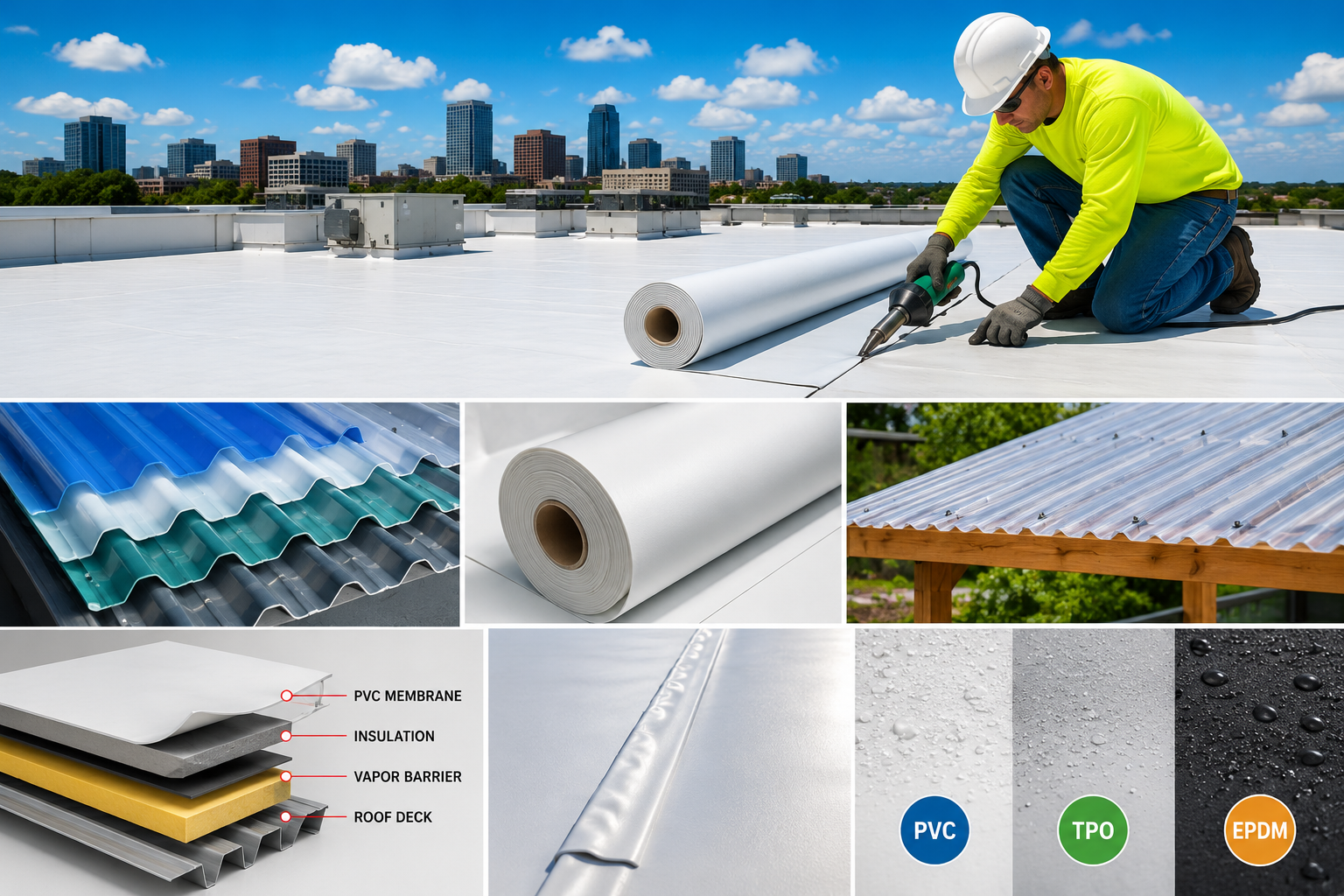
- Single-ply membrane sheets — flexible rolls used on flat and low-slope roofs, mostly for commercial and residential buildings
- Rigid corrugated or flat panels — thicker sheets used for sheds, carports, pergolas, greenhouses, and covered walkways
Both are lightweight. Both are far easier to work with than heavy materials like concrete tile or clay. And PVC membranes have been used in US commercial roofing for over 40 years, so there’s a long, proven track record behind them.
6 Key Benefits of PVC Roofing Sheets
1. It Lasts a Long Time
PVC is built tough. It handles impact, foot traffic, and even hail without breaking down. It doesn’t shrink or go brittle — which matters a lot in the Midwest and Northeast, where freeze-thaw cycles destroy weaker materials.
A properly installed PVC roof lasts 20 to 30 years. With good maintenance, some systems push past 35 to 40 years. Very few roofing materials can match that lifespan.
2. It Keeps Water Out — Reliably
PVC membrane seams are joined using hot-air welding. This creates a bond that is literally stronger than the membrane itself.
Rubber (EPDM) roofs use adhesive tape to seal seams. Those seams can peel over time. PVC seams don’t. This makes PVC one of the top choices for flat roofs, where standing water is always a risk.
3. It Saves Energy
Most PVC sheets are white or light-colored. That’s not just a design choice — it’s a performance feature.
Light surfaces reflect sunlight instead of absorbing it. In hot states like Texas, Florida, Arizona, and California, that reflection meaningfully cuts your cooling costs. The US Department of Energy officially classifies white PVC roofing as a “cool roof” — a recognized energy-saving strategy for homes and commercial buildings.
4. It Resists Chemicals and Fire
PVC naturally resists chemicals. That’s why it’s the preferred roofing material for restaurants, warehouses, and manufacturing plants — anywhere that grease, oils, or industrial chemicals could damage a standard roof.
It’s also inherently fire-resistant. That’s a safety advantage most other membrane types can’t offer as a standard feature.
5. It’s Lightweight and Easy to Handle
PVC is much lighter than concrete, tile, or asphalt shingles. That means less structural load on your building and an easier, faster installation.
If you’re doing a DIY project — a shed roof, a garden pergola, a backyard carport — the light weight of PVC panels makes the job noticeably more manageable.
6. It Needs Very Little Maintenance
Once PVC is properly installed, it mostly takes care of itself. Two brief inspections per year and one annual cleaning is all most systems need.
Metal roofing rusts. Wood rots. PVC doesn’t have those problems. It’s a genuinely low-effort material over its long lifespan.
Types of PVC Roofing Sheets
Not all PVC roofing products are the same. Here’s a clear breakdown of what’s available in the US market right now.
1. PVC Single-Ply Membrane
This is the most common form of PVC roofing in commercial construction. It comes in large rolls and gets installed over insulation on flat or low-slope roofs.
Membranes are measured in mils (thousandths of an inch). The three main thicknesses are:
- 45 mil — Entry-level. Fine for simple roofs with little foot traffic. Lower upfront cost, shorter lifespan.
- 60 mil — The standard for most commercial jobs. Good balance of cost and durability. Most commonly specified by contractors.
- 80 mil — Premium grade. Best for roofs with regular foot traffic, intense UV exposure, or long warranty requirements.
The rule is simple: thicker costs more upfront but lasts longer and performs better. For commercial installations, the extra investment in 60 or 80 mil is almost always worth it.
2. Corrugated PVC Sheets
These are the rigid, wavy-profile sheets you’ve probably seen on shed roofs, lean-tos, and greenhouse structures. They’re lightweight, easy to cut with basic tools, and available in clear, translucent, or opaque finishes.
Clear corrugated PVC is popular for covered patios and greenhouses because it lets natural light pass through. These sheets are typically 2mm to 3mm thick and are among the most DIY-friendly roofing materials you can buy.
3. Flat and Rigid PVC Panels
Flat panels work well where a smooth, clean surface is preferred — think industrial cladding, canopies, and outbuilding roofs. They look more architectural than corrugated sheets, but they offer the same core durability.
4. UPVC (Unplasticized PVC) Sheets
UPVC roofing skips the plasticizer additives found in standard PVC. The result is a stiffer, stronger, and more thermally stable sheet.
Standard PVC can soften slightly under prolonged extreme heat. UPVC doesn’t. It holds its shape better over long spans and performs more consistently in hot conditions.
If you’re in the Sun Belt — Arizona, Nevada, South Texas — UPVC is worth the slightly higher price.
5. PVC Foam-Core and Sandwich Panels
These panels have a hollow or foam-filled core sandwiched between two PVC faces. The core dramatically improves thermal insulation performance.
They’re most common in large warehouses and industrial buildings where energy costs are a major operational concern. If you’re managing a big commercial facility, these panels are worth a close look.
PVC Roofing Costs in 2026
Pricing varies based on the product type, membrane thickness, installation method, and your location. Here’s an honest breakdown.
Corrugated and Rigid PVC Panels (DIY-Friendly)
| Cost | |
|---|---|
| Material only | $1.50 – $3.50 per sq ft |
| Best for | Sheds, carports, pergolas, greenhouses |
These are straightforward to self-install. No specialized equipment needed.
PVC Membrane Roofing (Flat and Commercial Roofs)
| Installation Type | Cost Per Sq Ft |
|---|---|
| Mechanically attached, 50-mil, over existing roof | ~$5.15 |
| Fully adhered, 60-mil, new installation | $7 – $10 |
| Fully adhered, 80-mil, with full insulation | up to $14.65 |
| Labor only | $3 – $7 |
The typical range most US homeowners and building managers encounter is $6 to $12 per square foot installed.
Real Project Examples From Across the US
- Wisconsin — 1,500 sq ft residential flat roof (Duro-Last PVC system): ~$6,375 total
- Florida — 5,000 sq ft condo roof (IB Roof Systems): ~$7,000 total
- Commercial facility — 20,000 sq ft (Sika Sarnafil membrane): ~$110,000 total
One important note: on very small residential jobs, per-square-foot pricing can run 50% higher than commercial rates. Contractors factor in minimum trip and setup costs regardless of project size.
What Pushes the Cost Up
- Removing old roofing layers before installation
- Replacing wet or damaged insulation underneath
- Complex rooflines with lots of HVAC units, drains, or pipes
- Tapered insulation needed for drainage improvement
What Keeps the Cost Down
- A “roof recover” — laying new PVC directly over an existing dry, stable layer
- A simple rectangular roof with no penetrations
- Existing insulation that already meets current energy code
Always get at least three quotes from licensed flat roofing contractors in your area. Rates vary considerably between cities like Chicago, Houston, Los Angeles, and Atlanta.
Step-by-Step Installation Guide
Part A: PVC Membrane Roofing (Flat Roofs)
Membrane installation should be done by a licensed roofing contractor. But understanding each step helps you ask the right questions and evaluate bids with confidence.
Step 1 — Assess and Prepare the Roof The contractor inspects the existing roof for damage, wet insulation, and structural problems. Any deteriorated material comes out first. Skipping this step is the most common reason PVC roofs fail early.
Step 2 — Install Insulation New insulation boards (usually polyisocyanurate, or “polyiso”) go down across the roof deck. Most US building codes require a minimum R-30 for commercial roofs — roughly 5 to 6 inches of insulation.
Step 3 — Install the Cover Board A cover board (typically high-density polyiso or wood fiber) goes over the insulation. It creates a stable, firm base for the membrane and protects the insulation during installation.
Step 4 — Unroll and Attach the Membrane The PVC membrane is rolled out across the roof. There are two ways to attach it:
- Mechanically attached — screws and plates fasten the membrane to the deck at the overlapping edges. Faster and less expensive.
- Fully adhered — the membrane bonds to the cover board with adhesive across its entire surface. More labor-intensive, but stronger wind uplift resistance.
Step 5 — Weld the Seams This is the most critical step. A hot-air welding tool fuses overlapping edges together into a permanent, watertight bond. Properly welded PVC seams are stronger than the membrane itself. This work requires trained operators and proper equipment — it’s not a DIY task.
Step 6 — Flash All Penetrations Flashing goes around every roof opening — HVAC units, drains, pipes, skylights, parapet walls. Most roof leaks start at penetrations, not in the field of the membrane. This step deserves careful attention.
Step 7 — Inspect and Test A seam probe tool is run along every weld to confirm full bonding. A final visual inspection catches anything missed. No seam should be left unverified.
Part B: Corrugated PVC Sheets (Sheds, Pergolas, Carports)
This is a genuinely DIY-friendly installation. Here’s what you need and how to do it.
Tools needed: Drill with screwdriver bit, circular saw or fine-tooth jigsaw, tape measure, pencil, safety glasses, work gloves.
Step 1 — Plan Your Layout Measure your roof area carefully. Corrugated PVC sheets need at least one full corrugation of side overlap (about 2 inches) and a minimum 6-inch end overlap on low-pitched roofs. Buy 10–15% more material than your measurements suggest to allow for cuts and waste.
Step 2 — Check Your Support Spacing Purlins or battens should be spaced no more than 24 inches apart for standard 2–3mm PVC sheets. Drop that spacing to 18 inches if you’re in a high-snow-load area — the Northeast, Great Lakes region, or Pacific Northwest.
Step 3 — Cut Sheets to Size Use a circular saw with a fine-tooth blade. Cut slowly and steadily. Always cut from the smooth (top) side down to reduce edge chipping. Measure twice, cut once.
Step 4 — Start at the Bottom Begin with the lowest row and work upward. Upper sheets always overlap lower sheets so water runs over the seams, not into them. This is the most important rule of corrugated sheet installation.
Step 5 — Fasten With the Right Screws Use purpose-made roofing screws with neoprene or rubber washers. Drive them through the crown (the high point) of each corrugation — never the valley. This keeps water from pooling around the fastener. Pre-drill to avoid cracking the sheet.
Step 6 — Seal All Overlaps Apply butyl or silicone sealant along every end lap and around ridge caps and flashings. Unsealed end laps are the number-one source of leaks in corrugated roofing. Don’t skip this.
Step 7 — Cap the Ridge Finish with a matching PVC ridge cap, or use a flexible foam filler strip under a metal cap. This seals the peak and gives the roof a clean, finished look.
PVC vs. TPO vs. EPDM: A Clear Comparison
If you’re working with a flat or low-slope roof, you’ll likely compare these three membrane options. Here’s how they stack up:
| Feature | PVC | TPO | EPDM |
|---|---|---|---|
| Best for | Chemical exposure, restaurants, hot climates | General commercial flat roofs | Cold climates, tight budgets |
| Seam type | Hot-air welded | Hot-air welded | Adhesive or tape |
| Lifespan | 20–35 years | 20–30 years | 20–25 years |
| Energy efficiency | Excellent — reflective white surface | Very good — reflective white surface | Moderate — typically dark surface |
| Installed cost | $6–$12 per sq ft | $5–$10 per sq ft | $4–$8 per sq ft |
| Chemical resistance | Excellent | Moderate | Moderate |
| Flexibility in cold | Good | Good | Excellent |
The short version: PVC is the premium option. It costs more than TPO or EPDM, but it outperforms both in chemical resistance and seam strength, and it holds up better in hot, UV-intense climates.
If you run a restaurant, warehouse, or manufacturing facility — PVC is almost always the right call.
For a broader comparison of certified roofing products and their energy ratings, the Energy Star Roofing Products Database is a reliable, free resource maintained by the US government.
How to Choose the Right PVC Roofing Sheet
Whether you’re buying membrane rolls or corrugated panels, check these five things before you commit.
Thickness. For membranes, don’t go below 60 mil if you want 20-plus years of performance. For corrugated panels, 2.5–3mm handles snow and wind better than 2mm.
UV stabilization. All quality PVC roofing includes UV stabilizers. Without them, the material turns brittle and discolors within a few years. Check the product data sheet — if it doesn’t mention UV stabilizers, walk away.
Fire rating. Look for a Class A fire rating — the highest level available. Most reputable PVC membranes from Carlisle SynTec, Sika Sarnafil, Duro-Last, and Firestone carry it.
Warranty type. For membrane systems, ask specifically about NDL (No-Dollar-Limit) warranties. These cover both materials and labor with no depreciation. A standard material-only warranty can leave you with a large unexpected bill when something goes wrong.
Installer certification. Many major PVC manufacturers require certified installation to keep the warranty valid. Confirm this before signing any contract. An uncertified install could void your warranty on day one.
For current building codes and energy requirements in your state, the International Code Council (ICC) website is the authoritative source.
What to Expect by Region
PVC roofing performs well across the US, but different climates create different challenges. Here’s what to know for your region.
Southeast — Florida, Georgia, the Carolinas High UV, humidity, and hurricane-force winds are the main threats. Fully adhered, thicker membranes (60 or 80 mil) are the smart choice. Ask your contractor specifically about wind uplift ratings and whether hurricane damage is covered under the warranty.
Southwest — Texas, Arizona, Nevada Sustained heat is the top concern. UPVC or reinforced PVC membranes with strong UV ratings perform best here. White reflective membranes are especially valuable for cutting cooling costs.
Midwest and Great Lakes Freeze-thaw cycles and ice buildup can stress any roofing system. PVC membranes handle thermal movement well, but proper insulation design and drainage planning are non-negotiable.
Pacific Northwest Heavy rainfall and biological growth (moss and algae) are the main issues. PVC’s smooth surface resists that growth far better than asphalt or wood shingles.
Northeast Snow loads are the primary concern for outbuildings with corrugated PVC panels. Make sure your support structure is rated for local snow load requirements before you build.
5 Mistakes That Cost People Money
1. Not checking what’s underneath. Installing a new PVC roof over wet, damaged insulation is expensive and avoidable. Always inspect — and fix — what’s below before the new system goes in.
2. Choosing a membrane that’s too thin. A 45-mil membrane saves money today. If your roof has foot traffic or heavy sun exposure, it’ll cost you more in early replacement. Spend the extra amount on 60 mil minimum.
3. Using the wrong sealants. Not every caulk or flashing material is compatible with PVC. Some products will degrade PVC over time. Only use products approved by the membrane manufacturer.
4. Ignoring drainage. Standing water on a flat roof accelerates membrane wear and adds structural load. Tapered insulation and properly placed drains aren’t extras — they’re essentials.
5. DIYing a membrane roof. Corrugated PVC panels — yes, DIY is totally fine. A single-ply membrane system — no. Hot-air welding requires trained operators and proper tools. A bad weld is as useless as no weld.
Frequently Asked Questions
How long do PVC roofing sheets last?
A properly installed PVC membrane roof lasts between 20 and 30 years. Higher-quality 60 or 80 mil membranes, professionally installed and regularly inspected, can reach 35 years or more. Corrugated PVC panels for sheds and carports typically last 10 to 20 years, depending on UV exposure and product quality.
Is PVC roofing a good choice for residential homes?
Yes — especially for flat or low-slope roofs on garages, home extensions, and flat-roofed sections of a main house. PVC membrane systems are widely used on residential properties across the US. In the South and Southwest, where flat roof designs are especially common, PVC is a frequent first choice. For pitched structures like covered porches and carports, corrugated PVC panels work very well.
How much does PVC roofing cost in 2026?
For corrugated or rigid PVC panels, materials cost around $1.50 to $3.50 per square foot. For commercial-grade PVC membrane systems, fully installed prices range from approximately $5.15 to $14.65 per square foot, depending on membrane thickness, attachment method, insulation requirements, and local labor rates.
Can I install PVC roofing myself?
Corrugated and flat rigid PVC panels are very manageable as DIY projects. You need basic tools and a few hours. Single-ply membrane systems are a different matter. The hot-air welding process requires specialized equipment and hands-on training. Improper seam work will void the manufacturer’s warranty. For flat roof membranes, hire a certified contractor.
Is PVC roofing energy efficient?
Yes. White PVC reflects solar radiation instead of absorbing it. The US Department of Energy classifies this as a “cool roof” — a proven strategy for reducing cooling costs. In warm climates, the difference on your energy bill can be meaningful. Many PVC membrane products carry Energy Star certification for their reflective performance.
What’s the difference between PVC and TPO roofing?
Both are heat-welded, single-ply membranes for flat and low-slope roofs. PVC has better chemical resistance and a longer track record in the US. TPO is typically less expensive and has improved significantly in quality over the past decade. If your roof is exposed to chemicals or grease, PVC is the better choice. For a standard commercial flat roof on a tighter budget, TPO is a solid option.
Does PVC roofing need maintenance?
It needs very little — but not zero. The best practice is a visual inspection twice a year and a thorough cleaning once a year. Look at seams, check flashings around any penetrations, and clear debris from drains and gutters. Catching a small lifted flashing edge early costs almost nothing to fix. Ignoring it until it leaks is a very different story.
Is PVC roofing environmentally friendly?
It’s a fair question with a nuanced answer. PVC is one of the only commercial roofing materials with an active recycling program in the US — old membranes can be recycled rather than sent to landfill. Its reflective surface reduces urban heat island effects and cuts cooling energy demand. On the other side, PVC production involves chlorine, which is a legitimate environmental concern. On a full lifecycle basis, however, PVC compares well to most alternatives — largely because it lasts so long and can be recycled at the end of its life.
Final Thoughts
PVC roofing sheets are one of the most well-tested, versatile, and cost-effective roofing solutions available to US homeowners and commercial property owners in 2026.
Whether you’re replacing a leaking flat roof, covering a backyard structure, or planning a new commercial build, PVC delivers where it counts — durability, waterproofing, energy efficiency, and long-term value.
The key is choosing the right type for your specific project and making sure it’s installed correctly. Hire a certified contractor for membrane work. Follow proper technique for DIY corrugated panels. And don’t cut corners on thickness or warranty.
Do those things, and your PVC roof will likely outlast any other roofing decision you make on that building.
For a deeper comparison of flat roofing options, check out our complete guide to flat roofing materials — including climate-specific recommendations for every US region.