


Fort Wayne is still one of the more affordable mid-sized housing markets in the Midwest, but it is not the bargain it was five years ago. Prices have climbed faster than the national average, homes sell quickly, and the cheapest neighborhoods are rising fastest. A buyer expecting 2019 prices will be surprised, while a buyer comparing Fort Wayne to Indianapolis, Chicago or most coastal metros will probably still find good value.
This guide covers what homes in Fort Wayne cost now, how the market is behaving, which parts of town suit which buyers, what Indiana’s property tax rules mean for your budget, and which mistakes trip up buyers. Figures are current as of August 2026 unless noted.
Fort Wayne housing market snapshot (2026)
| Metric | Figure | Source |
|---|---|---|
| Median sale price (Jan–Jun 2026) | $268,954, up 6.0% year over year | Redfin |
| Median sale price, April 2026 | $279,123, up 11.6% year over year | Redfin |
| Typical days on market (first half of 2026) | About 30 days (about 50 nationally) | Redfin |
| Median price, ZIP 46805 | About $201,000, up 10.3% | TopHap (Aug 2026) |
| Median price, ZIP 46807 | About $199,000, up 20.7% | TopHap (Aug 2026) |
| 30-year fixed mortgage rate | 6.69% average, August 2026 | Freddie Mac |
| Average household income | $77,694 (U.S.: $87,934) | Redfin |
Quick answer: what does it cost to buy a home in Fort Wayne?
Redfin’s mid-year review puts the median sale price in Fort Wayne at $268,954 for January through June 2026, up 6.0% from a year earlier. Monthly numbers can jump: Redfin reported an April 2026 median of $279,123, up 11.6% from the previous April.
You will also see lower figures elsewhere, sometimes in the $210,000s. That usually reflects differences in data methods, such as which sales are counted, whether the data covers only the city or the whole metro, and which months are used. Treat any median as a rough guide and look at the price tier that matches the kind of house you want.
Redfin’s January 2026 tier breakdown shows how wide the range is. Starter homes had a median around $180,000, mid-tier homes sat around $254,000, higher-end homes reached $369,000, and the top 5% averaged about $729,000. The bottom tier, with a median near $76,000, is mostly fixer-uppers and distressed properties and rarely includes move-in-ready houses.
How the Fort Wayne market is behaving in 2026
The Fort Wayne market is moderately competitive, but not frenzied. Homes spent a median of about 30 days on the market in the first half of 2026, compared with roughly 50 days nationally. That is fast enough that you should not wait a week to decide on a well-priced house, yet nothing like the multiple-offer, waived-inspection environment of 2021.
ZIP-level data shows where the pressure is. TopHap’s August 2026 reports describe ZIP 46805 as a seller’s market with a median sale price near $201,000, up 10.3% over a year. ZIP 46807 is also rated a seller’s market, with a median near $199,000 and a 20.7% one-year increase. Both are close-in areas, and because their starting prices are low, the percentage gains look especially large.
The takeaway: the affordable end of the Fort Wayne market is where competition is tightest. If your budget is under $200,000, expect to move quickly and do not count on much negotiating room, even if national headlines talk about a cooling market.
Mortgage rates matter too. Freddie Mac reported the 30-year fixed rate averaging 6.69% in August 2026. Keep in mind that Freddie Mac’s survey assumes 20% down and excellent credit, so your own quote may be higher.
What a monthly payment looks like
Here is an example calculation, not an offer. Take a $269,000 home, close to the recent average, with a 6.7% rate on a 30-year fixed loan:
- With 5% down, principal and interest comes to about $1,650 per month.
- With 20% down, it drops to about $1,390 per month.
These figures do not include property taxes, homeowners insurance or mortgage insurance, all of which add to the real monthly cost. The number on your lender’s loan estimate is the one that counts.
Income helps put this in context. Redfin shows average household income in Fort Wayne at $77,694, compared with $87,934 nationally. Home prices are lower than the national figure, but so are incomes, so the affordability gap is real, just smaller than the price difference alone suggests.
Indiana property taxes: the part out-of-state buyers misjudge
Indiana’s system is unusually capped, and people moving from Illinois, Ohio or the Northeast are often pleasantly surprised.
For a home you live in, Indiana’s constitutional “circuit breaker” caps total property tax at 1% of the home’s gross assessed value. On a $270,000 home, that limit is $2,700 per year before other discounts. In practice, the amount you pay is usually lower because of homestead deductions. For 2026, the standard homestead deduction can be up to $48,000, with an additional 40% deduction on the remaining value. The 2025 law known as SB 1 also added a homestead credit of 10% of the bill, capped at $300. Because summaries of these credits differ, confirm current amounts with the Allen County Auditor or the Indiana Department of Local Government Finance before building your budget.
Two practical points that often get missed:
The homestead deduction isn’t automatic. You usually have to apply at the county office after you buy and start living in the home. If you forget, you could pay more than a neighbor with an identical house who filed.
Investors face a higher cap. Homes that are not owner-occupied are generally subject to a 2% cap instead of the 1% that applies to primary residences. If you plan to rent the property out or move out within a year or two, run your numbers at the higher rate.
Finally, the tax picture is still changing. SB 1 gave local governments more freedom to raise local income taxes to offset lost property tax revenue, so a lower property tax bill does not always mean a lower overall cost of living. Stay aware of changes as they roll out.
Fort Wayne neighborhoods and areas, by buyer type
Fort Wayne’s neighborhoods vary most in the age of the houses, lot size and school district. Four districts serve the city and surrounding county: Fort Wayne Community Schools, Southwest Allen County Schools, Northwest Allen County Schools and East Allen County Schools. Because the district can matter more than the neighborhood name, check which one a specific address belongs to.
| Area | Typical housing | Who it tends to suit |
|---|---|---|
| Aboite / Southwest Allen County | Established suburban subdivisions, many with lakes or HOAs; Southwest Allen County Schools | Families who prioritize school district and newer or mid-age construction; higher price points |
| Northwest (Carroll, Huntertown area) | Suburban and edge-of-town homes; Northwest Allen County Schools | Buyers wanting more land or newer builds who accept a longer commute |
| Southwood Park, Forest Park, West Central | Historic homes with architectural character; close to downtown and parks | Buyers who want older homes and a central location and can handle upkeep |
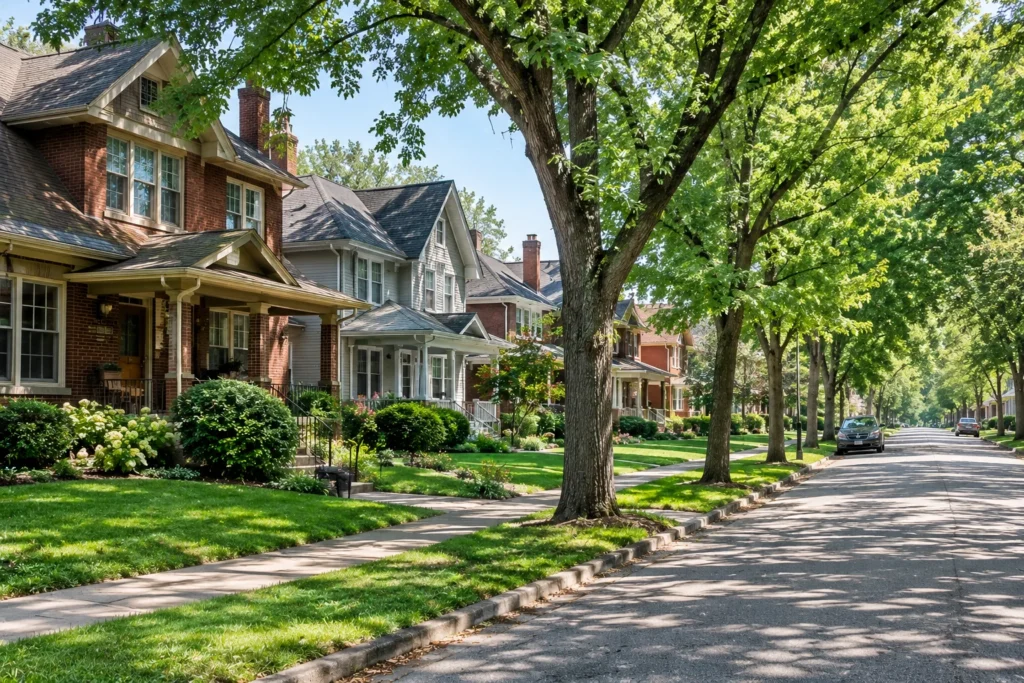
| Irvington Park, Wildwood Park, Mount Vernon Park, Memorial Park | Early to mid-20th-century homes on tree-lined streets | Buyers wanting character and central access at middle-range prices |
| Williams Park, Brentwood Park and similar | Older, smaller homes, generally lower prices | First-time buyers and renovators on a tight budget |
| Leo-Cedarville, New Haven and other outlying towns | Small-town feel, newer subdivisions, some acreage | Buyers trading a longer commute for space |
Treat this table as a starting point, not a verdict. It is built from neighborhood descriptions and public data. Before you decide, drive each neighborhood at different times of day, confirm how school assignment works for the exact address, and look at recent sales on the street to see whether they match what you expect.
The older-home reality
Low-priced homes in close-in ZIP codes are usually old. In ZIP 46807 the median year built is 1929 and the median home is about 1,500 square feet. In ZIP 46805 the median build year is 1940. These homes can be wonderful, but a low price tag often hides costs such as aging electrical systems, galvanized or cast-iron plumbing, basement moisture and original windows. Any home built before 1978 may also contain lead-based paint. Federal law requires sellers to disclose known lead paint hazards, and the EPA explains what you are entitled to receive in its real estate lead disclosure guidance.
Budget for a full inspection and consider having the sewer line scoped. A house listed at $150,000 that needs $40,000 in system repairs is not really a $150,000 house.
Water and flooding
Fort Wayne sits where three rivers meet: the St. Marys, the St. Joseph and the Maumee. That is part of the city’s history, and it also means you should check flood risk on any property near the water. Enter the address into FEMA’s flood map, talk to your insurance agent, and get a flood insurance quote before you make an offer. Ask the seller whether the basement has ever taken on water. Many Fort Wayne homes have basements used for storage or extra living space, and basements are where drainage problems usually show up. Even a little water can become a bigger problem over time.
Down payment help for first-time buyers
Indiana’s main program is run by the Indiana Housing and Community Development Authority (IHCDA), which works through participating lenders. Over the years it has offered a program for first-time buyers and a “Next Home” program for people who already own a home and want to buy again. Most of the help comes in the form of a loan, and some programs require a homebuyer education course before you apply.
Program terms and timing change, and summaries online often disagree. Start with the IHCDA’s current program guide, then talk to a participating lender about what you qualify for.
Mistakes that cost Fort Wayne buyers money
Treating the median as your budget. The median is the middle of the market, so the home you want may sit in a very different tier.
Skipping the homestead filing. It is easy to overlook in the rush after closing, and it directly affects your tax bill.
Falling for charm without an older-home budget. Charm is real. So is a 1920s electrical panel.
Ignoring the district boundary. Two houses a mile apart can feed different school systems.
Comparing list prices. Ask your agent for closed sales on comparable houses, since sellers in hot pockets can price above what the market ends up paying.
Shopping for a rate once. Freddie Mac itself notes that borrowers can save thousands by comparing lenders. Get at least three written loan estimates on the same day.
Who Fort Wayne makes sense for, and who it doesn’t
Fort Wayne works well for buyers who want a house with a yard at a price reachable on a single income or a moderate dual income. It also suits workers who don’t need a major-metro address, and people who like a mid-sized city with real parks, a downtown that is coming back and a lower cost of living than larger Midwest cities.
On the other hand, it is not a good fit if your work requires frequent in-person access to a large city. It may also disappoint buyers who want newer construction at the same prices as the older parts of town, or who expect easy discount-style negotiation in the lower price ranges.
How to search for homes for sale in Fort Wayne
Most major listing sites pull from the MLS, so Zillow, Redfin, Realtor.com and local brokerage sites largely show the same inventory. What differs is how quickly each one updates and what filters it offers. Set alerts for your price range and target ZIP codes, and be ready to tour within a day or two of a listing in the competitive tiers.
If you’d like to compare another Indiana market before talking to an agent, see our guide to Lake Tippecanoe homes for sale, or browse more in our Real Estate section.
While touring, ask about the age of the roof, furnace, water heater and electrical panel, and about any known drainage issues. Those answers tell you far more about future costs than the listing photos do.
Frequently asked questions
Is Fort Wayne a good place to buy a house right now?
For many buyers, yes, mainly because prices remain well below the national median. Prices are rising fastest in the cheapest neighborhoods and there is little room to negotiate there. Buy only if the monthly payment fits comfortably, not because you expect values to grow quickly.
What is the average home price in Fort Wayne, Indiana?
Redfin’s first-half 2026 median sale price was about $269,000. That figure can shift depending on the data source and the month. Starter homes were closer to $180,000 in Redfin’s January 2026 tier data.
Are Fort Wayne home prices going down?
Not according to the data reviewed for this guide. Redfin’s reports show year-over-year increases in 2026, and close-in ZIP codes showed larger gains. Prices could still shift, but there is no evidence of a decline in the sources used here.
How much are property taxes on a house in Fort Wayne?
For a primary residence, Indiana caps total property tax at 1% of gross assessed value. Deductions and credits usually bring the bill below that cap. Your exact amount depends on the assessed value and your filings, and the Allen County Auditor can show what a specific property’s bill looks like.
Do I need to apply for the homestead deduction in Indiana?
Generally yes. You file with the county for the home you live in. Because deadlines can change, ask your closing agent or the county auditor for the current one.
What neighborhoods are best for families in Fort Wayne?
Many families look at the Aboite area and the northwest suburbs because of their school districts. The best choice still depends on your budget, commute and priorities, so check the school assigned to a specific address before you make an offer.
Can I get help with a down payment in Fort Wayne?
Possibly. IHCDA offers down payment assistance through participating lenders. Eligibility depends on income, purchase price and other conditions, so confirm current terms directly with IHCDA or a participating lender.
Do I need flood insurance in Fort Wayne?
Flood insurance is required only if the property is in a mapped flood zone and you have a federally backed mortgage. Because Fort Wayne sits near three rivers, it is smart to check the address on FEMA’s flood map before you commit.
Sources & references
- Redfin Real Estate via Stacker: Fort Wayne mid-year housing market review (August 2026), price trend and cost-tier reports (2026)
- TopHap Market Reports for ZIP codes 46805 and 46807 (August 2026)
- Freddie Mac, Primary Mortgage Market Survey, August 2026
- Indiana SB 1 summaries and Indiana property tax guidance (2026); confirm with the Allen County Auditor and Indiana DLGF
- Indiana Housing and Community Development Authority, Homeownership Program Guide (2026)
- U.S. EPA, Real Estate Lead Paint Disclosure