

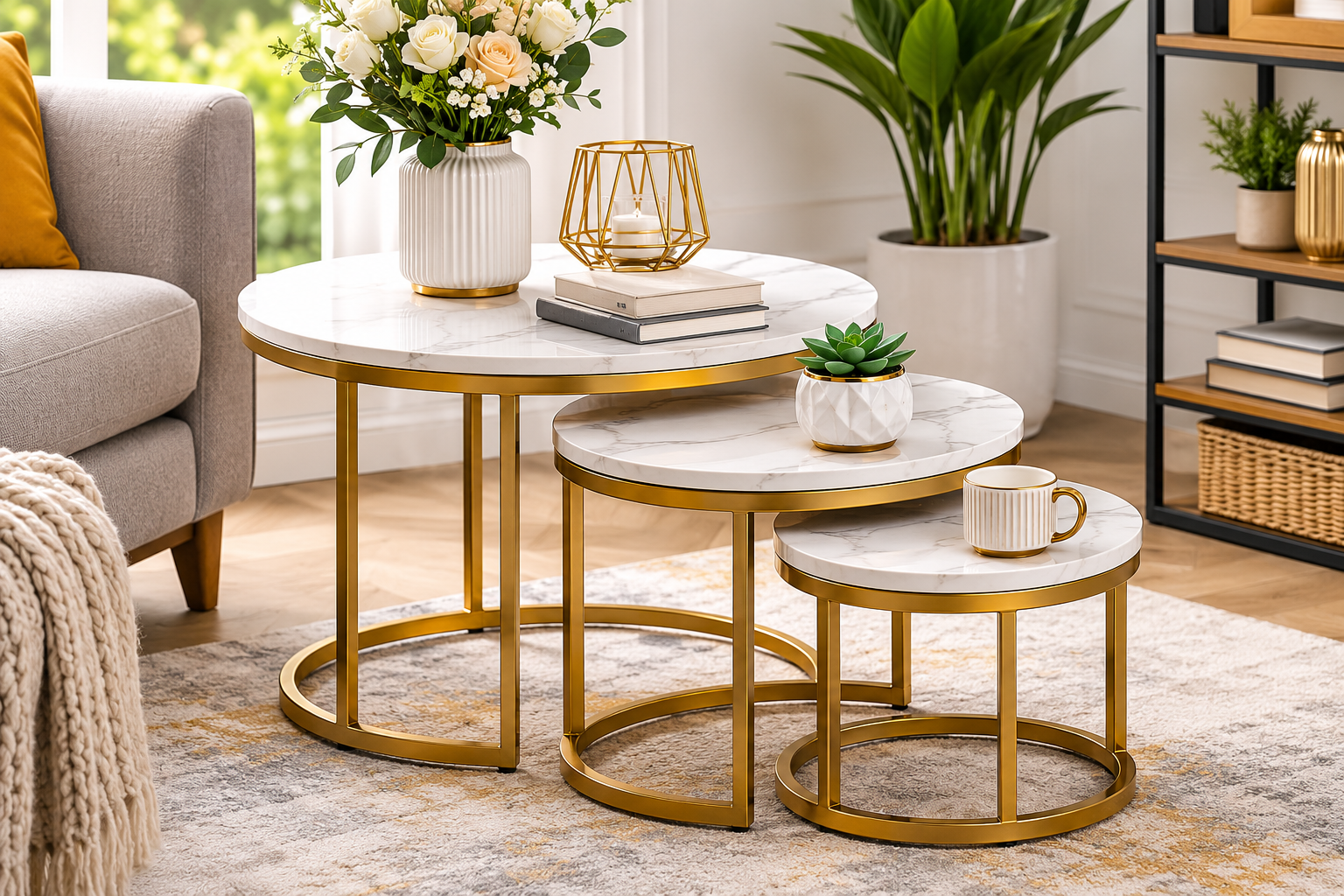
If you’ve ever needed an extra surface for a dinner party, a game night, or a lazy Sunday with coffee and a book, nested table furniture is probably the answer you’ve been looking for. These clever sets of two or three tables stack neatly inside each other when you don’t need them, then pull apart instantly when you do. As a result, they give you the flexibility of multiple tables without permanently eating up your floor space.
In 2026, nested table furniture is selling faster than ever. In fact, the global nesting table market now carries a projected compound annual growth rate of 9.5% through 2033, driven largely by smaller urban homes and a growing American appetite for multifunctional furniture. Whether you live in a Manhattan studio apartment or a spacious home in the suburbs of Atlanta, nested tables solve a real everyday problem — and they do it beautifully.
So let’s break down everything you need to know: the different styles, materials, sizing rules, placement strategies, and the key questions to ask before you buy.
What Exactly Is Nested Table Furniture?
Nested table furniture is a set of two or three accent tables that designers build in graduated sizes so they slide or stack beneath one another. The largest table stands on its own; the smaller tables tuck underneath it when not in use. When you need extra surface space, you simply pull the smaller tables out and arrange them however your layout demands.
The concept isn’t new — nested tables have roots in Georgian and Victorian English furniture design. However, their relevance in 2026 is sharper than ever, because today’s open-concept floor plans and smaller living spaces demand furniture that earns its place in multiple ways. A nested table set doesn’t just sit there looking pretty. It actively adapts to how you use your home day to day.
Why Nested Table Furniture Makes Sense in 2026
Before diving into specific styles and materials, it helps to understand why so many American homeowners are turning to nested tables this year specifically.
First, urban housing costs continue to push more families into tighter square footage. According to US Census data, the median new home size in metropolitan areas has trended downward over the past decade, which means every piece of furniture needs to work harder. Nested tables respond to that pressure better than almost any other accent furniture category.
Second, the 2026 furniture trend landscape has shifted decisively toward multifunctional, intentional pieces. Buyers are actively moving away from fast, mass-produced furniture toward pieces that are sustainable, multifunctional, well-crafted, and meaningful. Nested tables fit squarely into that mindset — they replace two or three single-purpose pieces with one smart, space-conscious set.
Third, and perhaps most importantly, nested tables are genuinely versatile. You can use them as a coffee table alternative, as companion side tables flanking a sofa, as nightstands in a bedroom, or as flexible work surfaces in a home office. No other accent table format gives you that range of use cases in a single purchase.
The Main Styles of Nested Table Furniture
Not all nested table sets look the same, and choosing the right style for your home depends on your existing décor, the room’s layout, and how you plan to use the tables day to day. Here are the main styles you’ll find in the US market in 2026.
1. Mid-Century Modern Nesting Tables
Mid-century modern nesting tables are one of the most popular choices in the US right now, and for good reason and mid-century design has never really left the scene. But in 2026 it’s making a comeback through fresh takes that pay tribute to the 1960s Californian look. In nested tables, that translates to tapered legs, organic oval or rounded rectangular tops, walnut or teak wood finishes, and clean lines that don’t compete with surrounding décor.
Best for: Living rooms with upholstered sofas in warm neutrals, Craftsman-style homes, apartments with wood floors and natural fiber rugs.
What to look for: Solid wood or wood veneer construction, tapered or splayed legs in walnut or teak, two-piece sets in oval or rectangular profiles.
2. Contemporary and Minimalist Nesting Tables
Contemporary nested tables keep everything clean, lean, and uncluttered. They typically combine two contrasting materials — a metal frame with a glass, marble, or wood top. And rely on geometric precision rather than decorative detail for their visual appeal. Metal nesting tables tend to be the slimmest in profile, which is useful when you want the look but don’t have much room to spare.
In 2026, the most popular contemporary combination is a slim black or brass iron frame paired with either a tempered glass top or a white marble surface. This pairing works especially well in rooms that already mix metal and stone in light fixtures or hardware.
Best for: Open-concept living rooms, modern apartments, spaces with neutral color palettes and minimal clutter.
What to look for: Powder-coated or brushed metal frames, tempered glass tops (safer and more durable than standard glass), two-piece sets in round or square silhouettes.
3. Traditional and Vintage-Inspired Nesting Tables
Traditional nested tables draw from English, French, and American colonial furniture traditions. They typically feature carved wood legs, rich dark finishes like mahogany or espresso, and rectangular or oval tops. Some sets include a small drawer on the largest table — a useful detail for stashing remotes, coasters, or reading glasses.
At the fall 2025 High Point Market — the world’s largest home furnishings event — traditional design’s comeback felt complete, with familiar silhouettes dominating showroom floors. Traditional nesting tables fit naturally into that revival. If your home leans toward classic or transitional design, a set with carved legs and a dark wood finish will look like it’s always belonged there.
Best for: Traditional or transitional living rooms, formal sitting rooms, homes with crown molding and classic architectural details.
What to look for: Solid wood construction (mahogany, oak, or cherry), dovetail joinery, small drawer storage on the largest table, three-piece sets for maximum flexibility.
4. Industrial Style Nesting Tables
Industrial nested tables combine raw, utilitarian materials — iron frames, reclaimed wood, pipe-style legs — with a modern sensibility. They’re bold, they’re sturdy, and they add visual weight to rooms that need grounding. Furthermore, they pair surprisingly well with soft, textural elements like linen sofas and wool rugs, because the contrast makes both elements look more intentional.
Industrial-style nesting tables are popular for their robust construction and unique aesthetic, offering a distinct option for buyers seeking a trendy look. In the US market, iron-frame sets with reclaimed wood or distressed wood tops are especially strong sellers.
Best for: Loft-style apartments, modern farmhouse interiors, urban homes with exposed brick or concrete elements.
What to look for: Welded iron or steel frames, reclaimed or distressed wood tops, matte black or aged iron finishes, two-piece sets in rectangular or square shapes.
5. Scandinavian and Natural Wood Nesting Tables
Scandinavian-inspired nested tables emphasize natural materials, honest construction, and a calm, clutter-free aesthetic. They typically feature light oak, ash, or beech wood in natural or whitewashed finishes, with simple round or rectangular tops and straight, minimal legs. As a result, they work beautifully in almost any room without demanding visual attention.
Sustainability leads all furniture trends for 2026, with buyers actively choosing furniture made from solid wood, reclaimed materials, and responsibly sourced components. Scandinavian-style nested tables align perfectly with that shift, since many brands in this category now use FSC-certified wood and water-based finishes.
Best for: Coastal homes, Scandinavian or boho-inspired interiors, nurseries and family rooms where a clean, safe aesthetic matters.
What to look for: FSC-certified solid wood, natural or light finishes, round two-piece sets, minimal hardware, non-toxic finishes.
6. Glam and Mixed-Material Nesting Tables
For homeowners who want their nested tables to make a genuine statement, glam-style sets combine luxurious materials in unexpected ways. Think brass frames with beveled mirror tops, marble surfaces on antique bronze legs, or gold-finished iron with smoked glass. Mixed-material sets — a brass frame with a marble top, or a wood base with glass inserts — help you tie together different finishes already in the room.
In 2026, the “quiet luxury” movement has given glam tables a more refined direction. Rather than ornate or overtly decorative pieces, buyers now gravitate toward sets with restrained elegance — clean lines, high-quality materials, and subtle metallic finishes that catch light without shouting.
Best for: Formal living rooms, master bedrooms, homes with jewel-tone upholstery or rich velvet accents.
What to look for: Solid brass or gold-finished iron frames, marble or mirror tops, three-piece sets for the most sculptural arrangement.
Nested Table Materials: What to Know Before You Buy
The material you choose affects not just how your nested tables look, but also how durable they are, how easy they are to maintain, and how much they cost. Here’s a straightforward breakdown.
Solid Wood is the most durable and long-lasting option. It handles daily use well, can be refinished if scratched, and brings natural warmth to any room. Oak, walnut, pine, and sheesham are the most common choices in 2026. Solid wood sets typically cost more upfront, but they last decades rather than years.
Engineered Wood (MDF or plywood) costs less than solid wood and resists warping better in humid environments. However, it doesn’t hold up as well to heavy impact and can’t be refinished. It’s a reasonable choice for budget-conscious buyers, but look for sets with a thick veneer and solid joinery for the best longevity.
Metal (Iron, Steel, Brass, Aluminum) frames are extremely durable, slim in profile, and easy to clean. They work particularly well as the base component in mixed-material sets. Powder-coated finishes resist rust and chipping better than raw metal. Brass-finished iron, in particular, is everywhere in 2026 — and for good reason, because it ages gracefully.
Glass tops add visual lightness and make small rooms feel more open. Always choose tempered glass (usually 6mm or thicker) rather than standard glass. Tempered glass is significantly stronger and, crucially, safer — if it does break, it shatters into small blunt pieces rather than sharp shards.
Marble and Stone surfaces are heavy, formal, and genuinely beautiful. They require a little more care than wood or metal (avoid acidic cleaners, seal annually), but they’re practically indestructible when properly maintained. Marble-topped sets are heavier and more substantial, and they read formal while pairing well next to upholstered seating.
How to Size Nested Tables for Your Space
Sizing is one of the most overlooked steps in buying nested table furniture, and getting it wrong makes even beautiful tables frustrating to use. Follow these professional guidelines to get it right.
Height: The largest table in your set should sit at or just below the height of your sofa arm or the top of your seat cushion. The smaller tables step down from there, usually by two to three inches each. This creates a natural stair-step arrangement that’s both visually pleasing and practically useful.
Width: The largest table should be wide enough to hold a lamp, a drink, and a small book simultaneously. For most sofa arms, that means a tabletop of at least 14–18 inches in diameter or width. The smaller tables can be narrower, since they typically serve as secondary surfaces.
Clearance: When you stack the tables together, make sure the combined footprint fits comfortably beside your sofa or chair without blocking foot traffic. A good rule of thumb is to leave at least 18–24 inches of walkway clearance on either side of the stacked set.
Room scale: In smaller rooms (under 150 square feet), stick to two-piece sets and choose round profiles — round nesting tables soften rooms full of straight-edged furniture and are easier to navigate around in tight layouts. In larger living rooms, a three-piece set gives you maximum flexibility for entertaining.
Where to Place Nested Table Furniture in Your Home
One of the best things about nested table furniture is that it works in almost every room. Here are the most effective placements.
Living Room
This is the most popular use case, and it’s easy to understand why. In a living room, a nested table set can replace a single coffee table entirely, especially in smaller spaces. Alternatively, you can place the stacked set beside your sofa as a tiered side table. Then pull the smaller pieces out when guests arrive. Fanned out in an arc, a set of three creates a layered, sculptural arrangement. Stacked, they act as a single compact surface with a refined profile.
Bedroom
In a bedroom, a two-piece nested set replaces a traditional nightstand. Keep the larger table next to your bed for your lamp and phone, and slide the smaller table underneath it. Then pull it out when you need a surface for a glass of water or a book. This approach works especially well in small bedrooms where a full-size nightstand feels too bulky.
Home Office
A nested table set in a home office acts as a flexible secondary surface. Use the larger table as a side perch for files or a second monitor. And keep the smaller table tucked away until you need extra desk space during busy periods. Because nested tables move easily, you can also reposition them around your desk as your workflow changes throughout the day.
Entryway and Hallway
A two-piece nested set works beautifully in an entryway. Place the larger table against the wall as a console-style surface for keys, mail, and a decorative accent. Then pull the smaller table forward when you need a spot to set bags while you put on shoes. It’s a small change that makes an everyday routine noticeably smoother.
2026 Price Guide: What Nested Tables Cost in the USA
Nested table furniture spans a wide price range depending on material, brand, and construction quality. Here’s what you can realistically expect to spend in the current US market.
| Tier | Price Range | What You Get |
|---|---|---|
| Budget | $50 – $150 | Engineered wood or basic metal, 2-piece sets, assembly required |
| Mid-range | $150 – $500 | Solid wood or mixed materials, better joinery, 2–3 piece sets |
| Premium | $500 – $1,200 | Solid hardwood, marble, or quality brass, designer brands |
| Luxury | $1,200 and up | Bespoke materials, artisan construction, signature brand names |
To give you a sense of real-world pricing: Four Hands offers iron-frame nesting end table sets around $279–$439, Hooker Furniture’s glass-top sets run $529–$719. And luxury options from brands like John Richard or Regina Andrew climb to $2,400–$3,363. At the budget end, IKEA’s Holmerud side table at roughly $50 per piece has become a popular building block for DIY nested arrangements.
Smart shopping tip: The mid-range tier ($150–$500) typically offers the best value. Sets in this range often use solid wood or genuine metal frames with quality joinery — meaning they’ll last years longer than budget options and cost significantly less than luxury pieces.
2026 Design Trends for Nested Table Furniture
Staying current on design trends helps you choose a nested table set that feels fresh now and holds up stylistically over the next several years. In 2026, these are the directions that matter most.
Warm wood tones are dominating. After a decade dominated by pale, pared-back finishes, furniture is finally deepening. In nested tables, that means walnut, dark oak, and sheesham are outselling lighter blondes and whites. If you want your set to feel current in 2026, lean toward medium to dark natural wood finishes.
Sculptural and organic shapes are having a major moment. Sculptural and organic shapes are becoming a key design trend for 2026, adding softness, movement, and artistic flair to interiors. In nested tables, this shows up as rounded rectangular tops, kidney-shaped sets. And asymmetric silhouettes that look more like objects than furniture.
Antique brass is the hardware finish of the year. Brass-finished iron legs, brass frame details, and gold-toned hardware appear across virtually every price tier in 2026. Moreover, this finish has genuine staying power — it’s warmer and more forgiving than chrome or nickel, and it ages in ways that look intentional rather than worn.
Mixed materials continue to thrive. The large version of the table nests with its smaller counterpart to form a sculptural pair — and in 2026, many of the most compelling pairs combine contrasting materials deliberately. A marble top on an iron base, or a wood surface on a brass frame, adds visual depth that single-material sets simply can’t achieve.
A Step-by-Step Buying Checklist
Before you add a nested table set to your cart — whether online or in store — run through this checklist. It covers the questions that most buyers skip and later regret.
Step 1: Measure your space first. Know the height of your sofa arm and the floor clearance available beside it. Write those numbers down before you browse.
Step 2: Define how you’ll use them. Will these primarily serve as side tables, a coffee table alternative, or a bedroom nightstand setup? Your answer shapes the ideal size and configuration.
Step 3: Choose your material based on lifestyle, not just aesthetics. If you have young children or pets, prioritize solid wood or metal over glass tops. If you live in a humid climate like Houston or Miami, engineered wood or metal holds up better than untreated solid wood in damp conditions.
Step 4: Check the construction quality. For wood sets, look for dovetail or mortise-and-tenon joinery rather than staples or glue alone. For metal sets, check that welds are smooth and frames feel rigid when you apply lateral pressure.
Step 5: Verify the nesting clearance. Confirm that the smaller tables actually slide cleanly under the larger one with minimal play. Poorly designed sets can feel wobbly when nested, which defeats the whole purpose.
Step 6: Order a sample or view in person when possible. Colors and finishes rarely look exactly the same on screen as they do in real light. If you’re buying online, read recent reviews specifically about finish accuracy before committing.
How to Style Nested Tables in Your Living Room
Knowing where to put nested tables is one thing. Styling them well, however, is what makes the difference between a functional corner and a room that genuinely looks designed. Here are the most effective approaches interior designers use in 2026.
Stagger the heights visually. When you pull the tables apart, resist the urge to place them side by side at the same height. Instead, pull the smaller table slightly forward and angle it outward. This creates a dynamic, layered look that feels intentional rather than accidental.
Follow the rule of three for tabletop styling. On the largest table, arrange three objects of varying heights — for example, a table lamp, a small plant, and a book or decorative object. On the smallest table, keep it minimal: a single candle or a drink coaster. This contrast in density makes the set feel like a considered vignette.
Match the metal to your room’s hardware. If your light fixtures use brushed gold or antique brass, choose nested tables with brass-finish frames. Similarly, if your room uses matte black hardware, black iron frames will tie the space together. This small decision creates a sense of cohesion that elevates the entire room.
Don’t be afraid to separate them. One of the most underused features of nested table furniture is the freedom to place the individual pieces in different areas of the room entirely. In a large living room, for example, the largest table can sit beside the sofa while the smaller tables flank accent chairs across the room. When guests arrive, you pull everything together. It’s a flexible system, so use it flexibly.
For more guidance on furniture arrangement and interior styling principles, the American Society of Interior Designers (ASID) offers a range of free consumer resources on their website.
Frequently Asked Questions
Q: What is the difference between nesting tables and side tables?
Side tables are individual accent tables that you place beside a sofa or chair. Nesting tables, on the other hand, are a set of two or three graduated tables that stack inside each other when not in use. So all nesting tables function as side tables, but not all side tables are nesting tables. The key advantage of nesting tables is that they give you multiple surfaces without permanently occupying multiple footprints on your floor.
Q: How many pieces should a nested table set have?
Most sets come in two or three pieces. A two-piece set works well for everyday use — one table stays in position while the second pulls out as needed. A three-piece set, however, gives you significantly more flexibility for entertaining and larger living rooms. If you frequently host guests or have a large sofa, a three-piece set is usually worth the modest extra investment.
Q: Are nesting tables sturdy enough for daily use?
Yes, when you choose quality construction. Solid wood sets with proper joinery handle daily use comfortably. Metal-frame sets with welded joints are also extremely durable. The weakest options tend to be budget engineered wood sets held together with staples or low-grade glue. Always check the weight capacity listed in the product specifications — a good nested table set should hold at least 30–50 lbs on the largest surface.
Q: Can I use nested tables as a coffee table replacement?
Absolutely — and this is one of the most popular use cases in smaller living rooms. A three-piece set arranged in a fanned arc in front of your sofa provides comparable surface area to a standard coffee table. Furthermore, you gain flexibility that a fixed coffee table can never offer, since you pull individual pieces away when you need the floor space.
Q: What size nesting tables should I buy for a small apartment?
For small apartments, choose a two-piece set where the largest table is no wider than 20 inches and no taller than 26 inches. Round profiles work best in tight layouts because they eliminate sharp corners and feel less bulky than square or rectangular sets. Also consider glass tops or open-frame metal designs, since visual lightness makes small rooms feel larger.
Q: How do I keep nesting tables from scratching each other?
Most quality sets include felt pads or rubber bumpers on the contact points where the smaller table slides under the larger one. If your set doesn’t include these, adhesive furniture felt pads cost just a few dollars and solve the problem immediately. It’s worth adding them as soon as you unbox the tables, because scratches accumulate gradually and are hard to reverse.
Q: Are wooden nesting tables safe for homes with children?
Solid wood and metal-frame nested tables are generally the safest choices for homes with young children, since they’re stable and durable. However, you should avoid glass-top sets in rooms where children play actively — tempered glass is much stronger than standard glass, but it can still break under significant impact. Additionally, make sure the tables sit flat and stable on your floor; sets with tapered legs can tip more easily than sets with straight legs and a wide base.
Q: Where is the best place to buy nested table furniture in the USA in 2026?
You’ll find the widest selection across several channels. For budget and mid-range options, Wayfair, Target, and IKEA offer solid choices with fast delivery. For mid-range to premium, Birch Lane, Article, and West Elm carry well-constructed sets with better material quality and for luxury and designer options, Perigold, LuxeDecor, and specialty furniture showrooms carry brands like Four Hands, Hooker Furniture, and Cyan Design. If you prefer to see before you buy, Pottery Barn and Restoration Hardware have showrooms across major US cities where you can evaluate construction quality in person.
Final Thoughts
Nested table furniture is one of those genuinely clever furniture ideas that solves multiple problems at once — space, flexibility, style, and value — without asking you to compromise on any of them. In 2026, the category has never offered more variety, from budget-friendly Scandinavian sets to sculptural luxury pieces that function as art objects.
The key is to buy with your actual lifestyle in mind, not just the way a room looks in a catalog. Measure first, choose materials that match your daily reality, and prioritize construction quality over price alone. A solid set of nested tables, chosen carefully, will serve you comfortably for a decade or more — and adapt to every living situation in between.