

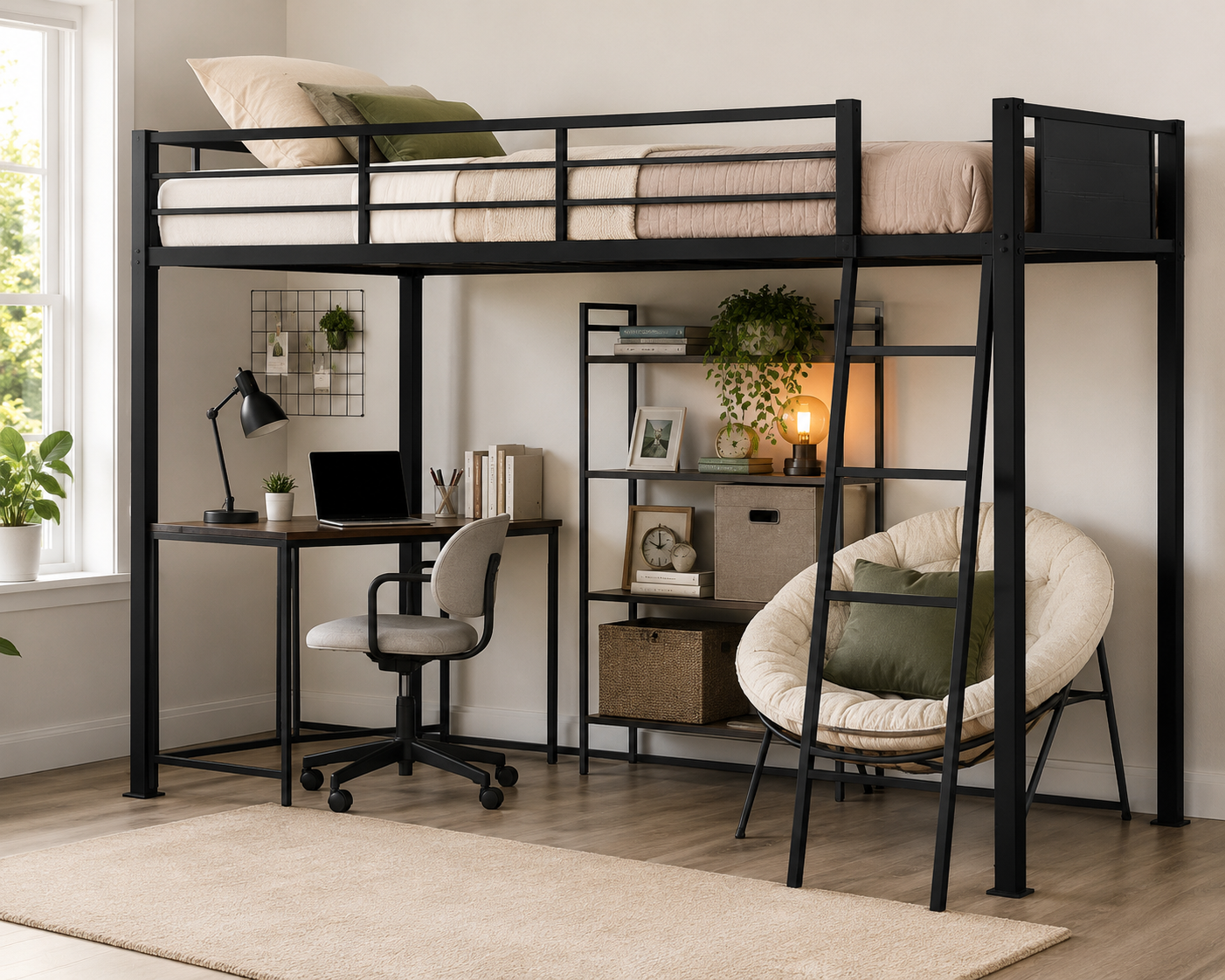
Picture this. You have a 10×12 bedroom. You need a bed, a desk, and room to breathe. So where does everything go?
That’s exactly the problem a twin XL loft bed solves. It lifts your mattress off the floor, and the space underneath becomes your workspace, closet, or lounge area. As a result, you get two functional zones from one small footprint.
In 2026, these beds are better than ever — sturdier frames, smarter designs, and styles that actually look good. Whether you’re setting up a dorm in New York, a studio in Austin, or a small bedroom in Ohio, a twin XL loft bed is one of the smartest furniture decisions you can make.
In this guide, you’ll find everything you need: dimensions, safety standards, top picks by use case, and a step-by-step measuring checklist before you buy.
What Is a Twin XL Loft Bed?
The Basic Concept
A loft bed is simply a raised bed frame with open space underneath. Think of the top bunk of a bunk bed — but without the bottom bunk. That open space, then, is entirely yours to use for a desk, storage, seating, or all three.
What “XL” Actually Means
A standard twin mattress measures 38 inches wide and 75 inches long. A twin XL mattress, however, is the same width but stretches to 80 inches long — five full inches more. That extra length matters significantly for anyone over 5’8″. In fact, it matches the length of a queen mattress, just narrower.
In the US, twin XL is also the standard mattress size in most college dormitories. That’s a key reason why these beds are so popular with students and their families shopping for move-in furniture.
Twin XL vs. Standard Twin Loft Bed
When a Standard Twin Makes Sense
Go with a standard twin when the room is very tight — under 100 square feet. Its smaller footprint gives you slightly more maneuvering room underneath. Additionally, it works fine if the sleeper is under 5’8″ and won’t use the bed for more than a year or two.
When Twin XL Is the Better Call
In almost every other situation, however, the twin XL is the smarter pick. Specifically, it’s the right choice for:
- Teenagers who are still growing
- Adults who are taller than average
- College students (since dorm mattresses are already twin XL)
- Anyone who plans to use the bed long-term
While the floor footprint difference between the two sizes is minimal, the comfort difference over months and years of use is very real. So if the sleeper will use this bed for more than a year, the XL is almost always the better investment.
Why These Beds Are More Popular Than Ever in 2026
Smaller Spaces, Bigger Need
The US housing market has pushed millions of Americans into smaller homes. As a result, studio apartments, shared bedrooms, and compact urban rentals are now the norm — from Seattle to Miami. People simply need their spaces to work harder.
A twin XL loft bed does exactly that. It lifts the mattress and reclaims the floor space a flat bed would otherwise waste. That space underneath then becomes a home office, wardrobe, or lounge area.
Remote Work Changed Everything
Many Americans now work or study from home full-time. Consequently, a dedicated desk space that once felt like a luxury has become a necessity. A loft bed with a built-in desk underneath solves this problem without requiring a separate room.
The Designs Have Finally Caught Up
The clunky metal frames of ten years ago are largely gone. Instead, in 2026, twin XL loft beds come with powder-coated steel finishes, warm wood tones, LED lighting, and USB charging stations. These are intentional furniture pieces — not dorm afterthoughts.
Who Benefits Most from a Twin XL Loft Bed?
Teenagers
Teens are the most natural fit for this style of bed. The XL length comfortably handles growth spurts, and the space underneath fits a proper study setup. Furthermore, every high schooler in the US can benefit from a dedicated desk area that doesn’t eat up the whole room.
College Students
A twin XL loft bed also matches standard US dorm mattress dimensions perfectly. Students at large state universities in California and smaller private colleges in New England both receive twin XL mattresses in their residence halls. Therefore, a loft bed is a natural upgrade that turns a cramped dorm room into a functional living and study space.
Adults in Small Apartments
Additionally, adults in compact urban spaces are a fast-growing market for these beds. Someone in a 400-square-foot apartment in Chicago or San Francisco simply can’t dedicate half their floor plan to a bed frame. A twin XL loft bed, however, frees up room for a couch, desk, or even a small workout area underneath.
Guest Rooms
Finally, guest rooms that double as home offices are a common setup across American homes. A twin XL loft bed makes this work seamlessly. The desk stays in place during the week, and guests sleep comfortably upstairs on the weekend — without anything needing to move.
Key Features to Look for Before You Buy
Weight Capacity
Weight capacity matters more than most people realize. Budget frames typically top out at 200–250 lbs., which is fine for a child but not enough for a teen or adult. Adult-rated frames, by contrast, support 400–800 lbs. Heavy-duty aluminum and solid wood options go even higher. Always check the manufacturer’s stated weight limit — not just the material description.
Ceiling Height
Many buyers forget to check ceiling height until the bed arrives — and that’s a frustrating surprise. You need at least 30–36 inches of clearance from the top of the mattress to the ceiling so the sleeper can sit up comfortably. Standard 8-foot ceilings work well for low and mid-height lofts. Nine- to ten-foot ceilings, however, give you far more flexibility with taller frame styles.
Guardrail Height
Guardrail height is a safety requirement — not merely a preference. ASTM International (F1427) and the US Consumer Product Safety Commission (CPSC) specifically require guardrails to sit at least 5 inches above the mattress surface. Moreover, openings in the guardrail must be no wider than 3.5 inches to prevent entrapment. Always confirm a bed meets these federal standards before purchasing.
Mattress Thickness
Most twin XL loft beds are designed for mattresses up to 6–8 inches thick. If you use a thicker mattress, it pushes the sleeping surface above the guardrail’s safe zone. As a result, check the manufacturer’s maximum thickness spec carefully. When possible, buy the mattress and frame together to avoid a mismatch.
Under-Bed Clearance
Under-bed clearance determines what the space below can actually fit. For a desk and chair, you need at least 48 inches. To stand comfortably underneath, you’ll need closer to 60 inches. So measure this before buying — it’s typically listed in the product specs.
Ladder Style
Ladder style affects daily usability more than people expect. Vertical ladders save floor space but are harder to climb. Angled ladders are easier to use — especially for kids — but they extend 18–24 inches into the room. Stair-step ladders are the most user-friendly of all, though they require the most floor space. Choose based on who’s climbing and how frequently.
Best Twin XL Loft Bed Options by Use Case in 2026
Best for College Dorms: Metal Frame with Built-In Desk
For dorm life, the primary goal is maximum function in a very small footprint. A metal-frame twin XL loft bed with an L-shaped desk and USB charging station is the top pick for this reason. Most of these models also include LED lighting and a few storage shelves. Weight capacity around 350 lbs. is more than adequate for college students. Additionally, look for noise-free steel frames — your roommate will genuinely thank you at 2 AM.
Best for Teenagers: Solid Wood with Storage
Teens want a room that actually looks good, so aesthetics matter just as much as durability here. Solid wood twin XL loft beds in farmhouse or mid-century modern finishes are very popular in 2026 for exactly this reason. Many include bookshelves, drawers, and a desk underneath. Beyond style, look for frames rated for at least 400 lbs. — growing teens need structural headroom along with the physical kind.
Best for Adults in Small Apartments: Heavy-Duty Aluminum
For adults, both style and long-term strength matter equally. Heavy-duty aluminum loft beds — many made right here in the USA, notably in Ohio and Tennessee — support 800 to 2,000 lbs. They also come in five or more decorative finishes and accept accessories like staircases and side shelving. These are serious, long-term furniture investments. Consequently, expect to spend $700 to $2,000 for a quality adult frame.
Best for Guest Rooms: Convertible Twin XL Loft
Some twin XL loft beds convert into bunk beds or even two separate beds. This flexibility makes them ideal for a guest room or a kids’ room where needs change over time. When shopping for convertible frames, specifically look for non-toxic finishes and clear assembly instructions — since you may reconfigure these more than once.
Twin XL Loft Bed Safety: What US Standards Require
Federal Regulations You Should Know
In the US, loft and bunk beds must comply with standards set by the Consumer Product Safety Commission (CPSC) under 16 CFR Part 1513 and ASTM F1427. Together, these cover guardrail placement, structural openings, ladder attachment, and mattress thickness labeling.
Key rules include:
- Guardrails on all sides of the upper sleeping surface
- No children under age 6 on the upper level
- Openings sized specifically to prevent entrapment
- A securely attached, non-slip ladder
What to Look for When Shopping
When shopping, look for products that explicitly state CPSC and ASTM compliance in the product description. Reputable brands call this out clearly. If a listing doesn’t mention compliance at all, treat that as a red flag worth investigating further.
For the most current federal guidance, visit the CPSC’s official page at cpsc.gov.
Everyday Safety Habits
Certifications are a solid starting point — but regular maintenance is what keeps a bed safe over time. First, tighten bolts, screws, and ladder connections every few months. Also, avoid placing the top bunk directly under a ceiling fan or low beam. Finally, never use a mattress thicker than the manufacturer allows. An oversized mattress is, in fact, one of the most common ways guardrails end up at an unsafe height.
How to Measure Your Room Before Buying
Step 1: Check Ceiling Height
Start by measuring from the floor to the ceiling — not to the bottom of a light fixture. Then apply this simple formula:
Bed platform height + mattress thickness + 30–36 inches = minimum ceiling height needed.
If the result exceeds your ceiling measurement, choose a lower-profile loft instead.
Step 2: Map the Floor Plan
Next, measure the room and mark where the bed will go. Factor in ladder clearance — angled ladders, for example, can extend 18–24 inches into the room. Also check whether the door swings freely with the frame in its planned position.
Step 3: Plan the Under-Bed Space
Finally, decide what goes underneath before you buy — not after. If you want a desk, measure the chair height and desk height you plan to use. The product spec for “under-bed clearance” should be at least 48 inches for a comfortable seated work setup.
Price Guide: What to Expect at Every Budget
Entry Level: $150–$350
At the entry level, you’ll find basic metal frames built for light use. These work well for guest rooms or college students. Weight capacity, however, typically tops out at 250–350 lbs. — so they’re not ideal as a primary adult bed for daily long-term use.
Mid-Range: $350–$700
The mid-range is the sweet spot for most buyers. This tier includes solid wood teen beds, feature-rich metal frames with built-in desks and LED lighting, and convertible models. Weight capacities are stronger here, and build quality is noticeably better across the board.
Premium: $700–$2,000+
Premium frames are built specifically for adults and long-term use. American-made aluminum frames sit in this tier, offering superior stability, higher weight limits, and fully customizable configurations. While the investment is substantial, these beds hold up for years — often a decade or more.
Actionable Tips Before You Click “Buy”
First, match reviews to your situation. A college student’s review is far more relevant to another student than a review from a parent buying for a 7-year-old. Read specifically for your use case.
Next, check the return policy before ordering. Loft beds are large freight items, and return shipping can run $150–$300 or more. As a result, look for brands that offer free returns or in-home trial periods.
Also, plan ahead for assembly. Most frames need two adults and 2–5 hours. Complex wood builds with storage can take even longer. Check real customer assembly reviews — not just the estimated time on the manufacturer’s box.
If you’re ordering for a US college dormitory, confirm dorm rules first. Many schools have specific height restrictions on furniture. Check with the housing office before purchasing a high-loft frame.
Finally, buy the mattress at the same time as the frame. This ensures the combined height meets safety specs. Discovering after delivery that your 10-inch memory foam is too thick for the guardrails is both frustrating and completely avoidable.
Internal Resource
Choosing a mattress to pair with your new loft bed? Check out our guide on the best twin XL mattresses for small spaces — it covers thickness limits, firmness levels, and which materials work best for elevated sleeping platforms.
Frequently Asked Questions
What is the difference between a twin and twin XL loft bed? The key difference is mattress length. A standard twin fits a 75-inch mattress, while a twin XL fits an 80-inch mattress — five full inches longer. That extra length makes a meaningful difference in comfort for taller sleepers. Additionally, it matches the standard mattress size used in most US college dormitories.
Is a twin XL loft bed safe for adults? Yes — provided you choose the right frame. Budget children’s frames support only 200–300 lbs. Adult-grade frames in heavy-duty aluminum or solid wood, however, handle 800 lbs. or more. Always verify the weight limit directly with the manufacturer. Also confirm the bed meets CPSC and ASTM F1427 safety standards before purchasing.
How much ceiling height do I need for a twin XL loft bed? You need at least 30–36 inches of clearance between the top of the mattress and the ceiling. For most high-loft designs, that means a ceiling of at least 9 feet. Standard 8-foot ceilings work for low and mid-height loft frames — though they can feel very cramped with taller designs.
What can I put under a twin XL loft bed? The most popular options include a desk and chair, a small sofa, a dresser, or shelving units. For a comfortable seated workspace, you need at least 48 inches of under-bed clearance. To stand up straight underneath, however, look for at least 60 inches.
Are twin XL loft beds good for college dorms? They’re one of the best dorm solutions available. Most US college dorms use twin XL mattresses as standard, so the dimensions match perfectly. Furthermore, a loft bed frees up floor space for a desk, storage, and a seating area. Always check with your school’s housing office first, though — some dorms restrict maximum furniture height.
What mattress thickness works best for a twin XL loft bed? Most frames work with mattresses between 4 and 8 inches thick. A thicker mattress raises your sleeping surface above the guardrail’s safe zone. As a result, always check the manufacturer’s maximum thickness spec before buying. When in doubt, purchase the mattress and frame together to ensure compatibility.
How long does it take to assemble a twin XL loft bed? Basic metal frames typically take 1–2 hours with two people. Complex wood frames with built-in storage, however, can take 3–5 hours. Two adults are recommended for nearly every model. Before buying, read real customer assembly reviews — especially if ease of setup is a priority for you.
Can a twin XL loft bed work in a room with an 8-foot ceiling? It depends on the specific frame height. Low-loft and mid-loft designs often work well in 8-foot ceilings. High-loft designs — the kind where you can stand underneath — typically need 9–10 feet, however. Always do the math first: frame height + mattress thickness + 30–36 inches of required headroom = the minimum ceiling height you need.