

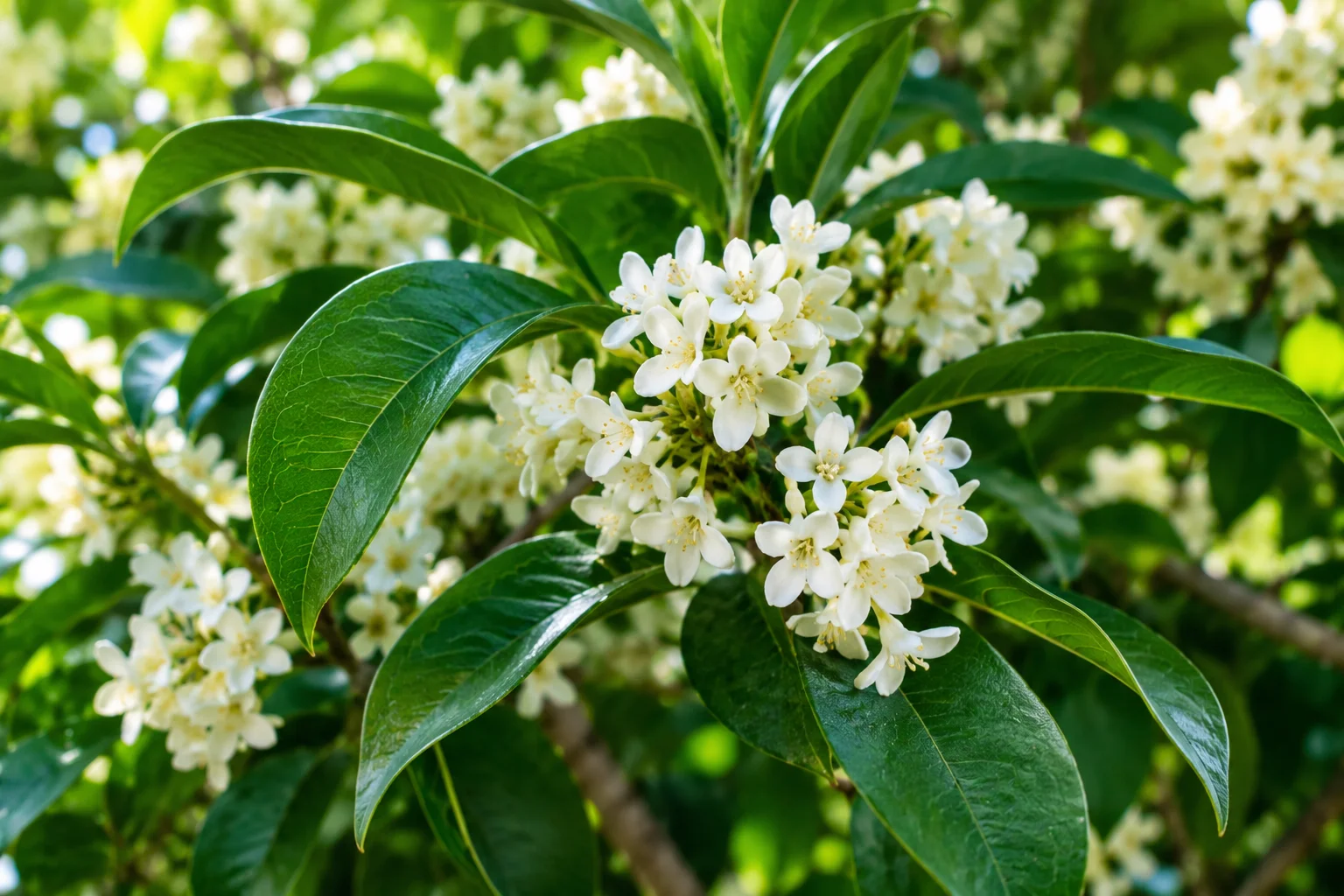
Have you ever walked past a plain-looking shrub in October and been stopped in your tracks by a scent like ripe apricots? There’s a good chance it was Osmanthus fragrans. The plant itself looks unremarkable. It has small, dark, leathery leaves and tiny flowers you might not even notice. But the fragrance carries for yards. On a still fall morning, it can fill an entire yard.
Here’s the quick version. Sweet olive grows reliably outdoors in USDA zones 8b through 11. It wants full sun to light afternoon shade and it needs well-drained soil that doesn’t stay soggy. It blooms most heavily in fall, with sporadic repeat flushes through winter and spring in mild climates. Gardeners in colder zones grow it in containers and bring it indoors for winter. The rest of this guide covers what actually matters if you want it to thrive.
What Is Osmanthus Fragrans, Exactly?
Osmanthus fragrans is an evergreen shrub or small tree. It’s native to the Himalayas, China, and Japan. It belongs to the Oleaceae family, the same family as true olives, though it isn’t one. Common names include sweet olive, tea olive, fragrant olive, and sweet tea olive. You’ll see all of them used interchangeably depending on where you live. In the South, “sweet olive” and “tea olive” dominate.
In cultivation, most plants reach 10 to 15 feet tall with a similar spread and in its native habitat, it can reach 20 to 30 feet. Some dwarf and compact cultivars stay closer to 6 to 8 feet. That matters if you’re placing one near a foundation or in a smaller bed. The leaves are oval, leathery, and glossy green, up to about 4 inches long. The plant holds its foliage year-round.
The flowers are the whole point, and also the most misunderstood part of the plant. They’re small and not particularly showy. It’s easy to miss them visually. But they carry an extremely powerful apricot fragrance. Depending on the cultivar, flowers range from white to cream to orange. Want a stronger orange bloom and heavier fall flowering? Look for Osmanthus fragrans var. aurantiacus at a nursery. Want the classic white? The straight species, fragrans, is what most nurseries carry by default.
USDA Hardiness Zones and Cold Tolerance
Get this right before you plant. Sweet olive’s biggest failure mode in the U.S. isn’t disease or pests. It’s cold.
Most authoritative sources place its reliable in-ground hardiness at USDA Zones 8b to 11. Plants are generally winter hardy to about 10°F. NC State Extension lists a similar range, 8a through 11b. That reflects that some cultivars and sheltered microclimates in zone 8a can succeed. Other sources are more conservative, putting the safe range at zones 7b to 9b for nursery production. They also note visible damage once temperatures drop into the mid-teens Fahrenheit.
Here’s what that means practically:
- Zones 9-11 (most of Florida, coastal and southern Texas, Southern California, parts of the Gulf Coast): plant with confidence. No special protection needed.
- Zone 8 (much of the Deep South, parts of North Carolina, Texas Hill Country): generally fine. A sheltered spot improves your odds in a hard winter. Try near a south-facing wall, protected from north winds.
- Zone 7 and colder (much of the Mid-Atlantic, Tennessee, Oklahoma, the Pacific Northwest interior): sweet olive is a gamble in the ground. It can survive mild winters. Then a harder one can kill it back, or kill it outright. This is where container growing makes the most sense.
- Zone 6 and colder (New York, most of the Midwest, New England, Mountain states): don’t plant it in the ground. Grow it in a pot instead. Move it indoors for winter, or treat it as a seasonal patio plant.
Are you on the edge of zone 8? Check your specific microclimate, not just your general regional zone. A courtyard, a south-facing wall, or shelter from a larger building can push your effective zone up by half a step.
Where and How to Plant
Light Requirements
Sweet olive wants full sun to part shade. In hot summer climates, it does noticeably better with part afternoon shade. In practice, morning sun with afternoon protection works well in Texas, Florida, or the Gulf Coast. Gardeners in the coastal Carolinas or mild Pacific Northwest pockets can often get away with full sun all day.
Too much shade isn’t fatal. But it noticeably reduces flowering. It can also leave the plant looking sparse and leggy rather than dense.
Soil and Drainage
This is where a lot of sweet olive problems start. The plant wants average, consistently moist, well-drained soil. It tolerates occasional dryness far better than it tolerates sitting wet. It does tolerate heavy clay soils, which is good news if you garden in the red clay of the Piedmont or similar soils elsewhere. But clay only works if it drains reasonably well. Does water pool and stay for more than a few hours after rain? Amend the planting area, or choose a different spot.
Soil pH tolerance is fairly wide. Extension sources list a workable range from roughly 4.5 to 7.5. Unless your soil is extreme in either direction, pH usually isn’t the limiting factor.
Spacing
Give it room. At a mature spread of 10 to 15 feet, don’t plant closer than about 6 to 8 feet from structures or other large shrubs. That way it can develop its natural rounded form without constant pruning. Planting a hedge instead? Closer spacing of 4 to 6 feet works, but expect to shear more often to keep a tight line.
Watering and Fertilizing
Young plants (first one to two years): water deeply and regularly to establish a strong root system. Most sources recommend keeping the soil consistently moist. Don’t let it become soggy during this establishment period.
Established plants: sweet olive becomes genuinely drought tolerant once established. Mature plants generally only need supplemental water during extended dry spells. Overwatering is actually a more common mistake than underwatering. Root rot from consistently wet soil is one of the few things that reliably kills an otherwise healthy sweet olive.
Fertilizing: young plants benefit from a fertilizer with extra phosphorus to support root development in the first season. Once established, a balanced, slow-release shrub fertilizer applied once in early spring is usually enough. Stop fertilizing several weeks before your area’s first expected frost. Late-season fertilizing pushes tender new growth. That growth is more vulnerable to cold damage, which is the opposite of what you want going into winter in a marginal zone.
Pruning: What Most Guides Get Backwards
Here’s a detail that trips up a lot of first-time growers. This plant largely flowers on old wood, meaning growth from the previous season. Prune hard in late winter or early spring, the way you would many other flowering shrubs, and you can remove a significant portion of that season’s flower buds before they ever open.
Here’s the better approach:
- Do structural pruning during the dormant season or right after the main flowering flush. This means removing dead, damaged, or awkwardly placed branches.
- Limit pruning during active growth to light shaping and tip pinching. This also encourages denser, bushier growth rather than a leggy form.
- Growing it as a hedge that needs regular shearing? Accept that you’ll sacrifice some bloom density for a tight formal shape. That’s a reasonable trade-off if structure matters more than fragrance in that spot. If maximum bloom is the goal, let it grow into a looser, more natural form instead.
Bloom Time: What to Actually Expect
Bloom timing is inconsistent across sources, and that’s because it genuinely varies by climate and cultivar. In much of the Deep South and Gulf Coast, the heaviest bloom flush comes in fall, typically September through November. Additional lighter flushes are possible in late winter and spring when conditions are mild. Some sources list a spring bloom peak instead. Others describe an extended bloom season running from spring into fall.
Given that spread, here’s the safest expectation to set: fall is usually the showiest bloom period in most U.S. growing regions. Additional flushes at other times are a bonus, not a guarantee. They depend heavily on your specific climate and the plant’s growing conditions that year.
Is your sweet olive young or recently transplanted? Don’t judge it too harshly if it doesn’t bloom heavily in its first year or two. Like many woody shrubs, it needs time to establish before flowering reaches its full potential.
Common Problems and How to Avoid Them
Root rot from poor drainage. This is the most common serious problem. It’s almost entirely preventable. Plant in well-drained soil or a raised bed, and resist the urge to overwater established plants.
Cold damage or dieback. In zone 8a and colder, a hard freeze can burn foliage or kill back branches. Don’t panic and rip the plant out immediately. Wait until new growth resumes in spring before deciding how much to prune away. Damaged wood is often easier to identify once the plant starts pushing new leaves.
Sparse flowering. This usually traces back to one of three causes: too much shade, over-pruning at the wrong time of year, or a plant that’s still too young to bloom heavily. Rule out light and pruning timing first before assuming something else is wrong.
Pests and disease. Sweet olive is comparatively low-maintenance here. NC State Extension notes it’s deer resistant, drought tolerant, and slightly salt tolerant. That also makes it a reasonable choice for coastal Southern gardens, where salt spray rules out more sensitive plants. Serious pest or disease problems are uncommon compared to many other ornamental shrubs. That’s part of why it’s such a popular, low-fuss landscape plant across the South.
Growing Sweet Olive in Containers (For Colder Climates)
Are you in zone 7 or colder and still want the fragrance? A container is your realistic path. Use a large pot, at least 15 to 20 gallons for a plant you intend to keep for several years. Choose one with excellent drainage holes, and use a well-draining potting mix rather than garden soil.
Position the container where it gets good light through the growing season. Move it to a sheltered but sunny indoor spot, unheated garage, or bright sunroom before your first hard frost. A cool, bright location that stays above freezing is generally sufficient over winter. Container-grown plants don’t need warm indoor heat. In fact, excessive indoor heat combined with lower humidity can stress the plant.
Expect slower growth in a container than in the ground. Expect to repot every few years as roots fill the available space.
Propagation
Do you already have access to a healthy plant? Propagating sweet olive from cuttings is straightforward and doesn’t require specialized equipment. The standard method uses semi-hardwood cuttings taken in late summer or early fall. Dip the cut end in rooting hormone, then plant it in a well-draining mix. Keep the cutting in a humid environment with indirect light while roots develop. Rooting typically takes a few weeks to a couple of months. This is a reasonable way to multiply a favorite plant or share it with a neighbor, though it does require patience.
Landscape Uses
Sweet olive’s fragrance is strongest at close range. That should shape where you plant it more than aesthetics alone. Good placements include near a patio, deck, or front entry where people linger. A spot beneath a window that opens onto the yard works well too, as does a frequently used walkway. It also works as an informal or clipped hedge, or as a screening plant along a property line. Thanks to its tolerance for shaping, it can even work as an espalier trained flat against a wall or fence in more formal garden designs.
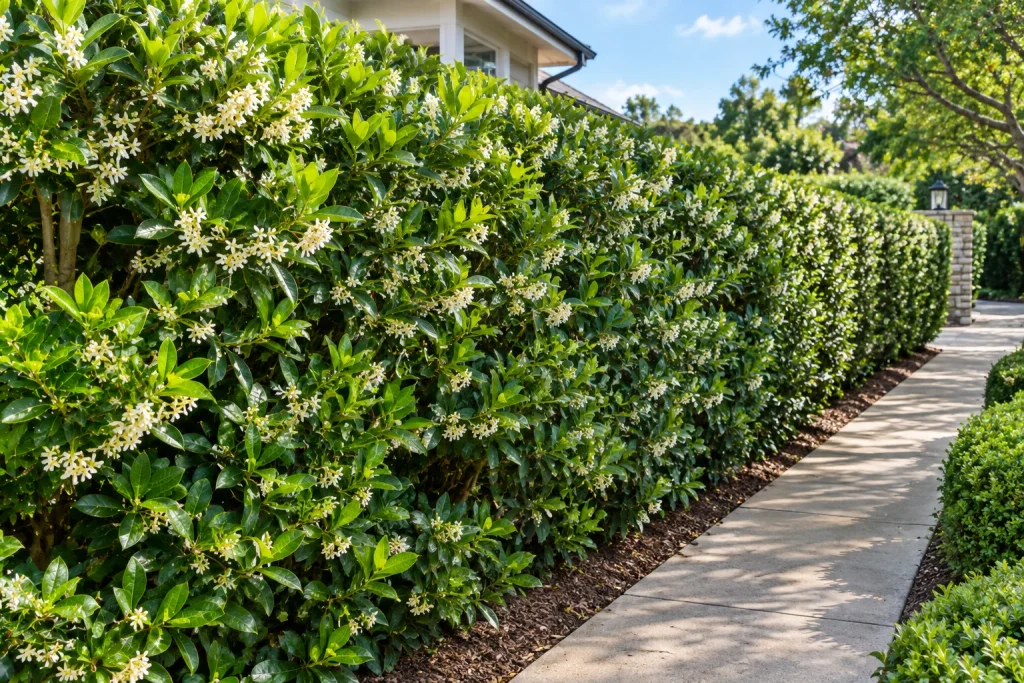
Are you planning a broader landscape refresh around your home? Want fragrant, low-maintenance shrubs that pair well with sweet olive’s growing requirements? It’s worth reviewing your overall planting plan alongside other curb-appeal projects. See our guide on Emerald Green Arborvitae
Frequently Asked Questions
Is Osmanthus fragrans a true olive tree? No. It belongs to the Oleaceae family, the same botanical family as true olives (Olea europaea). But it’s a different genus entirely, and it doesn’t produce edible olives. The “olive” in its common names refers to the family relationship and the shape of its small fruit, not to any culinary use.
How fast does sweet olive grow? It’s generally a slow to moderate grower. Don’t expect a small nursery specimen to fill out into a mature 10- to 15-foot shrub in just a couple of seasons. Plan for several years of steady growth.
Can I grow sweet olive in zone 7? It’s marginal. Some gardeners succeed in sheltered zone 7b microclimates, especially with winter protection. But it’s a genuine risk rather than a safe bet. A container you can bring indoors for winter is the more reliable option here.
Why isn’t my sweet olive blooming? The three most common causes are too much shade, pruning at the wrong time of year, or a plant that hasn’t matured enough yet. Rule those out in order before assuming a deeper problem.
Does sweet olive need a lot of water? Only while it’s getting established. Mature plants are drought tolerant. They’re more likely to suffer from too much water than too little, since soggy soil promotes root rot.
What does the flower actually smell like? Most people describe it as apricot. Some compare it to jasmine or ripe peach. It’s a strong, sweet fragrance that carries well beyond the plant itself. That’s exactly why it’s prized, despite the flowers themselves being visually unremarkable.
Can sweet olive be grown as a small tree instead of a shrub? Yes. Use selective pruning to establish a single leader and remove lower branches over time. It can be trained into a small tree form rather than left as a multi-stemmed shrub. This works well as a specimen plant near a patio or entry.
Sources & References
- NC State Extension, Plant Toolbox — Osmanthus fragrans: https://plants.ces.ncsu.edu/plants/osmanthus-fragrans/