

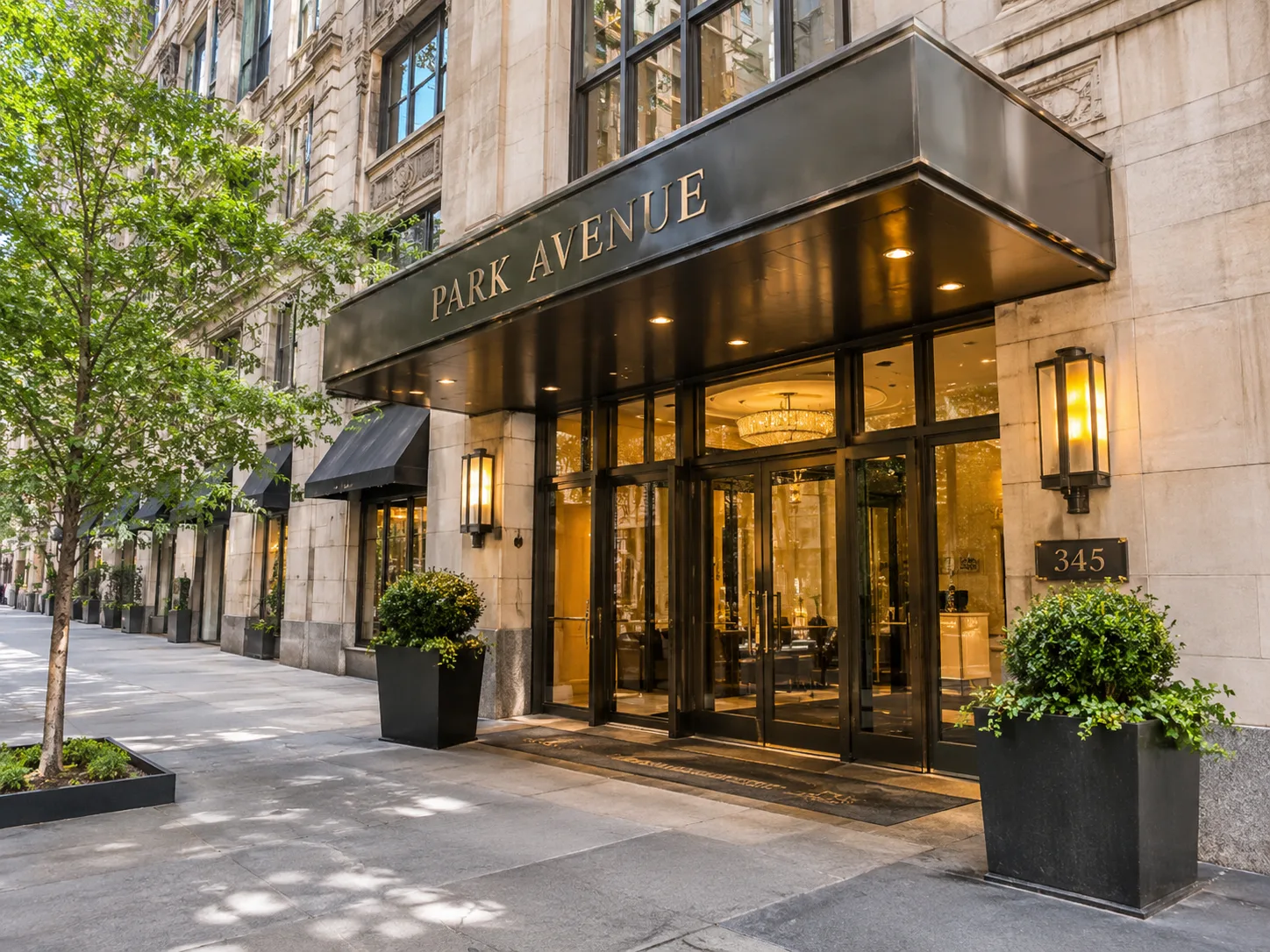
299 Park Avenue in New York NY 10171 is a Class A office tower on Park Avenue between East 48th Street and East 49th Street. It is a fit for mid‑size professional firms, especially those in finance or law that want a Park Avenue address a short walk from Grand Central and are prepared to pay Plaza District prices. It is not a fit for very small teams that need flexible terms or for companies that want a newly built glass tower.
The tower was built by Fisher Brothers; Emery Roth & Sons designed it. It opened in 1967 with 42 stories and about 1.2 million square feet. Some listings say 1.3 million square feet and one recent trade article says 44 stories so the numbers vary by source. Ask the leasing team for the figures, on any floor you are considering.
What kind of building is it?
The building is a mid-1960s tower that has been updated. It is not a new development, and that shapes everything from the floor plates to the lobby.
The site was once the original Park Lane Hotel, and the tower was built over the New York Central Railroad’s main line tracks. That helps explain the building’s engineering history. It also gives you a sensible question for your architect: how do the structure and column layout on your target floor affect your space plan? The published sources don’t spell out the answer, so ask for it.
Fisher Brothers has kept control since construction and keeps its headquarters in the building. The current ownership structure includes the Alaska Permanent Fund Corporation as a partner. Older references name a different partner, so confirm the current ownership on any lease paperwork.
The $20 million renovation
The most visible change is the lobby and exterior. Fisher Brothers completed a $20 million renovation with Rockwell Group that covered the lobby, elevators and façade, and added a digital art display. The construction team kept the lobby open to the public throughout the two-phase project. The centerpiece is “Living Canvas,” a 60-foot LED art installation designed by LAB at Rockwell Group.
Behind the lobby work are quieter upgrades. Reported improvements include Bluetooth-enabled technology and hospital-grade air filtration. Those matter more to many tenants than the art, but get the specifics (filter ratings, elevator controls) in writing rather than relying on press language.
Location and getting there
The building sits next to the Waldorf Astoria and a few blocks from Grand Central Terminal. Listing data shows the 51st Street station (4 and 6 trains) about a 4-minute walk away, with Lexington Avenue–53rd Street (E and M) and Grand Central–42nd Street each within roughly 6 to 7 minutes on foot.
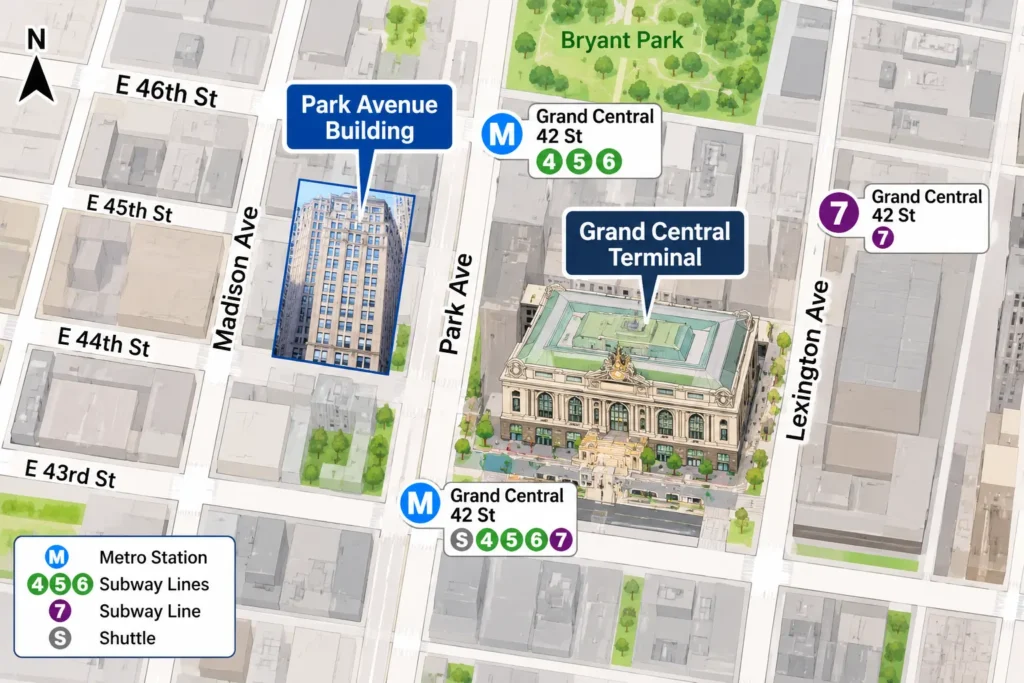
For employees, the practical result depends on where they live. Metro-North riders from Westchester, Connecticut and the Hudson Valley arrive at Grand Central, and Long Island Rail Road riders can too. Staff coming from New Jersey usually reach Penn Station first and need a transfer, so a firm with a heavy New Jersey commuter base should map that trip before signing.
Who is already there, and why it matters
The tenant list tells you something about the building’s character. Reports name Capital One, UBS and King Street Capital among the tenants. Recent leasing activity leans toward financial and professional firms:
- The Consulate General of Japan extended its lease across the entire 18th and 19th floors, about 58,244 square feet, through 2036.
- MacKay Shields took roughly 30,000 square feet on the 32nd floor.
- Bardin Hill Investment Partners signed for the full 24th floor, 28,045 square feet.
- One William Street Capital Management expanded to 44,754 square feet.
- GoldPoint Partners leased the entire 37th floor on a 15-year term.
Three of those full-floor deals are close to 28,000 to 30,000 square feet. That suggests typical upper floors sit near that size, and the pattern fits the average you get from dividing 1.2 million square feet by 42 floors (about 28,500). That’s an inference, not a published floor-plate figure, so verify it against a stacking plan.
The consequence for you: a firm needing 8,000 to 30,000 square feet will find the building comfortable. A company needing 100,000 square feet in one block would have to take multiple floors.
Pre-builts and amenities
Fisher Brothers has been building turnkey space on the lower floors, which is a useful option if you don’t want to manage a construction project. Five pre-built suites are being created on the third and fourth floors, and three were pre-leased by mid-2025. Those tenants get exclusive access to a gym and a custom-built lounge.
One broker listing for a partial fourth-floor pre-built showed suites from 5,803 to 28,305 rentable square feet at an asking rent of $105 per square foot. Treat that as a dated snapshot. Asking rents change, and the three pre-leased spaces may already be gone.
If you’re a smaller company, the pre-built route saves time and capital outlay, but compare the real cost. A turnkey suite at a high asking rent can cost more over ten years than a raw floor with an improvement allowance, depending on how much build-out you actually need.
What office space costs in this part of Midtown
Nobody publishes a single official rent for 299 Park Avenue, and the market reports for Q3 2026 don’t agree on one Midtown number, mostly because they define “Midtown,” “Class A” and “asking rent” differently. Here are the ranges reported by each source:
| Source (Q3 2026) | Measure | Figure |
|---|---|---|
| CBRE | Midtown average asking rent | $85.53/sq. ft. |
| Cushman & Wakefield | Midtown Class A asking rent | $90.57/sq. ft. |
| Meraki Realty (market summary) | Plaza District Class A asking rent | $98.47/sq. ft. |
| Lee & Associates NYC | Midtown Class A average asking rent | $101.50/sq. ft. |
| Hubble | Plaza District average asking rent | $105.95/sq. ft. |
CBRE put Midtown availability at 12.1%, down 240 basis points from a year earlier, with the average asking rent up 3% year over year. Lee & Associates reported Midtown availability at 11.8%, its lowest in over five years. One summary put the Plaza District at 10.5% availability, the lowest since 2016.
Rents are rising and space is tightening, which generally means less negotiating room than a few years ago. The Plaza District submarket, where 299 Park sits, shows firmer numbers than Midtown as a whole.
Keep in mind that an asking rent is a starting point. The effective rent depends on free rent, tenant improvement allowances and lease length. In a tightening market, concessions on the best floors tend to shrink, but that varies floor by floor.
Costs beyond the rent figure
Three items catch first-time Manhattan tenants off guard.
Commercial rent tax. Manhattan tenants south of 96th Street can owe this city tax, and 299 Park Avenue falls inside that zone. The tax has a 6% statutory rate, but only 65 percent of base rent is taxed, so the effective rate is about 3.9 percent. It generally applies once annual base rent reaches $250,000. A 2017 law raised that threshold to $500,000 for businesses with total income under $5 million, with partial relief on a sliding scale for businesses with income between $5 million and $10 million. A firm renting 15,000 square feet at roughly $90 a square foot is well above the threshold. The official NYC Department of Finance page on the commercial rent tax explains who qualifies and how to file. Check it, or ask an accountant, before you finalize a budget.
Operating expense and tax escalations. Commercial leases in New York commonly pass through increases in building operating costs and real estate taxes above a base year. Ask exactly how the lease defines the base year and what’s excluded from the pass-through.
After-hours services and electricity. Overtime HVAC charges and how electricity is billed vary by building and lease. Request the rate sheet.
Who should consider it, and who shouldn’t
It probably fits if:
- You’re a financial, legal or advisory firm that wants a recognized Park Avenue address and a Grand Central-adjacent commute.
- You need roughly one full floor or a large partial floor.
- You value an established landlord that keeps its own headquarters in the building.
It probably doesn’t fit if:
- You need under 3,000 square feet and flexible terms. A serviced office or coworking space will be cheaper and easier.
- You want a brand-new tower with modern floor-to-ceiling glass and contemporary structure. This is a renovated 1960s building.
- Your workforce lives mostly in New Jersey or on the West Side.
- Your budget is tight. The Plaza District is among Manhattan’s most expensive submarkets.
Step by step: from first call to signed lease
- Define your space need. Estimate headcount and the square footage you need, then decide whether you want a pre-built suite or a larger floor.
- Set a total budget. Include base rent, operating expense and tax escalations, electricity, after-hours HVAC and the commercial rent tax if your rent will exceed the threshold.
- Hire a tenant representative. Their job is to negotiate for you, not the landlord.
- Map your commute. Check where your staff live, and note that New Jersey commuters usually reach Penn Station first and need a transfer.
- Ask for the current availability and stacking plan. Confirm square footage on each floor you’re considering, since sources disagree on some building figures.
- Tour at peak hours. Check elevator waits, lobby traffic and noise, and ask for specifics on air filtration, power capacity and riser access in writing.
- Compare effective rents. Weigh free rent, tenant improvement allowances and lease length against other buildings, and make sure square footage is measured the same way.
- Get the lease details in writing. Ask how the base year is defined, what’s excluded from pass-throughs and what the after-hours and electricity rates are.
- Confirm ownership and certifications. Verify the current owner on the lease paperwork, and confirm any LEED status if it matters to you.
- Check the tax. Review the NYC Department of Finance commercial rent tax guidance, or ask an accountant, before you finalize your budget.
Mistakes to avoid when touring
- Comparing asking rents across buildings. Compare effective rents, meaning total cost after concessions over the full term, and make sure square footage is measured the same way in each building.
- Skipping the stacking plan. Know who your neighbors on the floor and in the building will be, and how the floor is configured.
- Taking sublease space without checking the term. Subleases can be cheaper but may run out in a few years, and the sublessor’s lease controls your rights.
- Ignoring technical details. Ask about air filtration, power capacity, riser access and elevator wait times during peak hours.
- Not hiring your own broker. A tenant representative’s job is to negotiate for you, not the landlord.
FAQs
Where is 299 Park Avenue?
It’s on Park Avenue between East 48th and 49th Streets in Midtown Manhattan. The building has its own ZIP code, 10171, while some listings use 10017.
Who owns 299 Park Avenue?
Fisher Brothers developed the building and remains its principal owner and manager. Reports in 2025 describe Fisher Brothers and the Alaska Permanent Fund Corporation completing a $500 million refinancing provided by Citi and JPMorgan.
How much space is available at 299 Park Avenue?
It changes constantly. One listing aggregator showed three available office spaces totaling 38,571 square feet, but that figure may be out of date. Contact the leasing team or a tenant broker for current availability.
Is 299 Park Avenue a Class A building?
Yes. It’s consistently described as Class A, and one listing site lists a LEED Gold certification. Confirm certification status with the landlord if it matters to your company.
Is it near Grand Central?
Yes, a short walk away. The 51st Street subway station is a few minutes on foot, and Grand Central is within roughly 10 minutes depending on your pace and which entrance you use.
Can a small company lease there?
Possibly. The pre-built suites on the third and fourth floors start near 5,800 square feet, which is small by building standards. Anything smaller may be a better fit for another building or a flexible office provider.
What’s the commercial rent tax, and does it apply here?
It’s a New York City tax on certain commercial tenants in Manhattan south of 96th Street, so it can apply at 299 Park Avenue. Whether you owe it depends on your annual rent and other factors, so check the NYC Department of Finance guidance.
Sources & References
- Fisher Brothers and trade press releases on leasing and the renovation (New York Real Estate Journal, Commercial Observer, ConnectCRE, REBusinessOnline)
- CBRE, Cushman & Wakefield, Lee & Associates NYC, Hubble and Meraki Realty Q3 2026 market reports
- NYC Department of Finance, Commercial Rent Tax
Market figures are as reported for Q3 2026 and will change. Rents, availability and ownership details should be confirmed directly with the landlord or a licensed tenant broker before any decision.
Looking for more on Manhattan neighborhoods or lease basics? See our guides to East 34th Street Manhattan apartments and what a lease agreement includes.