

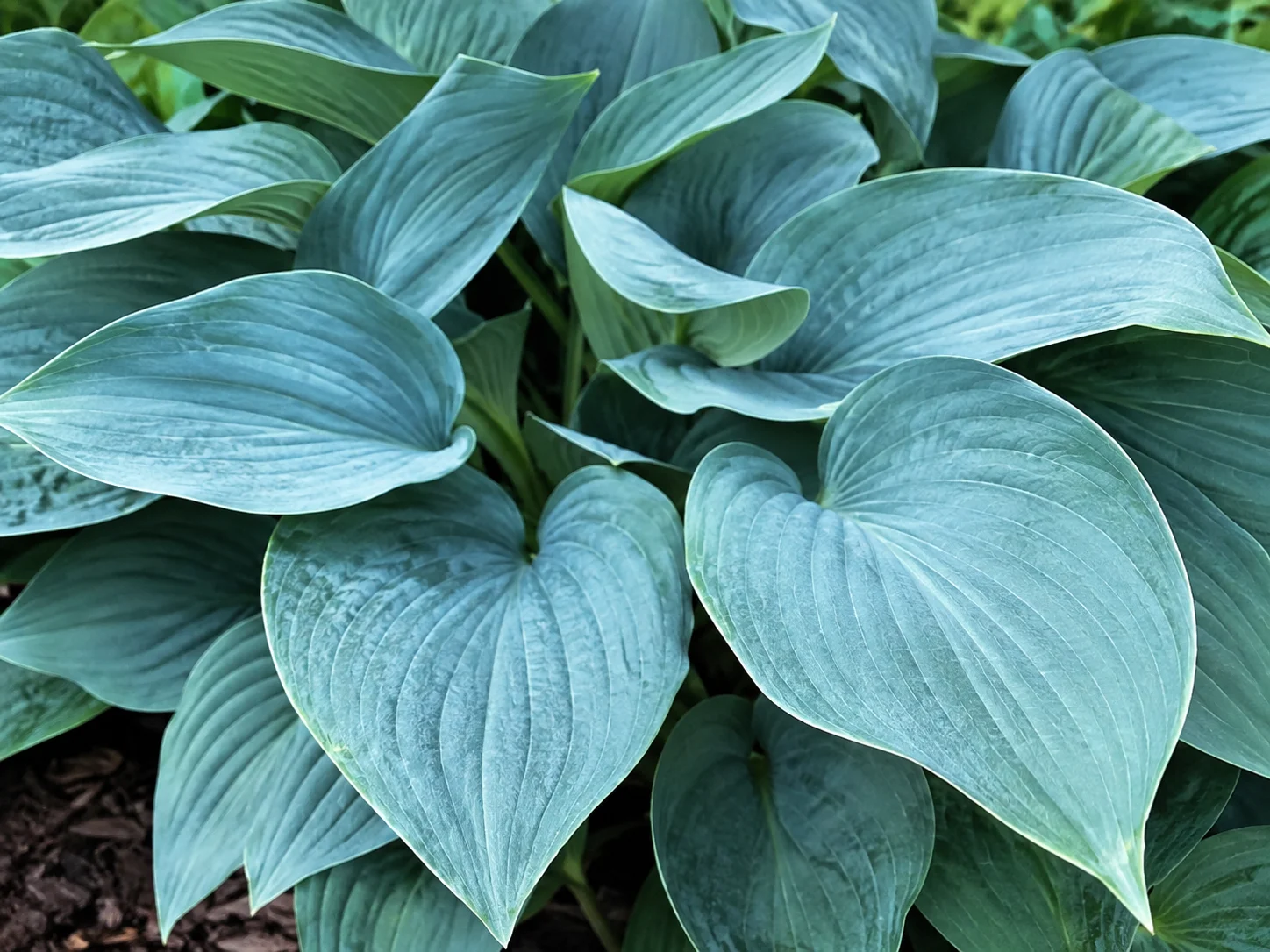
If you have a shady spot that needs something bold, Hosta ‘Blue Angel’ is one of the better choices at a garden center. It’s a genuine giant. Mature clumps spread 3 to 4 feet wide and reach 2 to 3 feet tall. The thick, heart-shaped, blue-green leaves hold their color better than most hostas through a hot summer. It’s hardy from USDA Zone 3 through Zone 8. Once established, it tolerates neglect. It’s also largely left alone by deer, compared to hostas with thinner leaves.
That’s the quick version. The rest of this guide covers what actually matters: where to plant it, how to keep the blue coloring from washing out, and the maintenance questions people usually don’t think to ask until year two.
What Is Hosta ‘Blue Angel’?
Hosta ‘Blue Angel’ is a hybrid cultivar, likely derived from Hosta sieboldiana. It was introduced by Minnesota hybridizer Paul Aden. It belongs to the “giant” size class of hostas. In practice, that means it will eventually dominate whatever bed you put it in. According to the Missouri Botanical Garden’s Plant Finder, ‘Blue Angel’ is a giant, blue-leaved hosta that grows in a mound to about 36 inches tall, with a spread that typically reaches 3 to 4 feet.
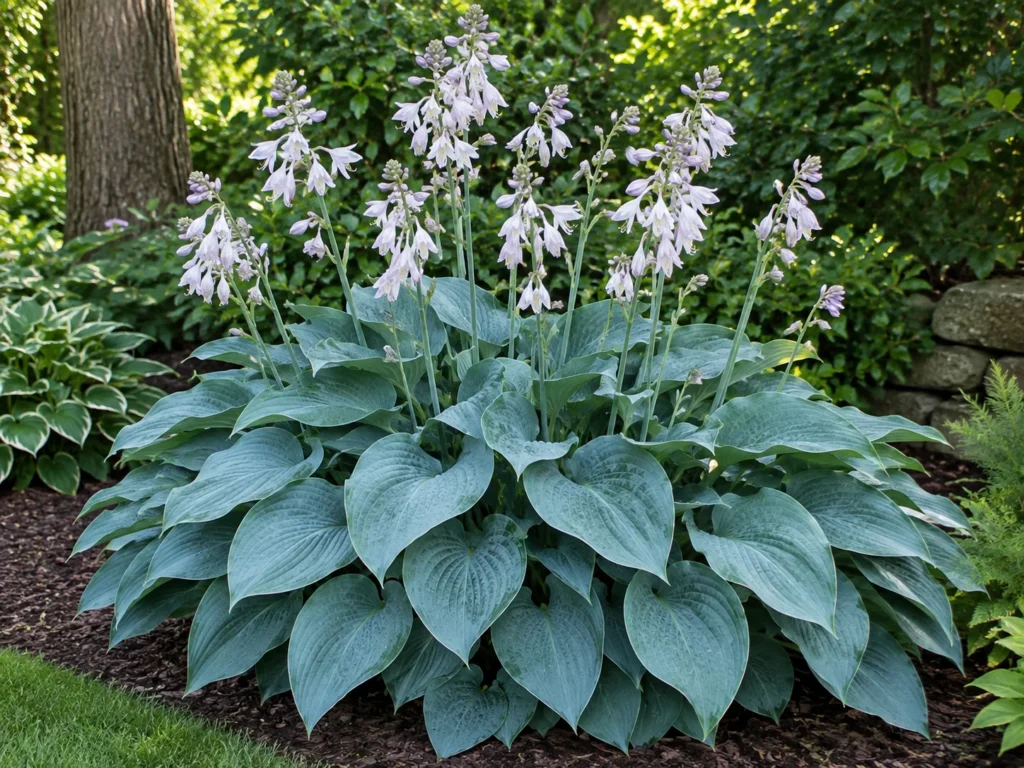
The leaves are the main event. They’re thick, waxy, and deeply corrugated, in a blue-grey that’s most intense in spring. The color fades slightly toward green as the season progresses. In midsummer, tall flower scapes rise well above the foliage. They carry pale lavender to white, bell-shaped blooms. Bloom time typically runs from July into August.
Where It Grows: Hardiness and Climate
‘Blue Angel’ is one of the more cold-hardy hostas on the market. That’s a big part of its appeal for northern gardeners. Missouri Botanical Garden lists it as hardy in USDA Zones 3 to 8. Several nurseries extend that range to Zone 9 with adequate shade and moisture. If you’re gardening in Minneapolis, Burlington, or anywhere else that regularly sees winters below -30°F, this is one of the hostas that will reliably come back.
The catch is the opposite end of the spectrum. Hostas as a group don’t love heat, and ‘Blue Angel’ is no exception. The blue, waxy coating on the leaves — called bloom, similar to what you see on a plum or blueberry — is what gives the foliage its color. That coating breaks down faster in intense sun and high heat. If you garden in the Deep South or the low desert Southwest, expect the blue cast to fade toward green by midsummer. Expect leaf edges to scorch, too, if the plant gets any real afternoon sun. Gardeners in the Pacific Northwest and Northeast generally get the best, longest-lasting blue color, thanks to cooler, more humid summers.
Light Requirements
This is where a lot of hostas get planted in the wrong spot. ‘Blue Angel’ is more sensitive to this than green-leaved varieties. Part shade to full shade is what it wants. Morning sun is tolerable and can even intensify color. Hot afternoon sun, though, will fade the blue tone. It can also scorch the leaf margins, especially in Zones 7 and warmer.
Here’s a practical test: if you can comfortably read a book outside in that spot at 2 p.m. in July without squinting, it’s probably shady enough. Dappled light under a mature deciduous tree works well. So does the north or east side of a house, or a spot shaded by a fence for most of the afternoon. Deep, dense shade — like under a thick evergreen canopy where almost nothing grows — is too little light. It produces a sparser, less vigorous plant.
Soil, Water, and Feeding
‘Blue Angel’ wants evenly moist, well-drained, humus-rich soil. It’s not particularly fussy about pH. It does not, however, tolerate standing water or heavy clay that stays waterlogged after rain. If your soil is dense clay, work in a couple inches of compost before planting. It makes a real difference in root establishment.
Water is the one input this plant is genuinely demanding about, at least while it’s young. First-year plants need consistent moisture to build out their root systems. Roughly an inch of water a week, between rain and irrigation, is a reasonable target. Once established — usually by year two or three — ‘Blue Angel’ has decent drought tolerance. It can coast through short dry spells. The leaves will still look noticeably better with regular watering, though. Mulching 2 to 3 inches around the base helps retain moisture and keeps weeds down. That matters, because hostas don’t compete well with aggressive weeds early on.
Fertilizing isn’t strictly necessary if your soil is already reasonably fertile. If you want to feed it, apply a balanced, slow-release fertilizer once in early spring, as new growth emerges. Skip high-nitrogen lawn fertilizer runoff near hostas. It pushes soft, floppy growth and can dull leaf color.
Size, Spacing, and Growth Rate
This is the detail that trips people up most often. ‘Blue Angel’ is a big plant. Nursery tags on a small 1-quart pot don’t always make that obvious. Give it real room: 30 to 36 inches of spacing between plants for a mass planting. Don’t tuck it within 2 feet of a walkway or foundation. It will eventually reach that boundary and start flopping over it.
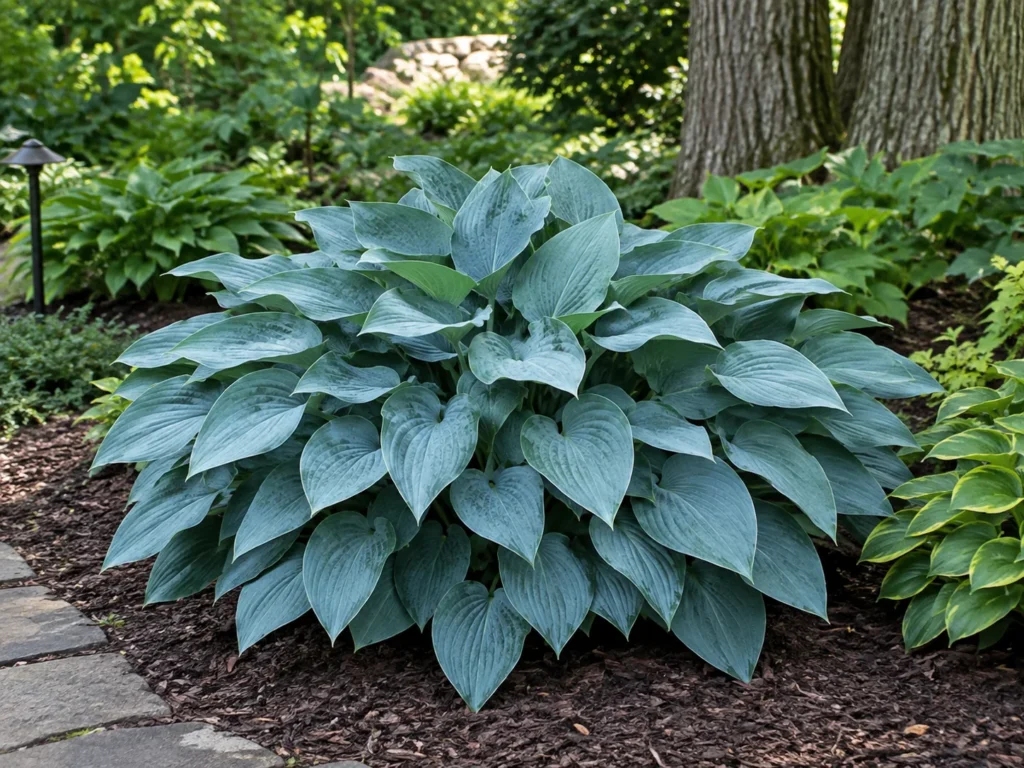
Growth is moderate. This isn’t a plant that fills in overnight. Expect a small, unimpressive-looking clump in year one. Expect meaningful size by year three. Full mature spread usually arrives around year four or five. That patience is worth it. A mature ‘Blue Angel’ clump is genuinely dramatic in a way a young one isn’t yet.
Common Mistakes With ‘Blue Angel’
Planting it in too much sun. This is the single most common issue. Even a few hours of unfiltered afternoon sun, in a warm-summer climate, will fade the blue color. It can leave crispy brown edges by August.
Underestimating mature size. People plant it like a small hosta. Three years later, they wonder why it’s swallowing neighboring plants. Plan for the 3-to-4-foot spread from the start.
Overwatering in poorly drained soil. Hostas want consistent moisture, not soggy roots. In heavy clay without amendment, root rot becomes a real risk.
Ignoring slugs early in the season. Hostas in general are a slug magnet. ‘Blue Angel’s’ thick, textured leaves make it somewhat more slug-resistant than thin-leaved cultivars. It’s not immune, though. Young, tender spring growth is still vulnerable. You’ll usually see the tell-tale ragged holes before you see the slugs themselves.
Cutting back too early or too late. Foliage should be left standing through fall. That lets the plant pull energy back into the roots. Wait until it’s fully collapsed after frost, or cut it back in early spring before new growth emerges — whichever fits your routine.
Pests, Diseases, and Wildlife
Slugs and snails are the most consistent pest problem, particularly in wet springs. Signs include irregular holes in the leaves and slime trails. Beer traps, iron phosphate slug bait, and hand-picking in the evening are the most common non-toxic controls.
Deer are a bigger concern in many suburban and rural areas than slugs are. Hostas in general are considered a deer favorite. Thick-leaved varieties like ‘Blue Angel’ are eaten somewhat less readily than thin-leaved cultivars, but “less readily” isn’t the same as “deer-proof.” In areas with heavy deer pressure, expect some browsing unless you use repellent sprays or fencing.
Disease pressure is generally low. The cultivar is noted for resistance to verticillium wilt. Foliar diseases like anthracnose mostly show up in poorly ventilated, consistently wet conditions — another reason good drainage and reasonable spacing matter.
One important safety note: hosta foliage is toxic if ingested by dogs, cats, and horses, causing gastrointestinal upset. If you have pets that graze on landscaping, keep that in mind when choosing a planting location.
Design and Companion Planting
Because of its size and strong blue color, ‘Blue Angel’ works best as a specimen or anchor plant, not a border filler. It pairs well with gold or chartreuse-foliage plants — golden hostas, Japanese forest grass (‘Aureola’), or heuchera in warm tones. The color contrast reads clearly from a distance, which smaller-scale pairings often don’t manage. It also holds its own in a woodland bed alongside ferns, astilbe, and hellebores. All of these share its shade and moisture preferences.
For containers, it’s a viable option, but it requires a genuinely large pot — at least 18 to 24 inches across at maturity. It also needs more frequent watering than an in-ground planting, since container soil dries out faster.
Cost and Availability
Pricing varies by size and region. Small container plants, roughly quart-size, commonly run $15 to $25 at nurseries and garden centers. Larger, established gallon-size plants cost more. Because it’s a widely grown, long-established cultivar, rather than a rare or patented one, it’s generally easy to find at independent nurseries and larger garden retailers across most of the country during spring planting season. Treat any specific price as a general ballpark, not a guarantee — availability and cost shift by region and retailer.
Quick Comparison: ‘Blue Angel’ vs. Other Popular Blue Hostas
| ‘Blue Angel’ | ‘Halcyon’ | ‘Blue Mouse Ears’ | |
|---|---|---|---|
| Mature size | 2–3 ft tall, 3–4 ft wide | 12–16 in tall, 24–30 in wide | 6–8 in tall, 12–16 in wide |
| Best use | Specimen, mass planting, large beds | Border, mid-size accent | Containers, small spaces, edging |
| Blue color intensity | Strong, fades some in heat | Very strong, holds color well | Strong, compact |
| Sun tolerance | Low — shade preferred | Moderate | Low |
If you love the blue tone of ‘Blue Angel’ but don’t have the space, ‘Halcyon’ or ‘Blue Mouse Ears’ give you a similar color palette in a much smaller footprint.
When ‘Blue Angel’ Isn’t the Right Choice
It’s worth being honest about where this hosta isn’t a great fit. Small beds and tight foundation plantings will end up crowded once the plant matures. So will anywhere within a couple feet of a walkway. A smaller cultivar is the better call there. Gardens in consistently hot, sunny climates with little shade cover will struggle to keep the blue color that’s the whole point of growing it. A heat-tolerant, green-leaved hosta, or a different shade perennial altogether, may perform better. And in yards with heavy, unmanaged deer pressure, any hosta is a gamble — unless you’re prepared to use repellents or fencing.
Frequently Asked Questions
How big does Hosta ‘Blue Angel’ actually get?
At maturity, expect a mound roughly 2 to 3 feet tall and 3 to 4 feet wide. Flower stalks rise above the foliage to around 4 feet. Full size typically isn’t reached until the third or fourth growing season.
Does ‘Blue Angel’ need full shade, or can it take some sun?
It does best in part shade to full shade. Morning sun is generally fine and can deepen the blue color. Hot afternoon sun will fade it and risks scorching the leaves, especially in warmer climates.
Is Hosta ‘Blue Angel’ deer resistant?
It’s somewhat more deer-resistant than thin-leaved hosta varieties, thanks to its thick, waxy foliage. No hosta is truly deer-proof, though. In areas with significant deer pressure, expect some browsing without protective measures.
Why is my ‘Blue Angel’ turning green instead of staying blue?
Some color shift toward green over the growing season is normal. The waxy bloom on the leaves naturally breaks down with heat and UV exposure. Too much direct sun speeds this up significantly, so a shadier spot holds the blue longer.
How far apart should I space ‘Blue Angel’ plants?
Roughly 30 to 36 inches apart, to account for the plant’s eventual 3-to-4-foot spread.
Is Hosta ‘Blue Angel’ toxic to pets?
Yes. Like other hostas, it’s toxic to dogs, cats, and horses if eaten. It can cause vomiting, diarrhea, and lethargy. Keep this in mind if pets have access to the planting area.
Can I grow ‘Blue Angel’ in a container?
Yes, but you’ll need a large pot — at least 18 to 24 inches wide at maturity. It also needs more frequent watering than an in-ground planting, since containers dry out faster.
When should I divide Hosta ‘Blue Angel’?
Division isn’t required for the plant’s health. But if you want to propagate it, or the clump has outgrown its space, early spring — as new growth emerges — or early fall are the best windows. Given its large mature size, division is more of an occasional project than a routine one.
For homeowners planning a shade garden as part of a broader landscaping or backyard renovation project, choosing plants suited to your specific light and soil conditions matters. It’s one of the details that’s easy to overlook, until things aren’t thriving a year later. If you’re building out a shade-friendly plant lineup, this Angel Wing Begonia care guide covers another striking option that pairs well with hostas in similar light conditions.
Sources & References