

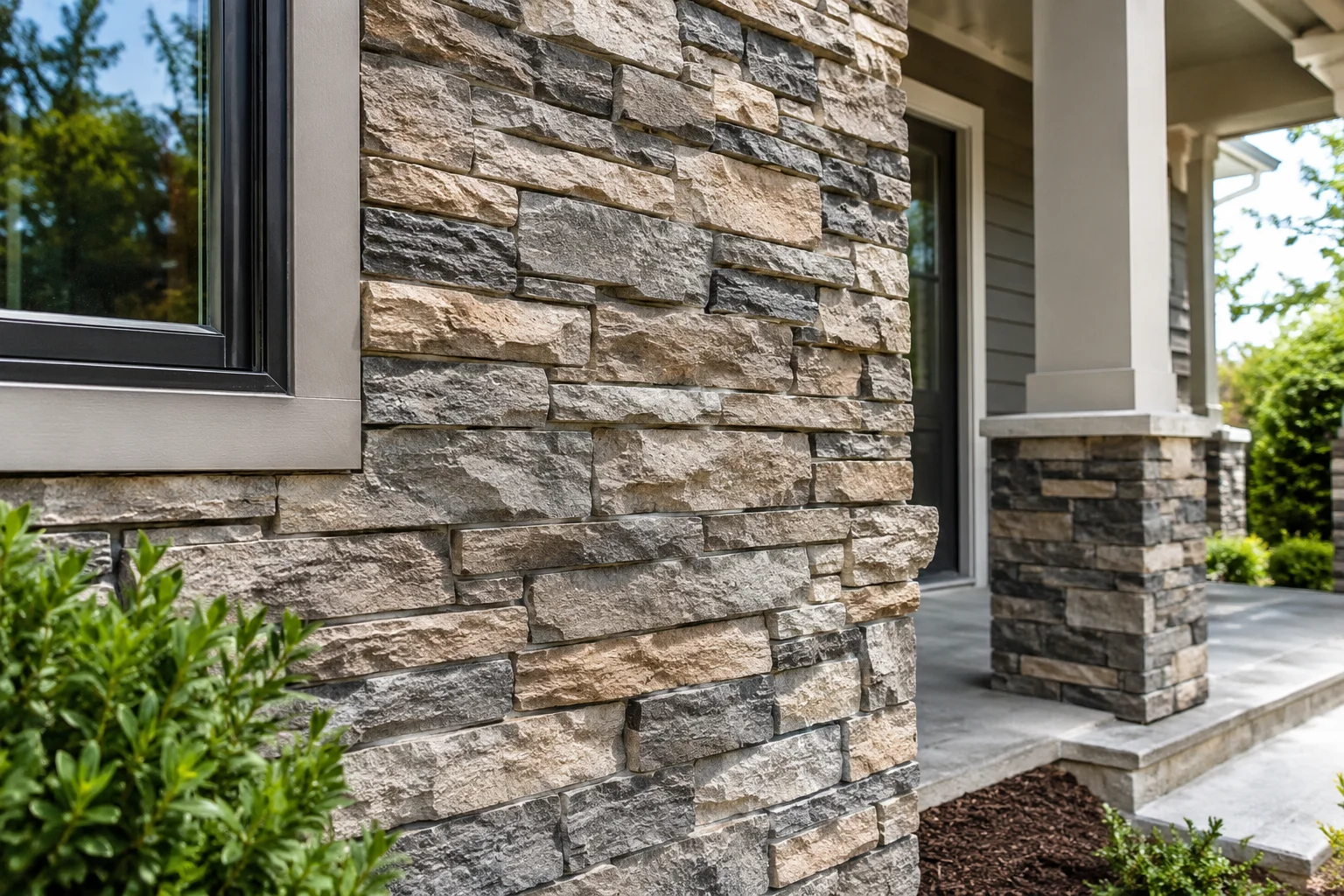
Versetta Stone is a mortarless, manufactured stone veneer siding system. It’s made from fiber-reinforced concrete panels that install like traditional siding — you nail or screw them directly to a wall, without mortar, scratch coat, or metal lath. Boral Stone Products manufactures it, and Westlake Royal Building Products sells it today. The system aims to give you the look of hand-laid stone masonry at a fraction of the installation time and labor cost. This guide covers what it actually is, what it costs, how installation works, and where it makes sense compared to real stone or other manufactured alternatives.
Quick Answer
Versetta Stone panels measure a nominal 36 inches long by 9.5 inches high. They install with an 8-by-36-inch exposure that covers 2 square feet per panel. Installed cost typically runs $17 to $21 per square foot, covering both material and labor for a standard job. That’s meaningfully less than traditional stone masonry, which often runs $25 to $32 per square foot in materials alone, before you add a mason’s hourly labor. The system carries a 50-year warranty and an ICC-ES code evaluation report. It’s also genuinely DIY-friendly for a comfortable weekend-project-level homeowner, though most people still hire a siding contractor or carpenter for a full exterior job.
What Versetta Stone Actually Is
The core idea behind Versetta Stone separates the look of stone masonry from the labor of stone masonry. Traditional stone veneer still requires a scratch coat, metal lath, and mortar joints, all installed by a trained mason — a slow, weather-dependent, physically demanding process. Factories precast Versetta Stone panels from portland cement and glass fibers, with a galvanized steel nailing flange embedded along the top edge. On site, installation looks much more like hanging siding panels than laying stone. You nail or screw the flange to the wall sheathing, and the tongue-and-groove profile on each panel laps into the one below it, shingle-style.
That construction method also explains the panels’ light weight relative to real stone. A single 8-by-36-inch panel weighs around 18 pounds, which matters both for installer fatigue and for what kind of wall structure can support it. Versetta Stone counts as a nonstructural exterior wall covering. In other words, it adds cladding but doesn’t contribute to the structural bracing or shear strength of the wall — a detail worth understanding if a contractor ever suggests otherwise.
Profiles and Colors
Versetta Stone ships in three main profiles, and each one mimics a different traditional stone-laying style:
Ledgestone gives a traditional dry-stack look, with irregular, horizontally oriented stones and minimal visible joint lines. This is the most common choice for a classic farmhouse or craftsman exterior.
Tight-Cut mimics the look of cut-and-fitted stone, with tighter, more uniform joints. As a result, it tends to read as more formal or refined than Ledgestone.
Carved Block offers a split-face stone look with a more contemporary, blocky presence, suited to modern or transitional home designs.
Within those profiles, the manufacturer offers a curated collection of color options. Names like Sterling, Plumb Creek, Mission Point, Sand, and Northern Ash show up frequently in supplier catalogs. Printed and online color samples can shift noticeably from the actual panel color, though, so it’s worth requesting a physical sample or seeing an installed project in person before finalizing a large order. This is standard advice straight from the manufacturer, not just a general precaution.
What It Costs
Installed pricing for Versetta Stone consistently lands in the $17 to $21 per square foot range. Multiple independent sources confirm this, including cost-estimating guides and building-material suppliers. That figure typically covers both the panel material and standard installation labor for a straightforward wall.
For comparison, here’s how that stacks up against nearby alternatives:
| Product | Typical Installed Cost | Notes |
|---|---|---|
| Versetta Stone | $17–$21/sq ft | Mortarless panel system, DIY-friendly |
| Natural stone veneer/cladding | $9–$15/sq ft material + mason labor | Thin natural stone on a backing, still needs skilled installation |
| Full natural stone masonry | $25–$32/sq ft material, plus $70–$110/hr mason labor | Heaviest, most labor-intensive option |
| Brick siding | $7–$15/sq ft material, plus $70–$110/hr mason labor | Different aesthetic, similar labor-cost structure to stone masonry |
| GenStone (competing panel system) | $13–$18/sq ft before promotions | Different material composition, 25-year warranty vs. Versetta’s 50-year |
A clear theme runs through these numbers: Versetta Stone sits below full natural stone masonry on total project cost, mainly because it eliminates the need for a licensed mason’s hourly labor rate. It does run somewhat higher per square foot than basic natural stone veneer cladding. Still, the trade-off is a simpler, faster, more DIY-accessible installation.
One practical note on ordering: several suppliers set a minimum order threshold, sometimes around $1,400. Suppliers also frequently sell Versetta Stone panels in full cartons — 36 panels covering roughly 72 square feet — rather than individual units. So factor that into your budgeting if you’re only covering a small accent area like a mailbox or a fireplace surround.
How Installation Works
Versetta Stone’s biggest selling point is simple: installation doesn’t require a stonemason’s skill set. The manufacturer’s own guidance breaks the process down into a sequence that a capable DIYer or general contractor can follow:
- Gather tools. You’ll need a hammer or screw gun, circular saw, hand grinder, level, chalk line, tape measure, tin snips, masonry chisel, and a chop saw with a continuous diamond turbo blade, along with standard safety gear — glasses, an N-95 mask, gloves, and hearing protection.
- Estimate materials. Use the manufacturer’s coverage formulas to calculate total wall area, then add corners, starter strips, and fasteners to your order.
- Inspect and prep the wall, and confirm the sheathing underneath is sound and appropriate for the fastening method.
- Mark level lines and install the starter strip, plus J-channel where the design calls for it.
- Install panels from bottom to top, one row at a time, lapping each row in a shingle fashion so the tongue seats fully into the groove below.
- Install corner panels, then any wainscot cap, sill, or receptacle/light box cutouts, using flashing and adhesive where those features require it.
- Clean the finished surface with water and a nylon bristle brush to remove installation dust.
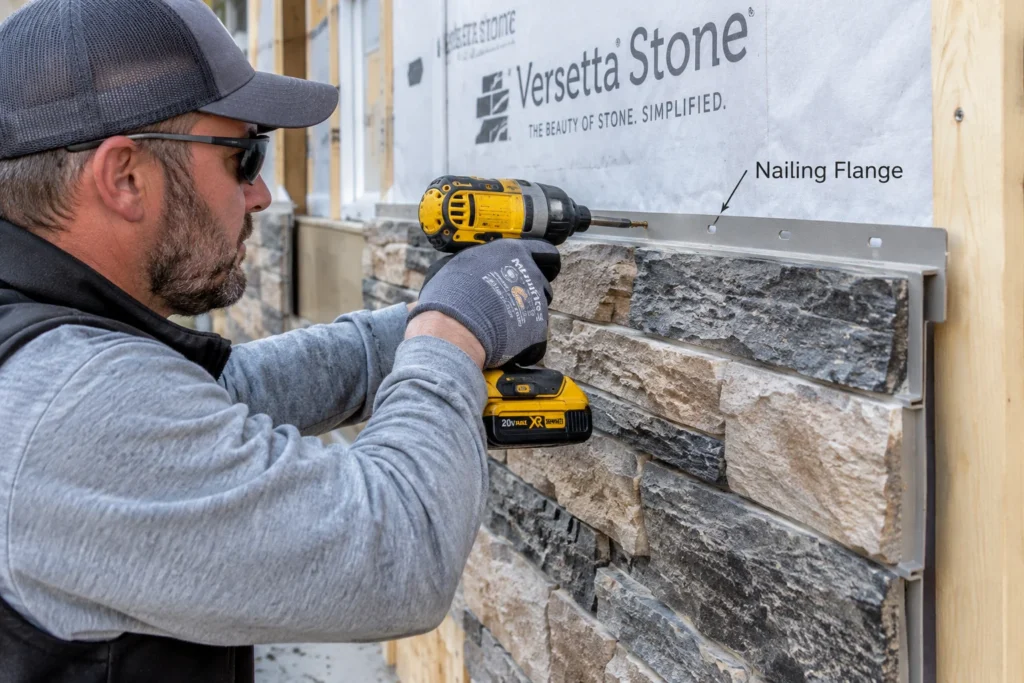
The system’s built-in rainscreen and pre-drilled weep holes help it meet code without requiring a separate drainage plane. Even so, flashing details at windows, doors, and penetrations still need to follow the manufacturer’s published instructions closely. This is one area where cutting corners causes real water-intrusion problems down the line, panel system or not.
Where It Can Be Used
Versetta Stone’s flexibility beats most exterior siding products, since the panels work indoors as well as out. Common applications include full exterior facades, accent walls, fireplace surrounds (interior or exterior), bathroom walls, kitchen backsplashes, porch columns, mailboxes, and freestanding bars.
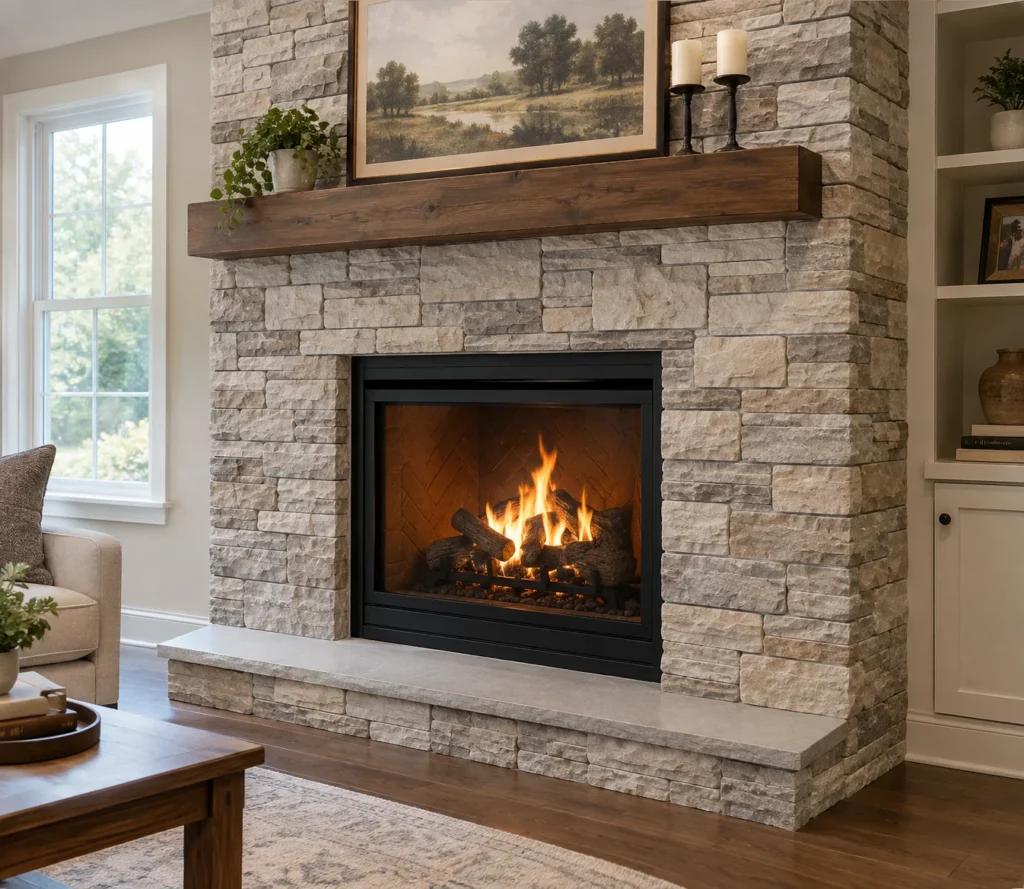
For interior use specifically, the mortarless installation offers a real advantage. You avoid the wet mortar mess indoors, and there’s no scratch coat curing time to work around.
Durability, Fire Rating, and Warranty
Versetta Stone carries a 50-year warranty, and the manufacturer rates it to withstand hurricane-force winds and handle freeze-thaw cycling. These specs matter if you’re comparing it against cheaper foam or polymer-based faux stone panels, which generally don’t carry the same wind and freeze-thaw performance claims. The panels also carry a Flame Spread Index and Smoke Developed Index of 0, meaning the material itself is essentially noncombustible. That’s a genuinely useful detail for homeowners in wildfire-prone regions of the West, where exterior cladding fire ratings factor into local building codes and, increasingly, insurance underwriting.
The product also holds an active ICC-ES evaluation report (ESR-2859), and building departments use this to confirm a product meets code requirements even when the base building code doesn’t explicitly name it. If a permitting office asks for documentation, reference this report.
Common Mistakes to Avoid
Treating it as structural. Versetta Stone is explicitly nonstructural — you can’t use it for wall bracing or as a shear wall substitute. If your project involves any structural wall bracing requirements, your framing and sheathing need to handle that separately from the stone veneer.
Skipping the wall framing and sheathing requirements. Code evaluation reports specify minimum framing (typically 2×4 lumber spaced no more than 16 inches on center) and sheathing thickness. Installing panels over undersized or improperly spaced framing can void warranty coverage and create real performance issues.
Underestimating flashing details. The panel system simplifies field installation, but window, door, and penetration flashing still has to follow manufacturer instructions precisely. Most water-intrusion failures in panelized stone systems trace back to flashing shortcuts, not the panels themselves.
Ordering based on online color images alone. Colors shown in marketing materials can differ from actual panel color. Request a physical sample or view an installed project before you commit to a full order, especially for a large exterior job where re-ordering a different color later gets expensive.
Ignoring minimum order requirements. Small accent projects can run into supplier minimums or full-carton purchase requirements. Confirm actual purchasable quantities before you finalize a budget for a small feature wall or mailbox project.
Versetta Stone vs. Alternatives
If you’re deciding between Versetta Stone and a competing panel system like GenStone, the practical differences come down to installation method and warranty length. Versetta Stone uses a fastener-only tongue-and-groove system and carries a 50-year warranty. GenStone panels combine fasteners with adhesive backing and carry a 25-year warranty, at a somewhat lower typical cost per square foot. If you’re weighing Versetta Stone against full natural stone masonry, the decision usually comes down to budget and timeline. Natural stone masonry costs meaningfully more once you factor in mason labor, but some buyers still prefer the irregularity and weight of real stone for high-end or historically accurate projects.
If you’re weighing Versetta Stone against other exterior cladding options, it’s also worth comparing it to fiber cement, our Hardie Plank siding cost, benefits, and installation guide covers a very different material with its own cost and durability trade-offs.
Frequently Asked Questions
Is Versetta Stone real stone?
No. It’s a manufactured stone veneer made from precast, fiber-reinforced concrete panels designed to replicate the look of hand-laid natural stone, without the weight, mortar, or masonry labor that real stone requires.
Can I install Versetta Stone myself?
Many homeowners install it themselves, since the panelized, mortarless system aims to be approachable for a handy DIYer. That said, larger or more complex exterior projects, especially those involving extensive flashing at windows and doors, are often better handled by a licensed siding contractor or carpenter.
How much does Versetta Stone cost installed?
Expect roughly $17 to $21 per square foot for a standard installation, covering both material and labor. Costs can run higher for complex wall geometry, extensive trim work, or difficult site access.
Can Versetta Stone be used indoors?
Yes. Because it requires no mortar or scratch coat, it’s a genuinely practical option for interior fireplace surrounds, accent walls, and kitchen backsplashes, without the mess of a wet-mortar installation.
Is Versetta Stone fireproof?
It carries a Flame Spread Index and Smoke Developed Index of 0, meaning the material is essentially noncombustible. That’s a meaningful advantage in wildfire-prone regions, where exterior cladding fire performance affects code compliance and insurance considerations.
What’s the warranty on Versetta Stone?
The manufacturer offers a 50-year warranty, which beats several competing manufactured stone panel systems on the market.
Does Versetta Stone need a structural wall to support it?
It needs wall framing and sheathing that meets the manufacturer’s and code evaluation report’s minimum specifications. The panels themselves, though, are nonstructural, so you can’t use them for wall bracing or shear resistance.
How is Versetta Stone different from GenStone?
Versetta Stone uses a concrete-based panel that installs with fasteners alone and carries a 50-year warranty. GenStone uses a different proprietary material and combines fasteners with adhesive, generally at a somewhat lower cost per square foot, with a 25-year warranty.
Sources & References
- ICC Evaluation Service, ESR-2859 Evaluation Report for Versetta Stone
- Texas Department of Insurance, Product Evaluation EC-112, Versetta Stone Veneer Wall Panels