

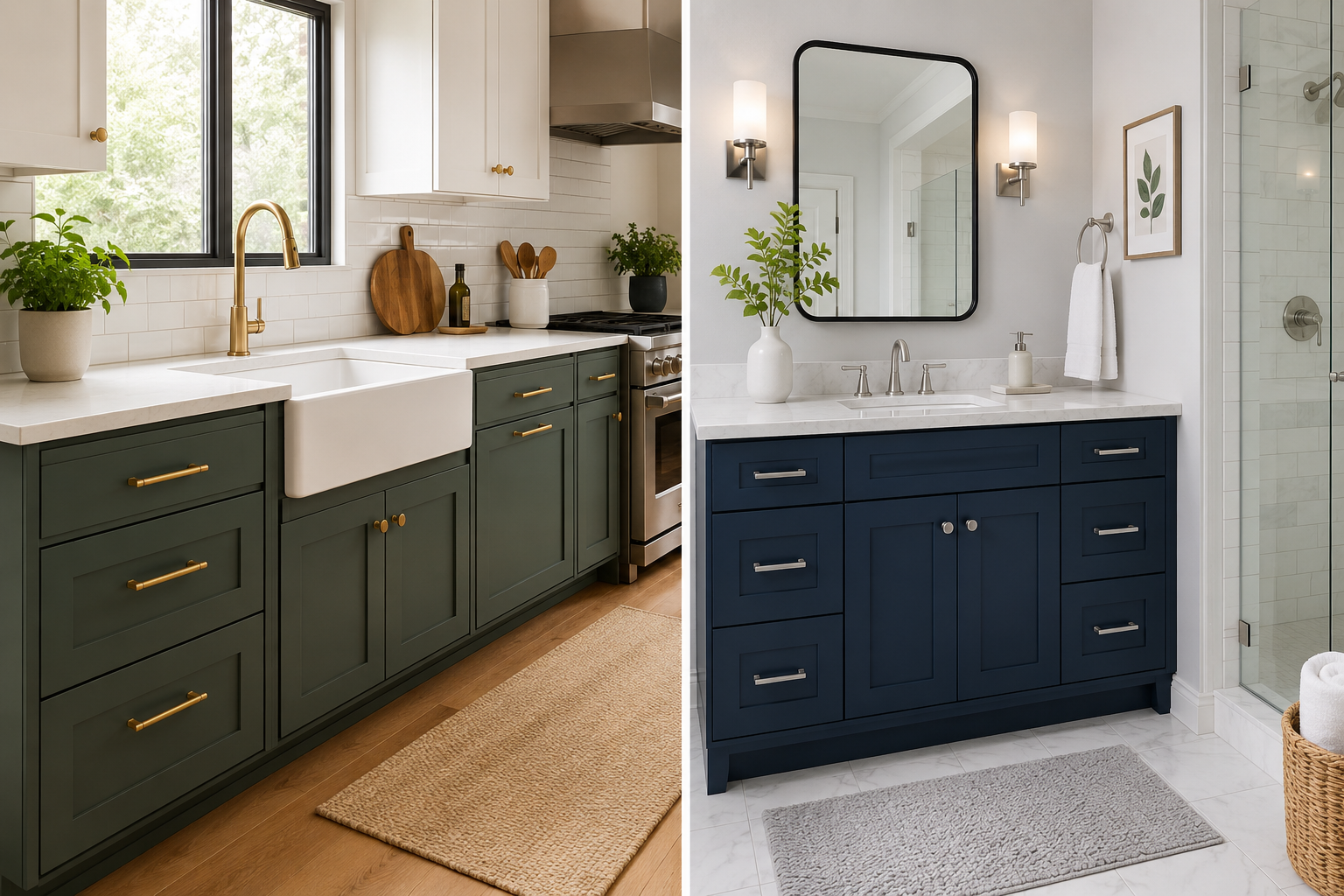
Introduction: Why Choosing the Right Base Cabinets Matters More Than Ever
Walk into any home improvement showroom across the U.S. right now — from a Lowe’s in Atlanta to a local cabinet shop in Portland — and you’ll notice one unmistakable trend: base cabinets have become the foundation of every serious kitchen and bathroom renovation. They are not just storage boxes under your countertop. They define the ergonomics, the aesthetics, and the long-term value of your entire space.
Base cabinets typically measure 34.5 inches in height (35 inches with the toe kick) and 24 inches in depth for kitchens. While bathroom base cabinets run shallower at around 21 inches deep. These standard dimensions exist for a reason — they align your countertop at a comfortable working height, accommodate standard appliances, and follow building codes recognized across all 50 states. Still, not every base cabinet is built the same way. And choosing poorly can cost you thousands in repairs, replacements, or a full redo down the road.
In 2026, homeowners are dealing with a market flooded with options ranging from budget flat-pack assemblies to custom built-ins that rival fine furniture. Supply chain stabilization since 2024 has brought pricing down somewhat, but material and labor costs in states like California, New York, and Texas remain elevated. This guide cuts through the noise with clear, experience-driven advice rooted in what actually works in real American kitchens and bathrooms.
What Are Base Cabinets and How Are They Different from Wall Cabinets?
Base cabinets sit on the floor and support your countertop, whether that’s granite, quartz, laminate, or butcher block. The structural demands on a base cabinet are significantly higher. It needs to bear the weight of the countertop, the sink, small appliances, and decades of daily use. That’s why material quality, box construction, and joint strength matter far more in base cabinets than in upper cabinets.
Another key difference is moisture exposure. Base cabinets sit closer to water sources — dishwashers, under-sink plumbing, bathroom vanity drains — making moisture resistance a critical specification rather than a nice-to-have. Cabinets built with particleboard cores can swell and delaminate within a few years in humid environments, especially in Southern states like Florida, Louisiana, and Mississippi where humidity runs persistently high. Plywood-box construction or solid wood frames hold up dramatically better over time.
Types of Base Cabinets: A Quick Reference
Understanding the different configurations available helps you match the right cabinet to your specific layout before you ever visit a store or request a quote.
Standard Base Cabinets
Single-door or double-door units with one or two interior shelves. They come in widths from 9 inches to 36 inches. They are the most common choice for general storage in both kitchens and bathrooms.
Drawer Base Cabinets
Replace the door-and-shelf setup with two to four full-extension drawers. These are exceptionally practical for storing pots, pans, utensils, and bathroom toiletries because everything stays visible and accessible. Many kitchen designers in 2026 now recommend going drawer-heavy on the lower run of base cabinets rather than door-and-shelf, citing ergonomics and ease of use as the primary drivers.
Sink Base Cabinets
Open inside to accommodate plumbing and are built wider — typically 30 or 36 inches — to fit standard kitchen or bathroom sinks. The floor of the cabinet is usually absent or removable for pipe access.
Blind Corner Base Cabinets
Address the tricky corner in L-shaped and U-shaped kitchens where two runs of cabinets meet. They waste some space by nature, but modern pull-out organizers and lazy Susan inserts have made them far more functional than they used to be.
Pull-Out Base Cabinets
Incorporate built-in roll-out trays or shelves, making deep storage accessible without kneeling on the floor. For aging-in-place renovations — a growing priority among America’s 73 million baby boomers — these are increasingly specified as standard rather than optional.
Best Materials for Base Cabinets in 2026
Material choice is where most buyers either invest wisely or regret later. Here is a practical breakdown of the most common options available in today’s U.S. market.
Solid Wood
Solid wood frames with plywood boxes remain the gold standard for durability and repairability. Species like maple, cherry, oak, and hickory are popular across the U.S. Maple and oak dominate the Midwest and Southeast markets due to their cost-effectiveness and wide availability. The trade-off is price — expect to pay 40–70% more than comparable MDF or particleboard alternatives.
Plywood Box Construction
Even if the door and drawer fronts are MDF or thermofoil, a plywood box is one of the most important upgrades you can make. Plywood holds screws better, resists moisture more effectively, and doesn’t sag under heavy loads the way particleboard does. Many mid-range brands like KraftMaid, Merillat, and Wellborn Cabinet offer plywood box upgrades as either standard or an add-on option. If your budget is tight, prioritize plywood boxes over fancier door styles — the box is what lasts.
MDF (Medium-Density Fiberboard)
MDF is a smooth, stable material that paints exceptionally well, which is why it dominates the painted cabinet segment. Door fronts and drawer fronts made from MDF deliver a cleaner, more uniform painted finish than solid wood, which can show grain through paint. However, MDF is heavy, difficult to repair once damaged, and highly susceptible to moisture swelling along exposed edges. Never use MDF box construction in a bathroom unless it has been sealed on all edges and faces.
Thermofoil and Laminate
Thermofoil (PVC film over MDF) and high-pressure laminate are the most budget-friendly options. They are easy to clean and come in a wide variety of colors and patterns. The downside is limited repairability — once the film delaminates or chips, the cabinet typically needs full replacement rather than refinishing. These materials work fine in low-moisture zones but should be avoided under sinks and near dishwashers.
Top Base Cabinet Brands Reviewed for 2026
IKEA SEKTION
IKEA’s SEKTION line remains one of the most popular choices for DIY renovators across the U.S., and for good reason. The frameless (European-style) box construction uses a honeycomb composite for lighter weight while maintaining reasonable load-bearing capacity. Prices for a standard 30-inch base cabinet start around $90–$140 before doors and hardware. The system is modular, meaning you can mix widths, depths, and configurations freely. The main limitation is that SEKTION uses a thinner cabinet wall than many domestic brands. So it’s better suited to light-to-medium use kitchens rather than heavy-duty cooking environments.
KraftMaid
KraftMaid has been one of the most trusted American cabinet brands for decades, and their 2025–2026 lineup reflects continued investment in dovetail drawer boxes, plywood construction options, and a wide range of door styles. Available primarily through Home Depot across the U.S., KraftMaid offers semi-custom sizing and a solid warranty program. A typical 30-inch base cabinet in their stock line runs $200–$350 before installation. Their Vantage Series introduced in late 2024 expanded the sustainable wood sourcing options, appealing to eco-conscious renovators in markets like Colorado, Washington, and the Pacific Northwest.
Shaker & Semihandmade
For IKEA-compatible upgrades that deliver a custom look without the custom price, Semihandmade has become a recognized name particularly in design-forward urban markets like Brooklyn, Los Angeles, and Chicago. Their solid wood and MDF doors attach directly to IKEA’s SEKTION boxes, giving homeowners the durability of better materials at a fraction of full-custom pricing.
Fabuwood
Fabuwood has grown rapidly since 2022 as a mid-range all-plywood cabinet brand sold through independent dealers and online. Their Allure Galaxy and Nexus series offer soft-close doors and drawers, full plywood construction, and dovetail drawer boxes at price points that undercut KraftMaid significantly. For budget-conscious homeowners in secondary markets who don’t want to sacrifice quality, Fabuwood consistently earns strong contractor recommendations.
Thomasville (Home Depot Exclusive)
Thomasville’s cabinetry, sold exclusively through Home Depot, occupies the semi-custom middle ground between stock and full custom. The 2026 lineup includes new matte finishes and wider color palettes responding to the shift away from all-white kitchens. Construction quality is solid for the price range, and the in-store design services available at most Home Depot locations make it accessible for homeowners without a dedicated kitchen designer.
Base Cabinet Sizes: Standard Dimensions Guide for U.S. Homeowners
Getting your sizing right before ordering is non-negotiable — cabinets are not returnable once installed, and custom modifications are expensive. The following dimensions reflect ANSI/KCMA standards followed by virtually all U.S. manufacturers.
Kitchen base cabinets come in a standard height of 34.5 inches (without countertop), a depth of 24 inches, and widths ranging from 9 to 48 inches in 3-inch increments. The toe kick at the base is typically 4.5 inches tall and 3.5 inches deep, bringing the finished height to 36 inches once the countertop is added — the ergonomic standard for most adults.
Bathroom vanity base cabinets run 31–35 inches in total finished height depending on personal preference and ADA requirements. ADA-compliant vanities must provide knee clearance of 27 inches minimum beneath the sink for wheelchair accessibility — a standard increasingly required by local building codes in new construction and full renovations across most U.S. states.
When planning your layout, always account for filler strips between cabinets and walls, which compensate for walls that aren’t perfectly plumb or square — virtually every residential wall. Most designers budget 3–6 inches of total filler material per run of cabinets.
Kitchen vs. Bathroom Base Cabinets: Key Differences
Kitchen and bathroom base cabinets share structural principles but diverge meaningfully in their specifications, and using a kitchen cabinet in a bathroom (or vice versa) can cause problems. If you’re specifically sizing a bathroom vanity, our 36-inch bathroom vanity guide covers those dimensions in more depth.
They are engineered for higher load capacities — a stone countertop plus a cast-iron farmhouse sink can weigh hundreds of pounds. Ventilation for dishwashers and moisture management under the sink are standard considerations in kitchen cabinet design.
Bathroom vanity cabinets are shallower (typically 18–21 inches) to preserve floor space in smaller rooms and allow comfortable access to the sink without leaning uncomfortably far forward. Many bathroom vanities also incorporate electrical cutouts for outlet access, which kitchen base cabinets do not typically include.
One more distinction worth noting: bathroom cabinets are more frequently specified as freestanding furniture-style pieces in 2026, as the market continues moving toward the “spa bathroom” aesthetic popularized in high-end renovations. This trend is particularly visible in markets like Miami, Austin, and Scottsdale where luxury renovations set local design standards.
How to Choose Base Cabinets: Step-by-Step Buying Framework
Choosing base cabinets doesn’t have to be overwhelming. Follow this structured approach and you’ll avoid the most common and costly mistakes.
Step 1 — Set Your Budget Per Linear Foot. In the U.S. in 2026, budget for $150–$300 per linear foot for stock/RTA cabinets, $300–$650 for semi-custom, and $650–$1,500+ for full custom. These figures cover cabinets only, not countertops, installation, or hardware. Labor for cabinet installation typically runs $50–$100 per cabinet depending on your region.
Step 2 — Measure Twice, Order Once. Measure your space in three places — floor, mid-height, and ceiling line — because walls are rarely perfectly square. Note all obstacles including windows, doors, outlets, switches, and plumbing rough-in locations. Bring dimensioned sketches to any cabinet supplier, not just verbal descriptions.
Step 3 — Prioritize Box Construction Over Door Style. Doors can be swapped; boxes cannot without a full cabinet replacement. Plywood boxes over particleboard is the single most impactful quality upgrade you can make within a fixed budget.
Step 4 — Evaluate Drawer Hardware. Soft-close, full-extension drawer slides rated for at least 75–100 lbs are the standard to aim for. Undermount slides are more durable and aesthetically cleaner than side-mount slides.
Step 5 — Check Lead Times. Stock cabinets are available same-day or within a week. Semi-custom typically runs 3–6 weeks. Full custom can run 8–16 weeks. Plan your renovation timeline around cabinet lead times, not the other way around.
If you’re also repainting cabinets as part of the same project, see our spray vs. brush paint comparison for which method gets the better finish.
2026 Design Trends in Base Cabinets
Color is shifting dramatically. All-white kitchens, while still popular, are losing ground to two-tone designs pairing white or cream upper cabinets with darker base cabinets in navy, forest green, sage, or charcoal. According to the National Kitchen & Bath Association (NKBA), two-tone cabinet designs were cited as a top trend by 63% of design professionals surveyed in their 2025 Design Trends Report — and that momentum has carried into 2026.
Hardware finishes have shifted from brushed nickel toward matte black, unlacquered brass, and champagne bronze. Flat-front (slab) door styles remain dominant in contemporary builds, while updated Shaker styles — particularly in painted finishes — continue to be the most specified door style in U.S. residential renovations overall.
Integrated pull systems (recessed rails replacing traditional knobs and pulls) are appearing more frequently in high-end installations, particularly in minimalist kitchen designs in cities like Seattle, Denver, and San Francisco.
Installation Tips: What Every U.S. Homeowner Should Know Before Starting
Even the best cabinets can look terrible if installed incorrectly. Understanding the basics helps you hold contractors accountable and plan realistically.
Always start installation at the highest point of the floor. Use a long level to find the high point, then snap a reference line for cabinet tops at that height. Shimming cabinets level is standard practice — don’t let any installer tell you your floor is “close enough.” Even a quarter-inch variance across a cabinet run can cause drawers to bind and doors to gap.
Finally, never caulk between the cabinet toe kick and the floor before the countertop is installed and confirmed level. Premature caulking locks in any errors and makes correction far more difficult.
Price Comparison: What to Budget in 2026
The table below provides a practical cost reference for U.S. homeowners based on current market pricing as of Q2 2026.
| Cabinet Type | Price Per Cabinet (30″ Base) | Typical Box Material | Lead Time |
|---|---|---|---|
| RTA (Ready-to-Assemble) | $80–$200 | Particleboard / MDF | 3–10 days |
| IKEA SEKTION | $90–$180 | Honeycomb composite | 1–3 days |
| Stock (Home Depot / Lowe’s) | $150–$350 | Particleboard / Plywood | 1–7 days |
| Semi-Custom (KraftMaid, Fabuwood) | $250–$600 | Plywood standard | 3–6 weeks |
| Full Custom | $500–$2,000+ | Solid wood / Plywood | 8–16 weeks |
These prices represent cabinet cost only. Add 20–30% for hardware, and budget separately for professional installation at $50–$100 per cabinet box depending on your region. Coastal metros and high cost-of-living areas trend toward the higher end of installation labor rates.
FAQ: Best Base Cabinets for Kitchen & Bathroom (2026)
What’s the difference between framed and frameless base cabinets?
Framed cabinets have a solid wood face frame attached to the front of the box, which adds structural rigidity and a traditional appearance. Frameless (European-style) cabinets have no face frame, so doors and drawers cover the full box opening — they offer slightly more interior storage access and a cleaner, modern look. Both styles are widely available in the U.S., with framed cabinets being more dominant in traditional and transitional designs.
Is plywood really worth the upgrade over particleboard for base cabinets?
Yes, consistently and significantly. Plywood holds screws more securely, resists moisture swelling, handles weight better, and outlasts particleboard by many years under normal use conditions. The cost difference is typically $30–$80 per cabinet, and in a kitchen that may hold 20+ cabinets, that’s a meaningful but justified investment given the longevity improvement.
Can I use kitchen base cabinets in a bathroom?
Technically yes, but it’s not ideal. Kitchen base cabinets are deeper (24 inches vs. the bathroom standard of 18–21 inches), which can make them feel awkward and intrusive in smaller bathrooms. More importantly, moisture resistance and finish specifications differ. If you do use kitchen cabinets in a bathroom, ensure all plywood edges are sealed and the interior finish is moisture-resistant.
What are the best base cabinets for a tight budget?
For tight budgets, IKEA SEKTION with upgraded hardware, or quality RTA (Ready-to-Assemble) brands like Lily Ann Cabinets, Forevermark, or Fabuwood offer the best combination of quality and affordability. Prioritize plywood box construction even within budget options — it’s the most important quality indicator at any price point.
How do I know if my base cabinets are installed correctly?
All cabinets should be level side-to-side and front-to-back, secured to wall studs, and joined tightly cabinet-to-cabinet with no visible gaps at the face frames. Drawers should open and close without binding, and all doors should hang evenly with consistent gaps. If anything is off after installation and before the countertop goes on, address it immediately — corrections become far more expensive once countertops are set.
What base cabinet width works best for a kitchen sink?
A 30-inch or 36-inch sink base cabinet is standard for most U.S. kitchens. A 36-inch sink base is recommended when installing a farmhouse or double-basin sink. Always confirm your sink dimensions before ordering — the cabinet width should be at least 3 inches wider than the sink cutout dimension to preserve adequate structural support at the cabinet walls.
Should I hire a professional to install base cabinets or DIY?
For homeowners with basic carpentry skills and the right tools (level, drill, stud finder, clamps), base cabinet installation is a manageable DIY project. However, professional installation is strongly recommended in kitchens with complex layouts, older homes with out-of-plumb walls, or when the cabinet run includes corner units. Mistakes in cabinet installation are expensive to correct after countertops are installed, so the $800–$2,000 typical installation cost for a standard kitchen is often well worth it.
Final Thoughts
Choosing the right base cabinets is one of the highest-impact decisions in any kitchen or bathroom renovation. Whether you’re updating a hall bath in a suburban Minneapolis split-level or gutting a full kitchen in a Houston new build, the same principles apply: invest in plywood boxes, match your cabinet depth to the room’s function, verify your dimensions before ordering, and don’t let door style drive decisions at the expense of structural quality.
The U.S. cabinet market in 2026 offers genuinely excellent options at every price point — from IKEA’s flexible modular system to mid-range semi-custom brands like KraftMaid and Fabuwood, right up to full custom built-ins. Know your priorities, set a realistic budget, and use this guide as your reference framework. Your cabinets will outlast your countertops, your appliances, and likely several redesigns — choose them accordingly.
[…] around $500 to $600. If you’re weighing base cabinets as part of the same renovation, our best base cabinets guide is worth a look before you start painting. More budget-friendly options from Wagner and HomeRight […]
[…] you’re also updating cabinetry as part of the same kitchen refresh, our best base cabinets guide covers matching finishes and construction […]