

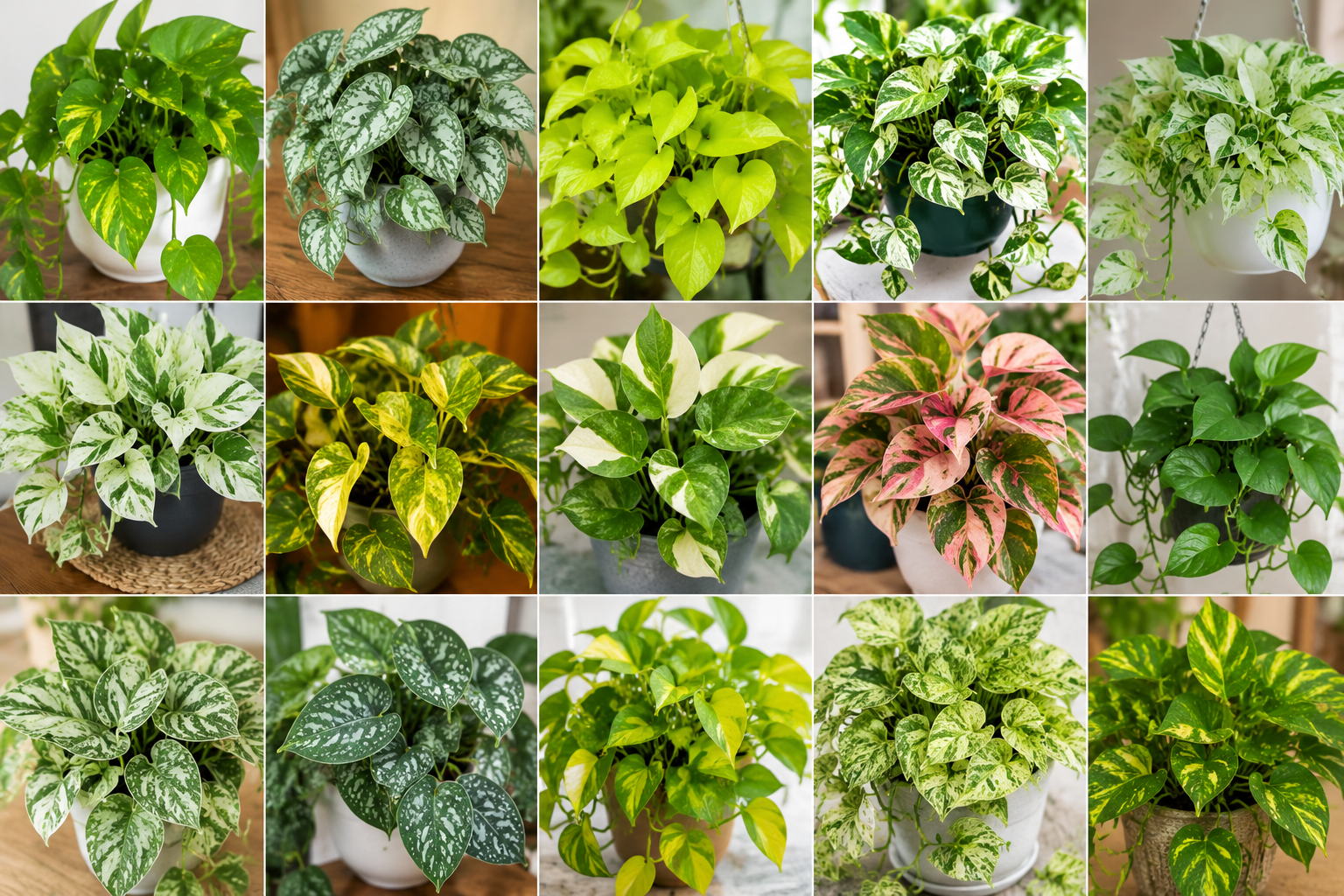
If there’s one houseplant that shows up in every corner of American homes — from cozy apartments in Portland to sunny sunrooms in Tampa — it’s the pothos. And for good reason. It tolerates neglect, thrives in low light, grows fast, and looks genuinely beautiful trailing from a shelf or climbing a moss pole. No wonder it’s often the first plant someone buys and the last one they’d ever give away.
But here’s what most people don’t realize when they first pick one up at Home Depot or a local nursery: there isn’t just one pothos. There are dozens of varieties, each with its own personality — different leaf shapes, color patterns, light preferences, and growth speeds. Some are as easy to find as a golden pothos at your corner hardware store; others are collector’s pieces that plant enthusiasts pay serious money to track down.
Scientifically known as Epipremnum aureum (and a few related species), all true pothos plants are vining, tropical plants native to Southeast Asia and the Pacific Islands. They’re part of the Araceae family, they’re remarkably adaptable, and — one important note before we dive in — they’re toxic to dogs, cats, and horses according to the ASPCA, as well as mildly irritating to humans if ingested. If you have curious pets, hang them high or use a wall-mounted planter they can’t reach.
Now, let’s get into the good stuff. Here are the 15 best pothos varieties to know, grow, and love in 2026.
1. Golden Pothos (Epipremnum aureum)
Best for: Absolute beginners, any room, any light level
The one that started it all. Golden pothos is the most widely sold houseplant in the world, and it earns that status completely. Its deep green, heart-shaped leaves are splashed with irregular streaks of golden yellow, and the overall effect is warm, lush, and instantly recognizable.
It grows fast, tolerates low light better than almost any other variety (though it shows its best color in medium to bright indirect light), and bounces back from missed waterings without complaint. If you’ve never kept a houseplant alive before, start here. You’ll build confidence quickly.
Care snapshot: Water when the top 1–2 inches of soil are dry. Medium to bright indirect light preferred. Fertilize monthly in spring and summer with a balanced liquid fertilizer.
Where to find it: Everywhere — Home Depot, Lowe’s, Walmart, most nurseries, and online.
2. Marble Queen Pothos (Epipremnum aureum ‘Marble Queen’)
Best for: High contrast, bright spaces, statement shelves
Marble Queen is the elegant cousin of the golden pothos. Instead of yellow splashes, its leaves are streaked with creamy white against gray-green, creating a marbled effect that looks genuinely sophisticated in a modern home.
The trade-off is that all that white variegation means less chlorophyll — so it grows more slowly than Golden Pothos, and it needs brighter light to maintain its striking coloration. Put it in a dim corner and the new leaves will emerge almost entirely green, which defeats the purpose.
Care snapshot: Bright indirect light is key. Water slightly less frequently than Golden Pothos. Don’t fertilize heavily — it can scorch the variegated sections.
Where to find it: Widely available at most garden centers and online retailers.
3. Neon Pothos (Epipremnum aureum ‘Neon’)
Best for: Dark corners that need a pop of life
Neon pothos is a mood-lifter. Its leaves are a single, vivid chartreuse-yellow — no variegation, just pure, electric, almost-glowing green. It’s one of the only fully non-variegated pothos varieties, and that’s actually an advantage: all that chlorophyll makes it one of the best pothos choices for genuinely low-light spaces.
It grows quickly, cascades beautifully from hanging baskets, and adds unexpected color in rooms that would otherwise feel flat. Pair it with neutral tones or dark wood furniture for maximum effect.
Care snapshot: Tolerates lower light than most pothos, though it thrives in moderate indirect light. Water when soil is dry to the touch. A fast grower — expect to prune regularly.
Where to find it: Readily available at most nurseries and big-box garden centers.
4. Jade Pothos (Epipremnum aureum ‘Jade’)
Best for: Low-light rooms, offices, beginners who want something simple
Jade pothos is the most understated variety on this list — and one of the most underrated. Its leaves are a solid, deep, glossy green with no variegation whatsoever. That uniformity is what makes it special in certain spaces: it’s clean, architectural, and doesn’t compete visually with patterned rugs, art, or busy interiors.
Because it has the most chlorophyll of any pothos variety, Jade is the undisputed champion of low-light tolerance. It can genuinely survive in spaces where other varieties would slowly fade and stall.
Care snapshot: The best choice for genuinely dark rooms. Rarely needs fertilizer. Very forgiving with watering schedules. One of the fastest-growing varieties.
Where to find it: Common at most nurseries and often sold in large, trailing arrangements.
5. Pearls and Jade Pothos (Epipremnum aureum ‘Pearls and Jade’)
Best for: Collectors who want something refined and relatively accessible
Pearls and Jade is a patented cultivar developed by the University of Florida, and you can see the careful breeding in its leaves. Each one features dark green with large, painterly blotches of white and soft gray-green, often with the variegation appearing along the leaf margins rather than the center.
It’s slower-growing than most pothos varieties and stays relatively compact, which makes it a great choice for smaller spaces like bookshelves, desks, or bathroom counters. It’s also noticeably more refined-looking than standard variegated varieties.
Care snapshot: Needs medium to bright indirect light to maintain white variegation. Water when top inch of soil is dry. Slower growth means less frequent repotting.
Where to find it: Increasingly common — most garden centers carry it.
6. N’Joy Pothos (Epipremnum aureum ‘N’Joy’)
Best for: Small spaces, desk plants, minimalist aesthetics
N’Joy is often confused with Pearls and Jade, and the differences are subtle but real. N’Joy has smaller leaves with cleaner, more clearly defined blocks of white and green — less of a painterly blend and more of a graphic, two-tone pattern. The overall plant stays more compact than most pothos varieties.
It’s a great pick if you want the visual interest of a heavily variegated pothos but you’re working with limited shelf or counter space. It also looks stunning in small hanging planters.
Care snapshot: Needs bright indirect light to maintain the strong white sections. Grows slowly — be patient with it. Avoid overwatering; smaller plants are more susceptible to root rot.
Where to find it: Widely available online and increasingly common at specialty nurseries.
7. Jessenia Pothos (Epipremnum aureum ‘Jessenia’)
Best for: Bright rooms, anyone who loves lime green tones
Jessenia is one of the most visually interesting mid-range pothos varieties. Its emerald green leaves are streaked and spotted with lime green and soft yellow variegation — a slightly cooler, more complex palette than the golden tones of the standard Golden Pothos.
It’s a patented cultivar and was initially hard to find, but availability has improved significantly in the U.S. over the past couple of years. If you love the shape of Golden Pothos but want something a bit more unusual, Jessenia is a natural upgrade.
Care snapshot: Does best in medium to bright indirect light. Moderate grower. Care is similar to Golden Pothos — generally forgiving and adaptable.
Where to find it: Specialty nurseries, plant shops, and online retailers. Less common than the basics but not difficult to track down.
8. Manjula Pothos (Epipremnum aureum ‘Manjula’)
Best for: Collectors, statement plants, bright windowsill spots
Manjula is one of the most beautiful pothos varieties you can grow, and it has the slightly fussier temperament to match. Developed by the University of Florida, its large, heart-shaped leaves feature a stunning mix of white, cream, yellow-green, and deep green — often all on the same leaf, with wavy edges that add texture you don’t see in most other varieties.
It grows slowly, it needs good light to show its best coloring, and it can be harder to find than everyday varieties. But when it’s happy, it’s genuinely one of the most striking pothos plants you can own.
Care snapshot: Bright indirect light is essential. Water carefully — this variety is more sensitive to overwatering than most. Worth seeking out at specialty nurseries or from reputable online plant sellers.
Where to find it: Specialty nurseries, plant boutiques, and Etsy plant sellers. Not typically stocked at big-box stores.
9. Cebu Blue Pothos (Epipremnum pinnatum ‘Cebu Blue’)
Best for: Anyone who wants something completely different from typical pothos
Technically Epipremnum pinnatum rather than aureum, Cebu Blue is widely classified and sold as a pothos, and its care requirements are essentially identical. What sets it apart is its appearance: elongated, pointed blue-green leaves with a subtle silver-gray sheen that photographs beautifully and looks unlike anything else in a typical indoor plant collection.
As a younger plant it trails gracefully; given something to climb, the leaves mature and develop natural splits — fenestrations — similar to a Monstera. It’s one of the more dramatic transformation plants in the pothos family.
Care snapshot: Needs moderate to bright indirect light to maintain the blue-silver sheen. Water when soil is mostly dry. Rewards climbing support with dramatically larger, fenestrated leaves over time.
Where to find it: More specialty than mainstream but increasingly available at independent garden centers and online.
10. Global Green Pothos (Epipremnum aureum ‘Global Green’)
Best for: Low-light rooms, anyone who loves green-on-green patterns
Global Green is a newer cultivar that’s quietly become one of the most coveted pothos varieties among enthusiasts. Unlike most variegated pothos that contrast green with white or yellow, Global Green features dark green leaves marbled with brighter, lighter green — a two-tone pattern that’s completely unique in the pothos world.
It’s also one of the better choices among variegated varieties for lower light, since both shades are green (and therefore chlorophyll-bearing). It won’t perform as well as Jade in truly dark conditions, but it handles dim rooms better than white-variegated cultivars.
Care snapshot: Adapts to medium light better than most variegated pothos. Water as you would Golden Pothos. A relatively fast grower for a variegated variety.
Where to find it: Harder to find at big-box stores but available at specialty nurseries and reliably stocked by online plant retailers.
11. Snow Queen Pothos (Epipremnum aureum ‘Snow Queen’)
Best for: Bright rooms, maximalist plant displays, dramatic contrast
Snow Queen is the most heavily variegated of the widely available pothos varieties. Its leaves are almost entirely white or cream, with only thin veins and patches of green remaining. The result is breathtakingly striking — and also more demanding than any other standard pothos cultivar.
Because there’s so little green tissue, Snow Queen needs consistent bright indirect light to survive and grow. It’s a slow grower even in good conditions. But if you have a bright south- or east-facing window in your home, it’s one of the most visually impressive pothos plants you can grow.
Care snapshot: Bright indirect light is non-negotiable. Water carefully and allow soil to dry more between waterings than you would with greener varieties. Not a beginner plant.
Where to find it: Available at specialty nurseries and online; occasionally found at larger garden centers.
12. Hawaiian Pothos (Epipremnum aureum ‘Hawaiian’)
Best for: Anyone who wants big, bold tropical leaves
Hawaiian Pothos is a cultivar of Golden Pothos, but it earns its own category for one reason: scale. Given the right conditions — good light, something to climb, room to grow — Hawaiian Pothos produces dramatically oversized leaves compared to standard Golden Pothos. We’re talking leaves that can reach a foot or more across in a mature, well-tended specimen.
The leaf pattern is similar to Golden — green with yellow flecks — but the sheer size of the leaves when the plant matures makes it feel like a different species entirely. It’s one of the few pothos varieties that can anchor a room as a floor plant rather than just a trailing or hanging piece.
Care snapshot: Needs good bright indirect light and a climbing support (moss pole or trellis) to achieve its impressive mature size. Grows vigorously when conditions are right.
Where to find it: Available at specialty nurseries, garden centers, and online retailers.
13. Trebi Pothos (Scindapsus pictus ‘Trebi’)
Best for: Anyone who wants texture and subtlety in a low-maintenance plant
Like Cebu Blue, Trebi is a Scindapsus rather than a true Epipremnum, but it’s widely sold and categorized as a pothos, and the care requirements are nearly identical. Its small, matte, velvety green leaves are dotted with irregular silver-gray markings that give it a shimmery, textured quality unlike anything in the standard pothos lineup.
Trebi is compact, grows at a moderate pace, and looks particularly good in hanging planters where its trailing habit and beautiful leaf texture can be appreciated up close. It’s a quiet, understated choice that rewards a second look.
Care snapshot: Needs medium to bright indirect light to maintain the silver markings. Avoid overwatering — the velvety leaves are a sign it prefers drier conditions than typical pothos. Keep away from cold drafts.
Where to find it: Specialty nurseries and online plant retailers; not common at big-box stores.
14. Harlequin Pothos (Epipremnum aureum ‘Harlequin’)
Best for: Serious collectors, anyone who wants the rarest of the rare
If there’s one pothos variety that plant collectors actively hunt for in 2026, it’s Harlequin. It looks, at first glance, a bit like Manjula — but where Manjula blends cream, green, and white in a painterly way, Harlequin is stark and graphic: bright white against deep, rich green, with no cream or yellow softening the contrast. Each leaf has a unique pattern, making every single one look hand-painted.
It’s rare, it’s expensive when you do find it, and it needs bright indirect light to maintain its dramatic coloring. But among all the pothos varieties available today, Harlequin is the one that stops people in their tracks.
Care snapshot: Bright indirect light is essential — the high white content means very little photosynthetic capacity. Water sparingly. Source carefully from reputable sellers to avoid mislabeled plants.
Where to find it: Specialty plant stores, curated Etsy shops, and plant swaps. Expect to pay a premium.
15. Thai Constellation Pothos (Epipremnum aureum ‘Thai Constellation’)
Best for: The collector who wants the crown jewel of the pothos world
Thai Constellation is the most coveted pothos variety in 2026. It’s a tissue-cultured cultivar with stable cream-and-green variegation — similar in palette to Marble Queen, but with a different, more consistent pattern that looks almost like cream-colored constellations scattered across each dark green leaf. Unlike some variegated plants whose patterns shift unpredictably, the Thai Constellation’s variegation is remarkably stable.
It was once astronomically expensive (early specimens sold for hundreds of dollars per leaf node), but availability has improved and prices have come down somewhat — though it still commands $50–$200+ for a well-established plant in the U.S. For serious plant collectors, it remains the holy grail of the pothos family.
Care snapshot: Moderate grower. Needs bright indirect light to maintain variegation. Water when top inch of soil is dry. Use well-draining potting mix. Worth the investment if you have the right conditions for it.
Where to find it: Specialty nurseries, high-end plant boutiques, and trusted online sellers. Occasionally available at Costco and similar club stores when supply allows.
General Pothos Care: The Essentials
No matter which variety you choose, these fundamentals apply across the board.
Light: Most pothos varieties do best in medium to bright indirect light. Avoid direct sunlight — it scorches the leaves. The rule to remember is this: heavily variegated varieties (Snow Queen, Harlequin, Marble Queen) need more light because they have less chlorophyll. Solid green varieties (Jade, Neon) can handle genuinely low light.
Watering: Water when the top 1–2 inches of soil are dry — typically every 7–10 days in summer and every 14–21 days in winter. Overwatering is the number one killer of pothos. If you’re unsure, wait another day. Root rot from soggy soil is far more common than drought damage in this plant.
Temperature and Humidity: Pothos prefers indoor temperatures between 65–85°F, which aligns perfectly with typical American home conditions. It tolerates average household humidity but thrives with a boost — a pebble tray or occasional misting works fine.
Fertilizing: Feed once a month during spring and summer with a balanced, diluted liquid fertilizer (a 20-20-20 formula works well). Stop fertilizing in fall and winter when growth slows.
Toxicity reminder: All pothos varieties contain insoluble calcium oxalate crystals, which are toxic to cats, dogs, horses, and mildly irritating to humans if ingested. Keep plants out of reach of pets and children. If ingestion is suspected, contact the ASPCA Animal Poison Control Center (888-426-4435) or your veterinarian.
For a deeper dive into pothos care troubleshooting — yellowing leaves, root rot, propagation — the Clemson Cooperative Extension’s guide to growing pothos indoors is one of the most thorough and scientifically grounded resources available.
How to Choose the Right Pothos Variety for Your Home
With 15 options in front of you, here’s a simple way to narrow it down:
You want something foolproof: Golden Pothos or Jade Pothos — both are fast-growing, adaptable, and nearly impossible to kill.
You’re a serious collector: Harlequin or Thai Constellation — the most coveted, hardest to find, and most visually arresting of them all.
For more on how to display and style your pothos in different rooms, check out our indoor plant styling guide for practical layout and placement ideas.
Frequently Asked Questions
1. What is the easiest pothos variety to care for? Golden Pothos is universally considered the most beginner-friendly. It tolerates inconsistent watering, adapts to a wide range of light conditions, and grows quickly enough that you’ll see visible progress week to week. Jade Pothos is a close second, particularly for very low-light environments.
2. Which pothos variety is best for low light? Jade Pothos is the top choice for genuinely dim rooms, followed by Golden Pothos and Neon Pothos. As a rule, the more green (and less white or yellow) a pothos has in its leaves, the better it handles lower light. Heavily variegated varieties like Snow Queen or Harlequin should not be placed in low-light conditions — they’ll lose their color and slowly decline.
3. Are pothos plants safe for pets? No. All pothos varieties are toxic to cats, dogs, and horses, according to the ASPCA. The plants contain insoluble calcium oxalate crystals that cause oral irritation, drooling, vomiting, and difficulty swallowing if ingested. Place pothos where pets can’t reach them — high shelves, hanging planters, or wall-mounted displays. If you suspect your pet has ingested any part of a pothos plant, contact your vet or the ASPCA Animal Poison Control Center immediately.
4. What is the rarest pothos variety? Harlequin Pothos is widely considered the rarest and most difficult to source in the U.S. Thai Constellation is close behind — it was once nearly impossible to find but is now available through specialty nurseries, though still at premium prices ($50–$200+ for a healthy specimen). Manjula is also rarer than most everyday varieties and worth seeking out at specialty plant shops.
5. How do I keep pothos variegation from fading? Variegation fades when a plant doesn’t get enough light. If your Marble Queen, Snow Queen, or Pearls and Jade is producing mostly-green new leaves, move it to a brighter spot with more indirect light. Never put it in direct sun — that will scorch the leaves — but a well-lit spot near a window makes a significant difference. Variegation is genetic and can’t be recovered in existing leaves, but new growth in better light will show the pattern again.
6. How fast do pothos grow? Growth rate varies significantly by variety. Jade and Golden Pothos are among the fastest-growing, capable of putting out several feet of new growth in a single growing season under good conditions. Heavily variegated varieties like Snow Queen, Harlequin, and Thai Constellation grow slowly due to lower chlorophyll content. In general, the more white or cream a leaf contains, the slower the plant will grow.
7. Can pothos be grown in water (hydroponics)? Yes — pothos is one of the best houseplants for water propagation and hydroponic growing. Cuttings root easily in plain water, and many plant owners keep them growing in vases or jars long-term. Just change the water every one to two weeks to prevent bacterial buildup, and add a few drops of liquid fertilizer monthly if you want to sustain growth beyond the initial rooting phase.
8. Where can I buy rare pothos varieties in the USA? For everyday varieties (Golden, Neon, Marble Queen, Jade), your local Home Depot, Lowe’s, or Walmart garden center is a reliable source. For mid-range varieties like Manjula, Jessenia, or Global Green, check independent nurseries and specialty plant shops and for truly rare varieties like Harlequin and Thai Constellation, look at reputable Etsy sellers with strong reviews, plant boutiques in major cities, or plant swap communities on Reddit (r/RareHouseplants) and Facebook Groups. Costa Farms is a large U.S. grower that distributes to many garden centers and increasingly carries specialty varieties.
[…] it tolerates lower light better. If your space is genuinely dark, Jade is the stronger choice. Our full pothos varieties guide covers all 15 in more […]