

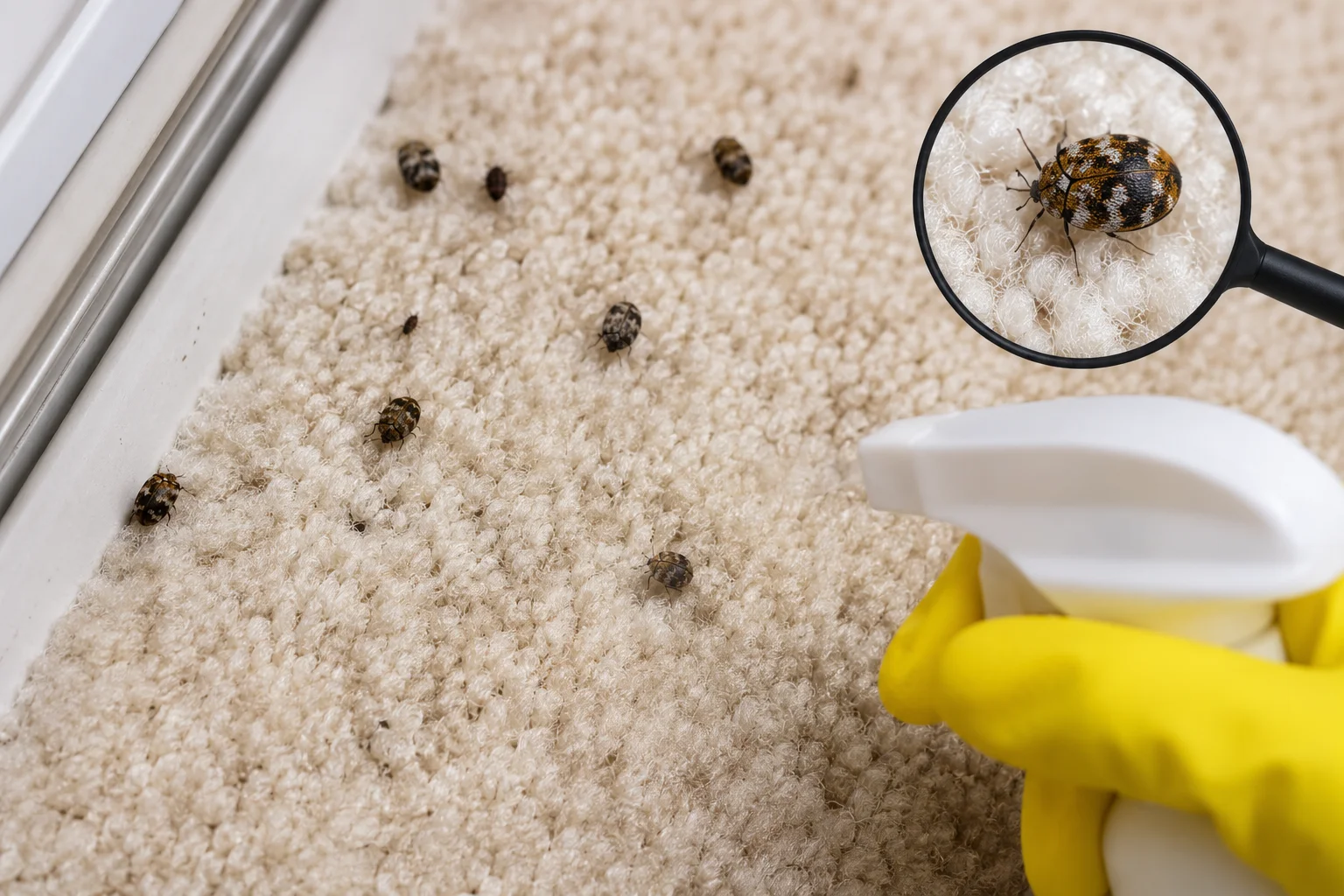
Finding small, oval beetles crawling near your windowsill is annoying enough. Discovering chewed holes in a wool sweater or a bald patch on your favorite rug is worse. Carpet beetles cause both problems, and once they settle into a home, they tend to stick around unless you address the infestation at every life stage, not just the adults you can see.
The good news is that carpet beetles are genuinely manageable with the right approach. This guide walks through exactly how to identify them, remove an existing infestation, and keep them from coming back.
What Are Carpet Beetles?
Carpet beetles are small household pests, typically about 1/8 inch long or smaller as adults. Varied carpet beetles show a mottled brown, black, and white pattern on their outer casing, while furniture carpet beetles look similar but carry touches of yellow as well.
However, the adults themselves aren’t the real problem. Adult carpet beetles feed on pollen and nectar outdoors, and they typically don’t damage fabric at all. Their larvae cause the actual destruction. Carpet beetle larvae feed on keratin-based materials, which includes wool, silk, fur, feathers, and leather. That’s exactly why you’ll often find damage concentrated in closets, wool rugs, and stored winter clothing rather than synthetic fabrics.
Because larvae prefer dark, undisturbed spaces, infestations frequently go unnoticed for weeks or even months. By the time you spot shed larval skins or fabric damage, the population has often already grown significantly.
Signs You Have a Carpet Beetle Infestation
A few telltale signs point directly to carpet beetles rather than other household pests.
- Shed skins. Larvae molt several times as they grow, leaving behind small, bristly skin casings in closets, drawers, or along baseboards.
- Irregular holes in fabric. Unlike moth damage, which often looks more uniform, carpet beetle damage tends to appear as scattered, irregular holes.
- Fecal pellets. Tiny, sand-like droppings near damaged fabric are another common indicator.
- Adult beetles near windows. Since adults feed outdoors and often enter through windows or vents, spotting them clustered near a windowsill is a common early warning sign.
- Damage concentrated in dark, undisturbed areas. Closets, under furniture, and inside storage boxes are prime larval hiding spots.
If you notice several of these signs at once, it’s worth doing a full room-by-room inspection before starting treatment, since larvae often hide well beyond the first spot you check.
How to Get Rid of Carpet Beetles: Step-by-Step
1. Vacuum Thoroughly and Repeatedly
Start with a vacuum cleaner that has strong suction and, ideally, a HEPA filter. Target carpets, rugs, baseboards, upholstery, curtains, bedding, and tight corners where beetles hide. Pay especially close attention to closets storing wool or other animal-based fabrics, since that’s where larvae concentrate most heavily.
Once you finish, immediately seal and dispose of the vacuum bag outdoors, or empty and wash a bagless canister with hot, soapy water. Skipping this step lets any collected eggs or larvae simply crawl back out.
2. Steam Clean Carpets, Rugs, and Upholstery
Heat kills carpet beetles at every life stage, including eggs. Steam cleaning penetrates fabric fibers deeply enough to eliminate larvae and eggs that vacuuming alone might miss. Focus extra time on high-traffic rugs and any upholstered furniture near previous damage.
3. Wash or Freeze Infested Textiles
For clothing, blankets, or smaller textiles, wash items in hot water whenever the fabric allows. For delicate items that can’t handle hot water or heat, seal them in a plastic bag and freeze them for at least 48 hours instead. Both methods reliably kill eggs and larvae without damaging most fabrics.
4. Apply Diatomaceous Earth for a Natural Option
Food-grade diatomaceous earth works as a non-toxic option that dehydrates and kills carpet beetles on contact. Sprinkle a light, even layer around affected areas, wait about 48 hours, then vacuum it up thoroughly. This method works especially well for households avoiding chemical treatments around children or pets.
5. Use Targeted Insecticides for Larger Infestations
For infestations that don’t respond to cleaning alone, insecticides containing cyfluthrin, bifenthrin, or deltamethrin tend to be most effective against carpet beetles specifically. Always test any product on a small, hidden area first to check for fabric or carpet discoloration, and keep children and pets away from treated areas until the product fully dries.
6. Treat Hidden Storage Areas
Attics, basements, and rarely used closets often harbor the source of a recurring infestation. Remove stored items, inspect them carefully, and discard anything heavily damaged with no remaining value. Vacuum these spaces thoroughly, including rafters and floor joists where accessible, since these unused areas can sometimes tolerate stronger residual insecticide treatments that wouldn’t be appropriate in a living space.
7. Call a Professional for Persistent Infestations
If you’ve gone through several cleaning and treatment rounds and beetles keep reappearing, a widespread or deeply established infestation may be at play. According to Orkin’s carpet beetle guidance, thorough cleaning combined with regular vacuuming and hot-water washing helps manage most infestations, though larger or recurring problems often require professional treatment. At that point, an exterminator can access treatment options and equipment that go beyond typical DIY methods.
Preventing Carpet Beetles From Coming Back
Removal only solves half the problem. Consistent prevention habits keep them from returning.
Vacuum regularly, not just during an active infestation. Weekly vacuuming removes the lint, hair, and skin flakes that carpet beetle larvae feed on, cutting off their food source before a population can build.
Store off-season clothing properly. Seal wool sweaters, coats, and other animal-based fabrics in airtight containers rather than open bins or garment bags.
Clean dryer lint traps and vents regularly. Lint accumulation provides an easy food source, and laundry rooms often serve as a highway between different areas of a home.
Seal entry points. Check window screens, door sweeps, and vents for gaps, since adult beetles frequently enter homes this way before laying eggs indoors.
Declutter storage spaces. Fewer piles of fabric, cardboard, and undisturbed clutter means fewer hiding spots for both eggs and larvae.
Schedule periodic deep cleanings. Steam cleaning carpets and rugs once or twice a year, even without visible signs of beetles, catches small populations before they grow into a full infestation.
If you’re dealing with other fabric-damaging pests alongside carpet beetles, our guide to identifying and treating clothes moths covers the key differences in signs and treatment, since the two pests are often confused with one another.
Frequently Asked Questions
What causes a carpet beetle infestation? Carpet beetles typically enter homes as adults through open windows, vents, or on cut flowers, then lay eggs near food sources like wool, lint, pet hair, or stored fabric. Once larvae hatch, they feed and multiply in dark, undisturbed areas.
Do carpet beetles bite humans? No, carpet beetles don’t bite. However, some people experience skin irritation from contact with the tiny hairs on carpet beetle larvae, which can resemble a bite or rash reaction.
How long does it take to get rid of carpet beetles? A mild infestation can often improve within a few weeks of thorough cleaning and treatment. Larger or long-established infestations may take several months of consistent effort, or professional treatment, to fully resolve.
Can carpet beetles live in mattresses? Yes. Larvae can hide in mattress seams and box springs, particularly if natural fibers like wool or cotton batting are present. Regular vacuuming of mattress seams helps catch this early.
Are carpet beetles dangerous to pets? Carpet beetles themselves generally aren’t dangerous to pets, though the tiny hairs on larvae can occasionally cause mild irritation if pets come into direct contact with them. Keeping treated areas pet-free until fully dry and vacuumed is still the safer approach.
What’s the difference between carpet beetles and clothes moths? Both damage fabric, but carpet beetles are small, oval, and hard-shelled, while clothes moths are soft-bodied and often seen flying. Carpet beetle larvae also tend to leave more irregular, scattered holes compared to moth damage.
Does heat really kill carpet beetles? Yes. Carpet beetles and their eggs generally can’t survive sustained temperatures above 120°F, which is why steam cleaning and hot-water washing are both effective, practical treatment methods.
When should I call a pest control professional for carpet beetles? If cleaning, steam treatment, and targeted insecticide use haven’t resolved the problem after several weeks, or if the infestation covers multiple rooms, a professional exterminator can access more comprehensive treatment options than typical DIY methods allow.
Final Thoughts
Carpet beetles are stubborn, but they’re rarely unbeatable. The real key is treating every life stage at once: vacuuming and steam cleaning to remove eggs and larvae, washing or freezing affected textiles, and following up with consistent prevention habits so a new population never gets the chance to establish itself. Stay consistent for the first few weeks, keep an eye on storage areas going forward, and most households can fully resolve an infestation without ever needing to call in professional help.