

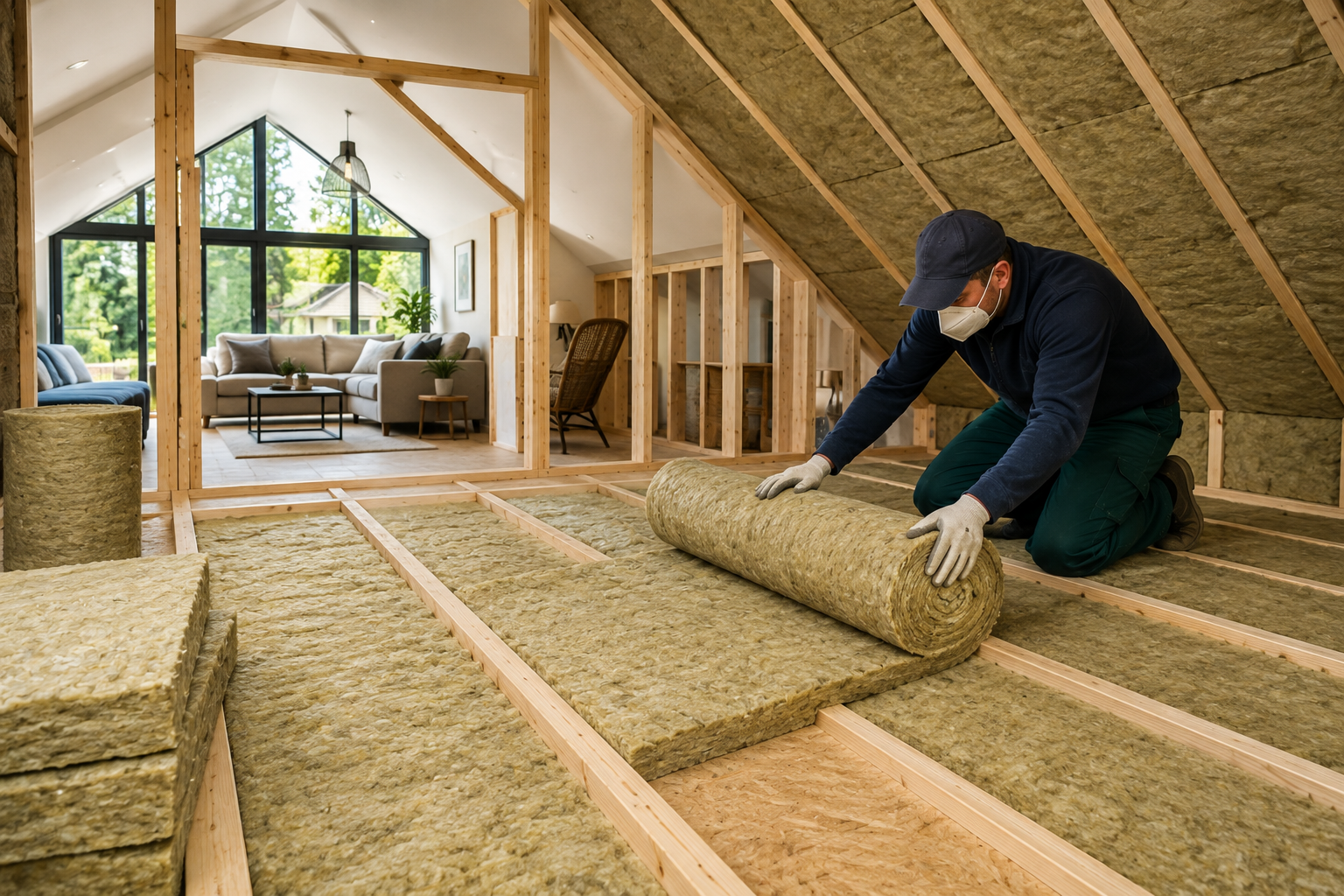
Insulation isn’t the most exciting home upgrade to think about. But it’s one of the few improvements that pays you back every month. It shows up as a lower energy bill. Mineral wool has become one of the most popular choices for homeowners. It delivers strong thermal performance without the higher price tag of spray foam.
This guide breaks down what mineral wool insulation actually is. You’ll see the different types available in 2026, what it costs installed, and how it stacks up against fiberglass and spray foam. By the end, you’ll know whether it’s the right fit for your project. You’ll also know what to expect when you get quotes.
What Is Mineral Wool Insulation?
Mineral wool is an insulation material made by melting natural rock or industrial slag. Manufacturers spin that molten material into fine fibers, similar to how cotton candy is made from sugar. They then press those fibers into batts, rolls, or rigid boards. About 70% of the material typically comes from natural rock. The rest is made up of recycled content, often recycled slag from steel production.
You’ll sometimes see mineral wool marketed under specific brand names, most commonly Rockwool or Roxul. Those are simply manufacturer brands, not a separate product category. All mineral wool shares the same basic composition and performance profile, regardless of brand.
Types of Mineral Wool Insulation
Mineral wool comes in a few distinct forms. Picking the right one depends on where in your home you’re insulating.
Batt Insulation
Batts are pre-cut panels sized to fit between standard wall studs, floor joists, or attic rafters. They’re the most common form for DIY installs and standard wall cavities. They also install quickly without special tools.
Rigid Board Insulation
Rigid boards offer higher density and more structural stability than batts. Builders often use them for exterior wall sheathing and basement walls. They also work well anywhere continuous insulation is needed to eliminate thermal bridging through wood studs.
Loose-Fill or Blown-In Mineral Wool
This form gets blown into wall cavities or attic spaces using specialized equipment. It’s especially useful for retrofitting older homes. Walls in these homes are already closed up, so batts aren’t practical to install.
Acoustic Mineral Wool
Higher-density mineral wool products are engineered specifically for soundproofing rather than temperature control. These are common in home theaters and shared walls between units. Recording spaces use them too, since noise reduction matters as much as thermal performance there.
What Mineral Wool Insulation Costs in 2026
Pricing depends heavily on product form, thickness, and labor. Based on current national averages, here’s what you can expect:
- Material cost alone: roughly $1.00 to $2.50 per square foot
- Fully installed (materials plus labor): roughly $1.40 to $4.50 per square foot
- Average full-home project: typically $2,000 to $7,000 for a standard 1,200 to 2,000 square foot home
- High-density acoustic or fire-rated boards: often exceed $4.50 per square foot installed
A few factors move these numbers up or down. Thicker material and higher R-values both increase cost. Difficult attic or wall access adds labor time too. Homes in coastal or major metro markets also tend to see higher labor rates than rural areas, sometimes by 20% or more. If you’re also addressing moisture in a basement while you’re at it, our basement humidity guide covers a related weak point in many homes.
For comparison, standard fiberglass batts usually run slightly cheaper. Expect around $1.00 to $1.50 per square foot installed. Spray foam typically costs $3.00 to $4.00 per square foot or more. Mineral wool sits in between on price. It still outperforms fiberglass on fire resistance and sound dampening.
Benefits of Mineral Wool Insulation
Mineral wool has earned its popularity for a few specific reasons. These go beyond simple energy savings.
- Strong fire resistance. Mineral wool can typically withstand temperatures above 1,800°F. It won’t melt or release toxic fumes, which makes it a common choice for fire-rated wall assemblies.
- Excellent sound dampening. The dense fiber structure absorbs sound far better than fiberglass. That’s why it’s a go-to material for home theaters and shared walls in multi-family buildings.
- Moisture resistance. Mineral wool doesn’t readily absorb water. It dries out without losing its insulating properties, which helps prevent mold growth in damp climates.
- Doesn’t support pests. Rodents and insects generally won’t nest in mineral wool. It offers no nutritional value and an uncomfortable fiber texture.
- Higher R-value per inch than fiberglass. Mineral wool typically delivers an R-value around 3.0 to 3.3 per inch. That means better thermal performance without needing extra thickness.
Mineral Wool vs. Fiberglass vs. Spray Foam
Choosing between insulation types usually comes down to three things: budget, climate, and how much installation disruption you can tolerate.
Mineral wool costs more than fiberglass. But it delivers better fire safety, sound control, and moisture resistance. It’s a strong pick for homeowners who want a meaningful upgrade without jumping to spray foam pricing. Our batt insulation guide covers fiberglass batt options in more depth if that’s the direction you’re leaning.
Fiberglass remains the most budget-friendly option. You’ll find it at every home improvement store. It performs well for standard insulation needs, but it falls short on fire resistance and soundproofing compared to mineral wool.
Spray foam offers the best air-sealing performance of the three. It expands to fill gaps and cracks that batts simply can’t reach. It’s also the most expensive option, and it requires professional installation, since the chemicals involved need careful handling.
If your main priority is fire safety or noise reduction, mineral wool is usually the better value. If air sealing and maximum energy efficiency matter most, spray foam earns its higher price tag.
How Much Insulation Do You Actually Need?
R-value requirements vary significantly depending on where you live. The Department of Energy divides the US into climate zones. Each zone comes with different recommended R-values for attics, walls, floors, and crawl spaces. A home in Minnesota needs considerably more insulation than a home in southern Florida to hit the same efficiency target.
The ENERGY STAR program’s home insulation guide breaks down recommended R-values by climate zone and location within the home. It’s worth checking before you buy materials or request quotes. Getting the R-value right matters more than picking a specific brand. Underinsulating even a well-made product still leaves money on the table every winter and summer.
Is Mineral Wool Worth the Extra Cost?
For most homeowners, yes. This is especially true if fire resistance, sound control, or moisture-prone conditions are a real concern. The price premium over fiberglass is usually modest, often just 20 to 40 cents more per square foot for batt products. The performance gains, meanwhile, are meaningful.
Are you renovating a shared wall, finishing a basement, or building in a wildfire-prone region? If so, mineral wool’s fire rating and moisture resistance can genuinely justify the added cost. For a straightforward attic top-up in a low-risk area, standard fiberglass may deliver similar savings at a lower price point.
If you’re comparing insulation options for an upcoming renovation, our complete guide to home insulation types and R-values walks through additional materials in more depth, including cellulose and spray foam.
Actionable Tips Before You Buy
- Get at least three quotes. Installed pricing varies widely by region and contractor. Comparing bids typically saves 15% or more.
- Match the R-value to your climate zone, not just your budget. Underinsulating costs more in the long run through higher utility bills.
- Ask about batt vs. board pricing separately. Rigid boards cost more, but they may save money overall if you’re also solving an air-sealing or soundproofing problem.
- Check for local utility rebates. Many US utility companies offer rebates for insulation upgrades that meet ENERGY STAR guidelines. That can offset a meaningful chunk of the installed cost.
- Wear proper protective gear during DIY installs. Mineral wool fibers can irritate skin, eyes, and lungs. Gloves, long sleeves, and a respirator mask are worth the extra ten minutes of prep.
- Don’t compress batts to fit. Squeezing mineral wool into a smaller space than it’s rated for reduces its R-value. That defeats the purpose of the upgrade.
Is Mineral Wool an Environmentally Friendly Choice?
Sustainability matters more to homeowners than it used to. Mineral wool holds up reasonably well on that front. Most products contain a meaningful percentage of recycled content, often recycled slag diverted from steel manufacturing. That reduces landfill waste. The raw rock component is also abundant, and it doesn’t rely on petroleum the way spray foam does.
On top of the manufacturing story, mineral wool’s long lifespan means fewer replacement cycles over the life of a building. A batt installed today can realistically outlast the home’s original mortgage. That reduces the embodied carbon cost per year of actual use. If sustainability is a priority for your project, look for products with third-party certifications like GREENGUARD Gold. These confirm low chemical emissions and safer indoor air quality.
Installation: DIY vs. Hiring a Pro
Batt insulation is one of the more approachable DIY insulation projects. It works especially well for open wall cavities or unfinished attics. Most homeowners with basic tools can complete a standard attic top-up in a weekend.
That said, a few situations call for a professional crew:
- Rigid board installations, which often require precise cutting and fastening for a continuous air barrier
- Blown-in retrofits in already-finished walls, since this requires specialized equipment
- Any project involving knob-and-tube wiring, older electrical systems, or existing moisture damage that needs remediation first
- Attics with limited access or low clearance, where working safely takes real experience
If you’re unsure which category your project falls into, most insulation contractors offer a free on-site estimate. That visit alone often reveals access issues or code requirements. Those details aren’t always obvious from measurements alone, so it’s worth doing before you commit to a DIY approach.
Final Thoughts
Mineral wool insulation has carved out a solid middle ground in 2026. It offers better fire resistance, sound control, and moisture performance than fiberglass, at a lower price than spray foam. Are you insulating a new build, retrofitting an older home, or soundproofing a shared wall? Either way, matching the right product form and R-value to your specific climate zone is the single biggest factor in getting real value from the investment.
Frequently Asked Questions
How much does mineral wool insulation cost per square foot? Material costs typically run $1.00 to $2.50 per square foot. Fully installed pricing, materials plus labor, usually falls between $1.40 and $4.50 per square foot. The exact number depends on thickness, product form, and regional labor rates.
Is mineral wool insulation better than fiberglass? Mineral wool generally offers better fire resistance, sound dampening, and moisture resistance than fiberglass. It also has a slightly higher R-value per inch. Fiberglass remains cheaper and widely available, which makes it a reasonable choice for standard, low-risk insulation projects.
Is mineral wool insulation safe to install yourself? Yes, with proper precautions. Wear gloves, long sleeves, eye protection, and a respirator mask, since the fibers can irritate skin and lungs during handling. Batt insulation is generally DIY-friendly. Rigid board and blown-in installations often benefit from professional experience.
How long does mineral wool insulation last? Mineral wool typically lasts 30 to 80 years without significant performance loss. It doesn’t compress, rot, or lose R-value the way some other materials can over time. Its lifespan often matches or exceeds the life of the home itself.
Does mineral wool insulation help with soundproofing? Yes, mineral wool is one of the most effective insulation materials for sound dampening. That comes down to its dense fiber structure. It’s a common choice for home theaters, recording spaces, and shared walls between apartment or condo units.
Is mineral wool insulation fireproof? Mineral wool isn’t technically fireproof, but it’s highly fire-resistant. It can withstand temperatures above 1,800°F without melting or releasing toxic smoke. That performance makes it a popular choice for fire-rated wall assemblies and homes in wildfire-prone regions.
What R-value does mineral wool insulation provide? Mineral wool typically delivers an R-value of about 3.0 to 3.3 per inch of thickness. That’s slightly higher than standard fiberglass batts. The exact R-value you need depends on your climate zone and which part of the home you’re insulating.
Can mineral wool insulation get wet without losing effectiveness? Mineral wool resists water absorption and dries out without significant loss of insulating performance. That’s unlike some materials, which lose R-value when damp. That said, persistent moisture problems should still be addressed at the source, since no insulation material performs well under constant water exposure.
Pricing reflects US national averages as of June 2026 and is subject to change based on region, product brand, and contractor rates. Always confirm current pricing and R-value recommendations for your specific climate zone before purchasing materials or scheduling installation.