

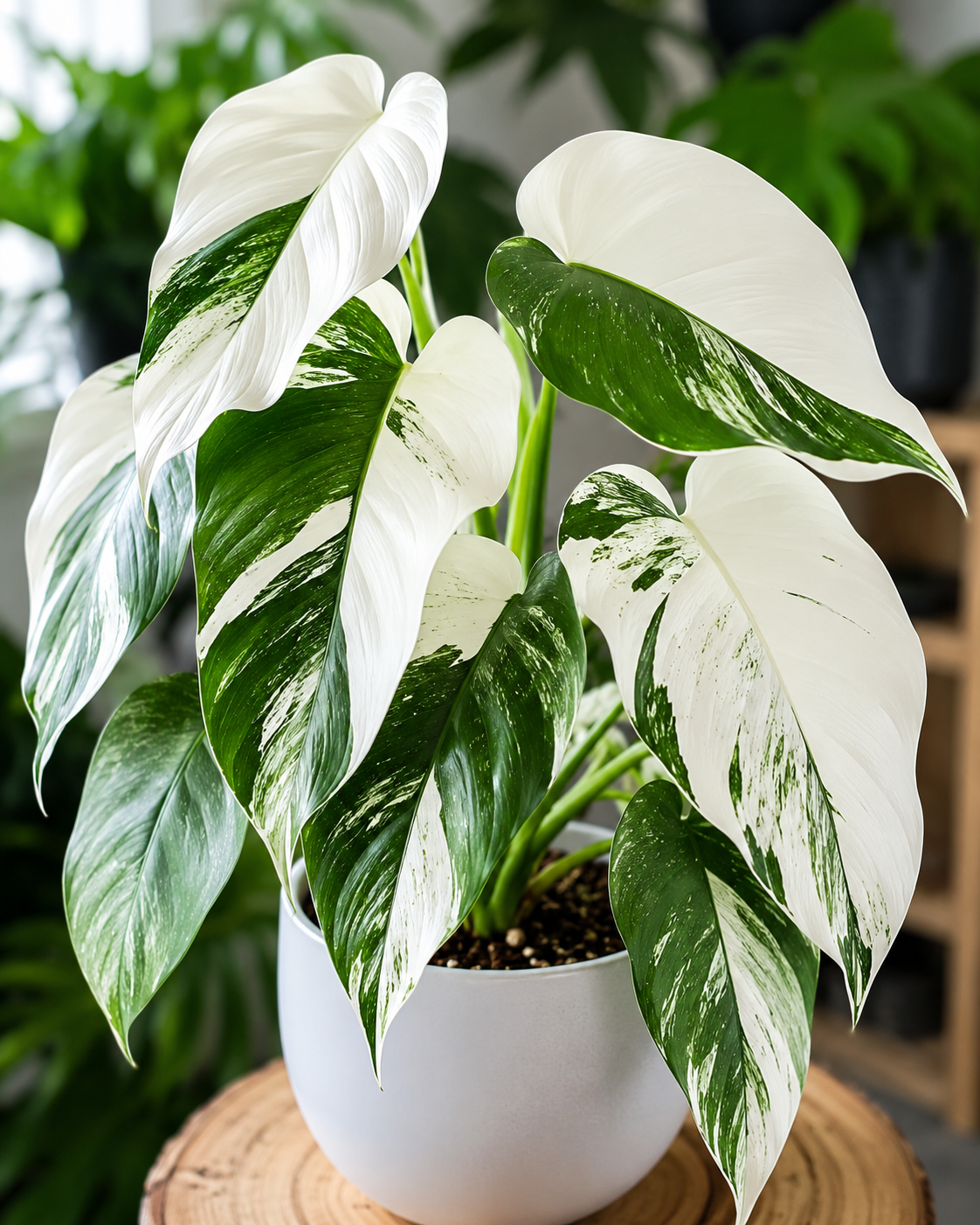
If you’ve ever stopped scrolling because of a leaf that looked half-green, half-snow — you’ve already met the White Wizard Philodendron. This variegated cultivar is one of the most sought-after houseplants in the U.S. rare plant community. As a result, prices range from $40 for a small cutting to over $300 for a mature specimen. Unlike many hyped plants, however, the White Wizard genuinely earns its reputation. It’s a climber with real personality, and it rewards attentive growers generously.
This guide pulls together hands-on experience, collector community knowledge, and current horticultural research. Whether you just unboxed your first cutting or you’ve been growing aroids for years, you’ll find everything you need right here.
What Exactly Is the White Wizard Philodendron?
The White Wizard is a cultivar of Philodendron erubescens — the same species behind the Pink Princess and White Princess. Its standout feature is crisp, bright-white variegation. That white coloring results from a genetic mutation that reduces chlorophyll in certain cells. Because of this, those white sections contain zero chlorophyll at all. Heavy variegation is beautiful, but it does come with real trade-offs in growth speed and vigor.
In terms of appearance, stems and petioles are typically deep green with a reddish blush. That detail, for example, distinguishes it from the White Princess, whose stems lean more pinkish-white. Leaves range from lightly flecked to almost entirely white on one side — what collectors call “half-moon” variegation. The more white a leaf carries, the more carefully you need to manage the plant’s energy, since photosynthesis only happens in the green sections.
Philodendron erubescens is naturally a climbing vine from the tropical rainforests of South America. In the wild, it scrambles up tree trunks under a filtered canopy. As a result, that origin story tells you everything about the conditions it prefers indoors.
Light Requirements: Getting the Balance Right
Lighting is where most White Wizard problems start. Too little light causes variegation to fade, because the plant pushes out more chlorophyll as a survival response. On the other hand, too much direct sun scorches the white sections within hours, leaving brown patches that never recover.
The sweet spot is bright, indirect light for 6 to 8 hours daily. For U.S. growers, an east-facing window is ideal — you get gentle morning sun without harsh afternoon rays. In contrast, north-facing windows rarely deliver enough light on their own. South or west-facing windows can work well; however, you’ll want to diffuse the light with a sheer curtain or keep the plant a foot or two back from the glass.
Grow lights have therefore become a real game-changer, especially in northern states. Minnesota, Michigan, and Washington, for instance, all see dramatic drops in winter light levels. A full-spectrum LED positioned 12–18 inches above the foliage on a 12-hour timer works reliably. In fact, many experienced growers report that consistent grow light use in winter actually stabilizes variegation better than relying on low natural light.
Finally, one easy habit to add: rotate the pot a quarter turn every two weeks. This prevents one-sided growth and keeps light distribution even across all the leaves.
Watering: Less Is Almost Always More
The White Wizard tolerates a missed watering far better than it tolerates soggy soil. In fact, overwatering is the single most common cause of decline in this plant. It tends to creep up quietly — first as yellowing lower leaves, then as root rot that’s already advanced before you notice anything is wrong.
Water thoroughly when the top 1–2 inches of soil feel dry. In a warm, bright spot during summer, for example, that might mean watering every 5–7 days. In winter or lower-light conditions, however, stretch that to every 10–14 days. Always check the soil before watering rather than following a fixed schedule, because conditions vary too much from home to home.
Drainage is, above all, non-negotiable. Use a pot with at least one drainage hole and never let the plant sit in a saucer of standing water. Terracotta pots are helpful if you tend to overwater; alternatively, plastic nursery pots retain moisture longer, which suits drier climates or heated apartments better. Water quality matters too. Fluoride and chlorine in tap water can cause tip burn on variegated leaves. As a result, growers in cities like Phoenix or Las Vegas — where tap water is notoriously hard — often filter their water or let it sit overnight first.
Soil Mix: Aeration Is Everything
Standard potting mix straight from the bag is too dense for this plant. Instead, you want a chunky, well-draining aroid mix that holds just enough moisture while letting roots breathe freely. A reliable recipe for most U.S. climate zones combines two parts quality potting soil, one part perlite, and one part orchid bark.
Additionally, some growers add worm castings for slow-release nutrition. A handful of horticultural charcoal also keeps the mix fresh and discourages bacterial buildup. For those comfortable with semi-hydroponic setups, LECA (lightweight expanded clay aggregate) is another strong option. It virtually eliminates overwatering risk and can speed up root development. The trade-off, however, is that it requires a different approach to fertilization.
Repot only when roots are escaping drainage holes or circling at the soil surface. White Wizards actually perform better slightly root-bound, so unnecessary repotting just stresses them. If you do need to size up, spring is the best time. In that case, choose a container only 1–2 inches larger in diameter than the current one.
Temperature and Humidity: Recreating the Tropics
White Wizard Philodendrons thrive between 65°F and 85°F. Most American homes stay comfortably within that range during summer. The bigger challenge, however, is humidity. Winter heating systems can drop indoor humidity to 20–30% — far below the 50–70% this plant prefers.
A small humidifier near your plant collection is therefore the most reliable fix. It’s also far more consistent than misting, which can invite fungal issues when water lingers on the leaves. Additionally, grouping plants together raises ambient humidity naturally through transpiration — a favorite trick of apartment collectors all across the country.
Beyond humidity, keep the plant away from heating vents, A/C drafts, and exterior doors. Cold drafts below 55°F can shock it and trigger leaf drop. Similarly, prolonged exposure below 50°F may cause permanent damage. In USDA hardiness zones 10–12 — for example, South Florida, Hawaii, and coastal Southern California — this plant can grow outdoors year-round in a shaded spot.
Fertilizing for Healthy, Variegated Growth
Feed your White Wizard during the active growing season. In most of the U.S., that runs from March through September. During this period, use a balanced liquid fertilizer at half strength every 3–4 weeks. Look for an NPK ratio around 20-20-20, or choose a formula made specifically for aroids.
That said, resist the urge to fertilize more heavily hoping for faster growth. Excess nitrogen can actually push the plant toward producing more solid-green leaves, since it prioritizes energy when nutrients are overloaded. As an alternative, some collectors switch to a lower-nitrogen formula like 5-10-10 in the second half of the growing season. This approach tends to support stronger stems and more stable variegation.
In fall and winter, therefore, cut back to once every 6–8 weeks — or stop entirely if growth has paused. Fertilizer salts accumulate in soil over time and can damage roots. To prevent this, flush the soil occasionally with plain water to clear that buildup.
Propagation: How to Make More White Wizards
Propagating the White Wizard is exciting — and a little nerve-wracking. Every cutting is a gamble on which variegation pattern the new plant will express. For that reason, watching a new leaf unfurl is genuinely thrilling.
Stem cuttings are the most reliable method. Cut just below a node — the knobby point where leaves and aerial roots emerge. Each cutting needs at least one node and ideally one leaf. Furthermore, use clean, sterilized scissors or a knife to avoid introducing pathogens.
Place the cutting in water, moist sphagnum moss, or perlite to root. Water propagation lets you watch root development easily. However, water-grown roots sometimes struggle when transitioning to soil. In contrast, sphagnum moss tends to produce sturdier roots that adapt to soil quickly. Keep cuttings in a warm spot with bright indirect light and change water weekly if using the water method.
Roots usually develop within 3–6 weeks. Once roots reach 1–2 inches long, pot the cutting up. Keep it in slightly higher humidity for the first few weeks as it adjusts. One important note: cuttings from heavily variegated sections can produce plants with unstable variegation. For the most reliable results, therefore, always cut from sections with balanced half-and-half coloring.
Staking and Training Your Climber
White Wizard is a natural climber, so giving it something to scale makes a noticeable difference in performance. Plants allowed to climb produce significantly larger leaves — sometimes dramatically so. A moss pole or coco coir pole is the classic choice; the plant’s aerial roots grip the pole and draw moisture from it, mimicking life on a rainforest tree.
Insert the pole at planting time to avoid disturbing established roots later. Secure new growth gently with soft plant ties or strips of pantyhose — never wire, since it cuts into stems. Additionally, mist the pole occasionally to keep it moist and encourage aerial roots to attach.
Wooden boards, bamboo stakes, or even a homemade burlap-wrapped plank all work well too. Above all, the key is giving the plant upward direction. Without support, stems sprawl and you lose the tall, dramatic silhouette that makes a mature White Wizard so impressive.
Common Problems and How to Fix Them
Yellowing leaves most often signal overwatering or poor drainage. Check the roots — healthy roots are white or tan, while rotted roots are brown, mushy, and often smell bad. As a result, you’ll want to trim away any rot, let the plant dry out, and repot in fresh mix.
Brown leaf tips or edges usually point to low humidity, inconsistent watering, or fluoride sensitivity in the variegated sections. Fortunately, switching to filtered water and raising humidity often clears this up within a few growth cycles.
Loss of variegation happens when the plant isn’t getting enough light. In that case, move it somewhere brighter. If fully green growth keeps coming, additionally prune back to the last variegated node. This signals the plant to produce variegated leaves again.
Pests to watch for include thrips, spider mites, and mealybugs, so inspect leaf undersides regularly. Early detection makes treatment far easier. For example, neem oil, insecticidal soap, or isopropyl alcohol on a cotton swab handles most infestations effectively. Our Kimberly Fern guide covers the same pest treatment for another humidity-loving tropical.
For deeper troubleshooting on variegated aroids, the University of Florida IFAS Extension offers peer-reviewed resources on tropical houseplant care and pest management.
Where to Buy a White Wizard Philodendron in the USA
The White Wizard remains a specialty item in 2026. As a result, you won’t find it at Home Depot or Lowe’s. Your best sources are:
- Etsy — search for verified sellers with strong reviews and photos of the actual parent plant
- Facebook Marketplace and local plant swap groups — often the best prices, and you can inspect before buying
- Specialty aroid nurseries — operations like Gabriella Plants (Florida) and Steve’s Leaves (Texas) ship nationally
- Plant shows and swap meets — great for meeting serious collectors and finding unusual specimens
When buying online, always request photos of the actual plant — not stock images. Additionally, ask about the seller’s packing method and avoid ordering during extreme weather. Plants shipped in a heatwave or a hard freeze rarely arrive in good shape.
You might also enjoy our Philodendron Billietiae care guide to find your next aroid obsession.
Frequently Asked Questions
How fast does a White Wizard Philodendron grow?
Growth depends heavily on conditions. In ideal light, warmth, and humidity, expect 1–3 new leaves per month during the growing season. In winter or low light, however, growth slows significantly or stops entirely. A moss pole and consistent fertilization during spring and summer will therefore push growth toward the faster end.
Is the White Wizard Philodendron toxic to pets?
Yes — like all Philodendrons, it contains calcium oxalate crystals that are toxic to cats, dogs, and humans if ingested. Symptoms include oral irritation, drooling, vomiting, and difficulty swallowing. As a result, keep it well out of reach of pets and children. Additionally, the sap can cause mild skin irritation, so always wash your hands after handling it.
Why does my White Wizard keep producing green leaves?
This is called reversion, and it typically means the plant isn’t receiving enough light. First, move it somewhere brighter. Then, prune back any fully green stems to the last variegated node. This prompts the plant to push new, variegated growth instead.
What’s the difference between White Wizard and White Princess Philodendron?
Both are cultivars of Philodendron erubescens with white variegation. However, they differ in stem color — White Wizard has deep green stems with reddish undertones, while White Princess has lighter, pinkish-white stems. Leaf shape differs slightly too. Both need similar care, though White Princess is sometimes considered a touch less vigorous overall.
Can I grow a White Wizard Philodendron outside in the USA?
Only in frost-free regions — specifically USDA zones 10–12, which includes South Florida, Hawaii, and parts of coastal Southern California. In those areas, dappled shade outdoors works well year-round. Everywhere else in the country, however, it’s strictly an indoor plant and should never be exposed to temperatures below 55°F.
How do I know if my White Wizard cutting has rooted?
In water, you’ll see white roots emerging from the node — usually within 3–6 weeks. In sphagnum moss or perlite, gently tug the cutting after four weeks; resistance means roots have formed. Furthermore, new leaf growth is another reliable sign, since it typically only emerges once the cutting has established roots.
Why are White Wizard Philodendrons so expensive?
Slow growth and high demand both drive the price. Because heavily variegated plants photosynthesize less efficiently, they grow more slowly than solid-green plants. As a result, nurseries simply can’t mass-produce them. Tissue culture (TC) cloning has started to bring costs down — TC White Wizards are more available through specialty growers in 2025–2026 — but high-variegation specimens still command a strong premium.
Should I mist my White Wizard Philodendron?
Misting isn’t recommended as a primary humidity strategy. Water droplets sitting on the leaves — especially the white sections — can encourage fungal spots and bacterial issues. Instead, a nearby humidifier is safer and far more effective. If you do enjoy misting, however, do it early in the day so the leaves dry completely before nightfall.
[…] you are also growing other trailing aroids, our White Wizard Philodendron guide covers similar humidity and variegation-preserving lighting […]
[…] promptly, and improve lighting conditions. This encourages colorful new growth going forward. Our White Wizard Philodendron guide covers the same reversion issue for another variegated […]