

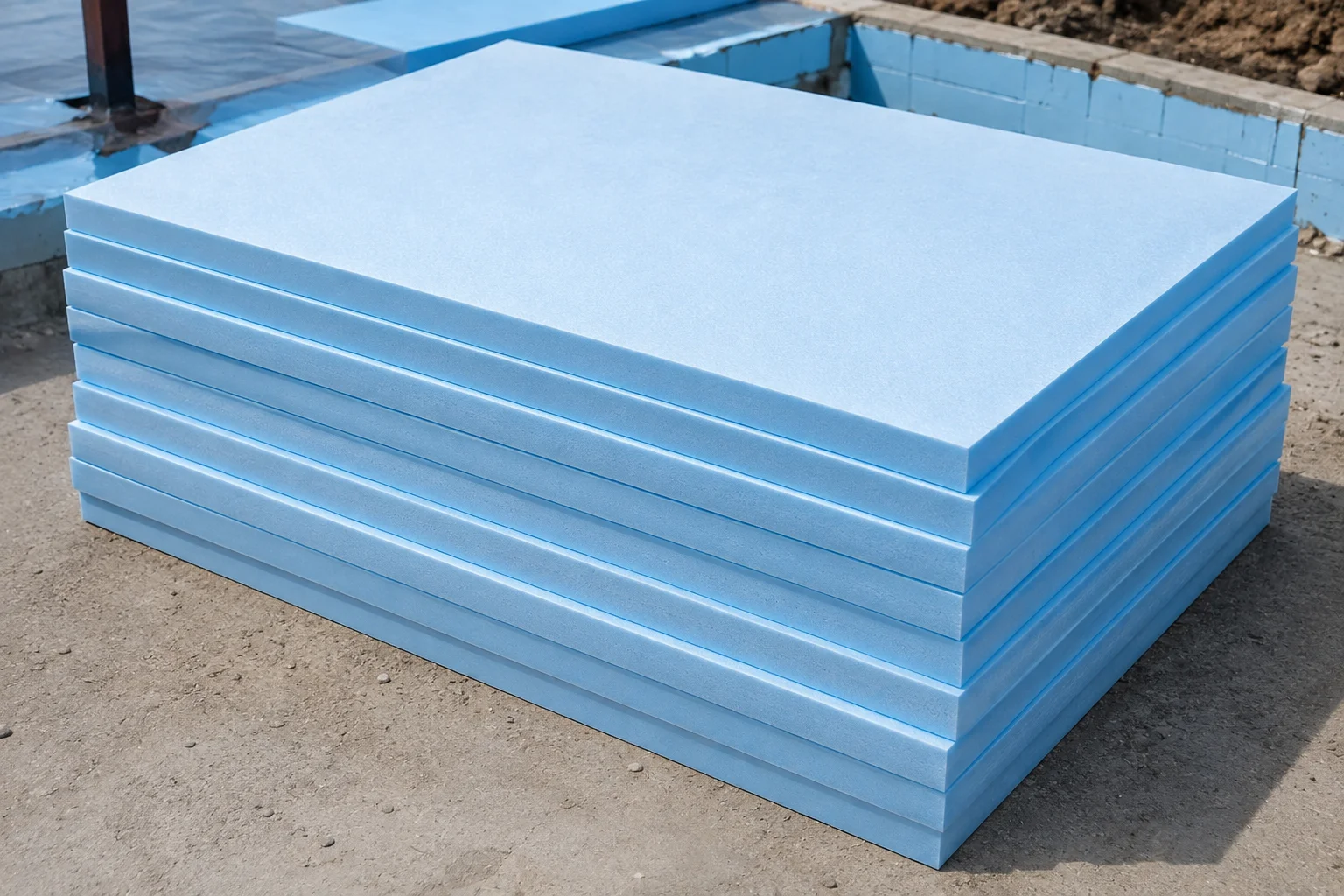
Walk into any building supply store’s insulation aisle, and you’ll spot it right away. That smooth, colored foam board, usually pink, blue, or green depending on the manufacturer, is XPS. It’s one of the most widely used rigid insulation materials in residential and commercial construction. It resists moisture, holds its shape under pressure, and delivers solid thermal performance in a relatively thin profile.
However, XPS isn’t the only rigid foam option on the market. It isn’t always the cheapest or most efficient choice for every project either. Before you buy a truckload, you need real numbers on cost, R-value, and where this material genuinely outperforms its competitors. This guide covers all of it.
What Is XPS Foam Board?
XPS stands for extruded polystyrene. Manufacturers create it by feeding polystyrene and a blowing agent into an extruder. They then force the mixture through a slot die to form a continuous sheet. That extrusion process packs the material’s cells tightly together, which gives XPS its signature closed-cell structure.
This closed-cell design matters a lot in practice. Because the cells sit so tightly packed, moisture struggles to pass through the board. That property makes XPS a strong choice anywhere water exposure is a real concern, particularly in below-grade applications like basement walls and foundations.
You’ll typically recognize XPS by its color. Dow’s version comes in blue, while Owens Corning produces a pink version. Other manufacturers sometimes use green. The color itself doesn’t affect performance. It simply reflects branding from each individual manufacturer.
XPS Foam Board R-Value
R-value measures how well a material resists heat flow. Higher numbers mean better insulating performance. XPS delivers approximately R-5 per inch of thickness, based on data from multiple sources. Some measurements place it slightly lower, in the R-4.5 range, depending on testing conditions and product age.
Because R-values are additive, thicker boards deliver proportionally higher performance. A 2-inch XPS board provides roughly R-10, while a 3-inch board delivers close to R-15. That scaling makes it straightforward to calculate exactly how much material you’ll need for your project.
One detail is worth knowing before you buy. XPS can lose a small amount of R-value over time as its blowing agent gradually off-gasses. Some studies suggest the R-value can drop from roughly 5.0 to around 4.7 after about five years, with a slower decline continuing after that. This aging effect isn’t dramatic, but it’s worth factoring in if you’re calculating long-term thermal performance for a critical application.
XPS vs. EPS vs. Polyiso: How It Compares
Three rigid foam types dominate the market, and each one fills a slightly different role.
EPS (Expanded Polystyrene): Molded from small foam beads rather than extruded, EPS delivers a lower R-value, typically around R-3.6 to R-4.2 per inch. However, it costs significantly less than XPS, often close to half the price. EPS also holds its R-value more consistently over time, since it doesn’t rely on a gradually off-gassing blowing agent the way XPS does.
Polyiso (Polyisocyanurate): This foil-faced foam delivers the highest R-value per inch among the three, typically in the R-5.6 to R-6.5 range at room temperature. That said, polyiso’s performance drops noticeably in cold weather. This makes it a less reliable choice for exterior applications in colder climates, unless installers factor in a derated value.
XPS: Sitting in the middle, XPS balances moisture resistance, compressive strength, and solid mid-range R-value. It costs more than EPS but generally less than polyiso. Its performance also stays more consistent across a wider temperature range than polyiso does.
Choosing between these three often comes down to your specific application rather than R-value alone. For below-grade foundation walls facing constant moisture exposure, XPS remains the traditional go-to. For budget-conscious above-grade projects, EPS often delivers adequate performance at a meaningfully lower cost and for roof and wall sheathing where maximum R-value per inch matters most, polyiso frequently wins out, as long as the application isn’t in an unheated, cold-climate space.
XPS Foam Board Cost in 2026
Pricing on XPS varies depending on thickness, retailer, and whether you’re buying by the board foot or by the square foot for a finished installation.
- Material cost per board foot: XPS typically runs $0.40 to $0.50 per board foot, where one board foot equals a 1-square-foot piece that’s 1 inch thick.
- Material cost per square foot: For a standard 2-inch board, total material costs generally fall between $0.70 and $1.50 per square foot, with thicker boards pushing toward the higher end of that range.
- Comparison to EPS: EPS runs noticeably cheaper, at roughly $0.25 to $0.35 per board foot. That gives it the best insulation-to-cost ratio of the three common rigid foam types.
- Comparison to polyiso: Polyiso generally costs $0.90 to $2 per square foot for material alone. Full installation costs range from $1.75 to $4 per square foot once labor is included.
For a real-world example, a typical 1,000-square-foot basement wall insulated with 2 inches of XPS requires roughly 2,000 board feet of material. That translates to somewhere between $600 and $1,000 in material costs alone. Buying in bulk directly from a distributor, rather than by the individual sheet from a home center, can often save 15 to 20 percent off that total.
Common Uses for XPS Foam Board
XPS shows up across a wide range of residential and commercial applications, largely thanks to its moisture resistance and compressive strength.
Below-grade foundation and basement walls. This remains XPS’s signature application. Its closed-cell structure resists water absorption far better than EPS, making it a reliable choice against consistently damp soil conditions.
Under-slab insulation. Placed beneath concrete slabs, XPS handles the compressive load from the slab above while still delivering solid thermal performance. This is an application where its strength genuinely matters more than in vertical wall installations.
Exterior wall sheathing. Many builders use XPS as a continuous insulation layer over wall studs. This reduces thermal bridging while still providing usable water resistance during construction, before final siding goes on.
Roofing insulation. XPS appears in certain roofing assemblies, particularly where moisture exposure is a concern, such as below roofing membranes in low-slope commercial applications.
Cold storage and refrigeration buildings. Because XPS actually performs slightly better in colder temperatures, it’s a common choice for buildings that maintain consistently low interior temperatures.
Where XPS Makes Sense by U.S. Climate Zone
Regional building codes and climate conditions genuinely affect which rigid foam type makes the most financial and performance sense.
Northern and cold climates (Minnesota, Wisconsin, Upstate New York, New England): XPS performs especially well here. It holds up in consistently cold, damp conditions without the cold-weather performance drop that affects polyiso.
Mid-Atlantic and Midwest (Ohio, Pennsylvania, Illinois): Basement and below-grade applications remain the most common use case here, particularly in older housing stock with a history of moisture issues.
Southeast and Gulf Coast (Florida, Louisiana, Georgia): Humidity and moisture exposure make XPS’s water resistance valuable. Above-grade applications sometimes lean toward EPS for cost savings, though, given the region’s less extreme heating demands.
Southwest (Arizona, Nevada, Texas): Cooling load, rather than heating performance, drives insulation decisions here. XPS still performs well. Budget-conscious builders sometimes opt for EPS in above-grade walls where R-value requirements are less demanding, though.
Pacific Northwest: Consistent moisture and mild temperatures make XPS a strong fit. This applies to both foundation walls and certain exterior sheathing applications.
Local building codes ultimately determine minimum required R-values based on your specific climate zone. Checking those requirements before finalizing material choice and thickness is a genuinely important step.
Installation Tips for XPS Foam Board
Getting installation right matters just as much as choosing the right material.
Calculate thickness based on your target R-value. Divide your desired total R-value by XPS’s per-inch rating, roughly R-5, to determine how many inches of material you actually need.
Tape and seal every seam. Foam board insulation only performs at its rated value when installers treat seams and edges as part of the overall thermal system, not an afterthought.
Protect edges during installation. Damaged or crushed edges compromise both the insulating performance and the moisture resistance that makes XPS worth its premium price over EPS.
Check local code requirements before finalizing thickness. Since minimum R-value requirements vary by climate zone, confirming your local code prevents under-insulating a critical wall or foundation assembly.
Consider bulk purchasing for larger projects. As mentioned earlier, buying XPS in bulk from a distributor rather than by the sheet can meaningfully reduce material costs on larger jobs like full basement insulation.
If you’re deciding between rigid foam types for an upcoming project, our guide to choosing the right insulation material for your home walks through additional comparisons across climate zones and project types worth reviewing before you buy.
For a broader, government-sourced overview of insulation materials and how they’re rated, the U.S. Department of Energy’s insulation materials guide offers a helpful, neutral reference point alongside any manufacturer-specific claims you come across while shopping.
Frequently Asked Questions
What is the R-value of XPS foam board? XPS typically delivers approximately R-5 per inch of thickness. Some measurements place it slightly lower, closer to R-4.5, depending on testing conditions and the board’s age.
How much does XPS foam board cost? Material costs generally run $0.40 to $0.50 per board foot, or roughly $0.70 to $1.50 per square foot for a standard 2-inch board, depending on thickness and retailer.
Is XPS better than EPS? It depends on the application. XPS offers better moisture resistance and a higher initial R-value, making it the stronger choice below-grade. EPS costs significantly less and holds its R-value more consistently over time, making it a smart choice for above-grade, budget-conscious projects.
Does XPS foam board lose R-value over time? Yes, to a modest degree. Some studies suggest XPS can drop from roughly R-5.0 to around R-4.7 after about five years. A continued gradual decline follows afterward, as its blowing agent slowly off-gasses.
What color is XPS foam board? Color depends on the manufacturer rather than performance. Dow produces a blue version, Owens Corning makes a pink version, and other manufacturers sometimes use green.
Can XPS foam board be used below grade? Yes, this is one of XPS’s most common and best-suited applications. Its closed-cell structure resists moisture absorption far better than EPS, making it a reliable choice for basement walls and foundation insulation.
How thick should XPS foam board be for a basement wall? Most basement wall applications use 2 to 3 inches of XPS, delivering roughly R-10 to R-15. Your specific local code requirements should ultimately guide the final thickness decision.
Is XPS foam board a good choice for exterior wall sheathing? Yes, many builders use it as a continuous insulation layer over wall studs to reduce thermal bridging. It also offers temporary water resistance during construction, before final siding is installed.
Final Thoughts
XPS foam board earns its reputation as a reliable, moisture-resistant insulation option, particularly for below-grade and high-moisture applications where its closed-cell structure genuinely outperforms cheaper alternatives. That said, it isn’t automatically the best choice for every project. Above-grade walls on a tighter budget often do just as well with EPS. Roofs and wall sheathing chasing maximum R-value per inch may benefit more from polyiso instead. Match the material to your specific application and climate, calculate your thickness carefully, and XPS will likely deliver the long-term thermal and moisture performance it’s known for.