

Published September 5, 2026
Self-closing door hinges do more than add convenience. On fire-rated doors and pool gates, codes often require them outright. This guide breaks down the main hinge types, the codes that govern them, and how to pick the right one for your project without overspending.
What Is a Self-Closing Door Hinge?
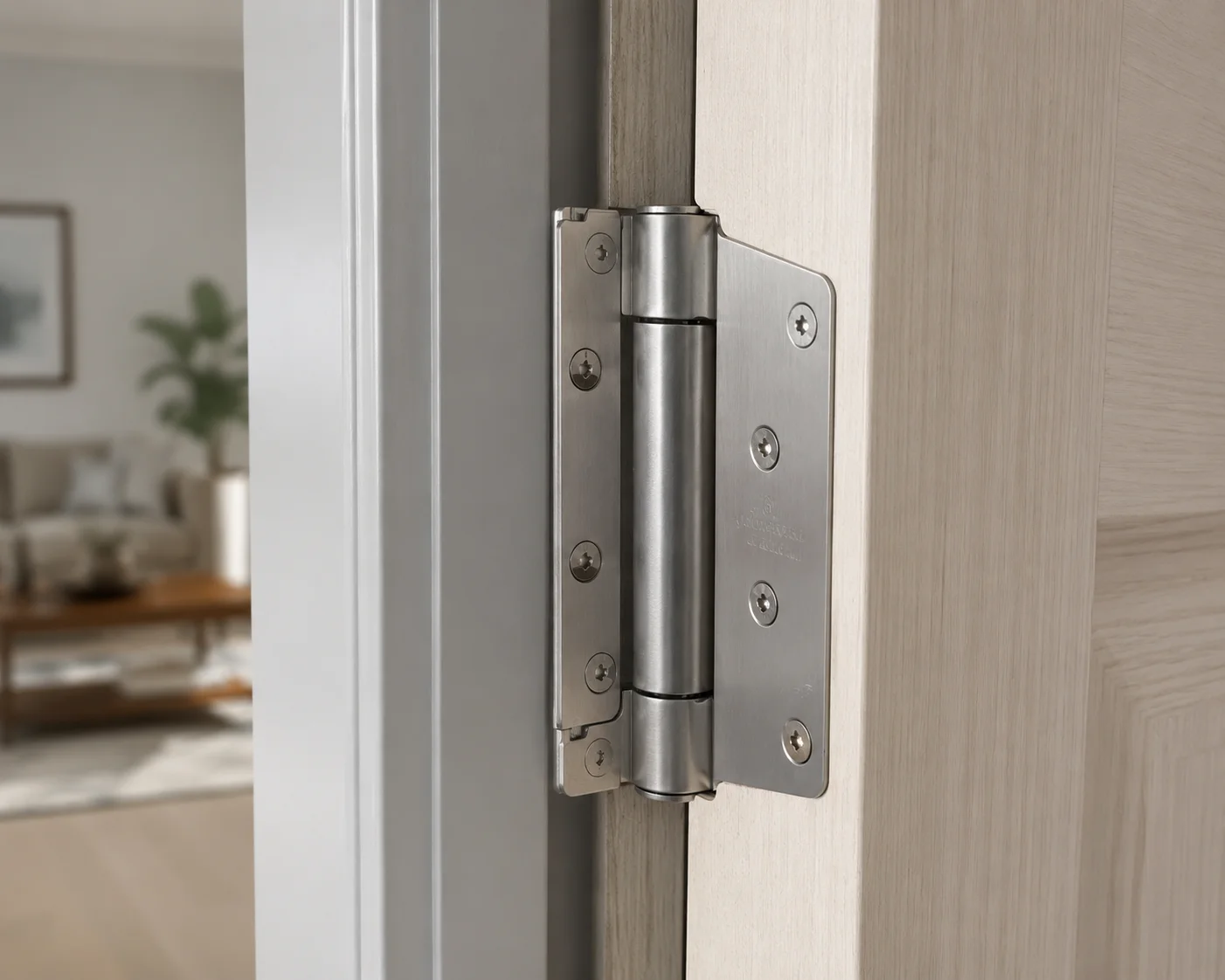
A self-closing hinge has a built-in mechanism, usually a spring, a hydraulic cylinder, or both, that pulls a door shut automatically after someone lets go. It skips the overhead closer entirely. The mechanism sits inside the hinge barrel itself.
That matters for two reasons. First, self-closing hinges look cleaner than bulky overhead closers. Second, they’re often the only hardware small enough to retrofit into an existing door frame without major modification.
How Do Self-Closing Door Hinges Work?
Most self-closing hinges rely on one of two mechanisms.
Spring hinges use a coiled spring inside the hinge pivot. Opening the door winds the spring. Release the door, and the spring unwinds, pulling it shut. Spring hinges cost little and work simply, but they don’t control closing speed. On a heavy door, that can mean slamming.
Hydraulic self-closing hinges add a sealed fluid circuit inside the barrel. That fluid circuit lets you adjust closing speed independently of door weight. As a result, hydraulic hinges can meet accessibility standards that pure spring hinges can’t.
A third type, the gravity hinge or cam-lift hinge, works differently. It uses angled cams that lift the door slightly as it opens. Gravity then pulls the door back down and closed. These show up most often on screen doors, storm doors, and gates, rather than interior fire doors.
Best Types of Self-Closing Hinges by Use Case
Spring Hinges (Residential Interior Doors)
Spring hinges work well for closets, pantries, and bathroom doors where slamming isn’t a major concern. They cost little, usually $8–$20 per hinge for standard residential sizes. However, they’re generally not the right choice anywhere accessibility matters, since they can’t reliably meet ADA closing-speed rules.
Hydraulic Self-Closing Hinges (Fire Doors, Commercial, ADA-Compliant Doors)
Hydraulic hinges cost more, typically $40–$120 per hinge depending on grade and finish. In exchange, you get adjustable closing speed and the ability to meet both fire code and accessibility requirements with one piece of hardware. If a door needs to satisfy NFPA 80 and ADA at the same time, this hinge type usually beats stacking a separate closer on top of standard hinges.
Cam-Lift and Gravity Hinges (Screen Doors, Gates, Pool Barriers)
These are the standard choice for storm doors and pool gates. They work simply, resist weather, and most hardware stores stock them for $10–$30 per hinge. On pool gates specifically, installers almost always pair them with a separate self-latching mechanism, since a hinge alone doesn’t satisfy pool barrier codes.
Are Self-Closing Hinges Required by Code?
Yes, in two common situations.
Fire-rated doors. NFPA 80 requires every fire-rated swinging door assembly to have a listed self-closing device. Code allows spring hinges, but only if the label shows testing to ANSI/BHMA A156.17, the standard for self-closing hinges and pivots, at Grade 1. That standard requires a cycle test of 1,000,000 open-close cycles for Grade 1 hardware. Additionally, a fire door using spring hinges needs at least two of them.
Door thickness and size matter too. For fire doors that measure 1¾ inches thick or thicker, NFPA 80 sets a maximum door size of 3′-0” by 7′-0” for self-closing spring hinges. Larger or heavier doors typically need a hydraulic closer instead.
Pool barrier gates. This is where a lot of homeowners get caught off guard. Most U.S. states have adopted some version of the International Swimming Pool and Spa Code (ISPSC), which requires pool gates to close and latch themselves from any open position, not just from fully open. California goes further, setting a 60-inch residential minimum gate height under Health and Safety Code §115920. Since code adoption and enforcement vary by jurisdiction, check with your local building department before finalizing a pool gate installation. For the federal baseline on pool barrier safety, the Consumer Product Safety Commission publishes guidance on preventing child drownings that’s worth reviewing alongside your local code (CPSC pool safety resources).
Self-Closing Hinges and ADA Compliance
If a door needs to be accessible, closing speed isn’t optional. Under ADA Standard 404.2.8.2, an installer must adjust spring hinges so that, from a 70-degree open position, the door takes at least 1.5 seconds to reach the closed position. That’s a minimum, not a suggestion. A door that closes too fast can violate accessibility rules even if it technically satisfies fire code.
Standard spring hinges struggle here, because spring tension alone doesn’t allow that kind of fine-tuning. Hydraulic self-closing hinges handle this far more reliably, which is why they’re increasingly the default spec on commercial fire doors that also need to meet ADA rules.
How Many Self-Closing Hinges Does a Door Need?
For fire-rated doors, NFPA 80 requires one hinge for every 30 inches of door height, or fraction thereof. In practice, that means a standard 7-foot, or 84-inch, door needs three hinges. Doors taller than 8 feet require heavy-weight hinges with a thicker leaf.
For non-fire-rated residential doors, two to three hinges cover most cases depending on door weight and height. Solid-core and exterior doors generally need three hinges to prevent sagging over time.
Buying Guide: What to Check Before You Order
- Grade rating. Look for ANSI/BHMA A156.17 Grade 1 if the hinge is going on any fire-rated or life-safety door. Lower grades work fine for closets and interior non-fire doors.
- Door weight and thickness. Heavier solid-core or exterior doors need a hydraulic hinge or a higher hinge count, not just a stronger spring.
- Finish and material. Choose stainless steel or another corrosion-resistant finish for exterior and pool-gate hinges. A standard steel spring hinge will rust outdoors within a season or two.
- Adjustability. If ADA compliance matters, confirm the hinge lets you adjust closing speed independently, which usually means hydraulic rather than pure spring.
- UL listing. For any fire door application, check the manufacturer’s UL listing for the specific fire rating of that door assembly (20, 45, 60, 90, or 180 minutes).
If you’re working through a broader hardware upgrade, our Interior Door Hardware Buying Guide covers how hinges, closers, and latch sets work together on a single door.
Frequently Asked Questions
What is the difference between a spring hinge and a self-closing hinge? A spring hinge is one type of self-closing hinge. “Self-closing hinge” covers the broader category, which includes spring hinges, hydraulic hinges, and cam-lift or gravity hinges. All of them close a door automatically, but they differ in speed control and cost.
Do self-closing hinges work on heavy doors? Spring hinges alone often struggle with heavy solid-core or exterior doors, since closing speed depends entirely on spring tension against door weight. Hydraulic self-closing hinges handle heavier doors more reliably because you can adjust their closing speed independently of the door’s weight.
Are self-closing hinges required on bathroom doors? No, standard residential bathroom doors carry no code requirement for self-closing hardware. Homeowners choose self-closing hinges there for convenience, or to help contain steam and odor, rather than to satisfy any code.
Can I install self-closing hinges myself? Swapping in basic spring hinges on a standard interior door works as a straightforward DIY project for most homeowners. However, confirm code requirements with your local building department first if you’re installing hinges on a fire-rated door or a pool barrier gate.
How do I know if my door is fire-rated? Fire-rated doors carry a metal label, usually on the hinge edge, stating the manufacturer, fire rating, and testing agency. If you don’t see a label and the door is original to a commercial building, ask your building’s facilities manager or local fire marshal before assuming it isn’t rated.
Do pool gates need a separate latch, or does the hinge cover it? You need both. A self-closing hinge only handles the closing motion; it doesn’t latch the gate shut. Pool codes require a separate self-latching mechanism that works alongside the self-closing hinge, mounted at whatever height your local code specifies.
How much do self-closing hinges cost? Basic residential spring hinges typically run $8 to $20 each. Commercial-grade hydraulic self-closing hinges that meet fire door and ADA standards usually cost $40 to $120 each, depending on size, finish, and load rating.