


The empress tree (Paulownia tomentosa) is one of the fastest-growing shade trees you can plant in the U.S. According to the North Carolina Forest Service, it can grow up to 15 feet in a single year when conditions are right. In spring it blooms with fragrant lavender flowers, and its huge, tropical-looking leaves stand out in any yard.
There are some big reasons to think twice. This tree is invasive across much of the U.S. It spreads easily and can take over natural areas. Its wood is weak and breaks easily in storms. And it’s illegal to sell in at least one state: Connecticut.
Before you buy one, check your state’s invasive plant list. If you still want to grow it, look for a hybrid that won’t spread seeds, or grow it as a cut-back foliage plant by trimming it hard each year to keep it small and avoid flowers and seed pods.
That last idea is the one most nursery listings leave out. So it shapes how the rest of this article is written.
What is the empress tree?
The empress tree is native to China. Its common names overlap and can be confusing: princess tree, royal paulownia and simply paulownia all refer to Paulownia tomentosa. The genus also includes other species, such as P. elongata and P. fortunei, which are often crossed to create the “hybrid” trees sold for fast shade or timber.
According to The Nature Conservancy’s species summary, paulownia was first brought into the United States as an ornamental tree in the 1840s. Mature trees usually grow 30 to 60 feet tall. The University of Florida’s fact sheet states that most landscape specimens reach 30 to 40 feet in height and width, though they can reach 50 feet with an equal spread.
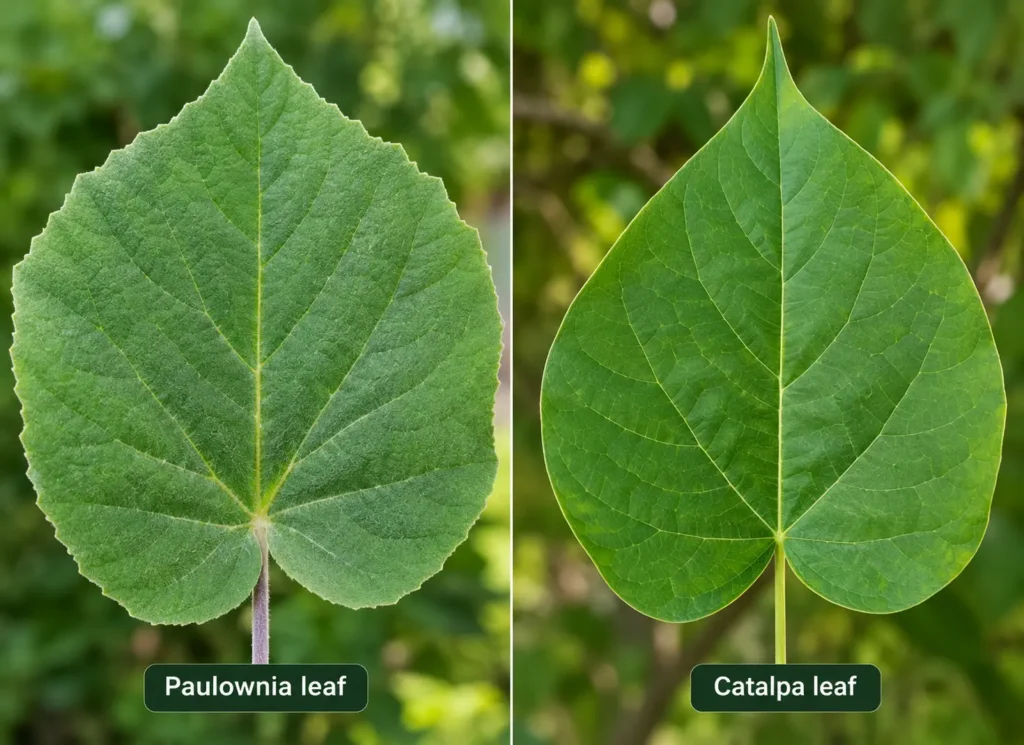
Paulownia is easy to identify once you’ve seen one. The leaves are huge, heart-shaped and fuzzy, typically six to twelve inches across on a mature tree and sometimes much larger on young plants and stump sprouts. The violet flowers resemble foxglove and carry a vanilla scent. They appear in spring, in April or May, before the leaves emerge. The fruit is a woody, egg-shaped capsule that stays on the tree through winter.
People often confuse paulownia with catalpa, a native tree with similar large leaves. The easiest way to tell them apart is by the flowers and fruit. Catalpa produces white blooms and long, thin, bean-like pods, while paulownia produces lavender blooms and short, woody capsules.
How fast does an empress tree grow?
The tree grows quickly, but how fast depends on where it’s growing. The North Carolina Forest Service says that P. tomentosa can grow up to 15 feet in a year on disturbed sites. Commercial hybrids bred for growth are marketed as matching that speed: one tree-selling website claims about 4.5 meters (roughly 15 feet) in a year. That figure comes from a company selling the tree, so treat it as a best-case result.
There are things to remember about these numbers.
- The fast growth lasts only a short time. Most of the growth happens in the first few years, especially if young trees are cut back and allowed to regrow. Once the tree is older, growth slows a lot.
- Soil and water affect how well the tree grows. The University of Florida says the tree does best in moist, well-drained soil protected from the wind. Don’t expect tall, fast growth in tight or windy places.
- Fast growth makes the tree weaker. The wood is light and not very hard. That’s useful for some purposes, as covered later, but it also means big branches can break off in strong storms. The NC State Extension plant list notes that the tree has brittle wood and can be messy.
For comparison, many homeowners are used to fast trees like hybrid poplars or silver maples. The empress tree can outgrow both, but it comes with more complicated problems.
The catch: it’s invasive in much of the U.S.
This is the part that matters most if you’re considering planting one.
A single mature tree can produce an enormous number of seeds. Oregon State’s landscape plant database says each capsule can hold as many as 2,000 small winged seeds, and the North Carolina Forest Service says a mature tree can produce millions. The seeds travel on the wind and sprout on disturbed ground: roadsides, stream banks, burned areas, forest edges and construction sites.
The USDA Forest Service’s Fire Effects Information System notes that the species has escaped cultivation and spread extensively through parts of the mid-Atlantic states. It’s listed as invasive by the North Carolina Forest Service and the Invasive Plant Atlas of the United States, and it’s a particular problem in the foothills and mountains of North Carolina. Virginia, Pennsylvania and other eastern states have also flagged it.
There’s a twist to keep in mind:
The eastern and southern U.S., roughly from southern New York down to Georgia and west toward Missouri and Texas, is most likely to have problems. Warm, damp weather and plenty of disturbed soil make it easy for paulownia seedlings to pop up.
In the Pacific Northwest, Oregon State’s database mentions that the University of Washington Botanic Gardens hasn’t seen paulownia act invasively in that climate. Still, Oregon extension experts have found seedlings and advise pulling them early. So even if it’s less aggressive there, it isn’t safe to ignore.
In Zone 4 and colder areas, paulownia doesn’t survive well, so it won’t spread much. That also means it won’t do well as an ornamental tree.
The rules about growing it differ by state. Connecticut, for example, prohibits selling paulownia. Laws change, so before you buy, check with your state’s department of agriculture or your county extension office.
One practical problem: paulownia grows back strongly from roots and stumps. Both Virginia and The Nature Conservancy warn that you need to remove every bit of root, because even tiny pieces can sprout again. If you plant one and later wish you hadn’t, getting rid of it can take years.
Safer ways to grow paulownia
If you like the way it looks but don’t want the problems, you have options.
1. Cut it back every year and grow it as a foliage plant. Oregon State notes that gardeners can grow paulownia as a large-leafed shrub by cutting it down to near ground level after the leaves fall. Grown this way, it doesn’t make flowers or fruit, so there are no seeds to spread. You still get big leaves, sometimes more than a foot wide. The trade-offs are that you miss the spring flowers and have to cut it down every year.
2. Pick a type that doesn’t make seeds, or makes few. Some hybrids of P. elongata and P. fortunei are sold as seedless or sterile. A journal study reports that one hybrid (sold as “Oxytree,” or Clone in vitro 112) has non-viable seeds, so it doesn’t spread. A hybrid sold in the U.S. for ornamental use, ‘Orienta’, is said to survive in USDA Zone 7. Sellers of these hybrids say they can stand in for the species as ornamentals.
A warning: Nurseries make the seedless claim themselves, and independent researchers don’t always confirm it. Ask the store for proof. Ask your local extension office, too, whether a specific hybrid is approved or recommended where you live.
3. Pick a native plant instead. If you want shade or showy flowers, there are native trees that won’t cause problems. Northern catalpa has similar big leaves and nice flowers. Tulip poplar grows fast in the East. Redbud gives you spring flowers on a smaller tree. Which is best depends on where you live and how much space you have.
Empress tree care
Climate and hardiness. The University of Florida lists USDA zones 5B through 9. In the colder end of that range, flower buds, which form in fall and sit exposed all winter, can freeze and drop. That’s why trees in Zone 5 often leaf out well but flower poorly. If flowers matter to you, Zones 6 through 8 are the safer bet.
Sun. Full sun is best. The tree tolerates light shade but grows more slowly and flowers less.
Soil. Well-drained soil is the key. Paulownia dislikes wet feet and high water tables. Heavy clay that stays soggy is a poor match. Beyond drainage it isn’t picky, and NC State describes it as tolerating poor soil.
Water. Young trees growing fast need steady moisture, particularly in their first two summers. A deep soak weekly during dry spells beats frequent light watering. Mature trees handle more dryness but will look best with water in drought.
Wind. The huge leaves catch wind and tatter easily, and the brittle limbs break. Plant it in a sheltered spot.
Placement. This is where homeowners get into trouble. Keep it well away from:
- Septic systems, drain lines, and foundations, because aggressive roots can cause damage (a point raised by Oregon extension experts)
- Driveways and patios, where roots and falling debris cause problems
- Property lines and neighboring yards, if seeds or sprouts could become a nuisance
- Natural areas, streams, and woodlands, where seedlings can establish unnoticed
Pruning. Young trees can be pruned for form in late winter. If you’re growing it as a coppiced shrub, cut to within a few inches of the ground each year after leaf drop.
Cleanup. Expect seed capsules (if it’s the seeding type), big leaves in fall, and twig drop after storms. If you choose a seeding tree, remove the capsules before they open if you can, though that’s hard on a tall tree.
The real benefits
Despite the drawbacks, there are reasons people plant it.
Shade, fast. A paulownia can provide meaningful shade in a few years, which is rare. That’s valuable on a bare new-construction lot or a hot, exposed yard, though the invasive risk and weak wood weigh against it.
Spectacular spring flowers. The panicles are large, lavender, and fragrant. Because they bloom before the leaves, they show up beautifully against evergreen backdrops, as the University of Florida notes.
Dramatic foliage. When coppiced, the leaves can become some of the biggest you’ll see on a temperate-zone plant, which makes a bold tropical effect in a cold-winter garden.
Lightweight, fine-grained wood. Paulownia wood is very light, fine-grained, and warp-resistant. In China it has been used for centuries, including for musical instruments. Hobbyist woodworkers value it for projects where weight matters.
Regrowth after cutting. The tree can regenerate from its root system after being harvested, which is why it gets the nickname “phoenix tree.” This is helpful in timber and biomass settings and a headache in weed control.
Claims to treat with caution. You’ll see marketing for “carbon-capture trees” and big timber profits. Some published reviews describe paulownia as a promising biomass and bioactive-compound source, but results depend heavily on the hybrid, climate, and management. Claims of quick returns on timber plantations should be checked against independent university or extension sources, particularly for U.S. markets, where established markets for paulownia lumber are limited compared with Asia.
Is the empress tree right for you?
| Situation | Recommendation |
|---|---|
| Small suburban lot in the Southeast or mid-Atlantic | Skip the species; consider a native instead |
| Pacific Northwest garden wanting bold foliage | Coppiced shrub form, or a verified sterile hybrid |
| Zone 5 or colder, you want flowers | Probably disappointing; buds often freeze |
| Large rural property, no natural areas nearby, in a region where it’s legal | A sterile hybrid may be reasonable |
| You want timber or biomass income | Research local markets first; get independent advice |
| Near streams, woods, or conservation land | Do not plant |
Common mistakes
- Planting the species tree because the nursery tag says “fast shade.” Always check the full botanical name.
- Planting too close to the house. Roots and falling limbs are bigger problems than the tree’s small-yard appeal suggests.
- Assuming “hybrid” means “sterile.” Not always. Ask for specifics.
- Letting volunteers grow. Seedlings show up fast, and small ones are easy to pull. Large ones aren’t.
- Cutting a mature tree without a follow-up plan. Stumps resprout, so plan to treat or repeatedly cut new growth. Extension services can advise on control methods suited to your state.
FAQ
Is the empress tree the same as the princess tree?
Yes. Empress tree, princess tree, and royal paulownia are common names for Paulownia tomentosa. Other paulownia species and hybrids look similar but may differ in hardiness and seed production.
Is paulownia illegal in the U.S.?
Not federally. Some states restrict or prohibit sale, and Connecticut is one reported example. Others list it as invasive without banning it. Check with your state agriculture department or local extension office.
How tall will an empress tree get?
Usually 30 to 60 feet, with a similar spread. Many landscape trees end up around 30 to 40 feet, according to the University of Florida.
Why isn’t my empress tree flowering?
Common causes: the tree is too young, flower buds froze over winter (common in Zone 5), or it’s been repeatedly cut back. Trees grown as coppiced shrubs don’t flower.
Can I grow it in a pot?
For a few seasons, yes, especially as a coppiced foliage plant. It will outgrow most containers quickly, so expect to repot or cut back hard.
How do I get rid of an unwanted one?
Pull young seedlings by hand, getting all the root. For larger trees, extension and invasive-species groups describe combinations of cutting and herbicide treatment, since stumps resprout. Check your local extension office for recommendations and any legal requirements.
Is it a good tree for bees and pollinators?
The flowers are large and fragrant and bloom early in the season, but there’s no reliable, independent U.S. research we could find that quantifies its pollinator value compared with native trees, so we won’t make a strong claim either way.
What’s a good alternative that grows fast?
Depending on your region, northern catalpa, tulip poplar, or a native willow or sycamore for wet sites. Your county extension office can suggest options suited to your soil and climate.
Final thoughts
The empress tree delivers on the things people ask for: speed, flowers, and big leaves. But for much of the eastern and southern U.S., it’s a plant with real ecological consequences, and its weak wood and aggressive roots make it a poor fit for many yards. If you do want one, the more responsible routes are growing it as a cut-back foliage plant or choosing a documented sterile hybrid. For help choosing trees that suit your yard, see our guides to specimen trees, Ginkgo ‘Autumn Gold’ and the Royal Red Leaf peach tree.
Sources & References
- USDA Forest Service, Fire Effects Information System: Paulownia tomentosa
- North Carolina Forest Service, Invasive Exotic Plants of North Carolina, No. 14: Paulownia tomentosa (2010)
- University of Florida IFAS, Fact Sheet ST-433: Princess-Tree
- Oregon State University Landscape Plants: Paulownia tomentosa