

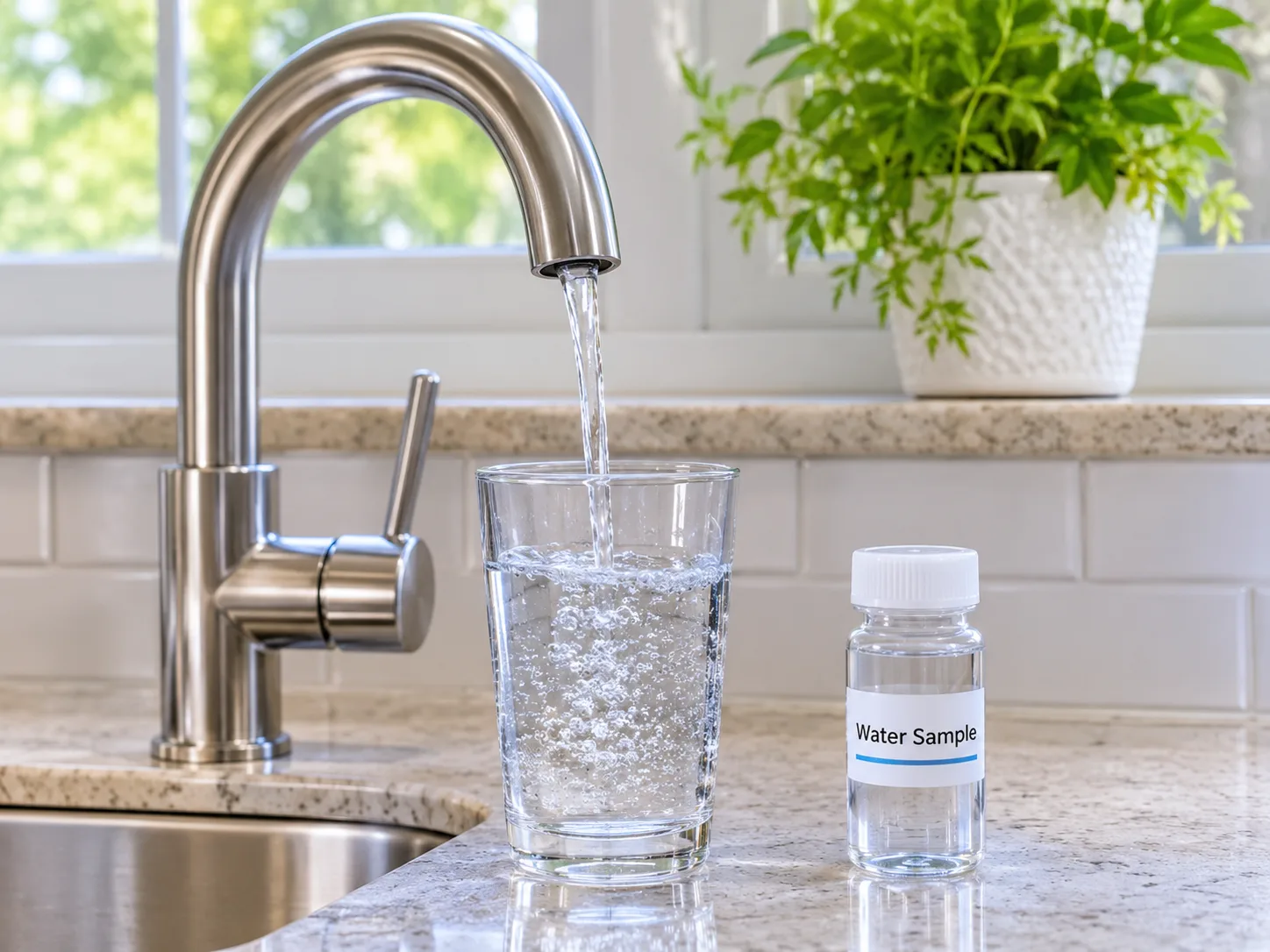
Use a water testing kit or meter for the things you can half-notice yourself, like hardness and chlorine. Send a sample to a certified lab for the things you can’t, such as lead, bacteria, nitrate and PFAS. That’s the working method for how to test water quality at home, and the only real decision is which side of that line your worry sits on.
Where your water comes from decides the order. City water comes with a free annual report. A private well comes with nothing, so you’re the utility.
City water or a well? Start there
If a utility supplies your water, your first test costs nothing. EPA says you can get the Consumer Confidence Report from the utility’s website or by asking for a copy. Consumer Reports adds that renters should go to the landlord if no report arrives. Read the lead and PFAS lines first, and look at whether any result sits close to a federal limit. A number near the line is a reason to test your own tap.
Then remember what the report covers. One testing guide points out that it reflects samples from the distribution system and a limited set of homes, not your kitchen tap. If your house has old pipes, fittings or solder, the report can’t speak for it. This Old House suggests a lead test for homes built before 1986 and after any move into a new place.
And a clear glass proves nothing here, because EPA states that you can’t see, taste or smell lead.
Well owners have a longer list. CDC says EPA’s public water rules don’t cover private wells, so testing falls on you, at least once a year, for total coliform bacteria, nitrates, total dissolved solids and pH. Coliform comes first for a reason: the federal limit for public systems is zero, so any detection counts as a violation. Some local health departments will run well tests for free, so call yours before you pay anyone.
How to test water quality at home with a kit, and where it stops working
A strip kit is simple. You dip a strip for a set number of seconds, wait, then match the colors to a chart, as Angi describes it. Prices run from under $10 to about $400 for a home water test kit, against $50 to $200 and up for a lab, according to the same article. Kits that collect a sample and mail it to a lab sit in the middle, and they’re a different animal from strips: you’re buying lab analysis in a box.
For hardness, chlorine and basic pH checks, strips are reliable enough to show whether a condition exists. That’s a legitimate use. If your kettle scales up or your tap smells like a pool, fifteen dollars and five minutes will settle it.
Lead is where cheap kits run out of road. They suit a basic yes or no, and a low reading should be followed by a certified lab. The same testing guide says they’re not reliable enough for decisions about infant formula or for confirming a lead service line is safe.
My view: a clean strip is the result to trust least, because it’s the one that makes you stop looking. If lead is the worry, skip the strip and go straight to a lab sample.
Do you need a water quality meter?
Probably not. A TDS meter reads conductivity and gives you total dissolved solids. That number says how much is dissolved and nothing about what, so it can’t tell harmless calcium from something you’d rather not drink. Handheld meters cost roughly $15 to $50 per the same source.
pH meters are more useful, mainly for aquariums and for watching the output of a reverse osmosis system. For safety, pH is rarely the deciding question. EPA’s secondary guidance range is 6.5 to 8.5, and a meter will tell you quickly if you’re outside it.
Buy one if you own an RO unit or a fish tank. Otherwise the money works harder in a lab fee.
Using a lab: finding one, paying for it, collecting the sample
Look for a state-certified lab. EPA’s laboratory certification search lists labs certified for drinking water by state, and your state health department keeps its own list. Confirm the lab is certified for the specific analysis you want, since a lab that handles soil or air doesn’t necessarily handle water.
Costs vary a lot by panel. A basic coliform and nitrate test typically runs $20 to $50, while a broader panel with arsenic, radon, pH and hardness can reach $100 to $300, according to one well-testing guide. A single lead sample usually lands between $15 and $60, depending on which source you trust.
For mail-in kits, Consumer Reports listed SimpleLab’s Tap Score at $160 for municipal water and $195 for wells, and National Testing Laboratories at $195 for municipal. Prices change, so check before you order.
PFAS needs its own paragraph, because the rules are moving. EPA’s 2024 rule set limits of 4 parts per trillion for PFOA and PFOS. In May 2026 the agency proposed giving utilities until 2031 to comply and rescinding four other PFAS limits, while keeping the 4 ppt numbers.
Testing needs specialized lab methods, and a full panel with PFAS runs $300 to $600. Consumer Reports lists a PFAS-only kit from $299. I’d read your utility’s PFAS results before paying for your own.
Sampling is where most home tests go wrong. For lead, EPA’s homeowner instructions call for a kitchen or bathroom tap that hasn’t been used for at least six hours, so morning, before anyone runs water. Don’t flush first.
Labs disagree on small things, too: some protocols ask you to remove the faucet aerator and others say leave it on. Some mail-in labs ask for two bottles from the same tap: a first-draw sample, then a second after the water has run for three to five minutes. The pair helps show whether lead comes from the faucet and nearby fittings or from further back in the plumbing.
Follow whatever your lab’s sheet says, even if it contradicts a blog.
Quick answers
How often should I retest? Well owners should test yearly, per CDC. City customers can test when they move in, after plumbing work, or when color, taste or odor changes.
Will my utility test my tap for free? Some do. Many utilities offer free or low-cost residential lead testing through state-certified labs, so ask before you buy a kit.
What to order first
On city water in a pre-1986 house, request your utility’s report this week and book a first-draw lead test at a certified lab. On a well, schedule coliform and nitrate testing before spring, since CDC suggests a spring check of the well itself anyway. Buy a strip kit afterward, if you still want one, for the hardness question your kettle has been asking.
Sources
- CDC, Guidelines for Testing Well Water
- EPA, lead and the Consumer Confidence Report
- EPA, Lead and Copper tap sample instructions for homeowners
- Consumer Reports, how to test your tap water
- Angi, how to test your water quality
- National Law Review, EPA proposed PFAS changes
- This Old House, testing for lead
- Private well water testing guide (coliform limit, panel costs)
- Private well testing guide (lab certification, PFAS panel cost)
- How to test water at home (strips, meters)
- How to test for lead (CCR scope, kit limits, aerator)
- Well water testing guide (pH range)
- Lead in water test guide (free utility testing)
- National Testing Laboratories, first draw and flush sampling instructions
- Water Filter Guru, how to test for lead