

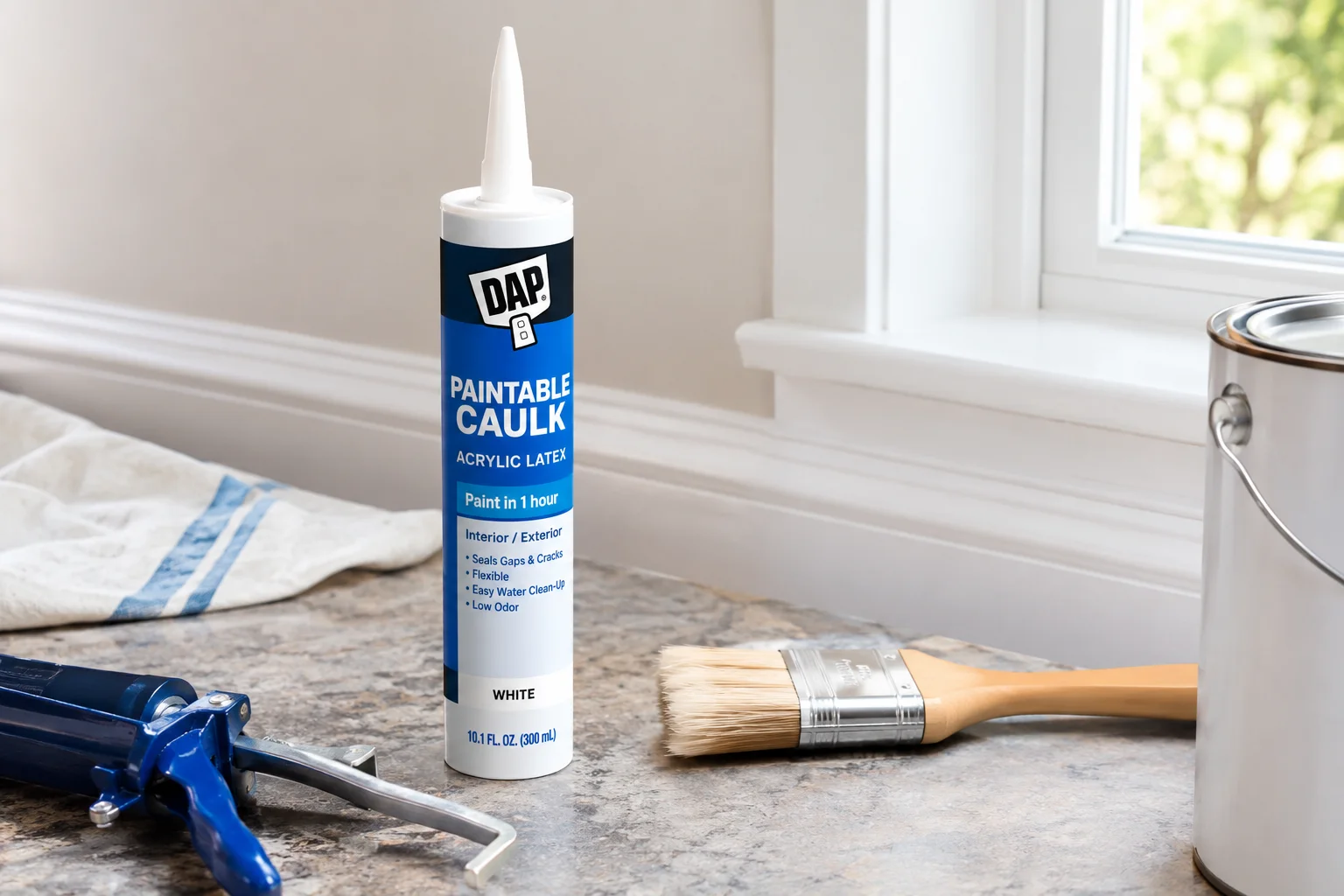
If you just need the short answer: DAP Alex Plus is the caulk most painters reach for on interior trim, baseboards, and window casings because it’s paintable in 30 minutes and won’t shrink or discolor your topcoat. If you’re sealing something that moves a lot — a wide exterior gap, an older window, a joint between two different materials — Sashco Big Stretch is the better choice, since it stretches up to 500% without cracking and still takes paint cleanly.
Everything else in this guide explains why those two picks work, when to choose something else instead, and how to avoid the single most common caulk mistake: buying a tube labeled “silicone” and wondering three days later why the paint is peeling right off it.
What Makes a Caulk “Paintable” in the First Place
Not all caulk accepts paint, and this trips up more people than you’d expect. The deciding factor is chemistry, not brand or price.
Acrylic latex caulk cures by letting water evaporate out of the formula, leaving behind a slightly porous film. Paint bonds to that film the same way it bonds to drywall or wood — mechanically, by gripping the microscopic texture of the surface. This is why acrylic latex (sometimes labeled “painter’s caulk”) is the default for interior trim work.
100% silicone caulk cures through a different chemical reaction and dries into a smooth, non-porous, slightly oily surface. Paint has nothing to grip onto, so it beads up, slides around, or peels off in sheets within days. If a tube says “100% silicone” anywhere on the label, assume it is not paintable, full stop, regardless of what a hardware store employee tells you.
Siliconized acrylic latex splits the difference. Manufacturers blend silicone additives into an acrylic latex base to get better flexibility and water resistance while keeping the surface porous enough for paint to bond. This hybrid category — which includes most of the picks below — is what people usually mean when they ask for “paintable caulk” in 2026.
There’s also a smaller category of elastomeric acrylic caulk, built for joints that expand and contract a lot with temperature. It’s still water-based and paintable, but it’s engineered for movement rather than pure adhesion.
Quick Comparison: Top Paintable Caulks for 2026
| Product | Type | Paint-Ready Time | Best For | Approx. Price (10-oz tube) |
|---|---|---|---|---|
| DAP Alex Plus | Siliconized acrylic latex | 30 minutes | Interior trim, baseboards, general use | $4–$6 |
| DAP Alex Fast Dry | Siliconized acrylic latex | 20 min (brush), immediate (spray) | Professional painters, fast turnaround jobs | $5–$7 |
| Sashco Big Stretch | Acrylic elastomeric | 4 hrs exterior / 24–48 hrs interior | High-movement joints, siding, old windows | $8–$11 |
| DAP Alex (economy/painter’s caulk) | Basic acrylic latex | Around 30 min | Budget interior jobs, low-movement gaps | $2–$4 |
| DAP Dynaflex 230 | Advanced siliconized acrylic | 3 hrs (touch) | Exterior trim, siding, window perimeters | $6–$9 |
Prices are typical big-box retail ranges as of mid-2026 and will vary by region, retailer, and package size. Treat them as ballpark figures, not quotes.
The Top Picks, Explained
Best Overall: DAP Alex Plus
DAP Alex Plus is the acrylic latex caulk most painting contractors default to, and the reasoning holds up under scrutiny. It’s rated paintable in just 30 minutes with either latex or oil-based paint, tools smoothly with a wet finger, cleans up with plain water, and comes with a 40-year durability rating. It also carries DAP’s claim of meeting ASTM C834, the industry standard test method for latex sealants.
Where it shines: baseboards, crown molding, door and window casing, and any interior trim gap under about 1/4 inch. It handles light exterior use too, but it’s not the caulk you want for a joint that’s constantly flexing.
Where it falls short: on wide or high-movement gaps, standard acrylic caulks like this one can eventually crack, because they don’t have the elasticity of a dedicated elastomeric product. For a small gap between two pieces of stationary trim, that’s a non-issue. For a gap that opens and closes with the seasons, it’s worth stepping up to something like Big Stretch.
Best for High-Movement Joints: Sashco Big Stretch
Big Stretch is a 100% acrylic latex, elastomeric caulk built specifically for joints that move — window and door frames that shift with the weather, siding gaps, and older homes where the framing has settled unevenly. It stretches up to 500% of the original joint width without tearing and spans gaps up to two inches.
It’s also genuinely low-VOC (roughly 60 grams per liter, well under most regulatory thresholds) and rated paintable with exterior latex paint after about 4 hours, or interior latex after 24–48 hours. That interior wait is longer than most people expect from a “paintable” caulk, so if you’re painting the same day, plan your sequence accordingly — caulk first thing in the morning, paint trim in the afternoon on exterior work; for interior jobs, caulk one day and paint the next.
Where it falls short: it costs roughly double what a basic acrylic latex costs per tube, and the longer interior cure time can slow down a job if you’re not planning around it. For a straightforward interior baseboard job with no real joint movement, it’s more caulk than you need.
Best for Professional-Speed Jobs: DAP Alex Fast Dry
This is essentially Alex Plus’s faster sibling, formulated for painters who can’t afford to wait around. It can be brush-painted just 20 minutes after application, or spray-painted immediately, and carries a 50-year durability rating versus Alex Plus’s 40. The trade-off is largely irrelevant for a weekend DIYer — you’re paying a modest premium for speed that mostly benefits someone caulking and painting dozens of units in a day, like a property manager repainting apartment turnovers.
Best Budget Option: Basic Acrylic Latex (Painter’s Caulk)
Every major brand sells a stripped-down acrylic latex caulk without the silicone additives — often just labeled “painter’s caulk” or “acrylic latex caulk” without a “Plus” or “Pro” suffix. These typically run $2 to $4 a tube and are genuinely fine for small, stable interior gaps: nail holes in trim, hairline cracks where drywall meets a door frame, gaps under 1/8 inch.
Best for Exterior Trim and Siding: DAP Dynaflex 230
Dynaflex 230 is a step above standard siliconized acrylic latex, formulated to handle 25–55% joint movement while remaining fully paintable. It’s a common choice for window and door trim on the exterior of a house, fiber cement siding joints, and gaps between dissimilar materials like wood trim against brick. It costs more than Alex Plus but less than pure elastomeric caulk, making it a reasonable middle ground for exterior work that doesn’t need Big Stretch’s extreme flexibility.
Why Paint Sometimes Peels Off “Paintable” Caulk Anyway
This is the complaint that shows up most often after someone’s already painted, and it’s almost always one of four causes:
They bought silicone or a silicone-heavy hybrid by mistake. Read the label. If it says “100% silicone” or doesn’t explicitly say “paintable,” don’t assume.
They painted too soon. Even fast-drying caulks need their full tack-free time before paint will bond properly. Painting over caulk that’s still skinning over traps moisture underneath the paint film, and it fails within days or weeks.
The caulk was applied too thick. A thin, properly tooled bead cures and accepts paint far more reliably than a thick blob. If you laid down more caulk than the gap needed, the surface can look dry while the interior is still curing, and paint applied on top will eventually crack as the caulk beneath continues to shrink.
Wrong paint chemistry for the caulk. Most acrylic latex caulks accept both latex and oil-based paint fine, but elastomeric caulks and some specialty products are pickier. Check the tube’s label — reputable brands specify compatible paint types directly on the packaging.
Common Mistakes People Make Buying Paintable Caulk
A few things buyers routinely overlook at the store:
- Assuming “waterproof” means “paintable.” Plenty of genuinely waterproof caulks — pure silicone chief among them — are specifically not designed to take paint.
- Ignoring the gap size the product is rated for. A caulk rated for gaps up to 1/4 inch will slump, sag, or fail in a 3/4-inch gap. For anything wider than about a half inch, you generally need backer rod (a foam rope pushed into the gap first) regardless of which caulk you choose.
- Buying based on tube color instead of formula. White and clear versions of the same product line sometimes have different cure times — DAP’s own clear Alex Plus, for instance, has a longer full-dry-through window than the white version because of how the clear formula is built. Check the specific product’s data sheet rather than assuming all colors in a line behave identically.
- Skipping the smoothing step. A caulk bead tooled smooth with a wet finger or a caulk tool sheds paint far more evenly than one left lumpy. This matters more for paint appearance than for the seal itself, but it’s the difference between a job that looks professional and one that doesn’t.
U.S.-Specific Considerations
Climate matters more for caulk selection than most buying guides mention. In the humid Southeast and Gulf Coast, longer cure times listed on the label (like Big Stretch’s 24–48 hour interior paint window) can stretch out further in high humidity, since these products cure partly by water evaporation and in the arid Southwest, the same products often cure faster than the label states.
In colder climates — the Upper Midwest, the Mountain states, the Northeast — pay attention to the application temperature range printed on the tube. Most acrylic latex caulks need surface and air temperatures above 40°F to cure properly; applying caulk to a cold exterior wall in late fall can leave it soft and prone to failure well into spring.
Some states also regulate VOC content in caulks and sealants more strictly than federal limits require — California is the main one to watch. If you’re in California, or buying online from a retailer that ships nationally, check that the specific SKU is compliant for sale in your state; formulations occasionally differ by region for this reason.
If you’re planning trim, siding, or window work as part of a broader remodel or refresh, it’s worth reviewing which materials on your home actually need this kind of maintenance seal versus a full replacement — that’s covered in more detail in Acoustic Caulk for Soundproofing 2026.
Work through these questions in order:
- Is the joint indoors and essentially stationary (baseboard, casing, small nail holes)? Standard acrylic latex or Alex Plus is enough.
- Is it exterior, or does it flex with temperature (window trim, siding butt joints, older home settling)? Move up to a siliconized acrylic like Dynaflex 230, or Big Stretch if the movement is significant.
- Is the gap wider than about 1/2 inch? Use backer rod first, regardless of which caulk you pick, and lean toward an elastomeric product.
- Does it need to be submerged or constantly wet (tub surrounds, shower panels)? None of the caulks above are the right tool — use a dedicated bath-and-kitchen silicone, and don’t plan to paint it.
- Are you on a tight schedule? Fast Dry formulas shave 10–15 minutes off standard acrylic latex paint-ready times, which adds up on a multi-room job.
Frequently Asked Questions
Can you paint over silicone caulk if you use the right primer? Sometimes, with a bonding primer specifically formulated for silicone, but adhesion is still unreliable long-term. It’s almost always easier to remove the silicone and replace it with a paintable acrylic latex or siliconized acrylic caulk than to fight for paint adhesion on cured silicone.
How long should I really wait before painting caulk, even if the label says 30 minutes? Treat the label time as a minimum in ideal conditions (moderate temperature, moderate humidity, thin bead). In cold or humid conditions, waiting an extra hour or two costs you nothing and meaningfully reduces the risk of paint failure.
Does caulk color matter if I’m going to paint over it? Not for the paint job itself, but white is easier to see for tooling and touch-ups.While clear caulk shows imperfections more easily before it’s painted. Many painters use white even under paint simply because it’s easier to work with.
What’s the difference between “paintable” and “stainable” on a label? Paintable means opaque paint will bond to the cured surface. Stainable means the caulk will absorb wood stain and blend with a stained surface rather than sitting on top of it as a visible line. Not every paintable caulk is stainable, and vice versa — check both claims separately if you’re working with stained trim.
Is elastomeric caulk overkill for a normal interior baseboard? Generally yes. Elastomeric caulks like Big Stretch cost more and take longer to become paint-ready specifically because they’re engineered for movement. A stationary interior baseboard doesn’t need that, so a standard acrylic latex is the more practical and economical choice.
Can I use exterior-rated caulk indoors? Yes, exterior-rated caulks are typically fine indoors too. They just cost more than you need for the job. The reverse isn’t true: don’t use a basic interior acrylic latex outdoors. Since it lacks the flexibility and weather resistance to hold up.
How do I know if a gap is too wide for caulk alone? As a rough rule, once a gap exceeds about 1/2 inch, caulk alone will sag or shrink excessively as it cures. Push a foam backer rod into the gap first, leaving room for a thin caulk bead over the top. This gives the caulk something to bond to on both sides without having to fill the whole depth.
Sources & References
- DAP Products, Alex Plus Technical Data Sheet: https://www.dap.com/media/23120/alex-plus-acrylic-latex-caulk-white_tds_5-12-25.pdf