

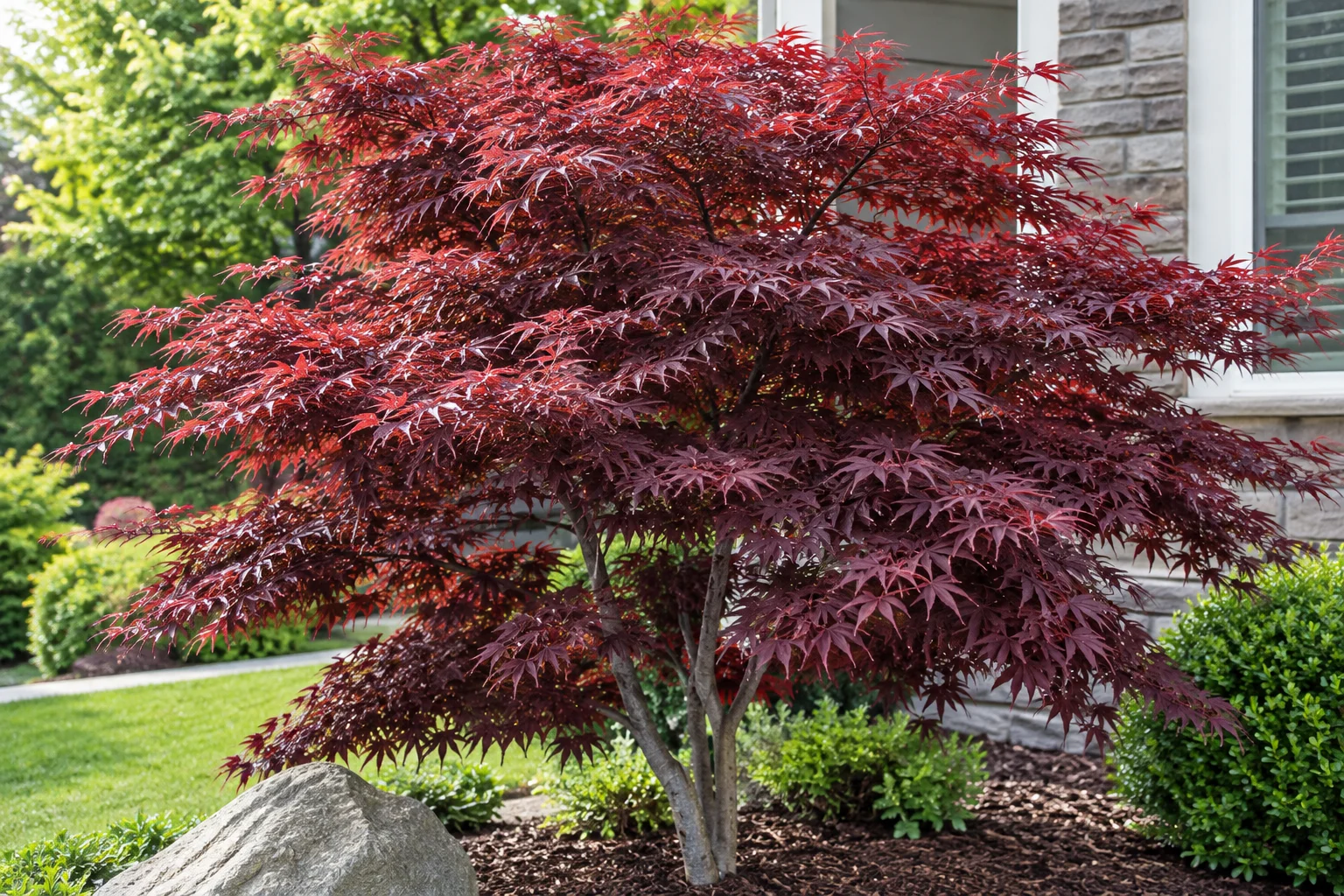
If you’re picking a Japanese maple for its deep red color that actually holds through summer instead of fading to green, Bloodgood is usually the variety people mean when they say “the classic red Japanese maple.” It’s one of the most widely sold cultivars in the U.S. for a reason: it’s reliable, it tolerates a wide climate range, and it keeps its color better than many other red-leafed maples.
Here’s what you actually need to know before planting one — size, growth rate, zone compatibility, and the care details that separate a thriving tree from a struggling one.
Quick Answer
Bloodgood Japanese Maple (Acer palmatum ‘Bloodgood’) grows in USDA hardiness zones 5 through 8. At maturity, it typically reaches 15 to 20 feet tall with a similar spread, though some sources list up to 25 feet under ideal conditions. Growth runs slow to moderate, around 1 to 2 feet per year once established, and it takes roughly 15 to 20 years to reach full mature size. It prefers full sun to partial shade, with afternoon shade recommended in hotter climates to prevent leaf scorch and preserve deep red color.
Growing Zones: Where Bloodgood Actually Thrives
Zones 5 through 8 cover most of the continental U.S. except the coldest northern states and the hottest, most humid parts of the Deep South and desert Southwest. Within that range, though, performance varies quite a bit by region.
Zones 5–6 (Upper Midwest, New England, mountain regions): Bloodgood tolerates full sun well here, since cooler temperatures reduce leaf scorch risk. Winter protection for young trees matters more in this range — a layer of mulch around the root zone helps buffer harsh freezes in the first couple of winters.
Zones 7 (Mid-Atlantic, parts of the Pacific Northwest): This is close to the sweet spot for Bloodgood. Morning sun with light afternoon shade produces the best color without stressing the tree.
Zone 8 (parts of the Southeast, Texas, coastal California): Afternoon shade becomes important here. Direct, intense afternoon sun in zone 8 heat can scorch the thin leaves and fade the red color to a duller tone. Gardeners in Georgia, for example, generally get the best results with morning sun and shelter from the harshest afternoon exposure.
If you’re outside zones 5–8, Bloodgood likely isn’t the right choice. Zone 4 and colder generally sees dieback or outright winter kill, while zone 9 and warmer often runs too hot and humid for the tree to hold its color or stay healthy long-term.
Growth Rate: What to Actually Expect
Bloodgood is not a fast grower, and that’s worth setting expectations around before you plant one. In its first year in the ground, expect very little visible top growth — the tree spends that season establishing its root system, which is normal and not a sign of a problem.
Once established, typically in year two, growth settles into a steady 1 to 2 feet per year. Some sources describe the tree as doubling in size within about five years, after which growth slows further as the tree matures and shifts energy toward developing its branching structure rather than pushing height.
Full maturity — that 15-to-20-foot final size — takes roughly 15 to 20 years. If you’re hoping for a quick privacy screen or fast shade, Bloodgood isn’t the tree for that job. It’s a long-term landscape investment, and most of its value comes from the color display and the graceful, sculptural branching it develops over time, not from rapid growth.
You can push growth somewhat with regular fertilizing and consistent watering, but faster growth tends to come at the cost of the tree’s natural branching structure. A tree forced to grow quickly often ends up leggier and less refined-looking than one allowed to develop at its own pace.
Sun, Soil, and Water Requirements
Sunlight
Bloodgood tolerates more sun than many other Japanese maple cultivars, which is part of why it’s so popular. In cooler climates (zones 5–6), full sun all day generally works fine. In warmer zones (7–8), aim for morning sun with afternoon shade — roughly 4 to 6 hours of direct light, with protection during the hottest part of the day.
Too little light causes a different problem: the leaves lose some of their vibrant red color and can shift toward a duller green-red. Finding the right balance of light for your specific climate is really the main variable that determines how good the color looks each season.
Soil
Bloodgood needs well-drained, slightly acidic soil, ideally in the pH range of 5.0 to 7.0. Heavy clay soil that holds standing water is one of the more common reasons these trees struggle or develop root rot. If your soil drains poorly, amend it with organic matter before planting, or consider a raised planting mound to improve drainage around the root zone.
Mixing in peat moss at planting time (roughly 25% of the backfill volume) helps with both drainage and acidity for gardeners working with neutral or slightly alkaline native soil.
Water
During the first one to two years, water deeply and consistently — roughly two to three times per week during the growing season, more during hot, dry stretches. Check soil moisture by pushing a finger about two inches into the ground near the root zone; water when it feels dry at that depth.
Once established, Bloodgood becomes noticeably more drought-tolerant, though it still appreciates deep watering during extended dry periods. Watering in the early morning, rather than evening, gives foliage time to dry out during the day, which reduces fungal disease pressure.
A 3- to 4-inch layer of mulch around the base, kept a few inches away from the trunk itself, helps retain soil moisture and keeps the shallow root system cooler during summer.
Fertilizing
Bloodgood doesn’t need heavy fertilizing to thrive, and over-fertilizing actually creates problems rather than solving them. A slow-release, organic, acid-forming fertilizer formulated for acid-loving plants works well if you fertilize at all — once in early spring is usually enough.
Avoid high-nitrogen fertilizers in particular. They push soft, fast new growth that’s more attractive to aphids and scale insects than the tree’s normal growth would be. If your soil is reasonably healthy already, many established Bloodgoods do fine with no supplemental fertilizer beyond an annual layer of compost.
Pruning
Bloodgood needs minimal pruning once established, which is part of its low-maintenance reputation. When you do prune, timing matters more than technique.
Prune during dormancy, in late fall through late winter, after the leaves have dropped. Maples “bleed” sap heavily if pruned in spring when sap is actively rising, and while this doesn’t usually kill the tree, it’s messy and can stress a young tree unnecessarily. Focus pruning cuts on dead, damaged, or crossing branches, and avoid removing more than necessary — Bloodgood’s natural branching habit is part of its appeal, and heavy-handed pruning can undo years of that graceful structure.
Common Problems and How to Spot Them
Leaf scorch: Brown, crispy leaf edges, usually from too much direct afternoon sun combined with heat or inconsistent watering. This is the most common issue in zone 7–8 plantings and is largely preventable with proper placement.
Aphids and scale: Small pests that cluster on new growth, often following over-fertilization with high-nitrogen products. A strong spray of water or insecticidal soap usually handles minor infestations.
Verticillium wilt: A soil-borne fungal disease that causes branches to wilt and die, sometimes just on one side of the tree. There’s no reliable cure once a tree is infected, which makes prevention through healthy soil and avoiding wounds near the root zone the best defense.
Trunk sunscald: Young trees with thin bark can develop sun damage on the trunk, especially on the south or southwest side in winter when snow reflects intense light. Tree wrap during the first couple of winters helps protect young trunks until the bark thickens.
Girdling roots: Roots that circle the trunk instead of growing outward can eventually strangle the tree as both grow in diameter. Check for this at planting time and again a few years in, especially with container-grown trees whose roots may have circled inside the pot.
Bloodgood vs. Other Red Japanese Maple Cultivars
| Cultivar | Color Retention | Mature Size | Notable Trait |
|---|---|---|---|
| Bloodgood | Excellent through summer | 15–20 ft | Most widely available, reliable color |
| Emperor 1 | Very good, slightly later leaf-out | 10–15 ft | More cold-hardy, good for shorter seasons |
| Fireglow | Good, translucent when backlit | 12–15 ft | Glowing effect in direct light |
| Crimson Queen (dissectum) | Good | 8–10 ft, weeping form | Lace-leaf, weeping habit rather than upright |
Bloodgood’s main advantage over other red cultivars is how well it holds its color through the heat of summer, when many red Japanese maples start fading toward green. If you want a weeping or lace-leaf form instead of an upright tree, though, Bloodgood isn’t the right pick — that’s a different growth habit entirely, found in cultivars like Crimson Queen.
Where to Plant It in a Landscape
Bloodgood works well as a standalone focal point near a patio, entryway, or lawn, where its color and branching structure can be appreciated up close. Because of its moderate size, it also fits well in mixed landscape beds without overwhelming smaller plantings nearby, unlike larger shade trees.
Keep it away from foundations and hardscaping where root space is limited, and give it room for its full mature spread — planting too close to structures or other trees crowds the canopy and can distort its natural shape over time.
Frequently Asked Questions
How fast does a Bloodgood Japanese Maple grow? Once established, expect about 1 to 2 feet of growth per year. It reaches full mature size of 15 to 20 feet in roughly 15 to 20 years, making it a slow-to-moderate grower rather than a fast one.
What zones can I grow a Bloodgood Japanese Maple in? USDA hardiness zones 5 through 8. Within that range, sun exposure needs adjustment by climate — more sun tolerance in cooler zones, more afternoon shade needed in zones 7–8.
Does Bloodgood Japanese Maple need full sun? It tolerates full sun better than many Japanese maple cultivars, especially in cooler climates. In hot zones, afternoon shade helps prevent leaf scorch and keeps the red color from fading.
How big does a Bloodgood Japanese Maple get? Most sources list a mature size of 15 to 20 feet tall and wide, though some report up to 25 feet under ideal growing conditions.
When should I prune a Bloodgood Japanese Maple? Prune during dormancy, from late fall through late winter, after the leaves drop. Avoid pruning in spring, since the tree bleeds sap heavily when it’s actively growing.
Why is my Bloodgood Japanese Maple losing its red color? Insufficient sunlight is the most common cause, since Bloodgood needs adequate light to produce its deep red pigmentation. Excessive heat and afternoon sun in warmer zones can cause the opposite problem: scorched, faded leaves.
Is Bloodgood Japanese Maple drought-tolerant? It becomes reasonably drought-tolerant once established, usually after its second full growing season. Young, newly planted trees still need consistent, deep watering to establish their root systems properly.
Sources & References
- U.S. National Arboretum, USDA Plant Hardiness Zone Map
- University Extension programs generally recommend consulting your local state extension office for region-specific planting guidance on Japanese maple cultivars.
If you’re planning a broader landscape refresh alongside new plantings like this, see this guide to the Ashley Quinnland console and sofa table for indoor furnishing ideas to match your outdoor updates — though for a purely gardening-focused piece, a PlazmaHomes landscaping or outdoor living article would be a more natural fit if one is available.