

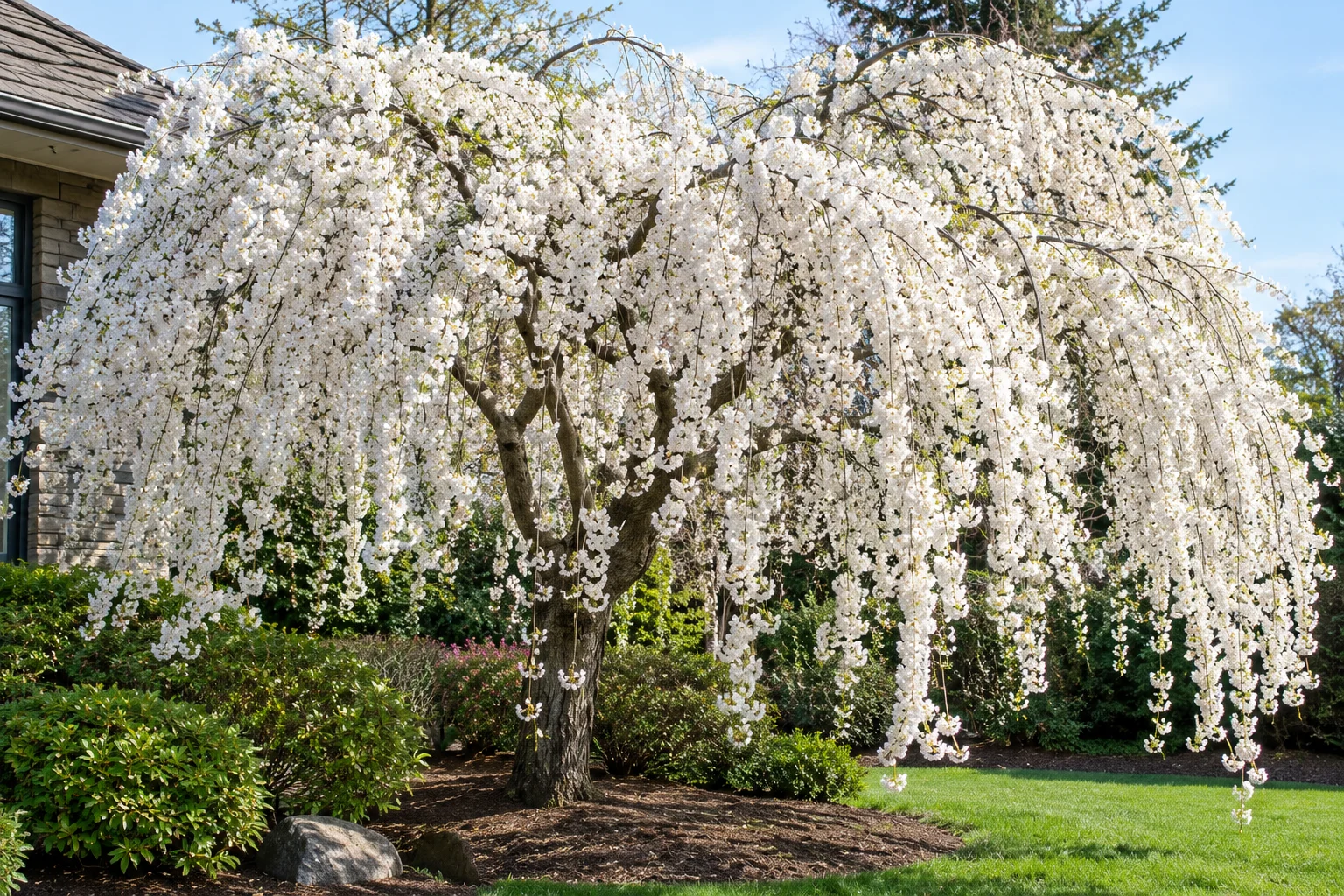
If you’re considering a Snow Fountain weeping cherry for your yard, here’s the quick version. This is a compact, slow-growing ornamental tree, botanically Prunus x ‘Snofozam.’ It reaches roughly 8 to 15 feet tall and 6 to 12 feet wide at maturity. It’s hardy in USDA zones 4 through 8, blooms with cascading white flowers in April, and needs full sun and well-drained soil to perform its best. It’s genuinely low-maintenance once established, requiring minimal pruning. Like most flowering cherries, though, it’s susceptible to a range of common Prunus pests and diseases if planted in a poor location. Below is what actually matters for keeping this tree healthy, from planting through year-round care.
Quick Answer: What Is a Snow Fountain Weeping Cherry?
Snow Fountain weeping cherry, sold under the botanical name Prunus x ‘Snofozam‘, is a small deciduous ornamental tree known for its strongly cascading branches. These branches can dip all the way to the ground. Lake County Nursery in Perry, Ohio, introduced the tree in 1985, and it has become one of the most popular compact weeping cherries for home landscapes since. In spring, before the foliage emerges, the bare branches fill with fragrant white flowers that open from pink buds. This creates the “snow fountain” effect the tree is named for. It’s a member of the Rosaceae family, the same family as roses, apples, and most other flowering fruit trees.
Where Snow Fountain Weeping Cherry Grows Best
This tree is hardy in USDA zones 4 through 8, according to most nursery and reference sources. A few sources, though, list the range as 5 through 8. So check your specific supplier’s guidance if you’re right at the edge of zone 4 or 5. Within that range, it performs best in full sun, meaning at least six hours of direct light daily. It will tolerate light shade, but expect noticeably fewer blooms and less vivid fall color in a shadier spot.
Site selection matters more than a lot of buyers expect with this tree. Beyond sun exposure, good air circulation around the planting site significantly reduces the risk of fungal diseases that commonly affect ornamental cherries. So avoid tucking it into a tight corner against a wall or fence where airflow is limited.
Planting Snow Fountain Weeping Cherry
Choose a site with moist, moderately fertile, well-drained loam. This tree doesn’t tolerate consistently soggy soil well, so avoid low spots where water collects after rain. Dig a hole as deep as the root ball and roughly twice as wide. Gently loosen the roots before placing the tree, and backfill with the native soil rather than heavily amended soil. Heavily amended soil can actually discourage roots from spreading outward into the surrounding ground.
Work some organic mulch or compost into the top layer of soil before planting. Apply a mulch layer around the base after planting, keeping it a few inches back from the trunk itself to avoid trapping moisture against the bark.
Because of its cascading form, gardeners often plant Snow Fountain at the top of a retaining wall or on a slope, where the weeping branches can drape downward for maximum visual effect. It also works well as a specimen tree near a pond or in a Japanese-style garden, where its reflective, fountain-like silhouette is particularly striking.
Watering and Feeding
During the first growing season, water deeply and regularly to help the tree establish an extensive root system. Once established, typically after the first year or two, you can reduce watering frequency, since this tree has moderate drought tolerance as a mature specimen. Still, avoid letting the soil dry out completely for extended periods, especially during hot summer stretches.
Feed with a general-purpose fertilizer in early spring, before new growth begins. Or simply apply a layer of organic mulch over the root zone annually, which provides a slower, more natural nutrient release as it breaks down.
Pruning
One of the appealing things about this tree is how little pruning it actually needs. Most sources recommend pruning only to remove dead, damaged, or crossing branches. Do any shaping after the spring bloom period finishes, rather than during dormancy, so you don’t accidentally cut off next year’s flower buds.
Want to train the tree into a specific form, such as against a wall or fence? Snow Fountain responds well to staking and training while young. Its naturally pliable weeping branches lend themselves to this kind of shaping more easily than a rigid, upright tree would.
Common Problems and Pests
This is where marketing descriptions and more objective horticultural references sometimes diverge. Retail nursery listings often describe Snow Fountain as highly disease and pest resistant, and relative to some other ornamental cherries, it does hold up reasonably well. However, university and botanical garden references list a fairly typical range of potential issues for the Prunus genus as a whole. These include leaf spot, dieback, leaf curl, powdery mildew, root rot, fireblight, brown rot, and bacterial canker. Common insect pests include aphids, scale, borers, leafhoppers, caterpillars, and Japanese beetles.
The practical takeaway is that Snow Fountain isn’t uniquely problem-prone, but it isn’t immune to typical cherry tree issues either. Good site selection, meaning full sun, well-drained soil, and adequate air circulation, does the most to prevent these problems before they start. Notice wilting branch tips, oozing cankers, or unusual leaf spotting? Address it early rather than waiting. Several of the fungal and bacterial issues common to this genus spread more aggressively once established.
Fall and Winter Interest
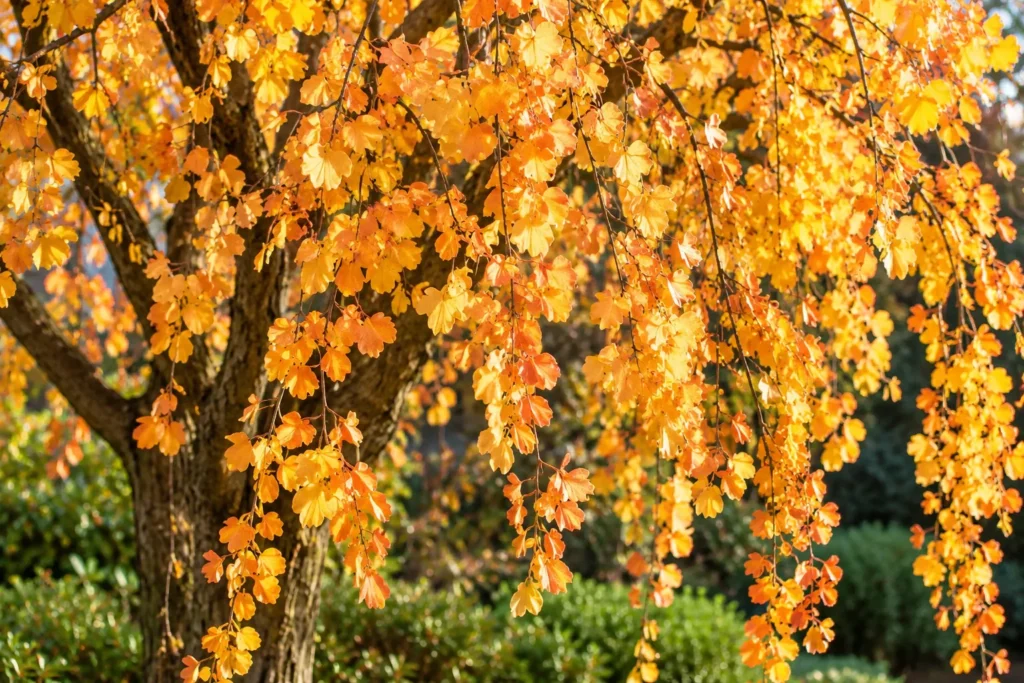
Beyond the spring bloom, Snow Fountain earns its place in a landscape through multiple seasons. The dark green summer foliage turns gold, orange, and sometimes red in fall. The bare weeping branch structure remains visually interesting through winter, even without leaves or flowers. Small red fruit, turning black as it matures, follows the spring bloom in modest quantities. It’s inedible for people but attracts birds, and the flowers themselves draw butterflies and hummingbirds during bloom season.
Landscape Uses and Placement Ideas
Because of its compact mature size, Snow Fountain works well in spaces where a larger flowering tree wouldn’t fit. This includes small front yards, narrow side yards, and urban lots. Nurseries commonly list it as safe to plant beneath power lines given its modest height ceiling. That’s a genuine practical advantage over larger flowering trees, which eventually require aggressive pruning to avoid overhead lines.
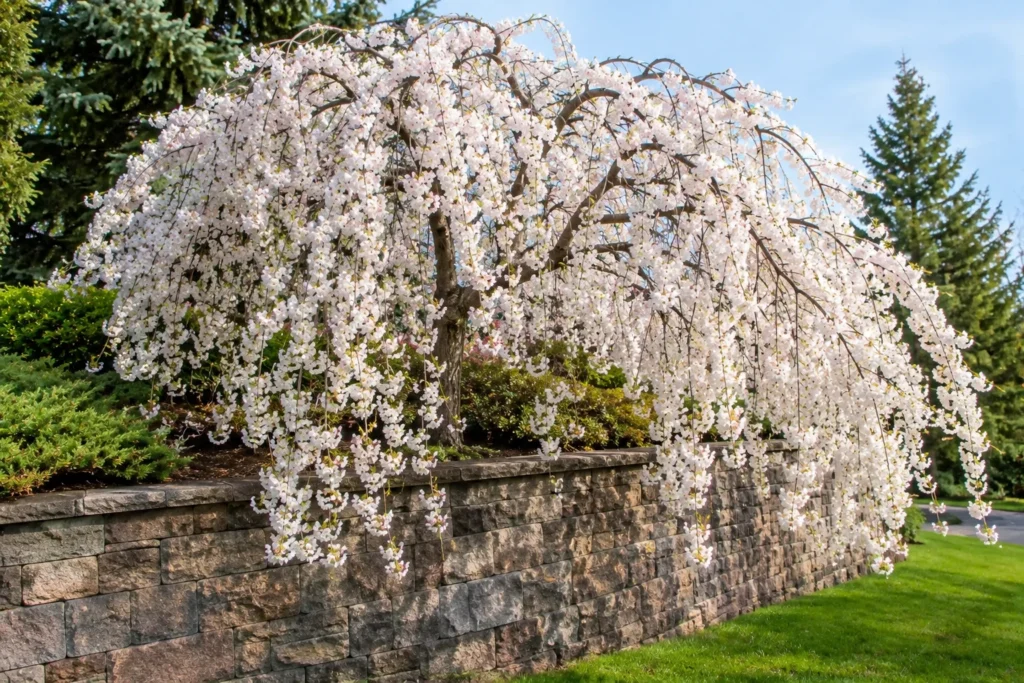
It also comes in a couple of different forms depending on the supplier. Options include a naturally weeping compact tree reaching 8 to 15 feet, a topgrafted form typically grown at around 6 feet, and even a low-growing ground cover variety for cascading over walls or as a spreading garden feature rather than a traditional tree form.
If you’re planning other elements of your yard alongside a new tree, PlazmaHomes’ decomposed granite guide covers another popular landscaping material worth considering for pathways or beds near your planting.
Frequently Asked Questions
How tall does a Snow Fountain weeping cherry grow?
Most sources put mature height at 8 to 15 feet, with a spread of roughly 6 to 12 feet. This varies somewhat depending on the specific form (naturally weeping, topgrafted, or ground cover) and growing conditions.
What USDA zones is Snow Fountain weeping cherry hardy in?
Most references list zones 4 through 8, though a few sources specify 5 through 8. If you’re near the edge of zone 4, confirm with your specific nursery or local extension office before planting.
Does Snow Fountain weeping cherry need full sun?
It performs best in full sun, at least six hours of direct light daily, for the heaviest bloom and best fall color. It tolerates light shade, but expect a noticeably reduced flower display.
How much pruning does this tree need?
Very little. Most guidance recommends only removing dead or damaged branches and doing any shaping immediately after the spring bloom, rather than a heavy annual pruning routine.
Is Snow Fountain weeping cherry disease resistant?
It’s relatively resilient compared to some other ornamental cherries, but it isn’t immune to common Prunus diseases like leaf spot, powdery mildew, brown rot, or bacterial canker. Good site selection with full sun and strong air circulation is the best prevention.
Does this tree produce edible fruit?
No. It produces small, inedible red-to-black fruit that’s ornamental rather than for eating, though it does attract birds.
How fast does Snow Fountain weeping cherry grow?
It’s generally described as a slow to moderate grower, which is part of why it stays compact and manageable for smaller landscapes over the years.
Is Snow Fountain weeping cherry deer resistant?
It shows moderate resistance to deer browsing according to some nursery sources, though “resistant” doesn’t mean deer-proof, particularly in areas with high deer pressure and limited food sources.
Sources & References
- Missouri Botanical Garden Plant Finder – Prunus ‘Snofozam’
- Washington State University PNW Plants – Snow Fountains Weeping Cherry
[…] Related: Ready to choose? See our growing guides for the Bloodgood Japanese maple, Coral Bark Japanese maple, and Snow Fountain weeping cherry. […]