

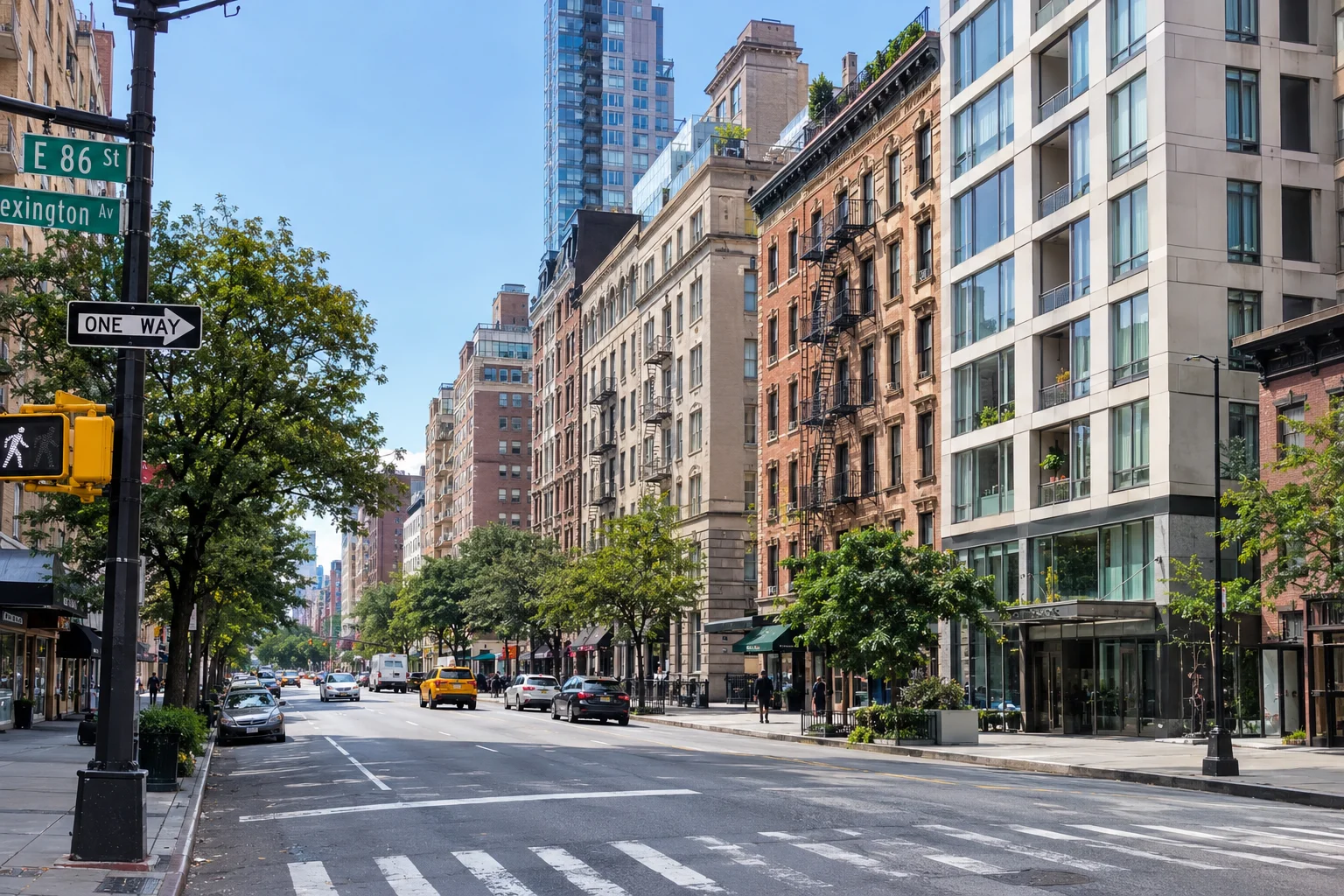
East 86th Street cuts straight across the Upper East Side. It runs from the edge of Central Park to the East River. Along the way, it crosses two neighborhoods with genuinely different real estate markets: Carnegie Hill to the north and west, and Yorkville to the east.
If you’re looking at listings on this stretch, the address alone tells you less than you’d think. A unit at 126 East 86th Street and one at 445 East 86th Street can differ by a million dollars. They can also sit in entirely different building cultures, even though they’re on the same block-length street.
This guide walks through what actually matters. That includes the transit access that changed the neighborhood in 2017, the mix of prewar co-ops and new condo towers, current pricing, and the trade-offs buyers tend to miss.
The Short Version
East 86th Street runs east-west through ZIP code 10028. It starts near Fifth Avenue and Museum Mile and ends at East End Avenue, near Carl Schurz Park and Gracie Mansion. The western and central blocks sit in or near Carnegie Hill. That side is quieter, more prewar, and more expensive.
The eastern blocks, past Lexington Avenue, run through Yorkville. This area has seen the bulk of new condo construction since the Second Avenue Subway’s Q train opened at 86th Street in January 2017. Housing stock ranges widely here as a result. You’ll find prewar co-ops with strict boards alongside brand-new limestone and glass condo towers. Prices on the block span roughly $700,000 for a one-bedroom resale up to the $8 million range for full-floor new-construction units.
Where East 86th Street Actually Sits
It helps to think of 86th Street as a dividing line rather than a single neighborhood. Real estate agents on the Upper East Side generally treat it as the rough boundary. Carnegie Hill sits roughly from 86th to 96th Street, Fifth to Third Avenue. South and east of that line is Lenox Hill and Yorkville.
A building on the north side of East 86th Street might get marketed as Carnegie Hill. A building a block south or east might get marketed as Yorkville instead. Both could still be a five-minute walk from the same subway entrance.
This matters for two practical reasons. First, Carnegie Hill carries a pricing premium. That premium ties to its landmark district status, its proximity to Museum Mile, and its lower density of new construction. The Guggenheim, the Jewish Museum, and Cooper Hewitt all sit a few blocks north on Fifth Avenue. Second, Yorkville has absorbed most of the new development on this stretch. It wasn’t landmarked to the same degree. It also had more prewar rental stock ripe for redevelopment once the subway arrived.
So if you’re comparing two listings and one says “Carnegie Hill” while the other says “Yorkville,” don’t assume it’s just marketing language. It usually reflects a real difference in building age, co-op board culture, and price per square foot.
Getting Around: Why the Subway Changed This Block
For most of the 20th century, the far east end of the Upper East Side was a transit desert. Anyone living east of Lexington Avenue faced a long walk to the 4, 5, or 6 train. That’s exactly why Third Avenue and points east had more affordable rentals and fewer luxury condos.
That changed on January 1, 2017. The Second Avenue Subway’s first phase opened that day, adding a Q train station directly at Second Avenue and 86th Street. Combined with the existing 4/5/6 stop at Lexington Avenue and 86th Street, this stretch now has two subway lines within easy walking distance of nearly every address on the block. The M86 Select Bus Service also runs crosstown along 86th Street. It connects to the M79 and other cross-park routes when you need to reach the West Side.
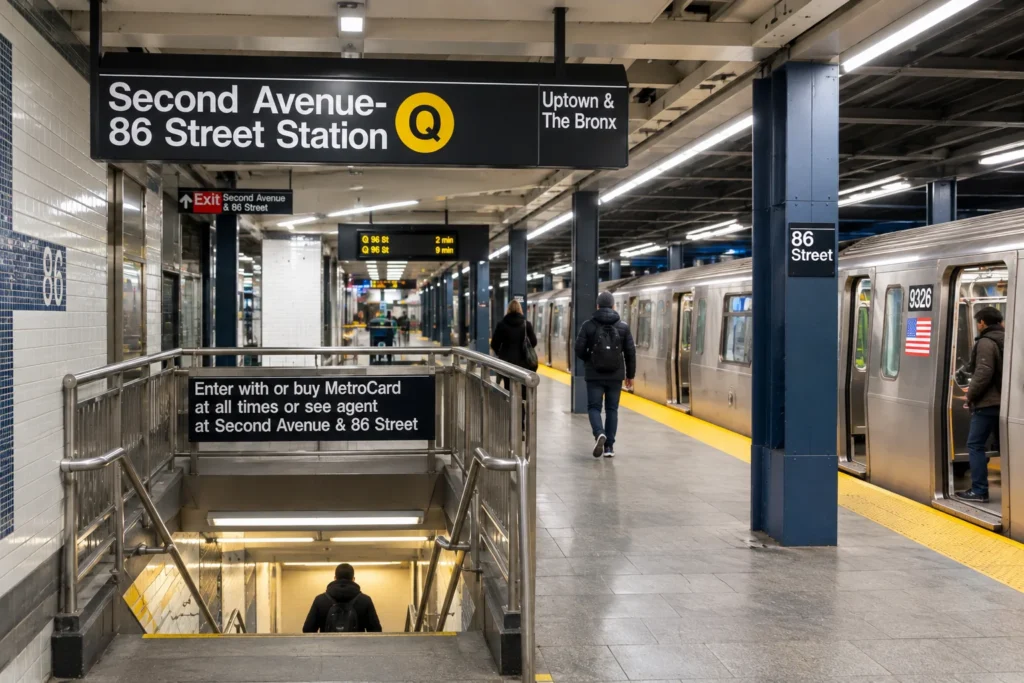
This is the single biggest factor behind the wave of new condo development east of Lexington Avenue. Buildings that would have been hard to sell as luxury product in the 1990s or 2000s are now a short walk from a one-seat ride to Midtown or Lower Manhattan. Getting to Midtown back then meant a bus and a transfer. If you’re evaluating a listing, check walking distance to both subway entrances block by block. Even a difference of two or three blocks can change your daily commute meaningfully.
What You’ll Find: Prewar Co-ops and New Condo Towers
East 86th Street’s housing stock splits fairly cleanly into two categories. Knowing which one you’re looking at changes almost everything about the buying process.
Prewar and postwar co-ops. These dominate the western half of the corridor. Co-ops also make up a majority of resale inventory across the Upper East Side generally, accounting for roughly half of active listings. They tend to have larger room counts relative to square footage, and some buildings still have prewar detailing. Co-op boards can be genuinely selective about financials, though, especially in Carnegie Hill. Expect board interviews, along with board-set restrictions on financing such as subletting rules and minimum down payments. Monthly maintenance fees have also been climbing faster than inflation in recent years. Insurance and utility costs are driving much of that increase.
New-construction condos. The most visible example is 126 East 86th Street, a 20-story limestone tower between Park and Lexington Avenues. It was completed in 2024 with just 28 full- and half-floor residences. The building features double-height ceilings, wide-plank oak floors, and full amenity packages including fitness centers and spa facilities. Units here have traded from the low $3 millions for two-bedrooms up to roughly $7.5 million for full-floor four-bedroom residences. Further east, buildings like 225 East 86th Street reflect the newer, amenity-driven product that followed the subway extension. Per-square-foot pricing there generally runs lower than the Carnegie Hill new construction closer to Fifth Avenue.
Condos are simpler to buy than co-ops overall, since they usually require just a financial review rather than a full board interview. That said, they carry higher purchase prices per square foot. New buildings often carry a property tax abatement, too, and that benefit eventually expires and resets to a higher bill. It’s worth asking about directly, because a unit’s current monthly tax number in a new building isn’t necessarily what you’ll pay in ten years.
What It Costs Right Now
Manhattan-wide, the median co-op and condo sales price reached $1.25 million in the second quarter of 2026. That marks six straight quarters of year-over-year increases, according to appraiser Jonathan Miller’s market report. The Upper East Side specifically stood out in that report, posting a 36.4% increase in closed deals compared to the prior year. Four-bedroom-and-larger units saw over 40% growth in sales volume. That’s a sign that larger, family-sized apartments have been in unusually strong demand on this side of the park.
Neighborhood-level broker reporting from mid-2026 put active Upper East Side inventory at a median asking price around $1.69 million. A meaningful share of listings showed price reductions, though. That suggests the top of the market has been strong, while ordinary resale inventory has faced more buyer resistance and longer negotiation.
Within that broader picture, Carnegie Hill and Yorkville tend to price differently:
| Carnegie Hill portion (west of Lexington) | Yorkville portion (east of Lexington) | |
|---|---|---|
| Typical building age | Prewar co-ops plus limited new construction | Mix of postwar rentals-turned-condo and new towers post-2017 |
| Board process | Co-op boards often stricter, more traditional underwriting | Mix of co-op and condo; condo purchases more straightforward |
| New construction pricing | Roughly low-$2,000s to $2,400+ per square foot in the newest buildings | Generally lower per-square-foot pricing than Carnegie Hill’s newest product |
| Best fit for | Buyers prioritizing quiet, landmark district character, proximity to Museum Mile | Buyers prioritizing subway access, more inventory, generally lower entry price |
These are directional patterns rather than fixed rules, based on recent listings and broker reporting. Individual buildings vary widely. A well-renovated Yorkville co-op can, in fact, outprice a dated Carnegie Hill unit. Treat any specific number as a starting point for your own comparison, not a guarantee.
Common Mistakes Buyers Make on This Block
Assuming “Upper East Side” pricing is uniform. Quoting a single median for the whole neighborhood hides a wide spread. A studio a few blocks from Carl Schurz Park and a full-floor unit in a Carnegie Hill tower are both technically “East 86th Street.” They’re not competing for the same buyer, though.
Underestimating co-op monthly costs. Maintenance charges have been rising faster than general inflation, largely because of building insurance and utility increases. A unit that looks affordable on price alone can carry a monthly nut that changes the real cost of ownership substantially. Always ask for the last two to three years of maintenance history, not just the current figure.
Not checking the tax abatement timeline in new buildings. New-construction condos on this stretch typically come with a property tax abatement. The exact type often depends on when the building broke ground. This benefit phases out over a set number of years. So the monthly tax line you see in a listing may roughly double or more once the abatement expires. Ask the listing agent or your attorney for the phase-out schedule before you budget around the current number.
Confusing walking distance to transit. Two blocks in Manhattan can mean an extra ten minutes door-to-platform, depending on cross streets and building entrances. If subway access is a priority, walk the actual route at the time of day you’d commute, rather than relying on a map’s straight-line distance.
Skipping the landmark district check in Carnegie Hill. Parts of the corridor near Fifth Avenue and Madison Avenue fall inside the Carnegie Hill Historic District, which restricts exterior renovations. This can affect what you’re allowed to change if you’re buying a lower-floor unit or townhouse-style property. It’s worth confirming landmark status before you plan any exterior work.
Who This Stretch Makes Sense For
Buyers who want quiet, established co-op living close to Central Park and the Museum Mile institutions tend to gravitate toward the western end near Fifth and Madison. Buyers who want new construction and easier condo board processes, on the other hand, tend to look east of Lexington Avenue toward Yorkville and the river. That side also offers the best subway access, along with a generally lower entry price than Carnegie Hill’s newest towers.
It makes less sense, though, for buyers who want a low-key building with minimal traffic and street noise. 86th Street itself is a major commercial and bus corridor. Units directly on the street will hear more activity than a typical Upper East Side side-street co-op. Look for a building just off 86th Street on a numbered cross street instead, if quiet matters more than convenience.
Buying in a different market, or weighing other ways to get into a home? See PlazmaHomes’ Rent to Own Homes in Albuquerque NM: 2026 Guide, which covers contract terms and why a real estate attorney matters.
Frequently Asked Questions
Is East 86th Street in Carnegie Hill or Yorkville?
It’s the rough dividing line between the two. Blocks closer to Fifth and Park Avenue are generally marketed as Carnegie Hill. Blocks east of Lexington Avenue are marketed as Yorkville. Check the specific building’s marketing and its distance to Third Avenue to get a sense of which identity it leans toward.
What subway lines serve East 86th Street?
The 4, 5, and 6 trains stop at Lexington Avenue and 86th Street. The Q train stops at Second Avenue and 86th Street. That station opened in January 2017, as part of the Second Avenue Subway’s first phase. The M86 Select Bus Service also runs crosstown along 86th Street.
Are most apartments on this block co-ops or condos?
It’s a genuine mix. Co-ops make up roughly half of Upper East Side inventory overall, and they’re common along the western and central parts of East 86th Street. New condo towers, by contrast, are concentrated toward the eastern blocks and in select Carnegie Hill new construction, like 126 East 86th Street. Most of that new construction followed the 2017 subway opening.
Is East 86th Street a good investment right now?
Manhattan’s overall co-op and condo market has posted price gains for six consecutive quarters as of mid-2026. The Upper East Side specifically has shown strong growth in larger-unit sales. Current market reporting also shows meaningful inventory and price reductions in the general resale segment, though, so results vary a lot by unit size, building, and price point. This isn’t investment advice. Talk to a local agent and, for larger purchases, a real estate attorney or financial advisor about your specific situation.
How strict are the co-op boards on this stretch?
Carnegie Hill co-ops have a reputation for more traditional, conservative financial underwriting. Expect debt-to-income scrutiny, sizable down payment requirements, and formal board interviews. Yorkville buildings vary more widely, though, and some are more flexible. Every co-op board sets its own rules, so ask your agent about a specific building’s reputation before you write an offer.
What’s the property tax situation in new condo buildings here?
Many new towers built after 2017 carry a temporary property tax abatement. This lowers the effective monthly tax bill for a set number of years before phasing out. Ask for the specific abatement schedule for any new-construction unit you’re considering, since the eventual increase can be substantial.
Is East 86th Street noisy?
Units directly on 86th Street itself will get more traffic and bus noise. Apartments on the quieter numbered side streets just off it are calmer. That’s because 86th Street is a major crosstown corridor, with commercial retail at street level for much of its length.
Sources & References
- Brick Underground, “Manhattan co-op condo sales market report, second quarter 2026” (Miller Samuel / Jonathan Miller data)
- NYC MTA, Second Avenue Subway project documentation
- CityRealty and Brown Harris Stevens building and listing pages for 126 East 86th Street
- StreetEasy building profile, 126 East 86th Street